Type your question here!

Saturday, August 13, 2011

August Todo List for the Orchard


Zinfandel
I know that you’re harvesting wine grapes right now but July and August are the months for harvesting plums and plum relatives such as pluots as well. Plums such as Emerald beauty and Elephant Heart should be coming on soon or ready now. Flavor Queen pluots should be ready or very close to being ready.

There should be apples coming on so walk the apples and see. If the apple looks like it might be ready then bite or cut into it and inspect the seeds. The seeds should be brown if they are ripe and ready to pick. Do some fruit evaluations on apples if they are ready. Remember to get multiple brix readings and do not combine evaluation scores but record them all independent from one another.

Hosui Asian pear 2009 and we are now working on
developing size by increasing our thinning
Yutaka on Saturdays can give you some advice regarding Asian pears but the early producers should be coming in soon. Please get some evaluations of this fruit as it ripens because we have scant data on how well they are performing. Last year was the first really good year for many of them and many achieved very high quality both visually and taste. They are getting better and better under Yutaka’s watchful eye. This is an important fruit to document since this is definitely not the Asian pear climate.

The remaining almonds were pretty much decimated by ground squirrels before I left. Good thing we sold a lot of them as green almonds this year. That would be a good market for us next year if we can let local chefs know that we have them. They went to San Francisco this year and sold at $4.00 per pound that their farmers markets. We sold them to a broker for $2.00 per pound.

Fallen fruit is always going to be a problem this time of year and if you do not keep it picked up you will have an outbreak of pests that attack ripe fruit such as the confused sap and dried fruit beetles. Fallen fruit should not be kept very long in buckets or exposed to the open air or the same thing will occur. If you leave the fruit sitting in buckets you are just moving the potential for infestation from the orchard aisles to buckets. These beetles can fly and they will go out looking for girlfriends and boyfriends. Remember, we used to put them in large containers that had lids. The lids kept them from getting infested. Somehow you need to keep this picked up fruit from getting infested and not leave them exposed.

Bubblers should have a perfect cone if they have no debris
in them and the pressure is adequate.
Because of the frequency of irrigation right now bubblers will have a tendency to plug more often. Once a month the irrigation bubblers need to be walked and checked for plugging. The easiest way to do this is to use the remote for changing irrigation stations and have two or three people inspect the bubblers for plugging. These inspectors should carry spare cleaned bubblers and replace plugged ones as they see them. You can flag the plugged bubblers and when the irrigation has moved to the next station then replace the bubbler unless of course you are hot and want a shower.

Pests that can occur now are still the peach twig borer which is the little worm that gets in the soft fruit, dried fruit beetle if you don’t pick up fallen fruit and we may have a short outbreak of Green June Beetles but they will be gone in a couple of weeks if they occur. It is also possible that we can act of revisit by the grape flea beetle soon which chews holes in the leaves. They cause some damage to the leaves but we don’t get real excited because the damage is minimal and they disappear in a couple of weeks.

I am sure Jon will have numerous things to do but here it is a short list of things that might be coming up in the orchard

Jujube fruit from the contorted jujube. There are quite a few
varieties to pick from. Along with almonds displayed still
in their husks these are showstoppers at farmers markets
because people want to know what they are
Remember to keep harvested fruit out of direct sunlight as much as you can or you will build up excessive heat in the fruit and internal breakdown of the fruit will happen much more quickly. After harvesting put the trays in the shade of the trees until you are ready to take them to the cooler or the shaded area.


Todo for August

• Pick up fallen fruit and make sure they are properly disposed of
• Irrigate and make sure bubblers are not plugged.
• Help with the wine grape harvest on Saturdays.
• Inspect apples for ripe fruit.
• Inspect late plums and pluots such is Emerald Beauty and Elephant Heart as well as Flavor Queen pluot if they have not already been harvested.
• Vegetables should be sprayed regularly with our insecticidal soap.
• Inspect asparagus for female plants and remove them.
• There should be table grapes and figs ready for harvest
• Don’t forget jujube as it should be coming in very soon. Some people like it mottled brown and green and still plump while others like it dried, brown and shriveled. It would probably be a novelty and attract people to a farmer’s market table just to ask what it is

Monday, August 8, 2011

Blueberries Won't Grow in the Hot Desert. So... Let's Give it a Try!

Q. I am interested in planting various fruits in my backyard. One that I am curious about is growing blueberries in our region. Do you know how they do here? Would you have any recommendations? I did not realize the varieties of blueberry plants that are out there! In my search I also came across pink lemonade blueberries, I am definitely interested, but I do not want to put forth the effort if they will not be a productive plant in our area.


A. This is the case where your gardening skills are going to be challenged. They are definitely not suited to our climate and definitely not suited to our soils. So let’s give it a try!

This means we have to modify the climate they are in as much as possible and also the soils. Pick a microclimate in your landscape that will be as cool as possible yet still provide 6 to 8 hours of sunlight every day and out of the way of strong winds. This would most likely be an east or north side of a landscape that avoids late afternoon direct sunlight. Find a location or create a location that is protected from prevailing strong winds.

Next, modify the soil. Blend anywhere from half to 2/3 of the existing soil with a good quality compost. To this mix and sulfur that is as finely ground as you can find or in a liquid form. If you are not opposed to it, aluminum sulfate can help lower the alkalinity. It is not used much any more and may be hard to find.

Water the soil thoroughly and let it drain several times before planting. Use only southern high bush blueberries in the planting holes and space them according to the directions. Stake the plants securely in the soil the first season of growth.

You will need pollenizers so make sure you get the correct blueberries together for good fruit set. Drip irrigation can be used or you can flood the area with water from bubblers. Cover the planting area with 3 to 4 inches of wood mulch, keeping the mulch away about 6 inches from stems that enter the soil.

Grow them for one season and see how they do. If you see signs of leaf scorching on the edges you might want to put 30% shade cloth over the top of them to help them a bit from intense sunlight. Every year you should be adding compost and acidifying the soil with finely ground sulfur or aluminum sulfate plus a good fertilizer and a soil applied iron chelate containing EDDHA. This is done in the spring before you see new growth. This should help get you started.

Stop Horsin' Around With My Pear Tree!

Q. Short story, we had a horse get out of their corral while we were out of the house today for probably 4-5 hours. While out, he ate most of the bark off of 60% of the trunk of one of our pear trees. The tree has quite a bit of fruit on it right now. We are more concerned with saving the tree than this year’s crop. Suggestions or ideas on anything you would suggest we should do would be very much appreciated.


Pruning cut healing over. Notice the wood is rolling over
the dead wood in the cylinder of the tree. Smoothing out
rough damage on the edges will help promote faster closure.
Use a sterilized instrument.
A. Long answer. The good part of this is that your tree, provided it is healthy, will probably survive. I have had fruit trees with that much damage to the trunk survive in the past.

Your horse probably ate all the way down to the wood. This means that the tissue which transports food from the leaves to the roots is gone in that area as well as the tissue which transports water from the roots to the leaves.

With 40% intact on the trunk the tree may struggle but it should still survive. I would recommend that you mulch the ground around the trunk with wood mulch which you can obtain free from our orchard. Saturate the ground around the trunk of the tree with water 2 to 3 times each week.

Clean the wound created by the horse with a sharp, sterile knife, cleaning the jagged edges of the damaged bark so that it is smooth. You do not need to paint the wound with anything. Just let it go after you have traced the wound with your knife.

Make sure you fertilize the tree next January and each January while it is trying to heal. Enjoy the fruit. But next year thin the fruit out why it is the size of the silver dollar so there is only one fruit per cluster.

Summer Brown Dead Spots on Lawns

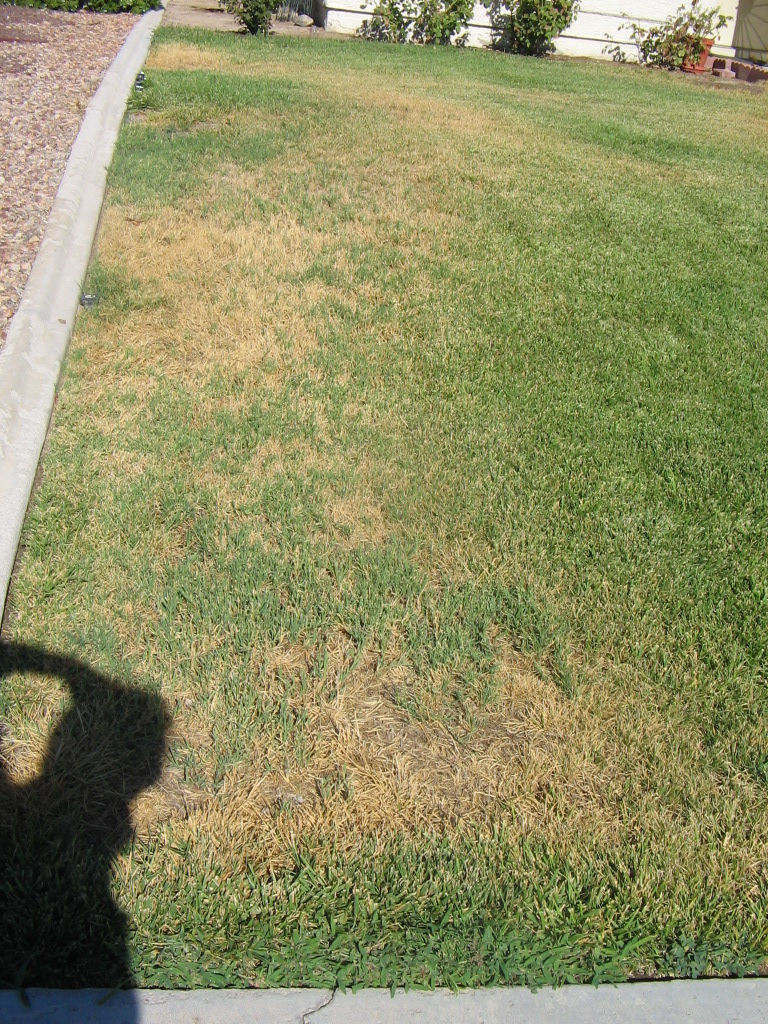
Q. I need your assistance. The photo I sent depicts the present condition of my backyard. It has patches of dry or dead grass. I don't know what caused the problem. Is there some way to revive the grass without going to the extreme of re-sodding? And what shall I do to prevent this in the future?
Lawn with patches of dead grass; damage is past
and now the grass surrounding the dead spots
is recovering

A. Thanks for the picture. The picture helps and it doesn’t help. It would have helped if I saw something in the picture that gave me a clue. But there is nothing in the picture that is distinctive to me. It would be interesting to know if those dead spots were in any kind of pattern in relation to your irrigation heads.

I did notice in the picture that whatever caused the damage appears to be gone. This would tend to eliminate irrigation as a problem unless you changed your irrigation schedule. If these dead spots occur in the same spots year after year it is usually associated with irrigation. I tend to think it is either insect or disease from your picture.

Browning due to poor irrigation coverage
by the sprinklers; darker green near the
sprinklers and brown between; not well defined
Let me just point out some weaknesses in the design that might contribute to the current problem. I tend to discourage homeowners from designing a turfgrass area other than straight lines. I know this might be somewhat boring but water from sprinkler heads tend to be thrown in straight lines.

Irregular lines or curving lines tend to cause those areas inside the curves to be under watered or the areas outside the curves and no longer in the turfgrass to be overwatered.

I noticed in your picture that most of the damage is closest to the non turfgrass area while the solid turf area are less damaged. Another point, those areas of the turfgrass closest to rock mulch, sidewalks or patios in full sun tend to use more water than those areas deep inside the turf area. These areas close to non turfgrass areas tend to be warmer and more prone to insect attacks than others.

Insect damage that is fresh tends to cause the grass on the edge of the damaged area to pull up freely from the lawn. If the insect damage is long gone, then it will no longer pull up.

Lawn diseases can also cause patterns like this. Unless a sample is sent to a qualified plant pathologist or we have seen the disease many times before it is a shot in the dark as to which disease it might be. From your picture, it is not a disease pattern I recognize.
Distinct horseshoe shape dying spots of summer patch
disease on winter overseeded perennial ryegrass

 
Since the problem is gone, there is probably no need to apply an insecticide or fungicide. At this point leave the dead grass alone and do not rake it up or you will open the soil surface to invasion by weeds. Since the cause of the problem is unknown it would be hard to tell you how to prevent it from happening again.

Around the end of September through mid October rake up the dead grass and broadcast the same seed or nearly the same seed in the dead areas and mulch the surface with top dressing and fertilizer.

White Fluffy Stuff on Cactus


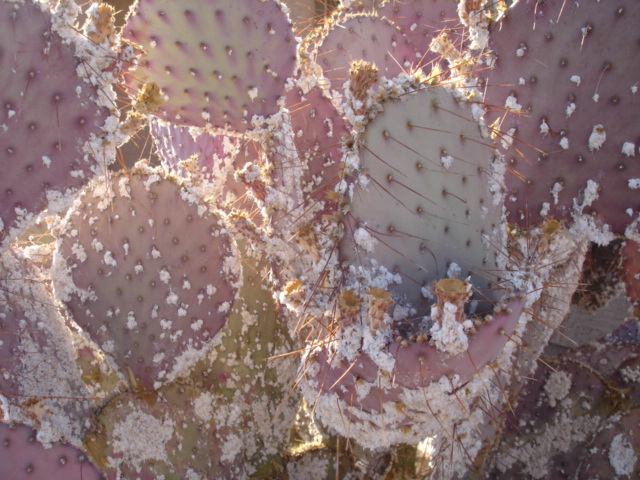
Cochineal scale on Opuntia cactus
  Q. At desertusa.com, I found out that cochineal scale is what is affecting my prickly pear cactus. Although it described the problem, there was no explanation on how to get rid of it. I used a hose to wash off the scale. Do I need to do something else to save my cactus?

A. Cochineal scale is that white, fuzzy stuff that you see on some cacti. If you crush it between your fingers it has this very pretty dark red color that oozes from inside the white fuzzy stuff. The scale insect itself is under this layer of white fuzzy stuff where it lies protected and can feed on the plant juices. They can infest a cactus quite quickly and can be difficult to control. They can be quite a problem on the edible cacti.


Red dye coming from cochineal scale

In Mexico they use hard pesticides such as Sevin to help keep them under control. We usually just use a sweep nozzle on the end of the hose and turn it on all the way. A strong, steady stream of water will wash the scale off of the pads.

The problem is that once infested you will probably have to hose them off once every week or two during the summer season. During the winter season it is not as often. You are right, this is Cochineal scale. This is not the same scale exactly that is used for the red dye but a very close relative and still gives off a wonderful color that can be used for dyeing.

Friday, July 29, 2011

Tree Stakes Should Be Removed After One Season Of Growth


Q. Hi Bob!
Tree trunk girdled by wire supports
after two years
I just found your editorial in the "The View" yesterday. I was wondering if you could answer a few questions about my trees in my yard. I have an African Sumac tree. I pulled out the wooden stakes thinking it would stay upright until the first wind storm came along. The landscaper put padded loops around the top of the branches and then secured the wires to three stakes around the tree. The tree started growing over the loops so I changed the position of the loops. Now, another landscaper took the wires off completely. I'm afraid that the next wind storm will blow the tree over again. The width of this tree is about 12 1/2 inches in circumference. Should I put wooden stakes back for this tree or should I wait to see if the tree can stand on its own?

My next question is, does the wires that hold down the tree stunt its growth? Someone told me that the tree needs to move around so that it can grow thicker and stronger. My tree looks so small compared to my neighbors who have the same tree and didn't use wires to keep it upright.

I would appreciate if you could answer my questions that I have been wondering about for a long time.

A.  Just a couple of quick rules about staking and tree growth.

Tree staked and the trunk
allowed to move
• When staking, the tree should be immobilized so that the roots do not move, not the trunk. The trunk should be allowed to move so that it becomes stronger but not move so much that it forces the rootball to move in the soil.

• Try not to leave stakes on planted trees for more than one growing season. This should be as much time as they should ever need if they need any staking at all.

• Allow side shoots to grow along the trunk the first couple of seasons. Only remove them when these become pencil diameter or larger.

The staking of trees is primarily to prevent the rootball from moving. If the rootball is prevented from moving inside the planting hole, the roots have a better chance of becoming established in the surrounding soil. Wires from the stakes should be low enough on the trunk to prevent the rootball from moving but not the upper part of the trunk.


Another possible way of staking
a tree with one stake
Unless you want a large tree for aesthetic value then select the smallest but healthiest tree possible for planting. These smaller trees become established more quickly and will surpass the larger plants in a couple of growing seasons.

Use organic surface mulch around the bottom of the tree to a distance of 3 to 4 feet from the trunk. This organic mulch should not be bark mulch but wood chips from trees that were removed by arborists in the valley and then chipped for disposal. The mulch should be 4 to 6 inches deep and kept at least 6 inches from the trunk for the first four growing seasons.


Allow shoots to grow from the trunks of newly planted trees for the first 3 to 4 years. Remove these shoots when they grow to be pencil diameter or larger. Remove them from the trunk leaving no stubs. Allow young shoots to grow from the trunk in new locations. These young shoots help to strengthen the trunk against wind and increase the trunk diameter more quickly. They also provide some shade on the trunk which can help prevent sunburn.

Wire supports attached to the trunk from stakes should be removed after one growing season. All plants grow in two dimensions: primary growth and secondary growth. Primary growth is growth from buds that contribute to the plants overall height and width. Secondary growth originates from inside the plant and makes the trunk and limbs larger in girth.

I hope this helps.

Tomatoes: All Vines And No Fruit

Sunburn on tomato fruit due to lack of leaf cover
Q. The 1st year that I had tomatoes, they were fantastic. I had so many tomatoes that I had a hard time giving them away, but the sun baked the plants ant the remaining tomatoes turned white from the blazing sun. As a result I made some shade for them (it was too late). The next year I put the shade over them and added Miracle Grow to them. They grew like crazy right through the roof ZERO FRUIT (someone told me that it was the Miracle Grow). This year I used a low nitrogen food something like 5-8-9, and one day the plants were wilting (I thought from the sun, So I shaded them. Oops.). They are still really blooming. Is there a time when the shade sould be applied? Talk about rocket science, man...I think I need a how to grow tomatoes instruction book that includes all the don't you do thises. Is such an animal available?

Tomatoes growing under 30% shade
A. When growing tomatoes you have to be careful about how much nitrogen that you apply or you will get all vines and no fruit for about 3 to 4 weeks until the nitrogen begins to run out and then they will start to flower and set fruit. I normally fertilize with high phosphorus and a moderate nitrogen fertilizer at the time of planting and do not fertilize again until I see flowers and fruit beginning to set. Once that happens, I then begin to fertilize lightly again and do so monthly. It is not the Miracle Gro. It is the amount of Miracle Gro that you applied. The fertilizer ratio that you selected might also have something to do with it. High nitrogen encourages leaf and stem growth. High phosphorus encourages flower, fruit, root development, seed and oil production.

Heirloom tomato grown in the desert
There are some people in town who are telling people that Miracle Gro is like crack for plants. This is entirely untrue. I have been using Miracle Grow, Rapid Gro, Peters and other similar mineral fertilizers for over 30 years and have found this to be the furthest from the truth. However, it does not substitute for good soil preparation and the use of compost, plenty of it, for soil bed preparation. Products like Miracle Gro should be used as supplements to enhance plant growth, not as a substitute for good soil preparation. My orchard manager did exactly the same thing as you did last fall with our tomatoes. He did not carefully apply fertilizers at about ¼ the amount on the fertilizer label. This was after the soil had been prepared in the spring. He applied the full amount for fall production of tomatoes. He got great tomato Vines and no fruit. This was after careful instructions by me not to do that but he thought if a little is good and more is better. All totally wrong! He learned a valuable lesson and we lost our fruit.

Next is your shade. If you are growing crops that flower and set fruit then do not exceed 30% shade. This includes tomatoes, peppers, eggplant, squash, melons, etc. If you are growing vegetables that you harvest for their leaves then you can increase the % of shade up to about 50%. Too much shade will cause plants that flower to reduce the number of flowers they produce, have leaves that are larger and more tender, and stems that are longer between the leaves they produce. In other words they tend to grow larger and “stretch” in their growth. Okra should not be grown in the shade. It loves full sun and lots of it. It will not perform well under any kind of shade cloth. I hope this helps.

There is not a good primer for growing vegetables in our climate. I am currently putting together some classes with a local nursery on vegetable, fruit growing and principles of landscape design for the desert. I will keep you in notified as they develop.

Thursday, July 28, 2011

Does Anyone Have A List Of Their Favorite Cacti For Containers?

Q. Would you please take the time to send a list of cacti that is best suited for containers? Thank you so much for your help.

A. I don’t know of any lists for container cacti. Any cacti can be containerized. The basic concerns will be the size of the cactus, how much it can tolerate low temperatures and how much sunlight it can handle. It may sound weird but some cacti require protection from high intensity sunlight and grow best with a little bit of shade.

Other cacti may come from the tropics and not handle temperatures below 45° F. The basic concerns are the larger the cactus, the larger the container needed. Look up the cactus you want to grow on the Internet making sure you have its correct Latin name. Find out where it came from. If it came from the tropics there is a good chance you will need to protect it from low winter temperatures. Find out about its exposure to light. If it is a shade loving cactus you will need to provide either shade cloth or lath to give it some relief from high light intensities.

Porous containers work best. This can be Terra Cotta or any porous material. The soil mix must drain freely. It should not be a houseplant mix and do not use our native desert soil. The soil mix should have compost or similar organics mixed with it at around 50% of the soil volume. The container must have a hole in the bottom for drainage. Do not put any course gravel or broken clay pot in the bottom of the container. Use the cactus soil mix through the entire container. When watering, water long enough so that water comes out the bottom of the container flushing any salts that might accumulate. I hope this helps get you started.

Maybe others have some favorite cacti that they may have liked growing in containers.

Pruning Peach and Nectarine

Reader's peach tree
Q. I have 2 fruit trees a peach & nectarine They have shoots growing out of the main body should I cut these off? I planted them last year.

A.  Congratulations. Your tree looks extremely healthy and dark green. Pruning is a management technique that you use to achieve a form or structure that you desire from the tree.

At the orchard we normally cut the fruit trees that knee height or about 30 inches at the time of planting. We do this to establish the major limbs coming from the trunk that will support the fruit loads in the future. We establish these structural limbs that we called primary scaffolds at around 30 inches because we want to pick the fruit as close to the ground as possible while still keeping the fruit off of the ground. This is because we do not let our peach trees or nectarines produce fruit far enough above our heads that we need a ladder.


Pruning fruit tree at knee height after planting
To do this we need about 10 feet between trees as a minimum. From your picture it looked like your plants were closer than this. I want to give you some good advice but it depends on the structure of the tree that you want to accomplish and where you want your fruit to be produced.
At this point I would not remove any major limbs from your young tree until leaf drop this winter. However, I would remove any limbs coming from the trunk up to a height of about 30 inches. These should be cut flush to the trunk with a clean and sterilized pruning shears. These aren't doing you any good and you will never need them. Fruit can potentially be produced on any wood that grew this past season. On our peaches and nectarines any of the new growth that was over 24 inches long we normally pruned back to about 18 inches but no more than this. I hope this gets you on the right track.


Gardeners Just Don't Want To Give Figs Enough Water

Q. We planted a fig tree two years ago in the Anthem/Henderson area. We’ve had few purple figs in the last two years. Unfortunately they don’t grow any bigger than inch in diameter, they’re dry/not moist and taste like like cotton.


A. Most likely the tree is not getting enough water or not watered frequently enough. Water requirement varies with the size of the tree but a tree about ten feet tall might require about 30- 45 gallons at every watering. The amount of water during each watering does not change so don’t change the number of minutes. Instead change the frequency of watering or the number of times per week you are watering.

This time of year we are watering three times a week. The tree will benefit from a four inch layer of wood mulch applied to the soil under the canopy. To deliver this amount of water if it is not on drip you will require a four inch basin constructed around the trunk about four feet in diameter. Try this first but I have not a seen a fig growing here yet that has not performed well provided it is getting enough water.

Red Flame Table Grapes Do Well In The Mojave Desert

Red flame table grapes grown by reader in Las Vegas
Q. My Red Flame grapes are terrific this year. I think some at the end of the bunches have turned into raisons from the heat. Is there a way to prevent this? When will the vine need fertilizer? By the way I used dollar store garland hanging from the grape arbor and from my fig trees and I've avoided 99% of bird problems this year, what a relief!


A. Red Flame table grapes do well here. Because of our heat we do get uneven ripening of the berries in a single bunch. When a bunch is ready to pick you may have a variation in berries from a few raisins to some berries that are still green.

You can reduce this to some extent by reducing the amount of water the vines are getting when the berries begin to turn color in the bunches, about 3 to 4 weeks before harvest.

Dwarf Coyote Bush Planted In Small Landscape Area


Probably dwarf coyote bush
planted in a small landscape area

Q. Please look at the attached image if two 'Desert Broom' or Coyote shrubs that I bought in October 2009. Note that they are very low to the ground, less than one foot high. I am trying to obtain more of them as they do well in our yard where many other shrubs fail. The original nursery doesn’t remember them and do not know what they are from the picture. Do you have any thoughts as to where I can get eight more of these. I have been to every nursery in the area without luck.

A. My first comment to you is that you will be very sorry you purchased those plants and planted them there. Unrestrained, they are going to grow 10 to 12 feet in diameter in that space were you have about 3 feet available to them and planted 2 feet apart. They do appear to be one of the dwarf coyote bush. Probably Twin Peaks. I would not leave those plants there. Twin Peaks dwarf coyote bush will reach about 2 feet tall and 10 to 12 feet wide or more. Buy some alternative plants that will fit in the spaces that you have and repeat this plant in multiple places through the yard to give your design a feeling of continuity.

Brown Spots Emerge In Fescue Lawn In Midsummer

The lawn with brown and dead spots
Q. I need your assistance. Below photo depicts the present condition of my backyard. It has patches of dry or dead grass. I don't know what caused the problem. Is there some way to revive the grass without going to the extreme of re-sodding? And what shall I do to prevent this in the future?

A. Thanks for the picture. The picture helps and it doesn’t help. It would have helped if I saw something in the picture that gave me a clue. But there is nothing in the picture that is distinctive to me. It would be interesting to know if those dead spots were in any kind of pattern in relation to your irrigation heads.

I did notice in the picture that whatever caused the damage appears to be gone. The grass around the dead areas seem to be thriving. This would tend to eliminate irrigation as a problem unless you changed your irrigation schedule. If these dead spots occur in the same spots year after year it is usually associated with irrigation. I tend to think it is either insect or disease problems from your picture.

Lawn with poor irrigation overlap
from sprinklers
Let me just point out some weaknesses in the design that might contribute to the current problem. I tend to discourage homeowners from designing a turfgrass area in other than straight lines. I know this might be somewhat boring but water from sprinkler heads is thrown in straight lines. Irregular lines or curving lines tend to cause those areas inside the curves to be under watered or the areas outside the curves, and no longer in the turfgrass, to be overwatered.

I noticed in your picture that most of the damage is closest to the non turfgrass area while the solid turf area is less damaged. Another point, those areas of the turfgrass closest to rock mulch, sidewalks or patios in full sun tend to use more water than those areas deep inside the turf area. These areas, close to bare ground or rock mulch, tend to be warmer and more prone to insect attacks than others. Insect damage that is fresh tends to cause the grass on the edge of the damaged area to pull up freely from the lawn. If the insect damage is long gone, then fresh grass will no longer pull up easily.


Summer patch disease on tall fescue
Lawn diseases can also cause patterns like this. Unless a sample is sent to a qualified plant pathologist or we have seen the disease many times before it is a shot in the dark as to which disease it might be. From your picture, it is not a disease pattern I recognize as common to all our area.

Since the problem is gone, there is probably no need to apply an insecticide or fungicide. At this point leave the dead grass alone and do not rake it up or you will open the soil surface to invasion by weeds. Around the end of September through mid October rake up the dead grass and broadcast the same seed or nearly the same seed in the dead areas and mulch the surface with top dressing and fertilizer. I hope this helps.

Young Apple Tree In Rock Mulch Dies In Midsummer

Apple tree planted in rock mulch
Q. I've attached a picture of what was once a beautiful, thriving golden delicious apple tree. Within one week this is what the tree looks like! Its a young tree as you can see, I didn't plant it myself I purchased my home last July and it had just recently been planted. I picked about 10 apples from it just 2 weeks ago. Can you tell from the picture what could have caused it to dry up and die like this, especially so fast? I planted some other fruit trees that are seemingly doing very well and want to protect them from whatever caused this to happen. Thank you for any help and/or insight you can provide.


A. Because the entire tree died from top to bottom we can be relatively certain the problem was at the very bottom of the tree, in the trunk or the roots. The most common reasons are watering too much or too little, planting the tree too deeply, and leaving mulch piled around the trunk when it is young.

First, manually run the irrigation cycle and make sure that water is getting to the tree. If that cycle is operating normally and other plants on that cycle seem to be doing fine then we can probably eliminate watering. But you must check this first since this is the easiest one to eliminate.

Next, let’s eliminate planting too deeply and problems with the rock mulch. Get something to kneel on and pull the rock mulch away from the trunk. With your fingernail or a penknife cut into the part of the trunk, just barely beneath outer bark, that was covered with mulch. Make the same cut into the trunk just above the bark or make one long cut to include both.

The color of the trunk just under the bark should be identical in color in both spots; white not brown. If the color just under the bark that was covered with mulch is brown, then the tree died from collar rot due to the mulch in contact with a young trunk. Never put mulch, whether it is wood or rock, directly against the trunk for the first four growing seasons. Keep its six inches away from the trunk until it is older.

Lastly with the mulch pulled away from the trunk and still on your knees, dig the soil away from the trunk until you find the first roots. These first roots should be no deeper than about ½ inch below the soil. If roots coming from the trunk are deeper than this and soil has been placed around the trunk and the part of the trunk covered by the soil was brown, then it died of collar rot because it was planted too deeply, a common mistake.

Always plant all trees and shrubs with no more than ½ inch of soil covering the roots and make sure the tree is staked the first growing season.

Follow up to this discussion:
Thank you for this very helpful response. I did exactly as you said and it seems to be collar rot because the (rock) mulch was planted right up to the trunk and when I checked the bark was not only brown but dried out. I've moved back the mulch on all of my other trees. Thank you again.

Monday, July 25, 2011

African Sumac Has Problems

Q. I have an African sumac in my backyard that has leaves which turn brown and fall off. I have one in my front yard that does not do that. The one in the back is close to grass which gets 5 minutes of water three times a day. The one in the front is in a rock landscape and gets a lot less water. Is this natural for them or is it getting too much water or not enough fertilizer? The backyard one is on the east side and the one in the front faces west which is very hot. The one in the back is about 15 years old and about 35 feet tall and wide. Any help would be great.

A. Sometimes they can get so dense that internal shading of the canopy will cause leaves to die and drop. These are fairly messy trees due to leaf drop and dropping of their berries. If the tree in the drier landscape is more open and the tree in the back is more dense then internal shading of the canopy can be the reason.

            Other reasons might include pest problems such as aphids which can cause the leaves to be sticky or shiny and leaf drop if there are in large numbers. If the leaves are sticky, try spraying with repeat applications of soap and water or insecticidal soaps. Aphids should disappear during hot weather but reappear again during cool weather. You may also see a lot of ant activity that are working off of the aphids sugary honeydew droppings.

            You can try to open up the canopy with some branch removal (thinning of the canopy by selective limb removal) and admit more light inside the canopy. This however will probably cause some suckering on the limbs if too many limbs are removed.  You can do some light removal of small branches now.  Remove the entire small branch.

            Another possibility could be overwatering. If the tree is watered too often it is possible to develop root rots and lead drop will occur and usually branch dieback.

Thursday, July 14, 2011

Japanese Privet Does Not Like Dry Feet

Readers plant appears to be Japanese privet which
does not like dry soils
Q. I have four bushes like the one shown. They were planted about six years ago and have never done very well. Each year around this time they look as shown. Can you advise and suggest anything?

A. From the looks it appears to be Japanese privet which must have soil around its roots that does not go dry. It will not do well in rock landscapes. They do well in a turfgrass landscape. This might be a case of the wrong plant in that location. You would have to increase the frequency of the watering and improve the soil in that location.

This is what Japanese privet will do in a rock landscape
with drip irrigation - drop its leaves on some branches
along with branch dieback
            The amount might also have to be increased but since I dont know the amount I would suggest increasing the frequency to about three times a week. The amount depends on the size of the plant but a three foot tall plant might require five gallons or so each watering. A ten foot plant might require perhaps 20-30 gallons at each watering.


Tomato Cracking May or May Not Be Your Fault


Radial cracks on an heirloom tomato from the orchard
Q. I have this problem. Our tomatoes develop cracks at times usually about half way to maturity.  They also rot on the bottom.


A. Tomato cracking can be from the variety of tomato you are growing or it can be how you are managing your irrigations or a combination of both.  Rotting of the bottom of the fruit can be caused by irregular irrigations.

Heirloom tomatoes with longitudinal
cracks (top right and top left) from irregular watering
            Some varieties of tomatoes, particularly heirloom types, are subject to what are called radial cracks.  These are concentric, circular cracks around the top of the fruit.  These might be reduced by growing them under light shade probably know more than about 30%.

            Cracks along the length of the fruit can be a particular problem after a heavy rain. Sometimes when the tomato fruit is near maturity very wet soil can result in a lot of water taken up by the plant with lots of it sent to the fruits. The fruit swells and cracks due to excess water taken in by the fruits and the skin.

Blossom end rot on tomato, picture submitted by reader
            Use a mulch on the soil surface to help keep the soil more evenly moist. This can result in less cracking to the fruits because the soil is kept more evenly moist. This can be straw, shredded or even sheets of newspaper or landscape fabric cut into strips.  As I said, tomatoes will do better if they have some light shade when they are growing.


What's Happening In The Orchard In July: Limb Damage and Wormy Peaches and Nectarines


Fruit Tree Limb Split Due to Heavy Fruit Load
Limb Damage Due To A Heavy Crop Load.  Too much fruit on a single limb and the weight can cause the limb to separate from the trunk.  We get it at the orchard if we do not thin the fruit enough on the limb or if the limb has a poor attachment to the trunk.  Make sure that limbs which support fruit are attached to the trunk at about a 45 degree angle.  Peaches should be thinned so that the fruit is about 4 to 6 inches apart along the limb.  Summer pruning, talked about here on this blog, will help to keep fruit loads more manageable and cause less damage to the tree.  During summer pruning, usually around April and May, excessively long branches on peaches and nectarines are pruned back so they are no longer than about 18 inches.  This helps to distribute the crop load for the next year which is born on the wood which is produced this year.
Flagging in new growth at the top of a peach tree


Wormy Peaches, Nectarines And Even Almonds. Peach twig borer in the adult stage is a brown month about 1/2 inch long.  After eggs are laid by the adult moths, worms or larva enter soft fruit usually near the stem end.  When they enter near the stem end they leave behind some brown excrement that looks a little bit like wet, dark brown would grindings. 

CloseUp Of DieBack Of A Young Peach Stem Due
To Peach Twig Borer
But earlier in the season when there is no fruit they attack something else that is soft and tender - - newly growing shoots.  They bore into the soft ends of the shoot where they tunnel and cause the newly growing tip to die back as you see in the picture.  Later in the season when there is soft fruit they attack the fruit instead.

It is important to get these insects under control very early in the season.  There can be several generations each growing season and their numbers are not additive but multiply at very high rates so their numbers increase rapidly.  

Peach Twig Borer Larva in Almond Husk
These little guys will also attack almonds.  They get into the husk where it is essentially just like the fruit of a peach.  They can get inside where the nut is located and cause damage there as well.

We use pheromone traps to begin to identifying when they are flying and add a very high density so that we get some mating disruption.  Then we usually use either sprays of Bt or spinosad.

For more information see the University of California IPM online web site at
http://www.ipm.ucdavis.edu/PMG/r602300611.html

Tuesday, July 12, 2011

Roses Can Be A Good Landscape Plant For The Hot Desert

Roses Should Never Be Grown
In Rock Mulch
Q. I read your column and have a question. I have two rose plants both have very dried blossoms on them. WHAT should I do?  Cut them back 1/3, fertilize, or leave it alone until the weather cools?  The heat has “mummified” the roses that did bloom. All on the branches. We lived in Hawaii for many years, and I am uncertain how to grow roses here...Hawaii so much easier!

A. Roses do surprisingly well here in our desert.  We have two rose societys here in the valley with some very avid rose growers, some with hundreds of roses in their yards.  The best time of year for roses is in the spring in the fall, months from February to May and then later when it’s cooler again beginning about mid September into mid December. 

If they are planted in front of a wall with reflected heat (west and south facing walls) they will do well all winter long.  The worst time of the year for roses, and the time when they struggle the most, is June through August.  The flowers do exactly as you are talking about.  They will bloom and the flowers shrivel up and die very quickly in our heat and lack of humidity. 

Never grow roses in a rock mulch here always use a wood mulch.  The best wood mulches are chipped or shredded landscape plants that arborists normally take to the landfill. 

Roses growing in Las Vegas in wood mulch
Roses do great on drip irrigation.  Use two, 3 gallon per hour emitters per rose plant and irrigate for 1 hour.  That will deliver 6 gallons of water.  In the heat of the summer irrigate three times a week if you are using wood mulch.  Go to twice a week in mid or late September, once a week in mid to late October, and once every 10 days after the leaves drop.  Repeat this in reverse in the spring as the temperature gets hotter starting with once a week on February 1.

Fertilize in January with a slow-release rose fertilizer plus a soil-applied iron chelate applied under the wood mulch next to the emitters.  The fertilizer stakes work great and are not as messy.  The best soil applied iron chelate is going to be one which contains the chelate EDDHA. 

I know that Plant World Nursery on Charleston carries this iron chelate but it is always expensive.  So does Grow Well on Nellis.  You only need a small amount per rose plant.  I would fertilize a second time, two weeks before the second crop in the fall comes on. 

What should you do now?  Remove any of the flowers that if mollified and cut off any dead or dying branch is and leave it alone until after leaf drop in late December.  Do your pruning at this time.

Friday, July 8, 2011

Privet Not Doing Well

Q. I have four bushes like the one shown. They were planted about six years ago and have never done very well. Each year around this time they look as shown. Can you advise suggest anything?
Reader's suspected Japanese privet

A. From the looks it appears to be Japanese privet which must have soil around its roots that does not go dry. It will not do well in rock landscapes. They do well in a turfgrass landscape. This might be a case of the wrong plant in that location. You would have to increase the frequency of the watering and improve the soil in that location.
Leaf tip burn on readers privet
The amount might also have to be increased but since I dont know the amount I would suggest increasing the frequency to about three times a week. The amount depends on the size of the plant but a three foot tall plant might require five gallons or so each watering. A ten foot plant might require perhaps 20-30 gallons at each watering.