Type your question here!

Monday, November 21, 2011

Preparing Your Equipment for Pruning


I know most people dont sharpen, adjust or sanitize their equipment but plants are alive. You are cutting into living tissue. Would you like it if your doctor didn't have sharp or didn't sanitize his/her equipment? You are now a plant surgeon. Sharpen, adjust and sanitize your equipment before pruning. If a plant is obviously diseased, sanitize before moving to the next plant. Do these three steps at the beginning of each new day pruning.

Pruners should be the bypass-type, not the anvil-type. Bypass pruners cut by passing the sharpened flat blade past a bar. The other type, called an anvil pruning shears, is not preferred. An anvil type pruner cuts by pushing a sharp blade through a stem by pushing against the opposite side of the stem with a bar. The anvil type is not prefereed by reasoning that this pushing of the bar against the stem damages the stem where it is being cut.
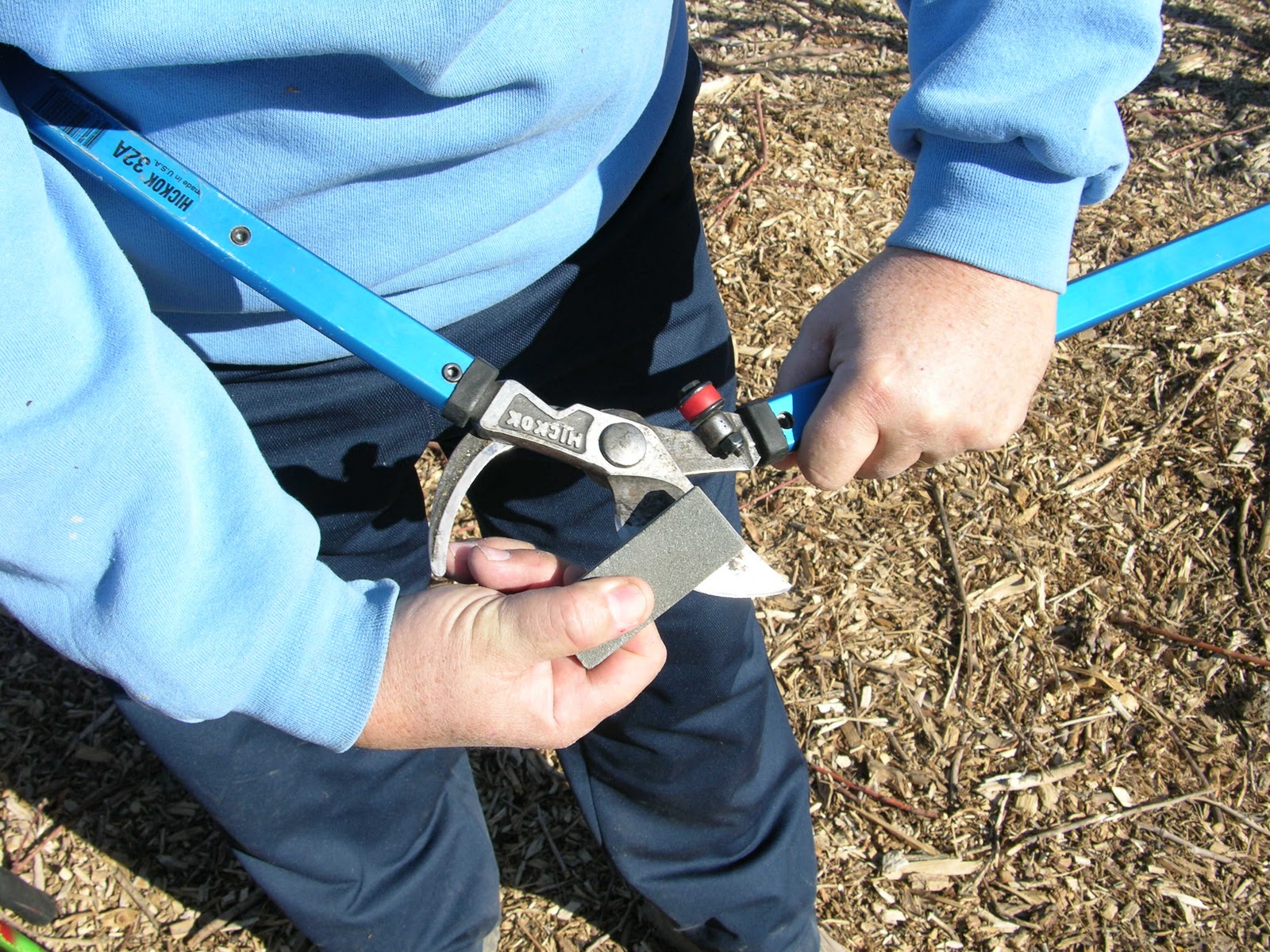
Hand shears and loppers. Recommended brand names include Corona, Felco and Fiskars.

  • Sharpen. Sharpen one side of the blade only (the beveled side) holding the stone at a consistent angle and running it along the beveled edge as you slide it across the bevel. If you are not comfortable using a stone then you might consider something like an Accusharp Gardensharp tool designed for pruning shears. These can be purchased for $10 or less and are much easier to use. Make sure you buy one for garden shears NOT the one for scissors or it will ruin your pruner's blade. It sharpens only ONE side of the blade unlike the one for scissors which sharpens BOTH sides of the blade.

If you are doing alot of trees you might have to stop and "put an edge" on the blade (just a two or three slides across the blade).
  • Adjustment and Lubricate. An adjustment nut that holds the pruners together is tightened or loosened to allow for easy opening and closing of the shears and lopper. Too loose and the shears or loppers tears the branch. Too tight and it creates early fatigue of the person pruning. Use a wrench to tighten the bolt until the blades move with some very slight resistance. You may need to tighten this nut a few times during the course of a day's work so carry the wrench with you.
  • Sanitize. Alcohol is sprayed or wiped on the cutting blades of the hand shears and lopper. You can use bleach but be sure to oil the equipment after its use or it will corrode the metal. I sometimes just use alcohol in spray bottle. A chef friend had no alcohol when we were pruning his fruit trees so he used Absolut vodka.

Now you are ready to prune.

Pruning Fruit Trees to Control Their Size

These full-sized peach trees are 17 years old and lowered
each year to 6 1/2 feet tall


Pruning at our orchard is a two step process: first for size control and secondly to enhance production. Pruning for size control is done the same way for all the fruit trees but pruning for production varies among the different types of fruit and how and where the fruit is produced on the tree.


We keep the size of all fruit trees so that the orchard is ladderless, easy and safe to perform work and harvest. This also allows us to plant trees closer together and get more fruit production in a smaller area. It also reduces our work load so we can get it done faster.

The tallest branches are identified visually.
These branches are visually traced to where
they join another branch somewhere
around 6 to 6 1/2 feet off of the ground.

Initial pruning for size control can begin before leaf drop, usually in November when leaves are beginning to turn color and we are sure all tree growth has stopped for the remainder of the year. If you have only a few trees to lower then you can wait until after all the leaves have dropped. If leaves are hanging on even into December you can turn off the water to the trees for two weeks and then turn the water back on again. This will stress the trees moderately and accelerate leaf drop.

Trees heights are lowered to 6 to 6 ½ feet tall using vutually all thinning cuts. The tallest limbs are identified, followed visually down to a point of attachment around 6 feet off of the ground and lowered to the proper height with thinning cuts.


The pruning cut is made at a "crotch" or
where two branches come together. This leaves
terminal buds intact to resume growth next spring.
Since we have our trees in rows, we must create space around each tree so that we can spray and harvest. We create space between trees by identifying limbs that are encroaching on a neighboring trees "space" or need to be removed so we can get between them. We trace these limbs back to a point of attachment (crotch) with another limb and remove it with a thinnning cut, not a heading cut.

Limbs that do not support fruit high enough to keep the fruit off of the ground or out of the reach of rabbits is removed with thinning cuts.

What Kind of Pruning Cut Do I Make?

Pruning Cuts. There are only two types of pruning cuts; thinning cuts and heading cuts.

Thinning cuts are made where two
branches or sems come together.
No stub is left after the cut is made.
Thinning cuts are made anywhere where two branches come together. The thinning cut totally removes one of the branches without leaving a stub. Thinning cuts result in a less dense canopy and less regrowth since terminal buds of the remaining stems remain after the cuts. New growth easily grows from the remaining terminal buds which helps minimize growth from side or lateral buds.


Heading cut - removal somewhere
along the stem just above a bud
Heading cuts are made anywhere along a branch NOT at a location where two branches come together. Heading cuts result in several new branches at buds growing immediately below the cut since the terminal bud is removed. Heading cuts are used to shorten the past season’s growth to increase a branches girth. Heading cuts encourage the development of short shoots that support fruit called spurs in fruit trees that grow fruit on spurs. If you do not cut back too severely and you make the cuts at the right time of year (around July or August) you may be able to get spur producing fruit trees to produce fruit a year or so earlier.

This growth resulted from a heading cut. Once the terminal bud was removed the side or lateral buds grew to replace it, fighting to see which might take over and dominate the new growth. The buds closest to the cut usually grow more erect (more straight up) than buds lower than this one. The lower buds tend to not grow as erect as the one closest to the removed terminal bud (the cut).

45 degree angles above horizontal
are the best angles for fruit production.
Here limb spreaders are used to push
the limbs into a 45 degree angle.
The most productive branches for fruit growth and development are at 45 degree angles above horizontal and should be preserved whenever possible. Branches are less productive as they are grow more vertically (more upright or downward). By the way, a branch that is at a 45 degree angle can be directed to be more upright and its growth will actually speed up (at the expense of fruit production, the energy goes to growth rather than fruit) and branches directed to be more horizontal will have slower growth (you can actually slow down its growth but it will still not put its energy into fruit production).

Vegetable Gardening in Southern Nevada

Here is a publication which is also posted at the University of Nevada Cooperative Extension website on vegetable gardening in the Moapa Valley. The Moapa Valley is located about 60 miles outside of the Las Vegas Valley, on the eastern edge of the Mojave Desert, with a very similar climate to the Las Vegas Valley. Planting dates will be similar but the soils of the Moapa Valley are typically much better than those in the Las Vegas Valley.


Here is the planting calendar that I pulled out of the publication so that you can use it without having to open the publication.

Learn About Hydroponics and Aquaponics April 9 -14, 2012

Sign up for this course at the University of Arizona if you have been wondering about raising fish in the same environment as a hydroponic greenhouse.

Which Roses Do Best in Hot Desert Climates?

Roses do well in the cool times of our hot desert Mojave Desert climate. They struggle during the heat but rebound nicely in the spring and fall months, about 7 to 8 months of the year. The lack of humidity and relative isolation helps keep insect and disease problems low. Here is a recommended list of roses from Weeks Roses, Inc., a top quality producer of garden roses.

Rose Insect Pests

This is a presentation I made to the South Valley Rose Society in Las Vegas, NV, on November 17, 2011.

Tuesday, November 15, 2011

Watering a Lawn May Not Be Enough For Trees Growing in a Lawn


Q. My tree is 30'x 25' and it is in a lawn area. We follow the SNWA guidelines for watering our lawn. Very little die back has occurred on this tree, and the only fertilizer it gets is what it steals from the lawn.
Tree dieback after the lawn was removed and rock
landscaping replaced the lawn.

A. Watering enough for a lawn is not enough for a tree planted in the lawn if you are not overwatering the lawn. Watering a lawn is enough for the lawn only if you are watering it correctly.

            When you put a large tree on it then you must deep water the tree as well as water the lawn. Different types of trees require more or less water than others. Tree water use is dictated by the size of the tree and the type of tree. Size is most critical. The only time trees do well in lawns is when the lawn is overwatered. The reason trees did well in lawns in the previous years is because lawns were overwatered.

New growth is often a different color from
the older growth
            As the price of water has gone up, people have chosen to conserve more and follow lawn watering guides more closely. This has caused some trees to be underwatered even though they are in lawns.

            Lawns are big fertilizer hogs, particularly nitrogen. If you apply fertilizer to the lawn then the lawn is what is going to get the fertilizer due to its extensive fibrous root system. Trees should be fertilized separately from the lawn with applications in the rootzone, just below the rootzone of the lawn so that the lawn does not burn.

            You can judge if the tree is growing enough by looking at its new growth this past year. It will be a different color than the older wood. Or you can see where the previous year's growth stopped. On a tree that size you should get 12 or more inches of new growth each year. If not, then something is wrong. It might be a lack of water or lack of fertilizer or both.

Modesto ash decline
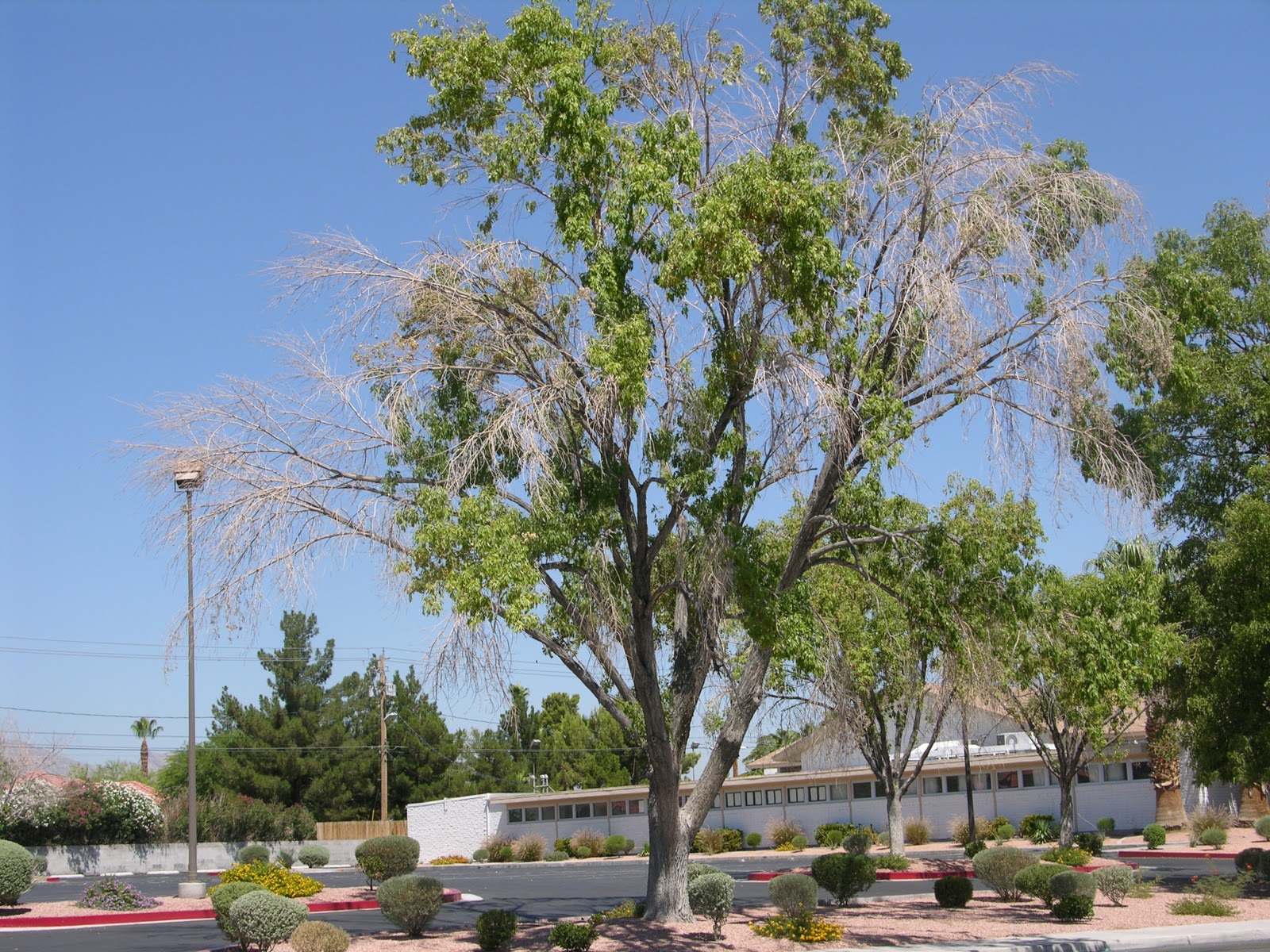
            I don’t know the type of tree you have but make sure you do not have Modesto ash decline if the tree is Modesto ash. I sent to you a picture of Modesto ash decline and have posted it on my blog. It is common here but does not hit every Modesto ash. I have been working with this problem for over 25 years with other professionals and no one has been able to determine its cause. This is why I no longer recommend this particular ash tree.

Several Options Available When Fertilizing Plants in Rock Mulch


Q. I know that this is not the time of year to fertilize plants, but I have a few questions regarding that subject now that it is on my mind. Do you have any suggestions for good way to apply fertilizer to plants that are in rock mulch? It's somewhat of a hassle to move the rock from around the plants, apply granular fertilizer, work it into the soil, and then replace the rock. I've used Miracle-Gro for foliar feeding, but they recommend that you feed the plants every 7 - 14 days. Is there another liquid option that only needs to be applied once or twice a season?

A. Let's cover a few options that you can use to fertilize plants in rock mulch.

            The liquid drench method. You can take a fertilizer which is soluble in water and dissolve it in a bucket of water and apply it to the root area where it is irrigated. This works very well with iron products that should be applied to the soil provided the product dissolves or is suspended in water.

            The dry fertilizer drench. Apply a dry fertilizer to the rock mulch between the plant and its source of water. Take a hose with a nozzle and wash it into the mulch. Make sure the fertilizer is not applied too close to the plant or the fertilizer might damage or even kill a plant.

One type of fertilizer stake with a plastic cap for driving
the stake into the wet ground with a hammer.
            The fertilizer stake method. Take a fertilizer stakes and either push them or hammer them into the soil after an irrigation and in the area close to the source of water. Of course you will use the plastic cap that comes with the stakes when you hammer them into the soil.

            Foliar applications of fertilizer. This works quite well but as you mentioned it is short-lived compared to a soil application. Make sure you use a wetting agent with the foliar spray.

            Install a fertilizer injector. These can be very pricey. Remember that with an injector the fertilizer is applied in proportion to the amount of water that is given to a plant. Those plants which receive more water, receive more fertilizer. It is important to have an irrigation system which applies to water correctly if this is to work well.

Increasing the Size of Pomegranate Fruits


Q. We have a pomegranate tree which grows fruit but not to the size of those that sell in stores or larger, they are very small.  This tree is growing on a slight hill and gets watered for about 20 to 30 minutes a day, plus my wife gives it an additional 2 gallons of water almost every day during the summer months.  What can I do to get larger fruit and more of it?

A. Increasing the size of your pomegranatefruits is more about pruning, watering and fertilizing than anything else.  Larger fruit will be produced on older wood so pruning a pomegranate to be more like a tree than a shrub will help. 

            During fruit formation it is very important to make sure pomegranate receives adequate water.  Water shortages during fruit development will result in smaller fruit at maturity or split fruit before the fruit matures.  Irrigations should not be daily but they should be applied in larger quantities but less often.
One fruit has already formed. The flowers arising from
the same point of attachment are removed to cause
the remaining fruit to get larger.
            Fertilize pomegranates lightly or in moderate amounts in February.  More fertilizer does not translate to more fruit or larger fruit.  But adequate amounts of fertilizer will.  Mulching with organic mulch around the tree will help.

We do some thinning of the trees when the fruits are about the size of walnuts. The only thinning done is when the fruits are arising from the same point of attachment. Then they are thinned to just one fruit. This has to be done all through the flower and fruit development period and not just thinning once but several times.

Wind A Problem for Fruit Trees But Maybe Not for the Reason You Think


Q. I am writing you in regards to a problem I'm having with my fruit trees in the spring when the winds are here.  I have a tree that grows 5 kinds of citrus fruit; Pink Lemonade, Bearss Lime, and 3 varieties of oranges (Washington Navel, Honey Mandarin, and Valencia).  I also have two other trees, a lemon and an orange, but do not know their variety.  My problem is the winds in spring when they lose their blossoms which then causes them not to bear fruit.  These trees are planted near the south wall in my backyard.  How is it best to prevent the loss of the blossoms in the spring due to wind?  How is this done in your orchard?

A. I do not believe that wind is blowing the flowers off of your trees.  In order for that to happen, you would need it gale force winds.  It is more likely that there was a dip in temperature causing a little bit of freezing damage. 

            All of these trees you mentioned cannot withstand cold temperatures.  Just the slightest freezing temperatures will nip them and cause them not to flower or drop their flowers. The most cold tolerant in the group is probably the Pink Lemonade which is most likely Eureka lemon which may withstand 26° F.  Just the slightest freezing temperatures will nip them and cause them not to flower or drop their flowers if nipped during flower formation. 

            All of these trees must be in a warm microclimate if they are to produce any fruit in the Las Vegas Valley.  And even if you have a warm microclimate, the chances of production will be iffy due to late spring freezes.

            The best advice I can give you is to provide some wind barrier to the area of the yard where they are planted. Wind combined with low temperatures can make freezing damage worse in the spring.

Full-Sized Peach Tree Not a Good Container Idea

Q. In March of this year I planted a 2 foot tree with few leaves.  It now has grown to 4 feet with a wide spread of branches. It is planted in an 18 inch pot in the southeast section of my yard.  Will this tree continue to grow in a container?  If so, should I transplant it to a larger container? I grow citrus trees in containers and in the ground successfully.  This is my first attempt to grow a peach tree.

A. I am not sure that putting a full sized peach tree in a container is a good idea. It is going to get REALLY big in there unless you can get a huge container.  A better selection would probably be one of the miniature peaches like Bonanza, Bonanza II, Eldorado, Garden Gold or Pixie. There are others but I do not know how they might perform in our climate. The fruit is okay, not great and that has been the problem with miniatures.

            I do not think a standard sized fruit tree will live as long in a container and will probably have to be replaced sooner than one in the ground. But if you do not have the room then go for it but put it in a very large container. The larger the better.

Monday, November 7, 2011

First Fruit Tree Pruning Workshop This Saturday, November 12

I will be holding the first pruning workshop of the season at the UNCE Orchard in North Las Vegas at 9 AM on Saturday, November 12, 2011. This workshop will talk about how to lower fruit trees to make them more manageable from the ground and hopefully eliminate the need for ladders. We typically begin this type of pruning before leaf drop in the fall because we have so many fruit trees to do. The homeowner can wait until after leaf drop in midDecember.

The Orchard volunteers are asking for a $5 donation to help support educational programming at the orchard.

You will learn:
  • how to sharpen, adjust and sanitize your pruning instruments
  • how to make the right kind of cut and where for all fruit trees
Bring your pruning tools and you can help the volunteers lower some trees after you learn how.

RLLM
aka Extremehort
Extremehort@aol.com

Sunday, November 6, 2011

Cutting Back Tomatoes for Fall Harvest in the Warm Desert


Q. In late February I planted in containers three Hawaiian tomato plants which grew to three feet, produced an abundance medium-sized sweet tomatoes.  By the end of July plants showed signs of dying.  Being from New England I assumed it was the end of the plants life and removed from pots. 

            A friend told me I should have slightly cut back the plants and continued watering. These plants would have made a comeback and produce new flowers and fruit during our fall season.  Would you elaborate on this subject?  I have never heard about tomato plants producing 2 crops.

A. Tomatoes stop setting new fruit as soon as temperatures get into the upper 90’s and so you will harvest these early fruits until usually in July and then it produces no more new fruit until fall again when the temperatures drop back into the lower 90’s.

            I often recommend cutting tomatoes back in late summer when it is no longer producing if you have a warm microclimate in your yard. If you do not have a warm location free from strong winds you probably shouldn’t bother.

            It is very touch-and-go when we do this at the orchard since we are fully exposed to cold northwest winds. Just depends on whether we have a warm fall or not. Late summer is when we begin some of our fall crops and is a good time to plant corn (bet you didn’t do this either in New England).

            So here we can have two springs, one before summer and one after summer (actually fall but acts like spring sometimes). I frequently call our summer “Las Vegas winter” since this is the time of year so many things struggle due to heat and lack of humidity.

            Winter can be a fabulous time for growing fall and spring crops again if you have a protected location or provide some protection if it is exposed.

            Cutting tomatoes back for fall production usually begins in late July or early August. The plants are trimmed back to invigorate new growth and reign them in if getting too large. A small amount of fertilizer is applied at this time to invigorate new growth.

            Foliar sprays are usually best since they don’t last very long but a small amount of quick release fertilizer (straight nitrogen) will work. Let them grow and begin flowering again and set fruit when temperatures drop.

            Be careful not to overfertilize. You should get a nice fall crop of tomatoes. If there is a threat of a freeze in mid December (usually) then cover the tomatoes at night if it is to be a light freeze with a light covering like a row crop cover or old sheet. Remove it in the morning when danger of frost has passed.

            If it is projected to be a hard frost pull the entire plant and hang the plant in the garage or sheltered area and let the tomatoes ripen on the vine in the garage. They will ripen more slowly if not removed from the vine allowing a more sequential ripening than if  you removed them all. Or use green tomatoes.

The Basics on Pruning Apricots and Persian Lime - the basic tree architecture is the same


Q. Could you send me a couple of directions relative to pruning Persian lime and apricot?  Also, any schedule of classes on pruning that might help me.  I am a chef and have some limited time.

A. I will give you my best shot at it without seeing it. Pruning is not a hard science and there are a lot of decisions that have to be made that are very specific to each tree.
Apricot spurs

            Apricots fruit on short flowering branches called spurs. It is important not to remove these short shoots. You will want to open the tree canopy to admit sunlight into the interior. You do this by eliminating the trunk at about 4 feet off of the ground.

            This should result in about eight or so major limbs that come from the trunk. These major limbs should originate from the trunk starting at about the height of your knee and ending around 4 feet off of the ground. These limbs should radiate from the trunk, ideally, so that about two limbs occupy about one fourth of the canopy (about eight total limbs).

            These limbs should radiate from the trunk in a pattern similar to spokes on a wheel so that they do not shade each other. The spacing of the major limbs coming from the trunk is such that hopefully there is at least a foot or more between limbs that originate on top of each other to prevent shading.
Young apple tree showing how limbs radiate from the trunk
using a birdseye view of the young tree. Yes, we prune
apple trees in our moderately high density orchard in an
open center fashion.

            These major limbs may have fruiting spurs coming from them but their primary purpose is to support smaller limbs that have the majority of the fruiting spurs. These smaller limbs should be at a 45° angle, as close as possible, from vertical. This provides the perfect angle for creating flowering spurs.

            Limbs that grow mostly up or mostly down should be eliminated at their source leaving no stubs. As you are finishing your pruning these major limbs should resemble a fan that radiate from the trunk in a fashion so that they do not shade each other, give balance to the canopy and allow filtered light to penetrate to the interior.

            Persian lime is also known as Tahiti lime or a selection of Tahiti called Bearss which is nearly seedless. Regarding the lime, it should be pruned in a similar fashion but the fruiting does not occur on short spurs. Rather, the fruiting occurs on new growth, frequently in the spring after new growth begins to emerge but it can flower later in the year.

            The biggest problem you might have will be protecting the tree from early freezing temperatures and the loss of fruit production because of these freezing or cold temperatures. The concept will be similar in arranging your major limbs to the apricot.

            Citrus usually does not require as much pruning so after you get the major structure established on your tree, you will mostly remove growth which is growing downward, upward or crossing each other besides any broken or damaged branches, limbs or stems. I hope this helps.

Proliferation of Flies in the Las Vegas Valley Causing Havoc (maybe a little exaggerated)


Q. My husband and I spend four months away from the Valley during the summer. When we returned in late September we could not believe the number of flies in our yard.....and because we are used to leaving our doors open....in our house. We have always bragged to those less fortunate than we are and live elsewhere in the country, mainly in the East, how we have virtually no flying insects in Las Vegas. I've had to eat my words this fall....along with some flies. I have not been able to even sit outside and read without being bombarded in the face with these nasty insects. We live in Sun City Anthem....the far southern end of the valley. Is there something blooming/growing in my yard that flies really like? Has anyone else noticed this proliferation?

A. Yours is the first report I have seen about an increase in flies this year. I do not know the products that are used for flight control, which is not an area of expertise for me. I would suggest however that somewhere, someone may be using a source of compost or manure products that are attracting flies.

The best advice I can give in the safest is to find out what is attracting them and where and address the problem there. If you do not do it this way and simply spray to control flies or use some sort of sticky trap you will not solve the problem but just work on the symptoms of a problem. I hope this helps.

I Have Several Questions That I Would Like Assistance With on General Stuff


I have several different questions that I would like assistance with. We have 3/4 acre lot in Las Vegas near the airport, it is sandy, and we have our own well so water is not an issue.

1)      We have just cleared the lot of sticker bushes and various types of weeds, what do you suggest we use to apply to the ground to prevent the weeds from reoccurring?

A. Mulch. Anything that provides complete shade on the ground. 100% shade prevents most weed seeds from germinating. If you want to use plant material and water is not an issue, then turfgrass makes the best groundcover to prevent weed seeds from germinating.

2)      We have just burnt tree limbs. Can we use the ashes to put around trees, and bushes, etc?

A. Yes. It is high in potassium salts. I would not worry about reports that suggest that you not use it.

3)      We would like to grass most of the lot, what type of grass seed do you suggest for sandy soil and well water and when is the best [or latest time] that we should sow the seed next year.

A. This is a loaded question and one I do not like to answer because it can be complicated. Hybrid Bermudagrass. It is not started from seed but from plugs, sprigs or sod. Plant from April to June. You can use common bermudagrass which is started from seed if County regulations allow you to plant it. I don't know where you live but if you are allowed to burn outside then do not overseed it in the fall and burn it back in late winter or early spring just prior to new growth, March or early April.

4)      We will be gone from January - April, can we cut back the tree in January before we leave, they are tall and full and we generally cut them way back in March so not sure we can do it earlier.  They are California peppers and approximately 5 years old.
A. You may prune anytime it is dormant and should be done before new growth in the spring. (Before February)

Wednesday, November 2, 2011

Broccoli Remains Packed with Health Benefits

USDA Research Demonstrates New Breeds of
Broccoli Remain Packed with Health Benefits

OCTOBER 13, 2011.—Research performed by scientists at the U.S.
Department of Agriculture (USDA) and published recently in
the journal Crop Science has demonstrated that mineral levels
in new varieties of broccoli have not declined since 1975, and
that the broccoli contains the same levels of calcium, copper,
iron, magnesium, potassium and other minerals that have made
the vegetable a healthy staple of American diets for decades.

“This research provides data on the nutritional content of
broccoli for breeders to consider as they further improve this
important vegetable,” said Edward B. Knipling, administrator of
the Agricultural Research Service (ARS), USDA’s principal
intramural scientific research agency. “The research demonstrates
how ARS is helping to find answers to agricultural problems
that impact Americans every day, from field to table.”
A team of three scientists evaluated the mineral content
of 14 broccoli cultivars released over a span of more than 50
years: ARS geneticist and research leader Mark Farnham at the
agency’s U.S. Vegetable Laboratory in Charleston, S.C.; plant
physiologist Michael Grusak at the USDA-ARS Children’s
Nutrition Research Center (CNRC) in Houston, Texas; and
Clemson University scientist Anthony Keinath.

The researchers grew the 14 cultivars in two field trials in
2008 and 2009, and harvested florets for testing.

“Our studies show that not much has changed in terms of
mineral content in the last 35 years in a crop that has undergone
significant improvement from a quality standpoint and that was
not widely consumed in the United States before the 1960s,”
said Farnham.

Broccoli florets in the study were tested for levels of calcium,
copper, iron, potassium, magnesium, manganese, molybdenum,
sodium, phosphorous, sulfur and zinc. Results indicated signifi-
cant cultivar differences in floret concentrations of calcium,
copper, iron, magnesium, sodium, phosphorous and zinc, but
not of potassium, manganese, molybdenum or sulfur. There
was no clear relationship between mineral concentration and
release year.

“For broccoli cultivars grown during the past 35 years, when
hybrids became the standard cultivar, evidence indicates that
mineral concentrations remain unchanged,” said Farnham. “As
broccoli breeders continue to improve this crop in the future,
data from this study can serve as a very useful guide in helping
breeders understand the variation in mineral concentrations they
should expect among their breeding stocks and also provide a
realistic baseline that should be maintained as other characteristics
are manipulated in the future.”

As USDA’s chief scientific research agency, ARS is leading
America toward a better future through agricultural research
and information.

www.ars.usda.gov/is/pr/2011/111013.htm

Monday, October 31, 2011

Silk Tree (Mimosa) Should Not Be in Rock Mulch


Q. You had a timely article for me on the mimosa tree. Mine started to struggle with leaf scorch. I started deep watering and I added iron, zinc, used a 15-15-15 fertilizer. After about three weeks and I had new growth on all branches and no scorch on new growth. I should have started when the
Silk tree growing in rock mulch will always struggle
temperature increased. Why never plant them in stones? My mimosa is in an area of about 250 square feet with stones surrounding it.

A. I think you just proved my point. Mimosa is difficult to manage in a rock landscape because these rock landscapes add nothing back to the soil. Over time, the soil becomes depleted of nutrients and organic acids because nothing is added back to the soil. The organic acids from decaying organic material help these nutrients to become available to plants.

With organic mulches they are constantly decomposing and replenishing the soil with nutrients and helping to stimulate important soil microorganisms and even worms. So by adding iron, zinc and the 15-15-15 fertilizer you began to replenish those nutrients that were depleted from your soil due to the presence of the inert rock mulch.

Some plants just do not do well under rock mulch and mimosa is one of them. Your other option is to add these fertilizers every year and in some way try to compensate for having that rock mulch. Either way is fine. Your choice. But you will have to add your fertilizer combinations annually for your mimosa to do well.

Lilacs Will Work in the Mojave Desert - Just Be Careful You Get the Right One


Q. I wish to transplant a lilac bush.  It is facing west and struggles during the heat of the summer. I believe a better spot is on the north side of a south wall with more shade. I would like to transplant now while it is cool, so I can continue my landscaping.  Is this the time?

A. In cooler climates, lilac can be planted in full sun and withstand full sun all day long. You are right, your lilac in our climate will do better in a different location. But if it is too shady, it may not bloom very well, if at all.

Morning sun is typically less damaging to plants than afternoon sun during the summer. Plants that produce flowers typically need more sunlight than those plants which we appreciate just for their foliage. If it is possible, try to find a spot where the plant can receive full sun in the morning and shade in the afternoon.

Regarding transplanting this time of year, we would like to have some root  growth after transplanting. Root growth is very dependent on soil temperature with very little of it occurring when these temperatures drop into the 40’s. It is getting late for that right now and you are moving the plant from a place that has warmer soils than its new home.

Plants are easier to move by hand if they have been in the ground less than three years. It seems to me, that once they hit that three year mark, the root system can be very established and make the plant difficult to move. Plants watered with drip irrigation with emitters close to the trunk are easier to move since most of the roots have restricted growth.

Unless you can be sure that you can take a very large root system with the plant, I would wait to spring. What you can do this time of year which will make moving the plant in the spring more successful, is to root prune now. Take a sharp shovel and slice the root system with this shovel just to the inside of the root ball that you will move in the spring. This will sever the root system, causing its regrowth closer to the plant. Be careful not to cut any drip lines.

This is kind of a judgment call this time of year. It is on the tail end of transplanting season. I hope I have given you enough information to make a decision regarding your situation.

Be careful when you buy lilacs. You have to plant lilacs with a low chilling requirement if you expect them to bloom in our climate. Common lilac may not bloom in the lower elevations of Southern Nevada because they do not get enough cold during the winter to form flower buds. Low chilling requirement common lilacs such as ‘Lavender Lady’ or ‘Angel White’ will bloom here. You may also want to select Persian or Chinese lilacs instead of common lilacs.