Type your question here!

Thursday, July 23, 2015

Suckers from a Removed Peach Tree Should Not Be Encouraged

Q. I had a old peach tree of about 30 years die, sadly. We cut it down and had it removed. Last year several suckers sprouted from below the ground. Different leaves so I know it is not peach. What are they?   Should I leave them alone and allow them to grow?
Sucker growth from the rootstock of ornamental plum. Notice the different color of leaves from the rootstock versus the top of the tree which is red

A. 30 year old peach tree is quite an accomplishment! They are normally very short-lived as far as fruit trees go. Peach is hit very hard by borers and starts to decline around 12 years of age or a bit older. A 20 year old tree is really getting up there in age.
When you purchase a peach tree from a nursery or commercially they are grafted (budded) onto a rootstock or a second tree that is growing in the ground. This is because the rootstock part of the tree has certain attributes that the peach tree does not. This can be some tolerance of wet soils, soils containing a higher amount of clay than normal, some resistance to soil salts, diseases and nematodes.
As far as peach goes, some even cause the top of the tree to be slightly smaller than it would if it grew on its own roots. There are a number of different rootstocks available for these purposes.

This may be a “plum” rootstock that you are seeing. It will produce fruit that you will probably not enjoy. Remove it and plant a peach variety that appeals to you.

What Is the Best Groundcover for Fruit Trees?

Q. What's the best groundcover under fruit trees?

A. It kind of depends on how much water costs. If water is expensive, a living groundcover might not be the best idea.
Farmer intercropping with sesame between fruit trees in Tajikistan
Also, living groundcovers like alfalfa or clovers don't return as much nitrogen to the plant as people think. In fact, they usually compete with the plant for water and nutrients and don't return the benefits that people think they should.
In our arid and desert West, surface mulches are usually the best option. I like to see woodchips from local arborists or tree trimmers used around the base of the trees to a depth of 4 inches or more.
I have seen some inter-cropping when fruit trees are young with things like melons planted beneath them. This way at least you can get double duty in food production from the water that's being applied.
Remember that intercropping increases the amount of care required because you are growing crops you have to tend. Fruit trees that may not require visits more than once every two or three weeks now have melons planted beneath them that require visits of 2 to 3 times per week.

So if it were me, I would use a nonliving groundcover such as woodchips from local tree trimmers.

Why Did My Desert Marigolds Die?

Why Did My Desert Marigolds Die?: Q. I have several Desert Marigolds in a sunny area of my yard. They are on a drip emitters, 2 gph, set to run every other day for 10 minu...

Viragrow Delivers!

Ornamental Pear Requires Deep Watering to Prevent Leaf Drop

Q. We are renting and we have a tree in our front yard that is not that old.  We have been noticing that the leaves are turning a brown on the ends and not sure if it's due to a watering issue, disease or pest problem.  I have enclosed pictures of the leaves and would appreciate any help so that we can correct the issue.


A. From the pictures, it looks like may be an ornamental pear tree. The leaves that I could see certain appear to be browning due to a lack of water. Ornamental pear can do so-so in rock mulch but it doesn’t prefer it.
My initial guess is the tree is not receiving enough water every time it is irrigated. What can be confusing is that we can see similar symptoms to trees that are also receiving too much water in this case I think it is not enough.
I am assuming the tree is on drip irrigation and I am also assuming it is in a rock landscape. We can increase watering by increasing the number of drip emitters surrounding the tree and making sure that these emitters are 12 to 18 inches from the trunk.
We can also increase the amount of water by increasing the number of minutes on the irrigation controller. The problem when we do this is that everything else that is watered will also get an increase in water when it may not be necessary.
Also, this will increase your water bill perhaps unnecessarily. It is best to increase the number of emitters that way only this particular tree will get the increase in water.
Another possibility (I don't want you to do this) is to increase the number of days the tree is receiving water during the week. This is frequently not a good solution to a lack of water.
Trees need to receive deep irrigations with lots of water, then arrest of a couple of days during the summer with no additional water, and then watered again deeply. You do not want to water trees daily if it is at all possible or unless they are in containers.

In the meantime, take a hose and give that tree a lot of water at its base very slowly. Do this once a week and I think you will see an improvement in the number of leaves produced and the overall quality of the tree.

Recommended Vines for a Very High Backyard Wall

Q. I'm looking for a vine to cover an extremely high backyard wall, approx. 10ft.  Backyard has southern exposure and the wall faces east.    I would prefer an evergreen.

A. I don’t like to answer questions about recommended plantss for specific applications. So I handed this question off to Andrea Meckley who loves these kinds of questions.

Bob Morris forwarded your question to me.  For an east facing wall, I suggest the following evergreen vines,
1.  Banks Rose (Rosa Banksea)-semi-evergreen
     yellow or white flowers are nice yet produce debris in spring, needs maintenance once in a while with wayward limbs and suckers
2.  Firethorn  Pyracantha (Pyracantha 'Graberi')
     red berries after spring white flowers may attract birds
3.  Star Jasmine (Trachelospermum jasminoides)
     fragrant white spring flowers
if you have a shady wall :
1.  Creeping Fig (Ficus pumilla)
     no flower, may damage stucco when you remove it, no flower
2.  Algerian Ivy (Hedera canariensis)
     VERY aggressive root system, may damage stucco when you remove it, no flower

    All plants will need support to stay on wall.  One place for more information on above plants is SNWA.com under 'plant search'.  Hope this helps with your decision.  Contact me with any other questions or comments.

Andrea Meckley, Certified Horticulturist

imn2plants@aol.com

Cutting down Cotton or Poplar Will Produce Suckers That Need to Be Controlled

Q. Is anything that can be done about cottonwood suckering from the roots after you cut the tree down, I poured stump killer onto it only to find later little cottonwood trees sprouting up around the stump and the lawn. A local expert said to pull out the sprouts until they start to go away.

A. The basic idea of exhausting the root system by removing the suckers is correct. Nearly all of the poplars, including cottonwood, sucker from the roots when they are cut down.
The mature tree acts like an energy sink for new growth. As long as the mother tree is alive, healthy and growing, it helps suppress growth from the roots. Once the mother tree is removed, the suppression of sucker growth is also removed. Suckers begin to grow from the roots as a survival mechanism for the tree.
These suckers will not pull easily because they are coming from roots. The usual term by “know-it-alls” is to "exhaust" the energy reserves in the roots by constantly removing sucker growth.
Lawn dandelion killer containing dicamba in the ingredients
The tree "invests" stored energy into sucker growth in a last ditch attempt to survive after it is cut down. In Mother Nature, this usually works. In a home situation with a diligent homeowner, removal of these suckers slowly but surely, exhausts the energy supply in the roots until finally the entire tree, roots and all, expires.
What to do? Remove the suckers as soon as you see them. This is no easy task even for the young at heart. Chemicals can help us remove or kill new sucker growth. By spending some money and purchasing products such as Glyphosate or a dandelion killer that contains dicamba or triclopyr in the ingredients makes this job much easier.
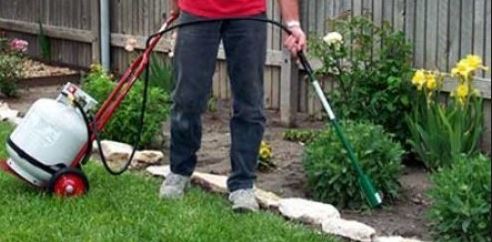
I have been quite happy with my red Dragon flame weeder that is worked quite well
If a lawn is present, dandelion killer that will also kill clover or tough to control lawn weeds would be a better choice than Glyphosate. If this is a desert landscape with rock mulch everywhere, then Glyphosate would be a good and possibly better choice.
Another possibility is to use a propane flame weeder such as Red Dragon. It will not work in a lawn very well but in a desert landscape it works quite well to burn down sprouts rather than to kill them with chemicals.

Spraying must be done when the sprouts are still young and immature to get good kill. They have to stay on top of this sucker growth and not let it get out of hand and spray probably once a month during the growing season as soon as new growth appears. 

Summer Leaf Scorch and Leaf Drop Can Signal a Lack of Water

Q. All developing yellow leaves plus other things going on indicate some trouble is brewing. Are these problems related to watering, bugs or both or something else?
Peach is notorious for borer problems. The scorching on the edges of peach leaves is a good indicator they are not getting enough water. They also will drop their leaves if water stressed. In the case of peach, I would look for borer problems in the limbs and interrupting the flow of water.
The reason these apricot leaves were damaged could be from a while back since the surrounding leaves appear to be healthy.
Citrus leaves will turn yellow from strong sunlight and a lack of water. This does not appear to be a fertilizer problem.
A. In the pictures you sent I see some leaves of peach that have brown or scorched edges and some apricot leaves that look damaged. With the apricot, leaves that are surrounding the damaged leaves appear to be just fine. Your citrus leaves are yellowing as well.

None of this appears to be a lack of iron or fertilizer.

Most of this looks like a lack of water to the leaves. Look at the newest growth and compare it to the oldest growth. If the older leaves are damaged and the newer leaves are not, then this tells me the problem occurred earlier in the season. Healthy new growth tells me the problem has been corrected.

If leaves have turned brown all over the tree or all over one limb and the new growth doesn’t look like it’s improving, then this tells me the problem is still going on and something needs to be done. 

Water travels from roots to the tops. Reasons for a lack of water may not be because not enough water is applied. If water is not reaching the upper branches even though enough water was applied to the tree, it can be from damage to the roots, trunk or limbs.

Damage to the trunk or limbs can also interrupt the flow of water to leaves. This becomes evident during the heat of the summer when the leaves require more water.

Look for borer damage in the limbs, particularly to the peach. Borer damage usually occurs on the upper surfaces of major limbs that are exposed to bright sunlight.

Apply wood chip surface mulches to the soil surface to cool the soil, reduce weed problems and slow the loss of water from the soil. 

Skeletonizers Still a Problem on Grape Even If You Spray

Q. My grapevine has been overtaken by these worms/insects and at least 25% or more of the leaves have been eaten and/or turning brown. Are the grapes safe to eat?  I've attached some pics.  Early in the season I was spraying the vine with BT but maybe I didn't apply it often enough?  Could the netting that I put over the vines have made it easier for them to multiply like they did?  I know it made it difficult for me to get to the undersides of a lot of the leaves, but it was that or feed the birds!  I think I will forgo the netting going forward now that the grapevine is more established.

Midseason attack of grape leaves by grape leaf skeletonizer larva

A. I don’t think the netting had anything to do with skeletonizer. The only thing I can think of is that birds might not have been able to get in to get the adult moths. They will not touch the larvae as they have stinging hairs near their heads which keep birds from eating them.

There are probably five generations of these larvae in one season and they probably overlap on each other. The first one starts about April/Mayish and a new generation every 4 to 6 weeks so if you don’t spray at least three during the season you will miss a generation or two.

The Bt spray only lasts a few days and it is gone. Control = picking the right poison, applying at the right time, at the right dosage and the right coverage. You probably missed one or more of the generations.

Start spray applications in May. Apply every two months during warm weather. Read and follow the directions on the label. Use a “sticker” such as EZ Wet or equivalent, Apply to both the top and bottom of the leaves.

The grapes are safe to eat. Just make sure you wash them.The netting is more for bird control than anything else. It is wise to delay putting bird netting over the top of grape vines until you start to see the berries turning color.

I want to make sure you know information I’ve already posted on my blog previously. http://xtremehorticulture.blogspot.com/2014/09/grape-leaf-skeletonizer-attacks-again.html

Century Plant Yellowing: Water or Damage by Agave Weevil

Q. A friend of mine is having trouble with his Century plants, Agave and Cactus turning yellow.  These plants are in a rock yard with hand watering, they are 2 years old. Last year he had something chewing a cactus and eventually lost the plant. This year he has had no chewing.  I hope you can help us without pictures.

A. Two things come to mind when agave is yellowing this time of year...watering too often or agave weevil. Because this is the time that we see agave weevil damage below ground showing itself to our eyes above ground I tend to think of agave weevil. Particularly if it is century plant and this time of year.

Treatment to prevent damage by this insect has to be done earlier in the season before they really get going on damaging the roots.

I hope these links help.

Chaparral Sage a Good Choice for Desert Landscapes


White Fuzzies on Ash Growth

Q. I have a 6-8 yr. old ash that has this white powdery looking substance on the newer growth. Can you tell me what it is and how to eliminate it. 
Picture from reader of white growth on ash

A.  I have seen this kind of "growth" on several vegetables and herbs as well including peppers and basil over the years. I have sent pictures of these two a good friend of mine, a well-known horticulturist in Arizona asking him what he thought they were. I could tell he was giving me his best guess as well but I don't think he was very sure himself. 

Here is a post on something similar I made back in 2012


Although not exactly the same thing it appears to be more insect related than disease or physiological in nature. I wish I could give you a better response than just to keep your eye on it and let me know if things get worse. If things do get worse, then I would direct you towards a soil applied systemic insecticide for the tree if it is needed. That is the best I can do for you at this point.

Perhaps some are other readers might hazard a guess?

Saturday, July 18, 2015

Potatoes Need to Be Started Early in the Season

Q. I want to plant potatoes here in Vegas. Our season is timed different than others though so there aren't seed potatoes available now for a mid or late July planting. Will standard Yukon Gold, Russett, fingerlings or Sweet Potatoes from the grocery survive here? Or can you suggest where to get some suitable seed potatoes?

A. You are planting too late if you put them in the ground in July. We need to plant Irish potatoes here in late February or early March. Purchase seed potatoes early in the spring. Sweet potatoes are a hot weather crop and need to go in later when soil temperatures are warm, around the first week in late April or early May.


            Any Irish potato can be quartered and used for “seed”. Potato seed are not seeds at all but cut up potato tubers. When cutting potato tubers for seed, make sure each seed piece has at least two “eyes” or “dimples” and plenty of tuber connected to it.
Potato tuber developing on underground rhizome

Sterilize knives used for cutting and allow the cut pieces to “heal” in the refrigerator, moistened, for a few days prior to planting. Warm up seed pieces taken from the refrigerator to room temperature before planting.

I have used potatoes from the grocery stores for seed but you should realize that they are not certified disease free so diseases are more of a potential problem. Purchase organic potatoes for seed since standard potatoes may be treated with a sprout inhibitor. Sprout inhibitors are sometimes applied to keep them from sprouting in storage.
 
Harvesting potatoes
All of the potatoes you mentioned will grow here including Sweet Potatoes. Consider Red Pontiac and Red La Sota for red skinned potatoes as well as those you mention. Also try blue potatoes such as “Adirondack Blue” as well as fingerlings.

If you’re going to grow potatoes here, make them really special because regular old potatoes are not terribly expensive to purchase. I don’t know of a potato that will not grow here.

Stop Watering Lawns at Night

Q. I read with interest your column in the RJ on watering. Our small lawn seems to be dying in patches. We water 4 days a week for 20 minutes at 11pm.  We regularly feed with Turf Builder Plus and Ironite. What should we do?

Lawn disease of reader.


A. First of all change your watering time to 4 in the morning and finish before sunrise. Never put your lawn to bed at night, wet. You are asking for disease problems if you do.
Most warm weather lawn diseases need about 6 hours of a damp, dark warm environment to get active. After a watering cycle, wait 30 minutes and push a long piece of rebar or screwdriver into the lawn in several locations. Make sure it pushes easily to 10 to 12 inches before you meet much resistance.
If it does, then you are watering deep enough. If not, increase you watering until you can push it that deep. If deeper than this, reduce the minutes to 15 or so and repeat. Break your 20 minute cycle into three shorter cycles totaling 20 minutes and space them about 15 minutes apart. 
This helps prevent puddling and runoff. This fall, rent a core aerifier and punch holes in the lawn. Verify your lawn every three to four years; more often if your lawn gets a lot of foot traffic.
In lawns, nearly any iron product works so you don’t have to spend a lot of money on iron. Not true about other plants.

Lawn Maintenance Companies Should Recycle Clippings Back into the Lawn

Q. I live in a subdivision with 400 townhomes and a fair amount of grass that the HOA maintains. The lawn crew does a couple of things that I question. They keep the grass mowed pretty short; 1-1/2 inches.  Shouldn't they wait until it gets about 3 inches and then cut only 1 inch off?  Wouldn't this minimize evaporation? They are collecting the clippings and discarding them. Wouldn't it be better for the lawn if the clippings fall back on the grass? Doesn't the nitrogen recycle back into the lawn?


A. They should be recycling the clippings back into the lawn and mowing higher. This will require that they use recycling mowers, a special blend of fertilizer with half of its nitrogen in the slow release form and closer lawn management.
Mow tall fescue no closer than 1 1/2 inch at any time and 2 inches is better. This gives them 1/2 inch of growth they can remove safely each mowing. These grass blades contain a lot of fertilizer that end up in the landfill so it is better to recycle them back into the lawn.
If removed clippings are an inch long, this tells me the nitrogen fertilizer applied is excessive. No more than 1/3 to 1/4 of the grass blades should be removed in one cutting. Measuring the average length of clippings is a good way to determine if nitrogen fertilizer is needed by a lawn or not.
Mowing is important for controlling lawn diseases. Grasses are unique because they push growth from the bottom of the blade; the oldest growth is removed when mowing. Old-growth contains more disease problems than the newest growth.
Lawn clippings can and should be returned to the lawn. If they do this successfully they must use recycling mowers and a quality lawn fertilizer. Returning lawn clippings to the lawn substitutes for one fertilizer application every year. Recycling lawn clippings back into the lawn improves its general health because lawn clippings are composted back into the soil, releasing nutrients.
Recycling mowers have a unique blade and a unique deck design that provides greater lift and causes lawn clippings to be “chopped up” more effectively than with traditional mowers. Traditional mowers retrofitted with recycling blades will work but they are not as efficient as recycling mowers.
If a recycling program is done correctly, you will not see any residue from lawn clippings left on the lawn after mowing.
Fertilizers used with recycling mowers are unique. They must have a large percentage of their nitrogen in a slow release form or the fertilizer should be applied in much smaller quantities, more often. Their greater cost is offset because less fertilizer is required.
Where I don’t agree with you is on water conservation. The research is conclusive that lawns mowed higher use more water than lawns mowed shorter. However, lawns with a deeper root system are more drought tolerant. So it is a trade-off.
Lawns that are mowed higher have deeper root systems. This makes them more drought tolerant but they also use more water.
This is misleading because the difference in water use between a closely mowed lawn and one that is mowed taller is not large. It is more important to have an irrigation system that is designed and maintained correctly and water applied when winds are minimal and adjusting your lawn watering schedule monthly during the spring and fall months. Lower water use is tied more closely to management of the lawn and irrigation system, not the root depth of of lawn grasses.
Mowing a lawn higher has other benefits. Lawns mowed taller have deeper roots. Deeper rooting means better drought tolerance. Here is the rub. Improved drought tolerance alone has no relationship to low water use. It could be argued the opposite; they use more water.
Water use of lawns in inches per day as the seasons change in Las Vegas. Months are January=1 and December=12
Bottom line. Lawn maintenance companies should not be bagging lawn clippings but returning them to the lawn using recycling mowers. They must be careful in applying nitrogen to lawns. Over applying nitrogen fertilizers causes lawn recycling programs to fail.