Learn which fertilizers to apply and when, whether organic or mineral. Learn how to correct leaf yellowing, improve growth and fruit production on all fruit trees including citrus.Topics covered include applying mineral and liquid fertilizers, tree stakes, injectors, and selecting the right fertilizer including micronutrients.
Where: Ahern Orchard, 700 Clarkway near Bonanza and MLK
Time: 9am to Noon
Cost: $10 plus tax
https://www.eventbrite.com/e/applying-fertilizers-to-fruit-trees-tickets-42153109084?ref=estw
Type your question here!
Friday, January 19, 2018
Thursday, January 18, 2018
Sunday, January 14, 2018
Calendar of Operations for Fruit Trees in the Eastern Mojave Desert
I promised my friends at the last fruit tree workshop on pruning that I would publish a calendar of operations for fruit trees in the Eastern Mojave desert climate. This is at a 2000 foot elevation. Elevations lower than this will be earlier and elevations higher will be later. It is up to you to make some adjustments but I will post something about what the fruit trees are doing so the calendar can be shifted to a different calendar date. These are not exact dates but can vary two or three weeks either way.
December – January. Fruit trees have no leaves
Dormant winter pruning
Pruning of the trees including any major structural changes including removal of limbs with saw or loppers and hand shears. Sharpen and disinfect pruning equipment at the start of each pruning day. More often if diseases are suspected.Winter insect control
Spray oil application to fruit trees for prevention of outbreaks from aphids, scale insects, mealy bugs and spider mites.These spray oils are marketed under several brand names including Horticultural Oil, Horticultural Oil Spray, Dormant Oil, Ultra Pure Oil, Dormant Spray, Dormant Oil Spray, and others.Two examples are below.Sprays are applied to the trees following label directions after pruning and include all branches and the trunk down to the soil. All weeds are removed. All fruit is removed from the tree and picked up off the ground.Fireblight
Fireblight is a horrible bacterial disease that is commonly controlled through pruning or even tree removal in severe cases. If there was fireblight in fruit trees the previous year, you might see remnants of this disease while you are winter pruning of Asian pear, European pear, apple and quince. If suspected, disinfect pruning equipment BETWEEN each separate cut on the same tree. If severe, remove the tree. Immediately remove infected wood from the property.
Fertilizer application - Two weeks before peach growth begins
Complete fertilizer mineral fertilizer application or compost application. Fertilizer stakes, fertilizer injectors, mineral fertilizers, guanos, fish emulsion, rich compost, many different fertilizers exist to use or put together your own concoction. Use last years growth to tell you how much to apply for the current year.
| Use mineral fertilizers or compost that you know is rich in nutrients |
Iron fertilizer application - Combined with a fertilizer application
Apply iron fertilizers to the soil for season long control of yellowing due to iron chlorosis. Most iron fertilizers will work but the best all around iron fertilizer contains an iron chelate called EDDHA.March - May - Fruit trees have finished flowering and small fruit are developing
Limb Spreaders
Limb spreaders are used to increase the angle of attachment of a small limb or branch to the tree. The best angle of limb attachment for growth and fruiting is about 45 degrees from horizontal. Limb spreaders can be used during winter pruning but there is a risk of splitting limbs and branches. These limbs and branches are much more supple and easier to bend to a 45 degree angle after new growth starts.Fruit Thinning
Removal of fruit from peach, plum, apple, pear so that remaining fruit gets larger. Remove extra fruit when they are the size of a thumbnail.Summer Pruning
Remove unwanted growth from fruit trees before this growth gets big. Redirects energy and nutrients into fruit production, helps keep fruit trees smaller and reduces the amount of winter pruning.May - First apricots and very early peaches are beginning to ripen
Pheremone traps
This is the time when the first pheremone trap for codling moth and peach twig borer (other insects if you have them and there are pheremones for them) are placed in the fruit trees to catch the first flight of these pests. Getting some insects under control very early will reduce populations of them later. First catches are used to time insecticide sprays for best control and reduced pesticide use (IPM). It can also be used to time the deployment of traps for mating disruption.Fireblight
Fireblight is an insidious disease of Asian pear, many European pear, apples and quince. This is when this disease first appears if it was not present before this. Cut at least 12 inches below where it is visible. If the infected limb dies to the trunk, remove the tree.General insect control
Patroling and inspecting fruit trees on a regular basis (at least once a week) and inspecting fruit and leaves (bottoms and tops of leaves) helps identify if other pests and diseases might be a problem.Harvest - May through December
The rest of the year is focused on protecting what you are growing and harvesting fruit. This requires frequent tree inspection and watching for insects, diseases, irrigation problems, mulch renewal, borer removal, etc.Thursday, January 11, 2018
Dieback of Mature Fan Tex Ash
Q. I was cleaning up the leaves from my Fan-Tex Ash
tree and noticed that there was sap leaking from 4 different limbs of the tree.
Attached are some pictures. The tree is about 18 years old.
Although the first picture shows a small number of leaves remaining, the
tree has always has had a nice canopy of leaves including this past year.
The tree is in rock much, but it receives nutrients (24-8-16) from an
in-line liquid fertilization system.
A. The amount of water it is receiving sounds about right or possibly a little bit on the light side. It is definitely not being over watered. Your frequency of application also sounds about right seasonally. If this tree is surrounded by rock mulch then the amount of water applied may not be enough.
I did some on-line research and the sap could be
caused by stress (not enough water) or some type of borer. The tree
receives about 30 gallons of water each time it is watered. In the winter
it is watered once a week, spring and fall twice a week, and in the summer 3
times a week. Is it common for this tree to have borers or is this
problem likely caused by insufficient water?
A. The amount of water it is receiving sounds about right or possibly a little bit on the light side. It is definitely not being over watered. Your frequency of application also sounds about right seasonally. If this tree is surrounded by rock mulch then the amount of water applied may not be enough.
Look at New Growth
Look at how much new growth occurs every
year. At eighteen years of age the tree is in youthful maturity. The tree
should be growing at least 8 to 12 inches minimum every year of new growth. If
new growth is less than 8 inches every year then there is a problem.
You are right in several things. It could
be damage from borers. It could also be from stress such as a lack of water.
Ash Decline Disease
Fan Tex ash is an Arizona ash. Arizona
ash has a problem with ash decline disease. For this reason, I no longer
recommend planting any of the Arizona ash trees including Fan Tex. The tops of
the trees could have developed ash decline even though this look is not typical
of ash decline.
Ash decline usually hits one or two branches at a time and causes dieback and slow growth and leaves scorching. It is also possible it has sooty canker disease. Borers are usually associated with sunburn of limbs lower in the canopy. If this tree were topped with a chainsaw it is possible that any of these three possibilities could be a problem.
If this is ash decline disease, the tree
is a goner and it will continue to slowly decline in coming years. I would
recommend that it would be removed. If this is borers or sooty canker disease
then some pruning might help it recover. If you decide to keep this tree, I
would have a qualified arborist selectively remove the damaged parts of this
tree. Certified arborists know how to prune trees and improve their ornamental
value.
Fertilizer Injector
It is nice to know that these trees are
getting part of what they need through an injection system that deliverables
mineral fertilizers.
Rock Mulch
This is only a partial solution to
successfully growing ornamental trees in desert soils. If these soils are
covered in rock mulch then the soil is probably low in organic content. The
organic content can be very important to ornamental trees growing in desert
soils. Rock mulch causes desert soils to slowly become less and less organic
over the years. Mineral fertilizers will not solve this problem. Either
covering the soil with woodchip mulch that decomposes or continually adding
compost to the soil will work. As this soil becomes more “mineralized” over
time the tree may continually decline.
If the soil is covered in rock mulch, add
compost to the top of the soil and water it in. You would do this once a year
for the next three or four years but it is a slow soil improvement process.
This is all hinged on whether you have rock mulch or not. The faster option is
to make vertical holes with post hole diggers throughout the root area of the
tree and backfill these vertical holes with compost. This gets the compost
mixed into the soil much faster and produces faster results.
If this turns out to be borers than
applications of systemic insecticides may be her only solution to the problem.
In any case, someone needs to make a decision about what the problem is which
determines the course of action.
Some Compost Can Be Used as a Fertilizer
Q. If I make my own
compost, can I use it instead of commercial fertilizers for grass, plants,
trees, shrubs?
| Some composts, if they are rich enough in nutrients, can be used like a fertilizer. |
A. Yes you can. But please
be aware that homemade compost is not consistent in fertilizer content and
quality. This is because of variability of different nutrients in ingredients
used to make the compost. However, compost is universally good, whether it’s
commercial or homemade, when added to soils as a soil amendment.
When using compost as a substitute for fertilizer, it is
important to know its carbon to nitrogen ratio, in other words how much
nitrogen fertilizer it contains. The nitrogen content of a compost is critical.
High nitrogen content (low carbon to nitrogen ratio) makes compost “hot” and
less of it should be used. If compost has a high carbon to nitrogen ratio (low
nitrogen content), then more of it should be applied when substituting it for
fertilizer
Commercial composts aim for a carbon to nitrogen ratio close
to 20:1 or twenty times more carbon than nitrogen. As this ratio increases to
40:1, the nitrogen fertilizer content decreases. At a ratio more than 40:1, the
compost is still valuable but it’s value is greater as a soil amendment rather
than fertilizer.
The carbon to nitrogen ratio in homemade compost is
managed through what is added to the compost mix before composting. “Woody”
additions to compost like wood chips, sawdust and shredded newspaper (sometimes
referred to as the “brown” component) increase the carbon to nitrogen ratio.
Additions of grass clippings, leaves of trees and shrubs,
and vegetable scraps (referred to as the “green” component) lowers the carbon
to nitrogen ratio and make it more valuable as a fertilizer.
Animal manure (think of it as a concentrated “green”
component) is high in nitrogen and added to get the carbon to nitrogen ratio
low and improve fertilizer content. If lots of different components are mixed
together in the right proportions, green components are balanced with brown
components, homemade compost has all the nutrients needed by plants.
The short answer is “yes”.
But substituting a homemade compost for a fertilizer application varies from
batch to batch depending on what was used to make the compost.
Organic Soil Amendments at Planting vs No Organic Amendments
Q. I’m planting
new fruit trees and landscape trees this year. I noticed there is a
consensus out there that fruit trees, trees and shrubs should be backfilled
with native soil without using any amendments. However, is there an exception
in Las Vegas with the soil is exceptionally poor?
| Typical "native" or "natural" desert soil in Las Vegas. Would you plant directly in this? I hope not. |
| Here is the SAME soil (25 feet away) ten years later after wood chips were spread on the soil surface and water was applied for fruit trees. Now which soil would plants be "happier" growing in? |
A. You are right and my advice is bucking conventional advice from most places. For instance, using native soil for backfill in North Carolina will be fine in most cases. But it also depends on what is planted. Many urban landscapes have "fill" that was brought in by the developer or general contractor. Most fill...No, I take that back...ALL fill... used in urban desert settings is junk. Using soil amendments depends on
the soil and also the plants. Let me explain why.
Desert Soils Vary in Organic Content
Some desert soils are okay to plant
into directly and you will have few problems. Others are not. Much of it
depends on the organic matter content of the soil and the type of plants. If your soil contains at least 5% organic matter at the time of planting, the addition of organics to the soil as a soil amendment probably won't do much. If the plants going into the soil prefer growing in highly organic soils, you are probably going to see a problem if the organic content is only 5%.For instance, a soil with low organic content but suitable for lawn grasses or some trees and shrubs will not be suitable for annual flowers or vegetables.
Soils are a Mixture of Sand, Silt, Clay AND Organics
Soils
are a mixture of minerals and organic content that results from dead plants and
animals that decompose into the soil. Desert soils with very low rainfall like
ours.
When
planting without soil amendments such as compost, soil organic matter content
should be at least 5% if you don't want the plants to be "unhealthy". If it is lower than this, add organic content to the soil
such as a good quality compost. Mix it with the soil taken from the planting
hole.
Another
option is to use a soil mix for filling the planting hole around the tree roots
or container roots. Soil mixes are like Hamburger Helper; they contain organics and it is convenient and
easier to use than mixing the soil yourself.
![]() |
| Soil color can tell you alot about a soil. This cark soil color tells me there is a good amount of organics in it and will not need to be amended for lawns and some trees and shrubs. |
Be
careful of adding too much organic content to the soil. This can work against
the establishment of the plant in the surrounding soil. This is the situation
with research done in Oklahoma, Arizona and other states. These practices of
“not adding organic matter” to the soil at planting is from their research with
soils already high enough in organic matter to make little difference after platning.
![]() |
| This is the same desert soil you saw above. Organics are added to this desert soil AND the soil is covered in wood chips to add organics to the soil over time as long as there is rain or irrigation. |
Many soils of the Mojave Desert with very low rainfall
are extremely low in organics. Soils in the desert that are relatively high in
rainfall or were previously farm land (under irrigation). These are usually
already high enough in organics and adding more does little, if any, good.
Using the deserts of the Southwest as an example (Sonoran, Mojave, Chihuhuan,
Great Basin) they range in historical rainfall from 4 inches to over 10 inches
of rainfall each year. This is a 250% difference depending on locale!!! Of
course we will see different types of plants and a difference in plant density
and canopy size when we compare desert environments with a difference in
rainfall of 250%!!! This is reflected in soil differences there as well. We see
differences in organic content, salts, pH, etc.
![]() |
| Map of the US showing organic content of soils and how it varies with rainfall. Desert soils are always lower in soil organics than soils in wetter climates unless they are amended. |
How Do You Know the Organic Content of a Soil?
We can send it to a soil testing laboratory and spend
maybe $75 to $100 and wait for three weeks for a reply or use our noggin and
get a rough approximation. The soil testing lab will give you a precise amount
in the sample sent to them. If the sample sent to them is representative of the
soil that interests us, then it may be fairly accurate. But, garbage in, garbage
out. If the sample is NOT a good representation of the soil that interests us
then it is garbage.
Look at the soil
Soil color is a pretty good indicator of soil organic
content. Rich soils, full of organics are brown to black. The lighter the
color, the less organics in it. If the soil is moist and dark brown, you
probably don’t have to add anything. If it is light tan or very light colored,
even when moist, it probably needs organics added despite the recommendations
from Oklahoma or Arizona.
Dig in the soil
If you need a pick to dig or a shovel barely scrapes the
surface, AND it is light colored….ADD ORGANICS!!!! Add organics in a ratio of
about 1:1 by volume or container. Add a five gallon bucket of compost to this
cement-like soil. Adding organics/compost in a 1:1 ratio (v/v) will NOT result
in 50% organic matter content but probably in about 3 to 5% content after
watering, settling, and growing for one season.
Next year add 25% by volume
(v/v) if it is a garden soil or apply about one inch of compost to the soil
surface around a plant and lightly scratch it into the soil surface, and water
it in. Keep compost at least (approximately) 6 to 12 inches from the “trunk” or
stem of the plant. Beginning the third year, add compost around the tree/plant
at the beginning of its growth cycle primarily for nutrients and improved
biological activity.
Las Vegas soils, most of them, are extremely low in
organics. ADD compost to these soils at the time of planting. You have one time
to do it and after that it is very hard to do if not done at planting.
Would You Like to Learn More?
Sign up for my half day class on the Basics of Desert Soils and Growing Horticultural Crops offered in early March 2018. Read all you want in books and the internet but this class focuses on growing plants in desert soils of the Mojave. Class size is limited. Enroll now using the link below.
Labels:
class,
Desert soil,
fruit trees,
landscapinglearn,
lawn,
understand,
Vegetable growing
Are Organic Fertilizers Really Organic?
The
organic movement has a foothold in the turfgrass and ornamental industry. The
same industry brewing for decades in home vegetable gardens, and then with
small-scale producers, has emerged as a significant market percentage for
commercial landscapers. Homeowners are asking for “organic” landscape plants,
organic methods of controlling pests and applications of “organic” fertilizer
to their landscapes.
Migration of Organics to the Landscape Industry
Alternative
methods for producing and maintaining ornamentals and turfgrass have been
around for a long, long time. In the past, very few residential clients were
willing to pay for the additional costa associated with the product. That may
be changing thanks to local food movements and organic agriculture1.
The word “organic” has become synonymous with “wholesome” and “safe”.
| Organic fertilizers for vegetable gardens |
Organic
has a different meaning in landscape horticulture industry. Organic can mean
sources that are not synthetic or conventional. Organic amendments, such as
municipal and animal sources of biosolids, can be applied to improve soil physical
and chemical properties which in turn can improve turfgrass establishment rates,
growth, and quality. We know, for instance, that in poor or marginal soils the
incorporation of compost improves soil properties, increases soil nutrients and
consequently improves plant growth. In soils with a naturally higher percentage
of organic matter these improvements are less noticeable.
| Nitroform urea used in the landscape industry could be classified as an "organic" fertilizer even though it is manufactured |
Composted Dairy Manure Reduced Turfgrass Disease in Colorado
Research
at Colorado State University evaluated the effects of applying composted dairy
manure as topdressing to Kentucky bluegrass. Researchers applied compost at the
rates of 13.3, 26.6 and 40 cubic yards to the acre. Applying composted manure as
topdressing to established bluegrass in 2003 through 2004 improved the soil’s
physical properties and nutrient content.
| EZ Green Is a composted chicken manure product for the landscape industry that is OMRI listed product for the organic program by USDA |
Although
nothing new, the application rates are important. The two higher rates improved
turfgrass overall quality and allowed the grass to retain color in the fall,
early winter and green up faster in the spring. Not bad for a product that is
not considered a fertilizer.
During
the hot summer months the two higher application rates produced about 50% more
clippings. The researchers concluded that compost improves turf quality and
shoot growth via its action as a slow-release fertilizer.
More
turfgrass clippings sound like a potential landscaper’s nightmare but there is
a positive side to this “problem”. Increased
amounts of clippings in summer months helps suppress the incidence of hot
weather diseases. Infected leaf blades are removed through regular mowing and
mulched back into the turfgrass sward or removed from the property.
Disease
suppression by composts, composted biosolids and compost teas in vegetable
crops has been documented fairly well. But research has been conducted on the
suppressive effects of composts, such as biosolids, on turfgrass diseases as
well, dating back 20 years or more.
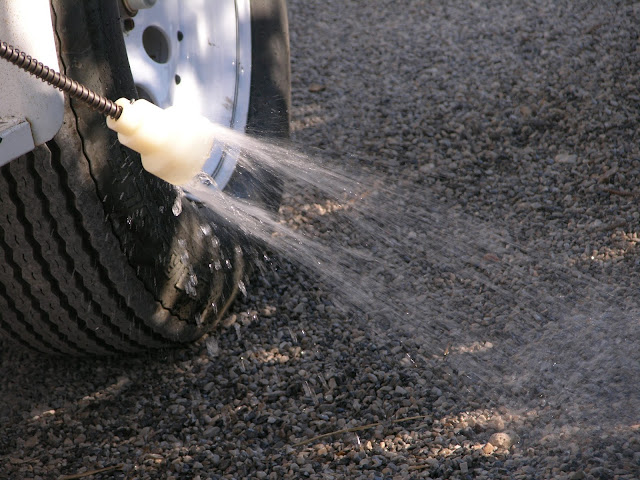
| Compost tea applicator used for soil applications |
This research
shows promise to “organic” gardeners by reducing the application of fungicides,
synthetic fertilizers and other chemicals to home lawns. Composts show promise
in controlling turf diseases such as Pythium, summer patch, brown spot, dollar
spot, red thread, necrotic ring spot and others. Reductions in the applications of pesticides
such as fungicides, directly supports the “organic” movement whether it is
truly organic or not.
![]() |
| Lawn clippings from commercial properties represent a huge amount of fertilizer that is removed from the lawn grasses and buried in landfills. |
Composted Biosolids Benefits To Landscapes Shown by Texas Researchers
Researchers
at Texas A and M University, from 2005 through 2008, demonstrated the benefits
from composts used for soil improvement and nutrient enrichment can be transferred
from the sod farm to newly established landscapes. Previous studies with sod
that recycled manure-based soil amendments as topdressing indicates that 77% of
the phosphorus and 47% of the nitrogen might be removed and transported in a
single sod harvest.
About
one quarter of the cubic yard of composted biosolids was incorporated to
rootzone depth in a cubic yard of native soil when establishing Tifway
bermudagrass sod. Researchers measured that five times more nitrogen and seven
times more phosphorus was available to turfgrass grown in biosolids compared to
grass grown without biosolids.
![]() |
| Fertilizer content of composted biosolid product by a local Las Vegas supplier |
After
two sod harvests, all of the nitrogen and phosphorus applied from the biosolids
was removed with the sod. These nutrients were transferred, with the sod, to
the landscape.
Although
not demonstrated, researchers claimed that this could result in faster
establishment times and better turfgrass cover in a shorter period of time. This,
of course, would reduce the amount of fertilizers needed during sod
establishment. Another coup for the
organic movement.
They
also found that sod established with biosolids was lighter in weight than sod
grown without biosolids. Biosolids-grown sod contained more water but less
native soil than sod without biosolids. This helped preserve the native soil. Less
fuel is needed for transporting the sod. Organics, are you listening?
Composts Release Fertilizer Nutrients Slowly
Composts,
when used as a fertilizer, releases nutrients slowly, acting like a
slow-release fertilizer. When establishing turfgrass in sod farm operations,
rapid turfgrass establishment is important so a rapid release of nutrients,
particularly nitrogen, is needed.
This was
not going to happen with compost-amended soils. So the researchers applied
either 50 or 100 pounds of nitrogen per acre at the time of sprigging (establishment)
to supplement the slowly-released nutrients contained in the compost.
Because
of the application of supplemental nitrogen, the time between harvests in biosolids-amended
soil plus fertilizer was reduced 60% compared to the time needed for sod grown
with biosolids only.
Similarly,
other researchers reported better turf coverage and density when a two to three
inch depth of compost was incorporated to a 6 inch soil depth compared to soil
without compost. They attributed these responses to improvements in the soil’s
physical properties such as better pore spaces, greater rooting depth and improved
drainage.
Applying Too Much Compost Two Landscapes Can Be a Bad Thing
Composts
can be over-applied to landscapes. This can become a serious environmental
concern to surface waters such as irrigation ponds and waterways. When composts
high in nutrients such as nitrogen are applied to turfgrass as topdressing,
researchers have found a significant amount of nitrogen can be transported to
these waterways.
Incorporation
of composts to a greater depth should reduce the amount of nutrients removed
compared with topdressing. Incorporation of composts to greater depths should
allow for less frequent applications as well which would save money. In
addition, soil incorporation of biosolids should reduce the potential for
runoff of nutrients after establishing in urban landscapes.
Labels:
biosolids,
compost,
landscapes,
lawns,
Organic fertilizers,
turfgrass
Lemon Not Meyers, Remove Fruit?
Q. My lemon is not a Meyers
lemon but the tree is starting to flower. I didn’t want to pick them this early
because they are still getting sweeter. Does the "remove lemons before the
tree flowers" rule apply to this variety as well?
| Ponderosa lemon ready to pick on the left and immature on the right. On the tree at the same time. |
A. Yes it does. It applies
to all fruit trees. Try thinking like a lemon tree. The reason the tree
produces fruit is to reproduce. When the fruit drops to the ground, the fruit rots
and releases nutrients that feed developing seedlings.
The tree “knows” if there is fruit attached to its
branches or not. It can’t see anything but there are other types of
communication that trees have perfected. When the fruit has been picked, the
tree “knows” the fruit is no longer there.
The reason for picking fruit before the tree begins
flowering is to send “signals” back to the tree that it no longer has fruit
attached to its branches. When fruit is missing, the reproductive or flowering
cycle of the tree is encouraged.
The beginning of flowering is the beginning of the
reproductive cycle. The normal flowering cycle of trees is at certain times of
the year. If this time for the normal flowering cycle to begin has passed or is
delayed, the tree may not flower at all or flower very lightly.
You are right. Most citrus are considered
non-climacteric, or, in other words the fruit doesn’t increase in sweetness
after it is picked. It is best to wait when picking lemons to improve its sweetness,
but you don’t want to leave it on the tree long enough to interfere with
flowering.
Other fruit which don’t ripen or ripen little after
picking include figs, grapes, pomegranates, cherries and apples. As a consumer
this means the sweetness of non-climacteric fruit does not increase much, if at
all, after picking.
If citrus is left too
long on the tree fruit quality is reduced because it becomes “pithy”; it starts
drying out. Remove all fruit from trees before they begin their next flowering
cycle.
Italian Cypress and Twisted Juniper Struggling in the Desert
Q. So,
I live in the high desert of Southeastern Utah, about 4500 feet. Minimal
precip. Temps up to 110 in summer and down to 20s at night in the winter. Fast
draining soil, actually just sand, but I do amend some when planting to
"slow the flow" and try to make it more like soil.
A. You live in some beautiful country.
I
have 2 Italian Cypress about 4-5 years old and 3 Hollywood Juniper about 3
years old. They were doing well up till beginning of last year. Now
something seems to be killing them from the ground up. Initially I thought maybe
rabbits were eating them but I no longer think that. I have tried more water,
less water, more amendments, iron, etc. Spray with Liqui-Cop after leaf fall on
my fruit trees and include the conifers. The Cypress seem to be doing a bit
better than the Juniper, at least there is some green growth there. The Juniper
look like they are totally dried out and peeling away.
Can
you tell me if it is a disease? Insects? Critters? And what I can do about it,
if anything, before they die completely! Guess
my question is whether you think I can save the cypress or should I just give
up?
A. You live in some beautiful country.
Why are the lower branches of the Italian
cypress missing? Was this due to rabbits? I have seen rabbits devour newly
planted, small pine trees during the winter but this is the first time I have
seen it on Italian cypress.
I think you have a problem with these
lower branches removed from the Italian cypress. Those lower branches are
needed for several reasons. First, that foliage produces energy for the tree
and improves growth by providing energy for its growth. Without that foliage,
new growth is going to be minimal and weak.
Secondly, the growth along the trunk is
needed for proper trunk development. Branches are needed for the trunk to
develop proper caliper, i.e., taper along the trunk. Without this growth, the
trunk never gets strong enough to remain upright or erect. The plant will never
get strong enough to remain upright.
When they are planted make sure they get
a good soil amendment such as compost and not just planting amendment. If you
use planting amendment, make sure you put some 16-20-0 or some type of starter
fertilizer at planting time. They should be fertilized at least once a year in
early spring. If in sandy soil, twice a year.
If this was rabbit damage, next time
plant them with a cylinder of 1 inch hexagonal chicken wire around them to keep
the rabbits from eating them. I would use 3 to 4 ft tall cylinders. Jackrabbits
can reach up to nearly 3 feet when they are on their back legs. Eating foliage
that high should not be a problem but lower foliage missing will be a problem.
I think you may have some sun damage to
the lower trunk on the cypress from missing branches along the trunk. Check for
borer damage in them as well.
Hollywood junipers are notorious for
borer damage. Look close at the trunks and I am willing to bet you have them.
Use Bayer Insect Control as a liquid drench around these to protect them from
borer damage. Better yet, don’t plant them here. Plant something else.
I think it will be okay. I would just
protect it with some chicken wire if rabbits are the cause. You need to push
new growth. That will be done with fertilizer and timely watering. Fertilize
twice during the year, February and again in about June. Throw one or two
handfuls of fertilizer about a foot from the base of the tree and sprinkled on
the soil. Water it in. If you have basins, put it in the basins and water it
in. Keep fertilizer away from direct contact with the trunk.
You have the self watering containers
around the base. I am wondering why you are not using the drip irrigation that
is there in the pictures. Italian cypress like wet winters and dry summers.
Water as you would any tree during the summer. Probably twice a week during
high temperatures and I would give them about 5-10 gallons when they are small
each time you watered. Winter time maybe once a week or ten days. Keep
the amount of water you apply the same each time. Apply this amount of water
more often as it gets warmer.
Subscribe to:
Posts (Atom)


