Thinning Fruit on Fruit Trees to Get Larger Fruit
April 19, 20 and April 26, 27
Thinning fruit, technically categorized as a form of pruning, is selective removal of fruit so that the remaining fruit get larger. On some fruit crops this is done with chemicals but we will only be using our hands. You will be taught how to thin fruit of apple, European pear, Asian pear, peach, nectarine, plum and pluot and even pomegranate! You will get hands-on experience learning how and when to do this very important form of orchard management.
Class fee is $25.
Sign up on Eventbrite.
Monday, March 4, 2019


Experience Summer Pruning Fruit Trees at the Ahern Orchard
Summer Pruning of Fruit Trees
April 5, 6 and April 12, 13
Summer pruning of fruit trees is done in late spring through early summer which keeps fruit trees smaller, manages their growth, improves fruit production and decreases the need for winter pruning. Summer pruning routes the tree's energy into better fruit production rather than into new growth. This keeps trees smaller and more efficient. If done early and at the right time, pruning equipment is not needed, only your hands. Learn how, when and where to do this simple technique that encourages smaller, healthier and more productive fruit trees.
Class fee is $25
Sign up on Eventbrite
Tired of Putting Frost Blankets Over Your Tender Plants?
Q. You talked about the freezing temps in the valley.
When we had the first freezing temp, I covered what I thought were my most
tender plants with freeze cloths. But they were damaged anyhow. If we have
another freeze, do I cover them again been though their damaged? It’s a pain
covering tender plants!
 |
| Wow! This looks great! That means in February my lowest temperature in Las Vegas will be 45°F and my highest temperature is 66°F. The uppre temperature estimate from those weather people was probably right. But that bottom temperature was wrong. Average temperatures presented by Weatherspark.com. February low temperatures were at or below freezing seven times. Do you smell a tourism conspiracy here? |
A. So, you thought
having freeze-tender plants requires no work? Whenever landscaping with plants
that do not belong in our climate zone, expect them to “cost” you in time, energy
and money. That’s “our agreement” with these plants when we use them.
Don't trust what you read about low temperatures in Las Vegas.
We had 3 hard freezes come through the valley in February. Those crop covers or "anti-freeze blankets", only protect tender plants to about 5° F below freezing. If it gets colder than this, they get damaged anyway. The amount of damage depends the condition of the plants, how cold it gets and for how long.Tropical and even semi tropical plants don't grow here.
Tropical
plants like Moringa, which has become popular Locallybecause of its reported health
benefits, won’t handle any freezing temperatures at all. Compare it to
Bougainvillea and handle it the same way; cut it back to within a few inches of
the soil and let it sucker from its base.I grow it on our farm in the Philippines but I don't have to protect it. If it gets too large and I can't harvest the leaves anymore, I cut it back about 6 to 8 inches off the ground and let it sucker from the base.
 |
| Moringa, called malungay in the Philippines, is a tree common to our farm because we use it for a lot of cooking. There are probably about 15 trees that are continuously cut back and suckered again from the base so that the leaves are easy to harvest.Freezing temperatures acts just like a chainsaw and, once established, it will re-sucker again from the base after a hard freeze. Just protect the base of the tree during extremely cold weather.This tree is a weed in the Philippines and we don't have to do much for harvest. |
Semi
tropical plants like many citrus show different degrees of damage depending on
its age, if it was flowering or has tender fruit, and how it was fertilized the
previous season.
 |
| Dalandan, or sweet orange, stays green in the hot tropics and is ripe when it's green and easily peels with its thin skin but it will freeze in Las Vegas. The amount of damage depends on how old the tree is, how low the temperature got and for how long. One of our citrus on our farm.We don't have to do much to grow this tree in the Philippines; water, fertilizer and horticultural oil to reduce scale infestations is about all it needs. We don't have to cover it. |
There
are 3 things you can do to reduce plant losses prior to freezing temperatures;
don’t fertilize after August 1 the previous year if using mineral fertilizers,
construct windbreaks around your plants to minimize damage caused from combined
low temperatures plus wind, pile mulch or dirt around the trunk of these plants
just before freezing temperatures.
Soil is a pretty good insulator from the
cold and wind. If you’re using compost as a fertilizer, then apply it only once
in the spring and no more.
Sunday, March 3, 2019
Controlling Bermudagrass with Chemical Sprays
Q. We are doing a lawn conversion to desert landscaping
in the front. Our lawn has a lot of Bermudagrass along with the fescue. Our contractor
told us to wait until May before spraying the lawn and killing the grass
otherwise the Bermudagrass will grow back. Is that accurate?
 |
| Common Bermudagrass and how it spreads from place to place with horizontal grow called stolons. In common Bermudagrass this kind of growth is extremely aggressive and invasive. When selecting Bermudagrass as a lawn grass, common Bermuda grass is not used unless you are nuts or cheapskate. It's going to cause nothing but problems. Common Bermuda grass is a pasture grass for feeding cows and horses during the summer months. |
A. I need to do a podcast on controlling Bermudagrass, particularly which chemicals to use and why Roundup sometimes works and sometimes doesn't seem to work and alternatives to Roundup.
Your contractor timing is right. Bermudagrass “wakes
up” around the end of March or early April. Spraying a weed killer for Bermudagrass
before that has limited success, if it kills it at all. Bermudagrass should be
growing happily to get the best control. The worst control comes by spraying it
when it is first waking up or when it is under stress. So, don’t stress it with
a lack of water or fertilizer for spraying.
The
second part is wishful thinking and maybe a little bit of sales. Don’t expect 100% control of Bermudagrass
after it is sprayed. It will never happen. You might get 75% or more but not
100%. The only way of getting it under control is with repeat killing, pulling
or hoeing of anything green as it pops out of the ground.
If you
stay on top of controlling it the first year, you will probably get about 95%
control by the end of the season. If you let its new growth get out of control,
you will probably be fighting it for years and never get rid of it. It is
important to get rid of new growth as soon as you see it.
The
safest weed killer to spray around landscape plants is a product called
Fusilade. Yes, I have actually used it around fruit trees and it works. Have some around after the landscape has been installed. Roundup is
usually used for the first kill by a contractor. But Fusilade, unlike Roundup,
only kills grasses.
Another similar product to Fusilade is Poast. It just works slower. So, both can be sprayed near flowers, trees or shrubs
that have Bermudagrass invading their spaces. If you accidentally spray
landscape plants, it won’t harm them. If you are really careful and know how to apply a spray evenly and the proper amount, it can kill bermudagrass growing in a fescue lawn. But if you are not careful and damage your lawn, don't blame me!
Western Redbud Better Choice for Desert Landscapes
Q. You mentioned Western Redbud as a better choice for
landscapes in the Mojave Desert than Eastern Redbud. You warned me it might be
hard to find, and you were right. What’s so special about Western Redbud when
compared with Eastern Redbud?
A. Eastern Redbud can be found as a native tree growing
from the southeastern United States from Northern Florida up into Canada.
Western Redbud has a more limited range, growing as a native in dry, desert
regions of southern California, Southern Nevada, southern Utah and stretching
into Arizona and Mexico. Sometimes the nursery trade doesn’t differentiate
between these two trees and calls Eastern Redbud, just simply Redbud. So, it
gets confusing.
 |
| One example, and it's not a particularly good example, of Western Redbud growing at the Springs Preserve in Las Vegas Nevada. In my opinion this is an extremely underused plant considering how many red bites planted of the Eastern kind. |
But
there are major differences between the two, not so much in looks but how they
perform in dry desert landscapes. The Western Redbud, sometimes called
California Redbud or Arizona Redbud in the nursery trade, is more tolerant of
our alkaline soils and high temperatures. It can also handle the heat better
than the Eastern Redbud. It is a better choice for desert landscapes in the
Southwest.
 |
| These are the leaves of an Eastern Redbud sent to me by a reader wondering why the leaves look like this. Eastern Redbud is not drought tolerant or salt tolerant to our alkaline soils. |
You will probably have to search online for Western Redbud but also include the names California Redbud and Arizona Redbud in your search. They are basically the same tree.
 |
| If you're not careful, Eastern Redbud can be a little difficult to establish in desert landscaping. It may look pretty after its first planted but then some problems may develop because of our alkaline soils and droughty conditions. |
Some
landscapers say they have better luck with Eastern Redbud, but I think it’s
because the Western Redbud is watered too often. It is more drought and heat
tolerant than Eastern Redbud. Western Redbud is better adapted to our soils and
climate. You might try looking at the Nevada State Forest Nursery located atFloyd Lamb State Park and see if it’s in their inventory.
Grapes to Grow in the Desert
Q. I am from San Miguel Community Garden, a non-profit
garden located near the North Las Vegas Airport. We are considering adding more
grape plants to the Garden. We have
Flaming Red and Thompson grapes. You said
you have grown many different varieties in the Las Vegas Valley, and I was
wondering if you would share with me other varieties that were successful for
you so we can explore them as well.
Table grapes are usually seedless (except Italia) and used for fresh eating, make seedless raisins or eaten frozen. Table grapes aren’t as demanding as wine grapes since wine grapes are oftentimes used for high quality juice or wine must.
Don’t forget wine grapes. You don’t have to make wine with them. Wine grapes come in an assortment of different flavors, more than table grapes, and can be pressed into juice and the juice used by itself or to make a variety of different jellies and fruit leather. They can make excellent raisins if you don’t mind their small size and seeds.
I would strongly suggest improving the soil at the time of planting with compost and then covering the soil around them with a thick layer of woodchips. Many people agree wine grapes should “struggle” to make good wine. I think just growing in this heat and lack of humidity is plenty of “struggle”. So I grow them "happy" and don't let them struggle too much. Let them do what they do best...produce fruit!
So far, we haven’t needed to grow grapes that are grafted, unlike growing grapes in California. Most of the grapes grown in the US and sold here can be grown in the Eastern Mojave Desert on their own roots. However, if you are faced with buying grapes that are grafted, most grow well in our desert soils on these rootstocks: 1103P, 110R, Schwarzman, Salt Creek, Harmony and many others.
 |
| Barbera Wine grape grown in the Eastern Mojave Desert. Notice the unevenness in berry ripening during the time of harvest. This is a common problem when growing wine grapes in the hot desert. |
A. I grew about 20 different table grapes and 18 wine
grapes in the Las Vegas Valley starting in 1996. Some perform better than
others. Still lots out there to try!
 |
| Grenache wine grape grown in the Mojave Desert.If wine grapes are grown with proper soil amendments and the soil around them covered with woodchip mulch, I had no problem with their acid and sugar balance. None of the grapes that I have grown were allowed to "struggle" as some of the romantics have suggested. |
Some
table grapes to consider growing include Thompson seedless and Flame which you
mentioned, as well as Concord, Thomcord, Perlette, Italia, Black Monukka, Fantasy
and Ruby. Right now, the jury is still out on Canadice, Summer Royal, Suffolk
Red and Crimson Seedless since they are only into their third year. These table grapes should get you started.
 |
| Alicante bouschet wine grape with uneven berry ripening. Some of this might be controlled with changing the irrigation schedule which we could not do. |
Table grapes are usually seedless (except Italia) and used for fresh eating, make seedless raisins or eaten frozen. Table grapes aren’t as demanding as wine grapes since wine grapes are oftentimes used for high quality juice or wine must.
 |
| Fantasy table grape grown in the Mojave Desert, one of my personal favorites particularly for making raisins. |
Don’t forget wine grapes. You don’t have to make wine with them. Wine grapes come in an assortment of different flavors, more than table grapes, and can be pressed into juice and the juice used by itself or to make a variety of different jellies and fruit leather. They can make excellent raisins if you don’t mind their small size and seeds.
 |
| Zinfandel wine grade demonstrating particularly good bunches even under unusual nighttime temperatures. |
Some
wine grapes to try include Zinfandel, Golden Muscat, Malbec, Syrah, Tempranillo,
Barbera, and Sangiovese. These should get you started. Basically, the grape
varieties grown in hot dry climates worldwide are best for growing in the
Mojave Desert.
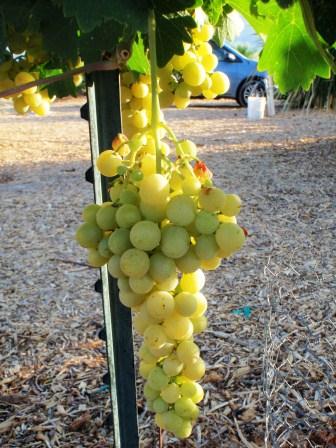 |
| Italia, a seated variety and one of my favorites because of its musky flavor, develops very large berry size in the desert heat if it's given regular irrigations without much thinning. |
I would strongly suggest improving the soil at the time of planting with compost and then covering the soil around them with a thick layer of woodchips. Many people agree wine grapes should “struggle” to make good wine. I think just growing in this heat and lack of humidity is plenty of “struggle”. So I grow them "happy" and don't let them struggle too much. Let them do what they do best...produce fruit!
 |
| Some said it couldn't be done. I don't recommend growing this grape in our desert climate but I always love this variety. This is Pinot Noir, a cool season variety and is not recommended for the hot dry desert. But it developed good flavor and acceptable sugar acid ratios. |
So far, we haven’t needed to grow grapes that are grafted, unlike growing grapes in California. Most of the grapes grown in the US and sold here can be grown in the Eastern Mojave Desert on their own roots. However, if you are faced with buying grapes that are grafted, most grow well in our desert soils on these rootstocks: 1103P, 110R, Schwarzman, Salt Creek, Harmony and many others.
Monday, February 18, 2019
Dormant Oil and Controlling Borers
Q. We found borers in a large sumac as well as a Chinese
pistache ornamental tree. My ash and oak tree have aphids. I want to spray
dormant oil but do not have enough information about it. Do I spray only trees without
leaves or can I spray evergreen trees like Holly oak and African sumac?
A. Read the label of your Dormant Oil product to make sure your trees are safe to spray but there should be no problem spraying most trees that have leaves. It just
requires applying more liquid spray because there is more surface area to cover.
Dormant oils themselves are not toxic. But using these oils to put a layer or blanket over your plant to "suffocate" bugs and eggs that might survive the winter is important. It’s important to spray the undersides of the leaves because that’s where most of the bugs will be hiding.
Dormant oils sold to the public are considered "summer oils". That is they are safe to spray even when leaves are present in the spring and fall months. But DONT SPRAY PLANTS WHEN THEY ARE FLOWERING. WITH ANYTHING. Honeybees and other pollinators will be harmed.
FYI. I was curious one year so I sprayed a "dormant oil" (summer oil) in June when I knew air temperatures would get about 105F on about ten different kinds of fruit trees and I was prepared that I might see damage. I sprayed the oil at about 500 am when it was cool. It would get to 105F by about noon. There was no damage.
I am not suggesting that you do this. I was curious what would happen. This is how safe summer oils sold to the consumers are now. Oils can be sprayed after trees have flowered and as new spring leaves have appeared. Good aphid control from a delayed application of "dormant oil" applied in the spring.
 |
| One Dormant Oil available to consumers. There are many out there with different names. Some are called Dormant Oil, some Horticultural Oil, some have their own name for marketing purposes. Read the label. |
Dormant oils themselves are not toxic. But using these oils to put a layer or blanket over your plant to "suffocate" bugs and eggs that might survive the winter is important. It’s important to spray the undersides of the leaves because that’s where most of the bugs will be hiding.
 |
| Another Dormant Oil in a 2 1/2 gallon container for large jobs. There are many out there. Shop around. |
Dormant oils sold to the public are considered "summer oils". That is they are safe to spray even when leaves are present in the spring and fall months. But DONT SPRAY PLANTS WHEN THEY ARE FLOWERING. WITH ANYTHING. Honeybees and other pollinators will be harmed.
FYI. I was curious one year so I sprayed a "dormant oil" (summer oil) in June when I knew air temperatures would get about 105F on about ten different kinds of fruit trees and I was prepared that I might see damage. I sprayed the oil at about 500 am when it was cool. It would get to 105F by about noon. There was no damage.
I am not suggesting that you do this. I was curious what would happen. This is how safe summer oils sold to the consumers are now. Oils can be sprayed after trees have flowered and as new spring leaves have appeared. Good aphid control from a delayed application of "dormant oil" applied in the spring.
Desert Horticulture Podcast: Pruning Grapes in the Desert
Pruning grapes for growing in the desert requires some "tweeking" the current thoughts about pruning grapes. Besides deciding if you should "cane prune" or "spur prune" your own grape vine, protection from the desert elements must be considered. This podcast discusses my experiences and results when pruning grapes in the Mojave Desert.
Saturday, February 16, 2019
Desert Horticulture Podcast: Dormant Oil, Repairing Limbs and Sunburn
Today
I want to talk to you about dormant oil, why it’s important and how and when to
put it on, borer damage to ornamental trees and repairing limb damage to
apricots and damage from intense sunlight to trees and what to do about it.
Join me now on these and many other topics In Today’s Desert Horticulture.
Friday, February 15, 2019
Bamboo Yellowing and Dead Shoots
Q. Several of my bamboo shoots died completely and now
they are all starting to yellow and have a white film on them. Any suggestions?
 |
| White film on the culms or stems of bamboo probably a wax "bloom". |
A. You didn’t say which bamboo it is, but I assume it’s one
of the bamboo tolerant of our winter temperatures. The so-called “running
bamboo” rather than the clumping types represent those that tolerate our climate
better.
The
white film is sometimes called a “bloom” of wax on the outside of the stem and
is normal. If these are instead white “fuzziness” in patches and appear to be a
problem, then you might be looking at mealybugs. But I think this white “film”
has more to do with the naturally occurring wax produced by many plants rather
than a pest problem.
Yellowing can be caused from water not
draining from the soil around the roots and suffocating them because of poor
drainage or watering too often. You may be thinking that this plant needs water
all the time, which it doesn’t. The soil needs to be kept to moist for good
growth but let the soil “breathe” so that the roots and rhizomes can get air.
Invest $10
in a soil moisture meter for house plants. As long as the soil is somewhat soft,
push the probe slowly into the soil and get a soil moisture reading at the 4 to
6 inch depth. I would not irrigate until the meter on this gauge reads
approximately “6” at this depth in 3 different locations. On these gauges, “10”
is sopping wet and the number 1 is totally dry.
The
yellowing could be a soil alkalinity problem but I think instead it is probably
poor drainage. When planting bamboo, amend the soil with compost at the time of
planting and cover the soil around the plant, out to a distance of 2 to 3 feet, with woodchips. If drainage is a
big problem even after amending the soil, plant it on a mound.
Leaving Mature Citrus Fruit on Ground Not Good
Q. What are the best practices to use if I decide to
leave calamondin fruits on the ground under the tree
to decompose. Or is it better to put the fallen fruit in the trash from the git-go?
 |
| Immature calamondin (calamansi) fruit from the tree in the Philippines at MoCa Family Farm |
A. Calamondin, called calamansi in the Filipino community, is a small citrus resembling a lime but is golden yellow inside. This citrus is native to the Philippines.
Fruit can
turn orange in color but is frequently harvested when green but the interior
flesh is a golden yellow. We have about 8 calamondin on our farm in the
Philippines where we have a tropical climate and they do very well there.
Let’s be
clear about growing citrus in the Las Vegas Valley. Many citrus, since they are
semi tropical, share a risk of losing the fruit, or possibly the tree, during
some cold winters and early spring freezing temperatures. There are parts of
the Valley too cold most years for even the hardiest of citrus. Other areas
with warmer winter microclimates can grow them. As long as you are comfortable
with that possibility, have fun and grow them!
In my
opinion, all fruit trees should have the area under them free from rotting,
mature fruit. Very young fruit is usually not a problem if it falls on the
ground and decomposes. Immature fruit thinned from the trees can be dropped on
the ground to decompose with no problems. Mature fruit dropped on the ground
may present a different issue.
If this
were a peach, fig, apricot or plum tree we would most certainly cleanup the
fallen mature fruit that dropped on the ground. There is a pest called the
dried fruit beetle that becomes a problem infesting soft, mature fruit growing
on the tree if fallen fruit is not picked up from the ground. With citrus, the
only pests to worry about are rats and mice. To be on the safe side, I would
pick up fallen fruit and dispose of them rather than leave them on the ground
to rot and attract varmints.
By the
way, calamondin is easily grown from seed and does well on its own roots rather
than purchasing it grafted like most commercial citrus trees.
Passionfruit Not Producing Fruit in Desert
Q. I have a 3 year old passion fruit tree in my garden
which started bearing fruit that grew fine and was mature enough to eat in
February. In spring I also had more flowers blooming on the same plant, but
these flowers never had any fruit. The same thing again in this past summer,
but the flowers are not fully developing and are stopping at just little buds.
 |
| Giant passionfruit with flowers growing in the Philippines.Giant passionfruit withstands even less cold than passionfruit and is more tropical. |
A. Passionfruit is a semi tropical vine that can’t handle freezing temperatures very well. It also likes moderate temperatures so it will have difficulties during the hot summer months. It grows very nicely in the tropics and moderate temperatures of high elevations in Africa.
 |
| Intercropping passionfruit, strawberries and kale in Kenya. |
Unless
you have a warm microclimate in your landscape, these plants will show serious
damage or die from winter freezing temperatures. If you can grow oranges in
your yard, you should be okay growing passion fruit vine. Passionfruit may have
difficulty setting fruit during the summer months because of high temperatures
and low humidity.
 |
| Flower of giant passionfruit |
Passionfruit definitely does not like soils with poor drainage. If this is the case, and you don’t do anything about it, the vine will always have problems and probably die. Make sure the soil is amended with compost at the time of planting and cover the area around the vine to a distance of about 3 feet with woodchips so that a decomposes into the soil.
 |
| Giant passionfruit trellised above fish nursery in Philippines |
Passionfruit
flowers are beautiful but they need help sometimes to produce fruit or to
produce larger fruit. You may need to hand pollinate the flowers, transferring
the pollen from one flower to the next, a job normally done by a variety of
different bees.
You may
need to grow 2 different vines and transfer the pollen from the flower of one
vine to the flower of another vine. This helps prevent what’s called “self
incompatibility” and failure of fruit to develop. Passionfruit germinates
easily from fresh seed and does well on its own roots. Passionfruit propagated
by cuttings has “self incompatibility” between flowers and will not set fruit.
Also,
prune the vine by removing side shoots after fruit is removed. This helps the
new growth growing from the older wood of the vine where flowers are produced
and keeps the vine renewed for more production.
Besides
trellising this vine and pruning it back occasionally after fruiting, apply
wood chip mulch at its base to preserve soil moisture and keep the fruit from
being dropped if the soil gets to dry. Fertilize the plant lightly after it
flowers by applying a “tomato fertilizer” to the soil around the plant and
water it in.
Propagating Prickly Pear Cactus from Pads
Q. I want to propagate my prickly pear and bunny ear
cactus. Should I place the cuttings immediately in the ground or in a pot and plant
them in the ground later?
A. You can plant cuttings from them directly into the
ground. Forget the pot. It’s not necessary. Wait until it gets warmer like
around March or April. Remove a pad from whatever plant you are propagating and
let the pad with the cut end heal in the shade for about a week.
 |
| The pad can be removed by cutting at the suture with a sharp, sanitized knife. |
T
o do
this, take a sharp, sterilized knife and bend the pad over without breaking it.
Touch the sharpened edge of the knife to the suture where the pad joins the
mother plant. The pad should pop right off at the suture. If not, gently push
the sharp edge of the knife into the suture and slice through it smoothly.
 |
| If you lay the pads horizontally they will begin to curve in a couple of days. |
If you
really want to guard against infections in the pad, dust the cuts and of the
pad with a fungicide such as Thriam, copper sulfate or Bordeaux. When you put
the pad in the shade to heal, lean it against something so it is upright or the
pad will begin curving if you lay it flat.
 |
| Plant them in amended soil so that the pads flat surfaces faced East and West. This way they get sun on both sides of the pad. |
Mix the soil where you are planting with compost and add water. Stick the pad so the flat sides of the pad faces East and West. Sink the pad about one third of its length into the soil and water it once. After that, water it about every 3 weeks and it will begin rooting into the soil where it is stuck.
Thursday, February 14, 2019
Whaaat? Zuchinni Failure!
Q.
For the second year, I am experience a repeat of last year
losing my zucchini before they mature. This is not to say I have a total
failure but my yield is slim at best. I have two zucchini locations of two plants each, which
allow me to monitor the better location for growing. I have changed my watering
schedule to 20 minutes at 4:00 am. which has been helpful for most other herbs
and vegetables but I am suspicious of possible over watering the zucchini as
the immature zucchini begin to develop, then gradually turn yellow, the blossom
drops off and the zucchini withers. Any suggestions?
Zucchini produce both female and male flowers on the same plant. The male flowers produce pollen which the female flower needs to produce a fruit from the female flower. Female flowers have a small zucchini like swelling at the bottom of the flower. The male flowers do not.
 |
| Summer squash fruit can yellow and drop off the plant for a variety of reasons. But don't let a poor selection or variety cause it for you. That's a lot of work on your part to invest in inexpensive seed. Good vegetable seed is worth the price. |
A. This probably wont make you feel very good but actually
summer squash is one of the easier vegetables to grow here. Just make sure you
amend your garden soil with compost, starter fertilizer for vegetables and
start them from seed. You can buy transplants but you don't need to. Probably
the biggest problem with summer squash or any squash are the squash bugs and
controlling them.
 |
| Male and female flowers of zucchini. Both flowers are necessary, as well as be activity and the right temperatures, to produce zucchini fruit. Male and female flowers must be open at the same time for the transfer of pollen and the making of fruit. You can transfer the pollen yourself with a Q-tip or soft paintbrush or let the bees do it for you. |
Zucchini produce both female and male flowers on the same plant. The male flowers produce pollen which the female flower needs to produce a fruit from the female flower. Female flowers have a small zucchini like swelling at the bottom of the flower. The male flowers do not.
The transfer of the pollen from the male flower to the
female flower is done usually by bees. If there are no bees around then the
pollen does not get transferred and there is no fruit production.
 |
| Don't let your fruits become baseball sized. Pick them when they are small, about 16 inches long, and pick them often. |
You can do the work of the bees by taking a soft horsehair
brush and touching the inside of the male flower where the pollen is and
transferring this pollen to the female flower. However, if there are very high
temperatures then this might also not result in producing zucchini fruits.
If temperatures are too hot then the pollen from the male
flower has a real hard time getting the female flower pregnant even if the bees
transfer the pollen successfully. And in our climate that can be a problem.
You should have
some production during days when the temperatures are cooler. If not, then try
a different variety next year.
Don't buy your seed from the hardware store. Buy it online from a good seed supplier for hot and warm climates such as Park Seed Company, Harris Seeds, Grow Organic, Territorial Seeds and many others. Look for seed companies that have offerings for hot desert climates.
Don't buy your seed from the hardware store. Buy it online from a good seed supplier for hot and warm climates such as Park Seed Company, Harris Seeds, Grow Organic, Territorial Seeds and many others. Look for seed companies that have offerings for hot desert climates.
My Apple is Weeping!
Q. I noticed my Anna apple
tree is seeping fluid and a white patsy substance from a previous cut done last
year. What shall I do to help it?
A. Smell the fluid. Take
your finger and wipe it against this wetness and judge your nose whether the smell
is “yeasty” or not. If there is a strong yeasty smell, there might be a
bacterial infection going on. If it does not smell “yeasty”, then there is
probably no infection.
 |
| Slime flux or more commonly called wetwood is a bacterial disease that invades the wood of trees and lingers. It is not life threatening for the tree but it is an eyesore. |
I would not do anything to the tree regardless. The
yeasty smell is caused by a non-lethal infection.
The inside of a tree has a central core of dead wood. The
living part of the tree is an outer cylinder of living wood that enlarges
year-to-year. The inside of the living cylinder increases the diameter of this dead,
central core each year.
Growth in the length of branches is called primary
growth. Growth in width or diameter is called secondary growth.
Secondary growth is responsible for “rolling over”
pruning cuts and they can no longer be seen. When this secondary growth rolls
over a wound, it surrounds or engulfs the wound, covering it, but the wound doesn’t
“heal” like it does in animals.
 |
| Anna apple is a good early apple for the desert but I still like Dorsett Golden a little better. Get them on M111 rootstock for the desert. |
I would do nothing to the tree at this time unless you
see other problems developing in its overall health. Judging from the picture
you sent, the old wound seems to be healing and rolling over the pruned cut very
nicely.
I would not disturb it in any way but let the tree heal
on its own. It should stop weeping when tree growth begins in earnest in the
next few weeks.
Subscribe to:
Posts (Atom)