Type your question here!

Thursday, December 5, 2019

Be Careful Where You Plant Carolina Cherry Laurel


Q. My gardener said my Carolina cherry laurel died from a pest. He is cutting it out and suggested treating the soil and waiting until March to plant anything new. He is suggesting a Holly Oak which sources day can reach 30 to 60 feet in height! That’s quite a range.
Typical leaf scorch of Carolina Cherry Laurel planted in desert soils in hot locations

A. Most likely the Carolina cherry laurel died due to where and how it was planted and maintained. It is native to the Carolinas (hence its name) and should tell you about its suitability for desert climates and where it might survive in local landscapes.
Carolina cherry laurel probably should never be surrounded by rock mulch

            Holly oak is big, but it grows slowly. It will grow about a foot a year with irrigation and handle lawns well. It is not used much anymore but a good tree for large landscapes, not smaller residential landscapes. Pick something smaller. Single story homes should have trees with a 20 to 25-foot mature height. Two story homes can handle 30 to 40-foot-tall trees. No bigger. This is just too big for most homes.

Expect Different Kinds of Mushrooms After Rain


Q. These creepy white “things” keep cropping-up out of the ground all over my backyard. What are they and are they dangerous? I am thinking they might be a mushroom or fugus of some sort. I am concerned because in the past, I had a serious, invasive fungal infection (aspergillus) requiring surgery.

Many different types of mushrooms can appear after a rain and there is wood in the soil or on the surface
A. Yes, these are mushrooms (fungal) and they “feed” from decaying wood, woodchips, particles of wood or rotting woody roots in the soil. They are common in the spring and fall months after rains when there is wood in the ground getting wet and rotting. The wood might be from woodchips used as a surface mulch or signal dead and decaying roots of trees. You might see some in compost piles as well. Oyster mushrooms, edible types of mushrooms, are commonly grown in decaying wood chips so it can be a perfect habitat for some types of mushrooms. But its natural for them.
Sometimes mushrooms grow in woodchips and they look like mushrooms with the stalk that supports the cap

            Several types of mushrooms appear in the cooler spring and fall months after a rain. Most are not poisonous but that doesn’t mean they can be eaten. The mushrooms seen can range from puffballs to traditional mushrooms to slime molds which look like vomit on the ground. I have been told by some they can make pets sick if eaten and may require a visit to the vet but its normally not life threatening.
Sometimes these mushrooms grow beneath the soil and make fleshy underground balls

            They are more of a nuisance to most people. To get rid of them and keep them from spreading, vigorously rake the area when they are young and first seen to prevent them from maturing. These mushrooms open up when mature and spread “spores” which are their “seeds” for spreading to other wood mulch during rains.
Sometimes they grow in piles of woodchips or compost

             I realize there are people very sensitive to the spores of some types of fungi including mushrooms. Take some pictures of the problem. It is best to check with a physician to be sure.
Sometimes they cause an allergic reaction or a rash


Monday, December 2, 2019

Viragrow: Soil Mix to Use When Planting Mesquite

Viragrow: Soil Mix to Use When Planting Mesquite: Q. I’m digging out an area to plant a Chilean Mesquite and the dirt is really terrible.  I’m going to dig about 6’ diameter, nice and wide,...

Viragrow: Do You Want to Plant in Winter?

Viragrow: Do You Want to Plant in Winter?: You can plant any  cold hardy  tree, shrub or fruit tree during the winter (except palms) but don't forget the mulch! Surface mulches ...

Viragrow: Apply Viragrow's Horticultural Oil 2-3 Times This ...

Viragrow: Apply Viragrow's Horticultural Oil 2-3 Times This ...: Applying horticultural oil to your fruit trees and woody landscape plants is very important this winter if you want to reduce pests for ne...

Viragrow: How to Eliminate Pests While They Sleep

Viragrow: How to Eliminate Pests While They Sleep: December and January are the best times to go on the offensive and reduce pest problems for 2015. Most people wait until there is a proble...

Best Books and Websites for Plant Selection in Las Vegas


Q. I am relatively new to this desert environment and I know hardly anything about desert plants.  Would you recommend the best book(s) you have read that describe these desert plants? Which are best as decorative lawn plants? When to plant them and how to care for them?

A. I would focus on something written for the Las Vegas climate or secondly Tucson, Arizona and lastly the desert Southwest.
            Tucson has a very similar climate to Las Vegas; a bit warmer in the winter and a bit more humid and wetter during the summer months. Tucson is in the Sonoran Desert which gets 250% more water (about ten inches of rain each year) than our Mojave Desert (four inches of rain each year) and generally has better soils.
            Adjust books not specifically for the Las Vegas area to our climate and soils by recognizing that our winter low temperatures can and frequently get into the low twenties and even the upper teens on occasion. Trees you select for the “backbone” of your desert landscape should withstand these temperatures or you are asking for trouble. Play around with lesser landscape plants that don’t tolerate these temperatures but don’t expect them to survive forever.
            Linn Mills from Las Vegas and Dick Post from Reno teamed up and wrote a book called the Nevada Gardeners Guide that has information split between both northern Nevada and southern Nevada. Its focus was to understand both Mojave Desert (Las Vegas) and Great Basin (Reno) conditions, soils and how to manage a landscape growing in them. Their book is available on Amazon and Abes Books if you search using the author names. It would be a good book for Pahrump, St. George and Kingman, Arizona besides Las Vegas and Reno area.
            Another book I used in the past is Plants for Dry Climates written out of the Tucson area by Mary Rose Duffield and Warren Jones. As well as plants, it includes desert landscape design ideas. It is also available on Amazon and Abes Books. The newest edition includes and expanded section plant selection and care. The original version presents a concept on desert landscaping called the minioasis landscape design concept which I really like as well as landscape plants that are successful here. It applies to any of our desert climates including the Chihuahuan, Sonoran and Mojave Deserts of the Southwest but less to the Great Basin area.
            A solid reference book you should have in your library is the Sunset Western Garden Book. It is not specific for the Las Vegas area but does a good job discussing desert soils, desert environments as well as an exhaustive list of plants and their descriptions suitable for many different kinds of Western environments.
            As far as free websites on plants online, I reference Chris Martin’s Virtual Library of Phoenix Landscape Plants housed at Arizona State University quite a bit. Just realize its focus is Phoenix climate and soils, is 5 to 10 degrees warmer in the winter and not quite as hot in the summer. It is perfect for Laughlin, Bullhead City and Lake Havasu, Arizona as is. It is excellent for Las Vegas selections but just keep in mind the temperature limitations between Phoenix and Las Vegas. This website doesn’t pull any punches on landscape plant shortcomings and how well they perform in desert climates and soils. Once you have made a plant selection, it is a good bench check on how it will perform here.
            Several knowledgeable local experts like the Southern Nevada Water Authority (SNWA) searchable database of landscape plants for Las Vegas, called “Find Plants”. It is accurate with information presented on plants but I find it somewhat cumberson to use at times. It is a good site when you are first looking for possible plants to use.

Tuesday, November 26, 2019

Desert Horticulture Podcast: Listen to Your Plants

Plants have a unique way of communicating to us what they need. Learn how to understand them on this podcast of Desert Horticulture.

Friday, November 15, 2019

Desert Horticulture Podcast: Grow Organic Fruit Trees from the Catalog for Spring

Lots of fruit trees are being ordered for spring planting now. These are bareroot trees, some with a known rootstock. Besides Grow Organic you have Bay Laurel to look at. They will ship early in 2020 so have your compost ready, your hole dug, a stake to keeps the roots from moving and chicken wire if there are varmits around that might want to nibble on it after its planted.


Monday, November 11, 2019

Use Quality Soap When Making insecticidal Soap

Q. When using soap and water for controlling insects, what do you use?

A. I use an unscented organic castile soap used as a baby shampoo that has been certified organic by one of the certifying bodies for the USDA and its Certified Organic program. 

This organic castile soap I use is available from Amazon

It is relatively expensive compared with a liquid dish soap. I just figured if it is certified as organic and used as a baby shampoo it should be safe to use. I use three tablespoons of it mixed in a gallon of water as recommended by Clemson University.
            Another good way is to use one of the commercial brands of insecticidal soap sprays for plants like Safers. These insecticidal soaps (yes, if it is used to kill insects it is technically an insecticide) are, hopefully, formulated with a decent soap or detergent that kills insects while keeping contaminants at a minimum and still safe for plants. For this reason, I use unscented soaps with no other additives like hand lotions.
            Laundry detergents are a no-no. They are too harsh on most plants.
            There is a misconception by some that these types of sprays are all around “safe” to use. We need to still treat these types of sprays with respect when using them. They are meant to kill any insect that is sprayed but once sprayed don’t stay long in the environment. Some soaps made from yucca extracts (Grow More’s EZ Wet for instance) and can be sprayed the same day as vegetables, herbs or flowers are harvested since it is also used to clean vegetables before they are sold. 
EZ Wet is an yucca extract made for washing fruits and vegetables prior to selling (commercially) but can be used as a wetting agent or insecticidal soap. I get it from Viragrow in North Las Vegas, NV.

These insecticidal soaps have no “residual” killing power like most traditional insecticides. For this reason, they must be sprayed more often.
             Insecticidal soap sprays, the kind you buy or the kind you make, do affect plants. Most are harsh on plants like portulaca, gardenias and Easter lilies. Spray a little of your formulation on a few leaves of the infested plant to find out. Soap sprays remove some of the waxy layer on leaves while they also remove waxy layers from insects so they dry out faster. Sometimes it may suffocate them.
            But soap sprays must be sprayed directly on insect pests to work well and these types of sprays do not kill only bad bugs. If good bugs are in the way, it will kill them as well.

Sunday, November 10, 2019

Desert Horticulture Podcast: Growing High Quality Vegetables in the Desert

Its all about WHEN to do things in growing vegetables in the Desert. Learn why.


Italian Cypress Brown and What To Do About Them

Italian cypress can turn brown for several reasons; how its watered, the type of soil its planted in, spider mites during summer months and borers...yes, borers.

Italian cypress

Italian cypress is a tree native to Mediterranean climates along the northern coastal areas of Africa, the Middle East, Greece, Turkey, Montenegro, and southern Europe. This plant grows in climates that are cool and wet in the winter and hot and dry in the summer. In the US the describes the coastal areas of southern California. It is NOT a desert plant...but it will grow there.

Selections of the tree chosen for landscapes can grow to 60 feet tall and 4 to 8 feet wide. It is propagated easily from seed but varieties like 'Glauca' are propagated by hardwood cuttings taken in late winter or early spring. These varieties were selected for some outstanding traits that could be marketed to residential and commercial landscapes.

This is a big tree. It should not be used around single story homes or commercial buildings. Its scale is for much larger residences, resorts or commercial buildings. But many homeowners select them because they are evergreen and can provide some visual privacy, not good for noise abatement.

Italian cypress can turn brown. The main reasons are the watering practices and soil type, spider mite feeding damage and borers. What? Borers? You heard it here first.

Soil

The soil it is planted into MUST drain water or it will die. Root rot is a common problem with this tree if it is planted in soils that have lots of clay or don't drain water. Make sure your soil drains!

Irrigation and Root Rot

This tree came from climates with cool wet winters and hot dry summers so don't water too often! Put it on a valve that waters palms, fruit trees, other landscape trees and shrubs but not with lawns, flower beds or vegetable beds. It will not like it if it is watered with the same frequency as cacti and native desert trees like palo verde and mesquite unless they are watered too often!
Italian cypress with drooping branches is a sign it is getting too much water. Either it is watered too often or the soil is not draining water fast enough.

Enough water should be applied each time to wet the soil to at least two to two and one half feet deep. The amount to apply varies because of the soil so you will have to play around with the number and size of the emitters. But when you apply water, it should wet the area under the canopy out to the ends of the branches. Normally I will tell people AT LEAST half the area but these trees are narrow and upright so water the entire area.

Spider Mites

Early stages of spider mite infestation and browning.


Spider mites are always there on Italian cypress. Count on it. They become a problem when it is hot, during the summer months, and the natural mites and insects that pursue and eat them are eliminated or interfered with. This can happen right a few days or weeks after an insect spray was applied or they get dusty. The insecticide kills off the good guys so spider mite populations explode in numbers.  Or dust on the leaves and branches run interference with the good guys and block them from finding the spider mites. This is like a slow leak and their numbers don't explode like after an insecticide application but their numbers go out of control more slowly.
Mite damage is not always accompanied by webbing but it can be a hint they might be there. Use the paper test to make sure.

Some mites don't spin webs.It can be an indicator they are there but don.t rely on it 100%. Use the paper test instead. Hold a white 81/2 x 11 piece of paper near the brown area and slap the browning branch against it a few times. Don't pick a branch that's been dead for awhile but one that is browning or recently died. Pick one with webbing in it if you want to check it. After slapping the white paper hold it still and look for little crawlies on the paper the size of this period "." Very small. Are the small dots moving on the paper? Do they smear on the paper if you brush your fingers against the paper? If those "periods" are moving, they smear and your plant is turning brown, it has spider mites.

What To Do About Spider Mites?

Wash the tree from dust after dust storms. You may need a power washer. Don't plant them near dirt roads that allow vehicles to kick up the dirt and make them dusty.
This horticultural oil can be used to control spider mites when weather is cooler.

Use insecticides as a last resort. Don't apply insecticides as insurance unless there is a good reason for the application. If mites become a problem, you may need to use a miticide, not an insecticide.

I use the University of California Integrated Pest Management  websites for recommendations on borer control.
http://ipm.ucanr.edu/PMG/PESTNOTES/pn7405.html

http://ipm.ucanr.edu/TOOLS/PNAI/pnaicompare.php?pn=7405&x=79&y=21

http://ipm.ucanr.edu/QT/spidermitescard.html

Most of the insecticide recommendations are oils (e.g. Rosemary oil, Cinnamon oil, Clove oil, etc.) and should not be applied until weather cools in the fall or spring.

Borers

Borers were never reported to be a problem with Italian cypress. So I didn't suspect borers until a few years ago when it was reported to me by a homeowner. I didn't think it was true until he sent me pictures and confirmed it. They are a problem with other cypress so it makes sense.

Borer damage in Italian cypress

What To Do About Borers?

If borers are confirmed to be a problem use the insecticide imidacloprid as the active ingredient as a soil drench. This insecticide has been implicated in colony collapse of honeybees and its use has been banned in several countries but not currently the US. Avoid applications in spring when the treated plant may flower and attract honeybees. Apply it after it has finished flowering in mid to late spring.

Pruning

These trees can be pruned with a "flat "top" by removing the pointed top just below the height wanted. This helps reduce its height but it will grow wider than if it were left alone.

Avoid pruning these trees by shearing with a hedge shears. If "floppy" branches are a problem use a hand pruners and cut the offending branch well inside the tree canopy and hide the cut.
These Italian cypress are sheared twice a year whether they need it or not
Avoid wrapping the tree with plastic green nursery tape f branches are "flopping". Instead, control "floppiness" through less frequent watering.

Friday, November 8, 2019

Desert Horticulture Podcast: Why Italian Cypress Turn Brown


Italian cypress can turn brown in desert landscapes. Learn why and how to prevent or cure the problem.


Tuesday, October 29, 2019

Desert Horticulture Podcast: What's Wrong with my Roses?

This podcast will teach you how to correctly select, plant and care for roses in our hot Mojave Desert climate.


Desert Horticulture Podcast: Freeze Alert from the National Weather Service Now!

Listen to this podcast so you know how to protect your tender plants from freezing temps.


Protect Plants from Early Fall Freeze Now

October 29
There are some freezing temperatures projected by the National Weather Service for the Las Vegas Valley over the next few nights. Temperatures may drop as low as 28F in some lower parts of the valley. What makes this worse is that landscape plants are not prepared for freezing temps. They need time to prepare and progressively lower temps help them to do this. Sudden freezes are the worst and cause the most damage!

Where are the Possible Problem Areas?

Any lower parts of the valley where cold air has no where to drain or if it does drain, it drains slowly. Think of water. Cold air settles into low spots or pockets. But we really dont know how cold it will get. The NWS is telling you this so you have time to prepare and they usually are very cautious in their predictions.
This bougainvillea froze back at the peak of its beauty


Wind Makes it Worse

If this cold air is combined with wind in your spot it will make it worse. Wind can channel between buildings and picks up speed in those spots. Wind removes any heat that might linger around and helps drop temperatures to freezing. Skies with good cloud cover and no wind usually don't allow freezing temps if there is a threat. Look at the sky and cloud cover before you go to bed.
Cloud filled skies mean warmer temps on the ground. Cloudless skies mean a greater chance of freezing.


Plants and Plant Parts That Might Freeze

Bougainvillea, a tropical plant that loves the heat of the desert, will freeze at 32F. It just does. Other tropical plants that freeze like this are tomatoes, peppers, eggplant and most of the hot weather vegetables. Plants that still have flower buds may lose them. Flower buds are very sensitive to freezing temps. They are more susceptible to freezing temps as they get closer to opening. If you have plants like Camelias that are loaded with flower buds, they may drop. Citrus too. Make a mental note which plants have flower buds.
Flower bud drop due to a light freeze and damage to the edges of new leaves are signs of a light freeze.


Summer Fertilizing and Freezes

Never, never, never apply nitrogen fertilizers to plants that are tender after August 1. Nitrogen fertilizers push tender new growth that is more susceptible to freezes than phosphorus and potassium. This includes compost! No compost applied to freeze tender plants after July 1. The fertilizers contained in compost are slow release and last longer so stop applying them earlier in the year to tender plants.
Fertilizers with anything in the first number, nitrogen, should not be applied after August 1 to winter tender perennial plants. Vegetables are fine because you will pull those to plant Fall vegetables.


Protect Tender Plants

Covering the plants with a freeze blanket or crop cover gives you about 5 degrees of protection. Thats all. Temperatures may get as low as 28F so freeze blankets or crop covers will work provided cold air does not get inside. So fasten them to the ground tightly to prevent wind and cold air from entering the inside. Apply them  to plants when the ground is still warm in late afternoon. Don't wait until night because you are relying on heat from the ground to get captured under the frost blanket.
Crop covers or frost blankets give you about five degrees of protection.

Thursday, October 24, 2019

Why Desert Soils Kill Plants

Q. I really didn’t understand the “soil” here, did not dig large enough holes and didn’t amend the dirt when I planted my oleanders. It’s been 5 years and I’ve tried to correct their scrawny growth by adding plenty of mulch and fertilizing regularly but the growth continues to be weak.  Any suggestions how to encourage stronger growth?
Its like backpedaling when you try to amend the soil after planting. Do it at the beginning and save yourself some grief and hard work.

A. As a friend of mine would say, “Pay me now or pay me later.” At some point you will pay the price for good plant growth and modify the soil at planting time or later when it is more difficult.

Amend Soil at Planting Time

            Whether it is raw desert soil or imported “soil” brought into the development by the developer, soils in developments are typically horrible in the Las Vegas valley. Constructing planting holes at the very beginning and using amendments are extremely important for good plant growth. Its cheap insurance.
Look at the size hole this guy dug for a 5 gallon mesquite tree. The brownish soil tells me it probably has 2% organic matter already but this mesquite tree will LOVE it. Just remember to mix the amended soil with native soil at the perimeter so there is no "hard edge" for roots to grow through.

Oleanders like Wet Winters and Hot Dry Summers

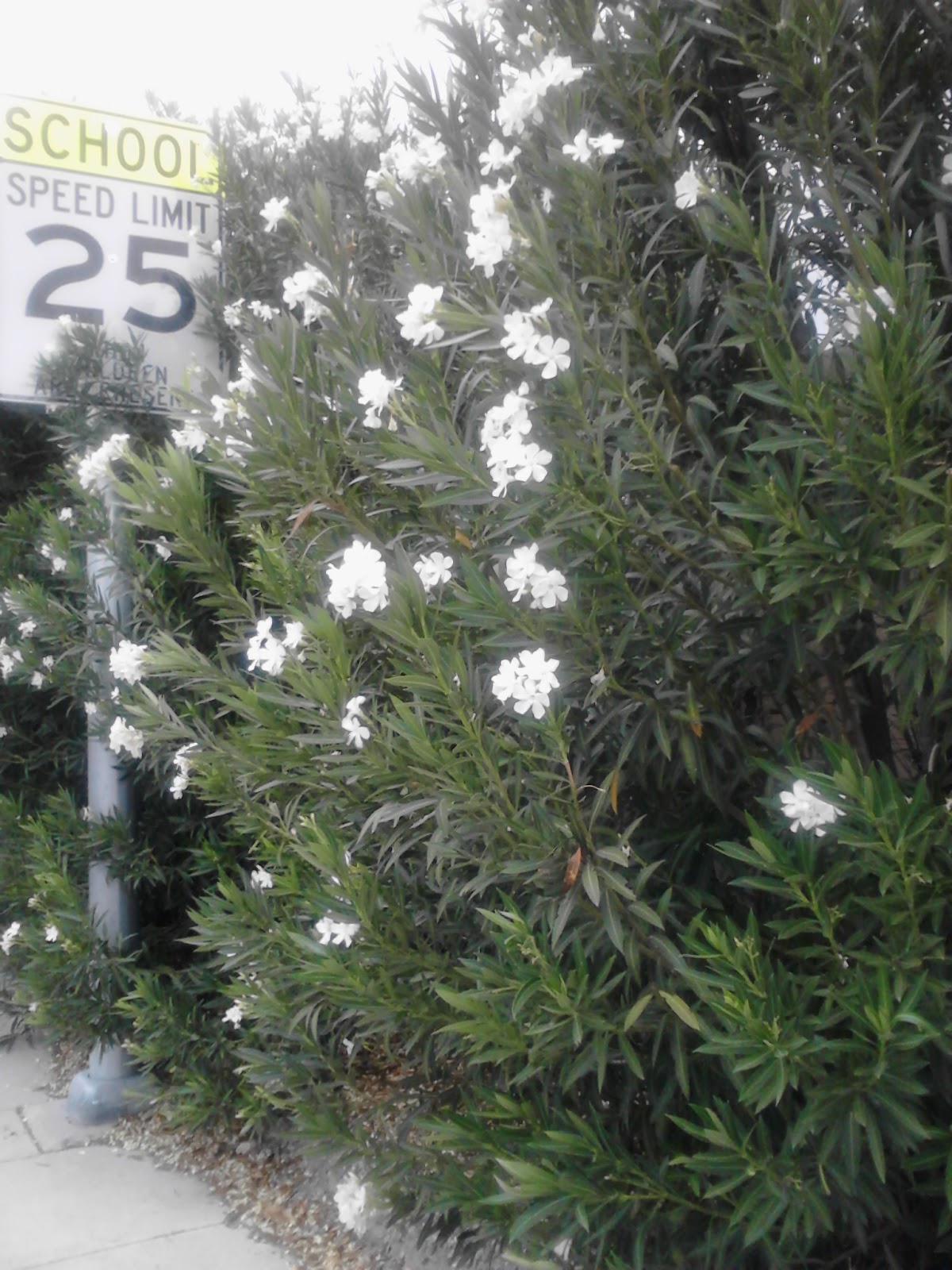
            Oleanders are Mediterranean plants. They grow well in a Mediterranean climate and soils but need some help when grown in the desert. The help is in the form of constructing a decent planting hole, using soil amendments that encourage good growth when the plant is young, and adding supplemental water. They love the heat and low humidity of our desert environment.
Oleander is tough. If given enough water they can survive just about anywhere.

            Now you have the job of amending the soil after it has been planted. Hopefully, your oleanders were planted with at least six hours of full sun every day. If not, prune any interfering trees so that they receive enough sunlight.

Fixing Trees After Planting

            Auger holes 12 inches deep around these plants so the holes occupy about half of the surface area. Fill these holes with a rich compost or make a rich compost by mixing a granular fertilizer like 16-16-16 with standard compost at the rate of two Grande coffee cups full for each cubic foot of compost.
            Construct a donut around the plant for containing the irrigation water and hand irrigate for about two weeks filling the donut each time. After that, let your irrigation system take over. Prune it after about three to four years of growth and fertilize lightly each spring.

How to Heal Chitalpa from Damage

Q. I have a Chitalpa tree that faces west with lots of direct sunlight. The tree bark has separated from the trunk leaving the inner portion of the tree exposed. There are very few leaves on the tree. Help!
Not the treaders tree but if chitalpa like this is put in a part of the landscape without enough water applied over a wide enough area under the canopy then the tree can struggle.

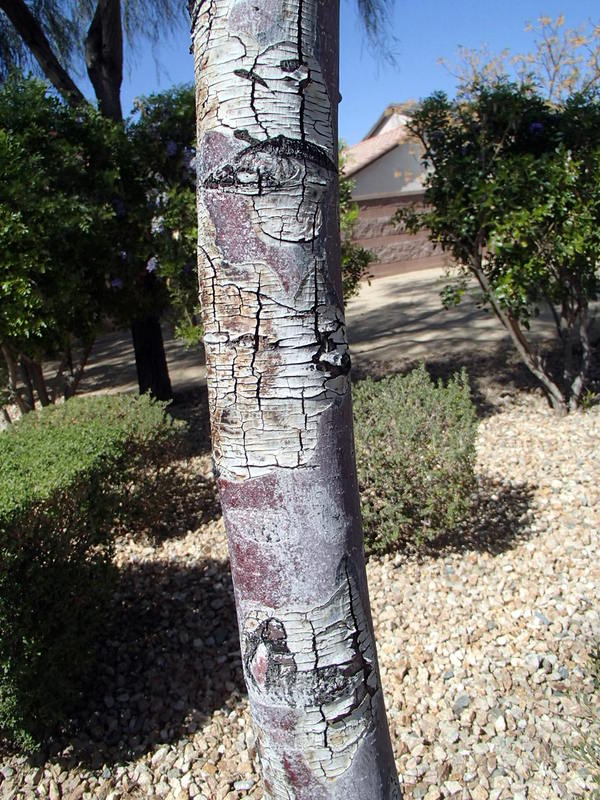
A. The tree trunk has sun damage. Probably because the tree’s lower limbs were removed too soon. This sun damage has caused the bark to be easily lifted from the damaged part of the trunk. Sunburn has cooked the living part of the tree that faces West while the side facing East may still be alive.
This is sunburn on a locust tree. This side is facing the sun, probably the south or west side. The tree is surrounded by rock and t his can reflect alot of heat and light back at the trunk and cause greater damage. Paricularly if the tree was limbed too high at the start.

            Sunburn of the trunk can leave it exposed to other problems like wood boring insects (borers) and diseases like sooty canker. Let’s hope it is just sunburn on the trunk causing the poor growth.
Locust tree has sunburn on the upper surface of its limbs.

            My concern is that the tree might be surrounded by rock. Reflected heat from the rock can damage the trunk if the tree was pruned so the lowest branches are removed. Not a good idea when the tree is young and the trunk susceptible to sun damage.
            When trees are young, leave the lowest branches attached to the trunk to help shade it from sun damage, particularly from the West side. Remove lower branches when the trunk gets older and develops a thicker bark layer that insulate it from direct sunlight.
Tree wounds like this large one can heal by the cambium layer "rolling over" the damaged area and eventually burying it.

            If there are no insect and disease problems, the tree will heal itself by “rolling over” its new growth on top of the damaged area. The tree just needs adequate water and fertilizer to do this.
            Apply water to a large area under the canopy. This area should be at least half the area under the canopy. Apply enough gallonage so the applied water wets the soil to 18 inches deep. Although this tree can handle a rock landscape, water it as frequently as fruit trees and other non-desert landscape trees.

How to Have Beautiful Roses

Q. I cut back my roses last mid-winter and they grew back just fine this summer. Later, all the leaves discolored, blotchy yellow. Any advice how to correct this and prevent it from happening next year?

A. I would like to see some pictures showing me what you mean. But before I get into this, if you want roses in the desert I would go to the Rose Show on November 9. Rosarians are experts on growing roses in the desert. Some of them have 300 or 400 roses growing in their yards! They know roses. Come talk to them on November 9.

When it’s hot, the roses use more water. When temperatures cool off, they need less water. If the soil stays soggy when temperatures begin cooling, the newest leaves begin to yellow. It’s an iron problem called chlorosis caused by suffocation of the roots.
            I have seen this too many times! Rock placed on top of the soil contribute to a soil problem while woodchips won’t. Spraying the plants with iron fertilizer may be a temporary fix but not a long term one.
Rocks covering the soil around roses eventually cause browning of leaves and dieback.
            Roses like soils that allow water to drain from around the roots. To get this kind of soil there must be organics in the soil. Organics come from things that rot, not rock. Putting rock on top of the soil causes the soil to lose its organic content over time. But the slow digestion or rotting of organics like woodchips keeps the level of organics in the soil high over time.
Expect your roses to look like this in a couple of years if you use rock.

            The rotting of organics is caused by moist soil, plant nutrients in the soil like nitrogen, and warm soil temperatures. Rich compost has lots of plant nutrients like nitrogen and organics all bundled together. This bundle of organics and nutrients all rotting together helps keep a healthy balance of good chemistry that benefit the plant nutritionally and environmentally.
Roses that grow this well will require compost and iron applications at a minimum.

            To correct this yellowing problem requires some expense and work on your part. When temperatures start to cool off this fall, remove whatever is covering the surface of the soil. Mix iron chelate called EDDHA with some rich compost at a rate of about 2 ounces per cubic foot of compost.
You can have roses in bare soil but amend this soil and improve it before planting. Notice the color. This color indicates it has at least 2% organics in it. Add EDDHA iron in January and a fertilizer.

            Auger holes around the roses to about 12 inches deep and pour this compost and iron mix in the holes and irrigate the plants. Replace the surface cover with woodchips to a depth of 2 to 3 inches. Spray the leaves with a liquid iron fertilizer three times, three to four days apart.
            In the early spring each year mix one ounce of EDDHA iron chelate in a bucket of water and pour it around your roses along with your favorite rose fertilizer. This should prevent leaf yellowing of roses in the future.

Why Vegetables Can Be Sweet but Bland


Q. I have vines producing melons during the summer. They wanted to split, and the taste was bland. But the same vine producing melons in the Fall were much sweeter! Can we conclude that when it is too hot sweetness suffers, and splitness reigns?
Melons splitting due to irregular watering and lack of surface mulch.

A. I wish it were that simple. It’s really a question of the type and variety of melon grown as well as time of year.

Why Melons Split

            During times of high water use some types of melons easily split. Splitting is usually an irrigation issue; soil gets dry followed by an irrigation. This happens frequently in the desert when growing in uncovered, bare soils. Water loss from the soil can be over 4/10 of an inch per day! This is about 50% higher than water lost from the same crops in melon growing regions. It helps if you make sure the soil is not dry when it enters the hottest time of the day.
            Melon splitting is a variety issue complicated by weather and climate. If splitting is a problem with a variety, then select sequential planting times, or chose a different variety. It can make a difference. Write down your choices in a garden calendar and learn from these notes.

Harvesting Melons

            Never harvest melons that do not separate from the vines easily. Melons can be harvested early, and they will ripen, but they don’t get any sweeter than when they were separated from the vine. Not true of many tree fruits. You can have a fully mature melon that is not sweet if harvested too early.

Melons Need Fertilizer

            Melons are “hungry” crops and can deplete a soil of nutrients quickly. That’s why it will be necessary to add nutrients back to the soil at least yearly.

Choose Varieties Carefully

            Some varieties and types of melons just don’t perform ideally during our hot summer months. If you grow tomatoes, this might sound familiar. The heat is great for helping the plant make sugars but not in developing acidity. So, in the future keep good notes, pick varieties of melons that are consistent quality producers, plant them so fruits are harvested during cooler times of the year and wait to harvest until the melon slips easily from the vine.
            Trials can be fun, but I would caution you about “putting all your eggs in one basket”. Rely on a proven variety that you like and combine it with something new.  And don’t rely on one season of growth. It can be a bad year. Three seasons are better and five are best.