Type your question here!

Friday, February 10, 2012

February Todo List for the Orchard and Fruit Trees

·       Pruning should be mostly finished by February 1. You have a little bit more time for grapes, pomegranates and figs. I like to prune grapes as late in the season as possible to avoid any late freezing damage to the spurs.
Thrips damage to nectarines
·        Irrigations should begin weekly as soon as new growth appears. The number of minutes depends on the irrigation system and how many gallons per minute or gallons per hour the system delivers. Drip irrigation is in gallons per hour.

·        Begin spraying nectarines for damage to the fruit by western flower thrips. Damage is heavy scarring and droplets of sap coming from the fruit. Do not spray during bloom but immediately after the petals fall from the flowers. Use Spinosad in rotation with insecticidal soap and Neem.

·        Fertilize overwintering onions and garlic with high nitrogen once a month. Garlic and onions will resume growth with warm temperatures. Lightly fertilize garlic as it begins growing again. Onion transplants are normally planted around mid-March and should be fertilized with high phosphorus when transplanted and nitrogen a few weeks later.

·         Prepare smoking wood from prunings. The Orchard has smoking and grilling fruit would available at very reasonable prices. Wood includes peach, apple, pear, fig and others.

·         Fix rabbit holes in fences particularly asparagus. Birds will damage the leaves of broccoli and cauliflower but usually not the heads.

·         Lightly fertilize winter vegetables monthly with your favorite high nitrogen fertilizer.

·       Spray emerging and growing vegetables weekly with insecticidal soap. Make sure you spray on the undersides of the leaves.

·         When you put vegetable transplants in your garden make sure you apply Bt (Dipel or Thuricide) for cutworm control. Spray or dust the soil surface around transplants after planting. Repeat it according to the label until transplants gain some size.

·         Irrigate vegetables as needed. New transplants or emerging seed will need to be irrigated daily until you see strong growth. Established vegetables can be irrigated every two or three days.

·         Be sure to apply a surface mulch after planting vegetable seeds, particularly if they are small like radish, carrots and lettuce.

Persimmon response to compost applied to the soil
·         Check irrigation lines and vegetable plots for leakage. Tighten drip tape so there are no kinks in the drip tape.

·         Apply two, 5 gallon buckets of compost around the persimmons. They really liked compost.

·         Harvest asparagus about once or twice each week right now. As air temperature increases you will be cutting more often. When temperatures reach the high 80s or 90s, expect to cut daily. Cut off spears 1 inch below the soil surface.

·         Begin pruning grapes in February. Prune last year's growth back to 18 inches and finish pruning grapes to one or two buds at the end of February. Table grapes are slower to emerge and can be pruned later than wine grapes.
Grape cutting
·         Take grape cuttings to start new plants. Cuttings should include three buds and be the diameter of a good-sized pencil. When taking grape cuttings, make the bottom cut straight and the top cut angled so you know which end should be planted up. Be sure to label the cuttings.

·       Tighten grape trellis wires and refasten the cordons tightly to the cordon wire.

·       Write labels for vegetable seeds that were ordered.

·        Dig blackberries and plant them in 5 gallon containers with a bamboo stake to hold them erect.

·      Watch for tent caterpillar in apricots and plums. Apply Bt or Spinosad if you see them starting to form a nest.

·       Check irrigation bubblers for blockage.

·       Move straw bales to vegetable plots for mulching.

·         Monitor weather temperatures for freeze losses to fruit. If you see freezing temperatures, look in the Orchard to see which fruit trees have flowers which are open. These will be the most sensitive to freezes.

·         Begin weeding vegetable plots.

Monday, February 6, 2012

Work and Preemergent Herbicides for Rock Garden Weed Problem


Q. I have a rock garden that is ten years old.  We have fabric under the rocks to prevent weeds, but I seem to have more weeds each year.  Could you recommend any effective pre-emergent herbicides?

Weed seedlings
A. This will sometimes happen for a couple of reasons. These fabrics do degrade over time and some last longer than others. Those with a tighter mesh usually last longer than those with an open or woven mesh. Landscape fabrics should be overlapped so there are no gaps when it is installed. I am assuming you did all of that.

            There are some weeds they just don’t prevent such as Bermudagrass and nutsedges or nutgrass. The key to controlling these is to remove them as soon as you see them when they are young, and don't let them get older or they just get stronger and more difficult to control.
            Over time, dirt and dust accumulate in the rocks on top of the fabric and provide a place for weeds to grow. Some rock mulches, like decomposed granite or sandstone, degrade over time. Sandstone is the worst. As these break down and decompose they leave debris on top of the landscape fabric. This is a place where weed seeds can germinate.

            It is always best to get rid of these weeds as early as you can and don't let them get to the point where they flower and produce seeds. The seeds are spread all over the place. I always look at chemicals as a last resort. If you can spend a few minutes once a week just pulling weeds, 95% of the weeds that you see will pull easily. Pull them just after an irrigation and most will pull easily.

            In the same way, 95% of the weeds are most likely annuals. If you can kill the tops before they flower this will reduce the weed population tremendously. There are sprays that will “burn” the tops down and thus prevent flowering and consequently seeds.

            When we start talking about weed killers, we have to pair the weed killer with the weeds we want to kill. If we pair the wrong weed killer with a weed, it won't work and we blame the weed killer. So it is very important to know which weeds you are trying to fight.


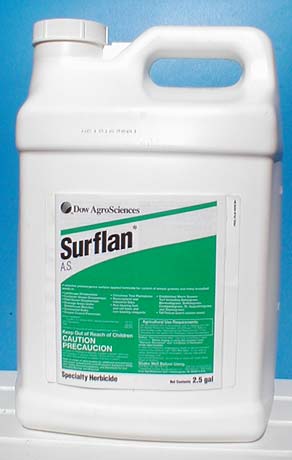
Both contain Surflan but you would
not know it unless you read
the ingredients on Impede
            However, there are a few we killers that can kill a wide range of weeds, but again not all of them. Pre-emergent weed killers, aka pre-emergent herbicides, include a variety of products with many different marketing names. Some of the lesser known brands have the same ingredients as more expensive products but are not marketed as well.
            The pre-emergent products that you can get from your local nursery or supplier are going to be general, all-purpose pre-emergent herbicides. For instance one product by Monterey is called Impede. It contains Surflan which is a very good pre-emergent herbicide.
            I don't know it by its trade name, Impede, but I do know its active ingredient which is Surflan and that is a very good broad spectrum product. Other ingredients you can look for in the labeling that control a wide range of weeds are Dacthal, Ronstar, Goal and Treflan.
            Be sure to read the directions and follow them precisely.


Almost All Plants Like Wood Mulch - Even Desert Plants


Roses don't like rock mulch
Q. I heard it is best to move rock away from my shrubs and replace it with mulch.  What is your recommendation?

A. Rock can also be a “mulch” and we call it that in our desert landscapes; rock mulch. We have three categories of mulches; organic, inorganic and living. In the organic category are wood mulches. In the inorganic category we have rock mulches. All mulches are important but organic mulches, like wood mulch, give extra benefits to plants that rock mulches cannot.

            Our desert creates its own rock mulch and that’s why plants that originate from desert environments can “tolerate” rock mulches. It is not that they grow better in rock mulch but rather that they survive better in it.

            Nearly all plants grow better with organic mulch rather than rock mulch when grown in our desert soils. Plants like most of our fruit trees, roses, iris, lilies and those which are not true desert plants, perform better with wood mulch.

Mockorange yellowing in rock mulch
            Those that come from desert climates like mesquites, acacias, desert bird of paradise, agaves, cacti, etc. will tolerate rock mulch better than nondesert plants. But in most cases they still perform better surrounded by wood mulch.

            Newly planted trees and shrubs should have wood mulch kept away from them a distance of about one foot the first few years of their life. After that they usually tolerate wood mulch in contact with their trunk. This is because the wood mulch keeps the soil too moist and can cause the trunk to rot when they're young.

Controlling Growth of Shrubs More Than Water and Fertilizer


Q. You have always have stated to prune shrubs and trees when they are dormant, but it seems mine do not go dormant in the winter.  They continue to grow even though they get water only once a week.  I halved their fertilizer application but they continue to grow larger than I want them to. Why do they grow when they should be dormant and when should I prune them to slow their growth and spread?

A. Shrubs desire to reach their mature size. Keeping them smaller than this will require more maintenance than selecting one that is the size you need. Select shrubs by determining the size you need and finding one that fits that size at maturity.

            Dormancy here is not the same as dormancy in Minnesota. Dormancy here, in some cases for some plants, means that they may stop growing as much, not that they stop growing at all. Just depends on the plant and its location.

            Where the plant is located in the landscape also dictates its level of dormancy. Very warm microclimates in the yard may mean that some plants never totally shut down during the winter while in colder spots they do. Hot south and west facing walls with little winter wind are the warmest locations.

            Cutting back on water and fertilizer will help but they do not act like an “on and off switch” for plants. Think of fertilizer and water more like a “rheostat” where it can increase and decrease growth but not totally shut it down. At some point though, turning down the water and fertilizer will damage the plant. The real solution is to match plant mature size to the site.    

            Focus your pruning on older growth and remove it from deep inside the canopy leaving the younger growth still flourishing. Prune in the winter months. Avoid trimming on the edge of the canopy whenever you can. Hide your cuts if at all possible. They should not be obvious. This will help keep them smaller.

Winds Blew the Flowers Right Off My Peach Tree


Q. For the last two years in North Las Vegas heavy winds have come while my young peach tree was in bloom. Both years I wrapped it as best I could but the blooms were blown off the tree anyway. Do you have any good way to protect the tree during these windy times? You don't wrap your trees at the farm?

A. We don't wrap our trees and we are exposed to strong, cold winds from the northwest with recorded gusts of 70 mph. My guess is that the wind is channeling through that area which will increase its speed. I would suggest constructing a windbreak to protect that small area by diverting or slowing the wind. This can be made from fencing or evergreen plants.

            You do not need to stop the wind entirely but you can slow it down with a windbreak. Windbreaks should not be a 100% barrier to wind but allow about 20% of that wind to penetrate through it. Things like chain-link fences with PVC slats or woven materials placed along windward side of the fence will affect wind a distance of 5 to 8 times the height of the barrier.
            Wind will increase its speed if it goes from a large area through a small area such as between homes or into backyards. This can be a problem if this channeled wind enters small areas where fruit trees and vegetable gardens are located.

            Be creative. See if you can design a windbreak into your existing landscape that can help modify that part of your yard and make it more enjoyable.

Friday, February 3, 2012

Desert Orchard Expands to West Texas


One of our Orchard volunteers, Matt Heff, started a small orchard in West Texas, near the panhandle a bit south and west of Odessa. One year later his Orchard in now on its way with 100 fruit trees using two or three of each variety. He writes:

Hi Bob!

Matt Heff here.

Attached our Texas orchard pics 1 year later.
Wanted to show you the difference by planting clovers to recharge the Texas alkaline soil just like you and Jon told me to.

The orchard was covered in peat moss, Texas compost, manure and tons of clover seeds (different varieties).

Over 1,000 worms happily living in west Texas- notice the difference between worms and no worms photo?

We broke bud 2 weeks ago. Very early  and trees are very much Alive.

Thursday, February 2, 2012

Job Posting: HEAD FARM MANAGER, MOHAVE COUNTY, Kingman, Arizona, USA


DESCRIPTION:  Head Farm Manager will provide strategic direction and hands-on leadership for a unique desert farming operation. The position requires the ability to manage a diverse, high-quality irrigated vegetable farming operation from start-up through post-harvest. Business expansion to include large and small livestock operation, orchard, vineyard and other high-value crops suitable for the middle desert environment. Applicant must have an appreciation for organic and sustainable food production. The Head Farm Manager will be responsible to coordinate with livestock range manager and corporate office of absentee owner. The ultimate farm operation to include 38,000 acres.


QUALIFICATIONS: 

·         5 Years management experience in farm operations in arid or desert environments
·         Minimum Bachelor’s Degree in Ag-related field
·         Farm fiscal and budgetary experience using appropriate computer software
·         Hands-on experience in food production under arid or desert environments
·         Experience in compost operations and recycling, sequential planting and harvest, water efficient irrigation practices, postharvest handling of food products and business management
·         Must be willing to live in northwest Arizona
·         Experience in start-up operations a plus


SKILLS:

·         Outstanding start-up skills and self-motivation
·         Extremely well organized and multi-functional
·         Strong business acumen and computer skills
·         Strong Interpersonal skills that further the interests of the organization
·         Strong communication skills, both written and oral. Ability to communicate at all levels
·         Strong business knowledge with the ability to support and achieve the financial objectives of the organization
·         Self-Starter with ability to develop goals and initiatives and deliver on measured targets of performance

Resume and cover letter should be emailed to: recruiting@harmonyhomes.com
I can help with inquiries. Extremehort@aol.com

Monday, January 30, 2012

New Bee Group Forming in Las Vegas


Become A Founding Member of a New Bee Club!


Anyone can join!


All ages welcome!


If you want to learn about our pollinator friends, or want to have a more abundant garden, or you want to become a beekeeper this is the club for you!


When: Sat. Feb. 4th, 2012

11am-12noon

Where: RISE Resource Center (Housed in the Advent Church)

3460 N. Rancho (Between Gowen & Cheyenne) Las Vegas,NV

What to bring: Yourself and a friend, a sense of adventure and a "Bee Friendly" attitude

Contact Rita at pillbow@gmail.com

Tom Spellman to Speak at Orchard 2 PM Thursday Feb 16 2012

Tom Spellman from Dave Wilson Nursery
If you are interested in fruit trees and hearing from true experts on the subject I would invite you to come out to the UNCE Orchard on Thursday afternoon at 2PM on February 16 to hear Tom Spellman from Dave Wilson Nursery. He will tour the orchard and talk about new fruit tree introductions from Zaiger Genetics. There is no fee. This only happens once a year and the first time I have offered this opportunity to the public.
Tom is a true expert on citrus as well.

How Much Asparagus Should I Plant?


Asparagus spear just starting to become
overmature for best quality
Q. I'm gardening in raised beds that are 4' x 8'. I'm not sure how much asparagus to plant. My wife and are I the only ones who would eat it and I'm guessing we would harvest 1x per week during the period they are harvestable. How much of my garden would need to be dedicated for that production level?

A. If asparagus is planted correctly it should start producing in February and you will stop picking about eight weeks later. When asparagus is in production and when it is warm outside you will picking as frequently as every other day to stay ahead of it. If you don't, much of it will be unusable. There is no such thing as picking weekly with asparagus once it is in production.

            It does freeze well, it makes great soup and they can be grilled nicely. I would say half-dozen crowns should be plenty for you and your wife. My asparagus class will be offered in March at Plant World and through Eventbrite.com.

Replanting In Same Hole for Fruit Trees Usually Not a Problem if Borers are the Reason


Q. I removed a diseased (clarified by saying the only problem was borers) peach fruit tree.  How soon can I plant another peach tree in the same hole?

A. If this is from borers, then you can plant immediately. Not a problem with borers and replanting. The entire lifecycle of the borers in our fruit trees are in the aboveground portion of the trees, not the roots or soil.

            There is a problem potentially with something called replant disease but it is minor in this case and should be not a problem for you. Remove as much of the root system as possible before planting.

Removing White Salt Deposits on Walls With Acid


Q. Our backyard block wall has some white stains on it. These appear where the sprinkler water hits the wall and I want to remove them.  I have read on-line to use things like diluted muriatic acid, but I don't want to kill the plants my wife has throughout her garden.  How can I clean the stains, and can I treat the walls to protect from more stains forming

Salt deposit on slumpstone wall when plants are being
irrigated by bubblers. Salt in the water is carried
up the wall where it evaporates, leaving behind the salts.
The other side of the wall does not have sprinklers
hitting it either.
A. These are salts remaining from either those sprinklers or water from the soil wicking up the wall. Our soils contain quite a bit of salt as well as our water. Water coming from Lake Mead carries about 1 ton of salts for every 326,000 gallons. It sounds fairly dilute but it is not.

             Our soils vary much more in salt and can be removed by leaching. The salt in the water of course is consistent. The combination of the two can mean some pretty high salt levels. Salt dissolves readily in water and when the water evaporates from the wall, it leaves the salt behind. These are probably the salt deposits you're seeing on the wall. Even drip irrigation can cause problems like this since the water can wick through and into porous surfaces.

            You don't have to use muriatic acid but you can use and acid, even vinegar to help remove it. The major concern with plants is having the acid fall on foliage. This will damage the plant. Of course the best way to prevent it is to not use overhead irrigation.
            In the case of drip irrigation, put the emitters on the opposite side of the plant from the wall, not next to the wall. Perhaps there is a treatment to the wall that could prevent this from happening. I don't know of any.

Special Deal on Fruit Trees on My Twitter Causes Frustration - For Me!


Q. Your twitter feed mentioned a good deal on peach trees which we are going to now purchase. Which two peach trees to get for a 10 x 10 space? I'd like to keep the harvest staggered so we can enjoy the fruit longer. I also have a five-gallon Bonanza dwarf peach in a whiskey barrel that I started last October.

https://twitter.com/ or go to my home page and follow my Twitter there.
Stark Saturn peach with some bird damage. For some
reason birds LOVE this particular fruit.
Problem: SO DO WE!
A. This was a special deal on ten fruit trees for $199 plus $35 shipping on Groworganic.com. On the peaches that they had available, I would recommend that you look at Red Haven (yellow acidic), Babcock (white subacid) or Stark’s Saturn (donut, white, subacid, but birds like it alot). For an earlier peach, mid July or so, and Indian Free (late august, beautiful flesh turning nearly blood red and subacid) or O’Henry (early august, yellow, favorite at roadside stands and farmers markets) for a later peach.

            It is hard to recommend just one or two peaches since they can be so different from each other. There is not really a June peach in the group that I know well enough to recommend.

When to Transplant Fruit Trees?

Q. With this unusually mild LV winter, when is the best time to transplant dwarf grapefruit trees?

A. By transplant I take it to mean you are moving a grapefruit from one location to another location. Planting or transplanting can be done now. You will have more success if the tree has not been in the ground more than three years. You will have even more success if the tree has been watered by drip irrigation in a fairly small basin or area next to the tree. You will have even more success if the tree was root pruned last fall around mid to late September.
Roots of M111 on 12 yo Anna apple. We remove fruit
trees from the orchard as we learn about them and
then move on to those varieties we have not explored.
Root systems can get large quickly and make it no longer
feasible to relocate older fruit trees to new areas after
about three years in the ground

            Root pruning just means you went around the entire tree with a shovel and severed the roots in the approximate location where you are planning to dig and transport it. Given all that, prepare your hole for planting first before you move the tree. Dig deep enough to accommodate the root ball but not much deeper.

            It is more important to dig it wide than it is to dig it deep. Get your soil amended and add some phosphorus to the soil. Move your tree as quickly as possible to its new location and try to orient it in a similar orientation, north to south, as it was in the old location.

            Backfill around the tree. During planting, run a hose in the hole at the same time you backfill to remove air pockets. Drive a stake next to the tree and into the bottom of the hole into solid ground. This stake will immobilize the roots if tied to the tree tightly.

            I usually use rebar pounded into the soil next to the tree after it has been planted. I wrap the tree and rebar together with green nursery tape to immobilize roots. This leaves the top to move in the wind.

            The trees should be planted the same depth as it was when it was removed from the soil. No deeper and no shallower. If you have rabbits, protect it with one inch chicken wire after planting. Mulch the soil around the tree with wood mulch keeping the mulch away from the trunk a foot. After one season of growth, remove the stake.

Apples Planted As A Hedgerow May Need Special Rootstock


Q. I planted ten bareroot trees I picked up at the orchard yesterday. I followed the directions from your Blog and everything went really well. I cut them all off at approximately knee height but when I got to the apple, I wasn't quite sure what to do.  Should I cut off any side branches? Leave desirable ones? Cut them partially back? Or just leave them alone? I am planting my trees in hedgerows 10' apart with 4' between trees.

A. In hedgerows make sure the trees are on very dwarfing rootstocks. M111 rootstock is probably not aggressive enough for planting that close. You could do them maybe six feet apart but four is really close. 
Birdseye view of young apple tree scaffold limb development
            If any of the branches can be bent down and they touch the ground they should be removed to the trunk. The lowest branches are probably going to be somewhere around 18 inches to 2 feet off of the ground.

            On apples look for a whorl of branches, a minimum of four and probably a maximum of six, to leave attached to the trunk. These will be your scaffold limbs which are limbs that support other limbs which bear the fruit.

            Otherwise, if this is to be a hedgerow, you can wire trellis the limbs to support them so they don't touch the ground and you could keep limbs as close to a foot off of the ground if you wanted to.

            If you are not sure what to do even after reading this just remove the ones that you know are too close to the ground and leave the rest, come to the orchard so we can talk, and address the problem next year.

Monday, January 23, 2012

You Can Grow SOME Berries in the Mojave Desert

Womack blackberry grown at the orchard

Q. Have you had any luck with berries? I have a friend that says she does blackberries successfully.


A. Some blackberries will do just fine here and others do not. Two blackberries which I have found to work well here are Rosborough and Womack, both of which you probably have to purchase online. They come from the Texas A and M breeding program. One that did not do well from that breeding program is Brazos.

Dorman Red raspberry grown at the orchard
            Generally speaking, I would not recommend most of the blackberries with native American names such as Apache, Navaho, Arapaho, etc. which came, I believe, out of the Arkansas breeding programs. Historically they have not done well here according to locals who have tried them so I did not bother trying them.

Strawberries at the orchard
            Raspberries have not done well over time generally speaking. I did try a Florida variety which had a lower chilling requirement and it failed here. I have heard some reports from locals where they had some success with raspberries but they either did not remember the name or had them in for only one or two years. Others have generally reported failures with raspberries.

            Strawberries will do well with everbearing types probably doing better than the main crop varieties. You will have some iron chlorosis problems, yellowing, that will need to be addressed. I have liked them when they were growing under about 30 to 40% shade here.

            With all of these you MUST prepare the soil adequately prior to planting.

Lemon Can Get By On Few Hours of Sun During Winter But Not Other Times of Year


Q. I have a Meyers lemon that is currently potted.  Now that I have lived through a winter here I have paid better attention to my sun. There are two spots along the back wall that get maybe 3-4 hours of direct sunlight at the shortest time of year.  Do you think it would survive being planted against a warm cinder block wall with only that much sun? 

Gloria Caruso's immature
Eureka lemon in Las Vegas
A. Meyer lemon will freeze back in our harshest microclimates in the Valley. On the other hand some of the more tender citrus, such as the limes, can handle our winters just fine if they are placed in the right microclimate.


The number of hours of sunlight in the winter is probably not as important as the number of hours for the rest of the year. Certainly four hours of sunlight is far too short for nearly all fruit producing and flowering plants if this light is during the spring, summer and fall months. But if this plant receives eight or more hours during these non winter months, when temperatures are at least warm, it might do just fine.


To protect from freezing temperatures in the winter it is best that it's placed near a very warm winter wall with very little exposure to wind. Some people wrap or drape them with materials and other use heat sources such as Christmas tree lights along with draping.

Can't Find a 1-2-2 Fertilizer for Fruit Trees


Q. I was looking for the 1-2-2 ratio fertilizer that you recommended for fruit trees.  Both nurseries I looked at do not have fertilizers with that ratio.  The fruit tree fertilizer that they carry has a ratio of 4-2-1.  Any suggestions where I can get the 1-2-2 ratio fertilizer?

A. What I have been telling people is to make their own. You just need sources of nitrogen, phosphorus and potassium. If you are not concerned about organic sources of fertilizer, then pick up some straight nitrogen, straight phosphorus and straight potassium and mix your own.

You can vary the amount of nitrogen or phosphorus simply by adding more or less of each product to a mixture you create. You can blend them together if you want but if they are different sized particles they will tend to segregate and not remain mixed very well over time. I prefer to add them separately. 

You can do the same thing with organic fertilizers. An organic source of nitrogen would be blood meal, phosphorus would be from bone meal and potassium you could use muriate of potash. I found all of these locally in at least one nursery. Purely organic sources of potassium are hard to find.

Planting Zones for Las Vegas Nevada

USDA hardiness zones

Q. What do you say is our planting zone?  I got a Plant Smart Sensor for Christmas and it says we are a 7B which is way lower than I always read.  Just because a website says a tree or plant will be ok for a certain zone doesn't mean it is necessarily right?
A. I use both the USDA and Sunset’s planting zones for our area. Because we have various microclimates in landscapes I will normally include a couple of climate zones colder for very exposed microclimates and a couple of climate zones hotter for protected areas with lots of exposure to sun in the winter time and wind protection. Start with winter time lows reaching 10F and add zones that are just at freezing (32F) to cover our microclimates in backyards. Yes, they will vary that much.
USDA Hardiness Zones
http://www.usna.usda.gov/Hardzone/hzm-sw1.html

            I like Sunset’s zones but find them a little bit too narrow at times and too restrictive. That is the reason Sunset went ahead in developing their own which they did a fabulous job doing. On the other hand, the USDA zones are too broad. Very little in this world is perfect so I use these fudge factors I mentioned to “fudge in” the microclimates.
Mojave Desert Las Vegas and Arizona
Mojave Desert Las Vegas and California

            Frequently, the selection of a plant and whether it will work or not, depends on several things: the microclimate, where you plant it in the yard, how you modify the soil and irrigate it.

Recommended Shade Trees for Southern Nevada


Q. Could you recommend some trees to replace a tree that I think is dying?  I don't like desert plants for the most part, especially desert looking trees.  So if there is something that is nice and full, that grows fairly fast and that does well here I would be interested to hear some of your recommendations.

 
A. I do not give recommendations regarding specific plant materials. The list of plants can be long and tedious. You and I could go back and forth a dozen times and still not find the tree that suits you. The only person who can do this is you.
            If you narrow your search down to five plants, then I can help you or at least give you characteristics of those plants and how they grow here to help you make the right decision. Sorry if you were looking to shorten your selection time down to a few but plant selection can and should be a very personal thing if you are serious about your landscape.

 Some places you can try for some non desert plant selections include

http://www.monrovia.com/plant-catalog/ Monrovia searchable plant database
http://www.hineshort.com/Gardener/GardenerHome.aspx Hines Nursery database
http://davesgarden.com/ Daves Garden searchable plant database
http://aggie-horticulture.tamu.edu/picturepages/ Texas A and M's database
http://hortiplex.gardenweb.com/plants/#hortiplex Hortiplex database
http://www.amwua.org/plants_index.html AMWUA's database for desert landscaping
http://www.horticopia.com/ Horticopia can be fee based
http://plantfinder.sunset.com/sunset/plant-home.jsp Sunset Magazines Plant Finder