Type your question here!

Friday, July 27, 2012

My 30 Days of Ramazan - Day 4

I cheated today. I put a small bottle (1/2 liter) of frozen water next to my bed and woke about 4am. The alarm didn’t go off but I grabbed my bottle of now warm water and drank about half of it and went back to sleep. You older folks can sympathize. You know if you wake up early in the morning there is a very good chance you will not go back to sleep. Not true when I was much younger but this fear of not going back to sleep and not getting my rest affected my decision whether to get up or not. Probably subconscious but I thought my alarm was set but it was not.

Vineyard with disease problem near a Level 2 village in
northern Afghanistan
I got up at 5 am because I had staff going into the villages today early. I give the villages security numbers from 1 to 3. These numbers I establish from local reports of “undesirable” activity which might be a problem for myself or my staff. Taliban controls much of the rural areas while city centers are much safer. Those of you who understand, most of the security is handled by ISAF.  If a village is remote, it usually is not safe for any of us. This gets a “3” ranking. There are other villages which are safe for locals but not for me. If I do go into places like this I should spend only about one hour there and get out. I never tell anyone where I am going. I watch my driver. He is secure and I trust him but he makes mistakes too. He does not know where we are going until we go and he is not allowed to use his cell phone while we are gone unless it is from the office. Places like these are given a “2” rating. Then there are places that are relatively safe for us all and this is given a “1” rating. This morning it was a “2” so I was not going and I knew my staff was experienced enough to handle it without me. Before they go I brief them, cover what needs to be done and review and send them on their way.

 
I was having a hard time this morning. I just couldn’t wake up. I don’t know if it was the lack of caffeine or the dryness I felt in my mouth from the previous days but I just found it very hard to get going. So a little after 5 am I had a small (maybe two to three ounces at most) cup of coffee with extra Maxwell House freeze dried crystals thrown in. That did the trick. Now I understood why opium was used by some in extremely poor villages where there is little food. I didn’t need or want any opium but caffeine is a legal drug and got me on a little bit of a high for the morning. I was now on after burners.
Iranian glyphosate, same percent active ingredient as
Roundup Pro

I had salary contracts for staff to finish and didn’t get out the door until nearly 10 am. I had to test some Iranian glyphosate I found at the bazaar and see if it would help to control some of these woody weeds in our new saffron plots. First it was Iranian glyphosate so I had no idea if the label was accurate, secondly I was spraying some weeds I did not recognize at all. I didn’t even know if this would work. I had formed a saffron working group of educators and we were putting together four saffron demo plots to demonstrate how to correctly plant, manage, harvest, and process saffron. Saffron is very labor intensive and does bring in enough income to make a possible alternative to growing poppies. Some of these Extension agents had never grown saffron.
Saffron with straw mulch

Many of the farmers do not know how to grow it either and do it incorrectly. I was told that the local saffron was better than the Iranian and that is saying a lot. These plots, it was hoped and we did a good job of documenting for many illiterate farmers, would show them how to do it correctly. The spraying went well but it was hot and by the time we finished. I knew today would be probably one of the toughest days of the fast, at least regarding dehydration. Hunger had disappeared for the most part or it was covered up by the more acute dehydration. During the spraying I felt a bout of heat stroke coming on; intestinal cramps, dizziness. We finished quickly (as quickly as you can because these people are now my friends and there were lots of questions about what we were using, why and the rate of application and explanations were in full sun.)

When we got back to the office around 2 pm my staff had returned from the villages and had very good reports. That is always good to hear. My mouth was full of cotton. My voice sounded different. I could tell the dehydration had affected the sound of my voice. My lips were parched as well as my staff’s. I told them all to go home and rest. The Professor who was working for me, a very kind and devout Muslim, had trouble pronouncing some words as well. I had trouble concentrating. We all tried to conserve moisture by using as few words as possible. We all rested in the air conditioned office and spoke very little. After they all left finally at 4 pm I went upstairs and laid down to take a rest. As I did, I remember saying to myself, I am not hungry. I wonder why… as I dozed off.

Eliminating the Fruit on Texas Umbrella Tree a Tough One


Q. We have a Texas umbrella tree which is approximately 15-years old. In spring when it blossoms, it produces these peas/pods which drop on the lawn and are a pain to remove since we have synthetic grass. This also occurs in the fall when the leaves drop.
            Is there a spray or solution we can use to eliminate these annoying peas/pods? I really don't want to remove the tree (it's my favorite) but it really hurts my husband's back when he has to rake them and vacuum them with the indoor/outdoor vacuum. Can you help us?

A. This is going to be a tough one. There are several products that are supposed to eliminate or remove flowers or fruit from trees and shrubs. The problem will be they've never been tested on Texas umbrella tree so the rate of application and timing might be difficult to establish without doing some experimentation.

            Most likely any chemical that you use will have to be sprayed over the entire canopy of the tree at least once or possibly even twice depending on what the label tells you to do.

            You can try Florel Fruit eliminator for example and follow the labels precisely if it is going to work. Missing an application by even a couple of days might mean it will not work. Let me know how it turns out.

Thursday, July 26, 2012

Will Gingko and Tulip Tree Grow in the Desert?


Q. I’m a Las Vegas resident and just bought a house in the Desert Shores community. I had a question with regards to a couple deciduous trees that I really like and are said to grow/survive in USDA zones 4-9 which Las Vegas is considered zones 8a-9b but in the Sunset Western Garden Book, Las Vegas is zone 11 because the heat index is part of the equation.  Will the Tulip Poplar and Ginkgo Biloba thrive in our climate with proper planting care, adequate watering, good drainage and a slow release fertilizer or would they eventually die anyway, becoming heat stressed and succumb to disease/ insect problems???? 

Information on Gingko from Wikipedia

Information on the tulip tree from Wikipedia

A. It is hard to make sweeping generalizations but why in the world would you pick those two trees for here in the desert? Both, if they would grow to maturity are very large trees. They would consumer enormous amounts of water just due to their sheer size. They are out of their ideal habitat so they would require a great deal of care IF they would make it to maturity which I would rather doubt.
            There is at least one example of a gingko in Las Vegas growing on the campus of UNLV on the north side of the old Biology building. It is growing slowly and an oddity which is why they probably planted it on the campus in the first place. I didn’t mean that UNLV is odd but that it does house an arboretum on its campus so this is a good place to grow these kinds of things.

            I would have to guess on the tulip tree since I am sure someone has tried to grow it but I have no information on how it would do here. I would guess much of it would have to do with how it was planted, cared for and the microclimate.

            Heat tolerance is kind of a relative thing. Much of tolerance to adverse conditions, like any organism, has to do with its general health. If the plant is kept healthy, it can handle a lot more adversity than if it is sick.

            Just because of its sheer size, and the fact it is not native to arid and desert climates, at some point will do it in. Pest problems are not a factor for gingko since it is relatively pest free.

With so many other really good plants out there I would pick something more suitable to our desert climate unless you want to babysit them for the rest of their lives.

Is This Brown Beetle a Pest in My Garden?


Joe's Bug
Q. What type of pest is this?  They seem to be on and around several of my fruit trees (apple, pomegranate, plum) but don’t appear to be causing any leaf or bark damage.  I did notice that there were several worm holes in the soil around my grape vines, but didn’t see any of these bugs on my grape leaves.  Are these pests harmful to my vines/trees? If harmful, how can they be controlled and/or eliminated?
-Joe

A. Well Joe this is one of the June beetles. They can also be called scarab beetles. Generally they all look the same except for their color. They are obviously beetles with that hard outer shell and range from ½ to 1 inch in length generally speaking. Colors range from your light brown one to dark brown and shiny metallic colors like the Green June beetle common here.

Green June Beetles attacking Kadota fig at the orchard
            There are so many different types that it is hard to narrow it down unless you were to take it to an entomologist. But some of them, like the Japanese beetle which this is not and does not live in southern Nevada, can cause a lot of damage to plants.

            Another scarab beetle is the Green June Beetle which we will start seeing now can also attack fresh fruits like figs and peaches. Yours is not the Green June beetle either since that pest is a very distinctive metallic green color. I will post in on my blog and it does live in southern Nevada.

White grub larvae attacking the roots of a lawn grass
            The immature form, grubs, of some of these June beetles can cause a lot of damage like white grubs which attack the roots of lawns causing wilting and extensive brown patches. The best I can tell you about this one is that the immature form (the beetle is the adult) could have possibly been attacking the roots of some plants in your garden.

            They could also have been in a compost pile since these grubs do like rotting and decaying plants. Some are actually dung beetles.
            If you don’t see a lot of them and don’t see any damage then don’t worry about it. They are part of some life cycle out in the garden and as long as the numbers are low they are not causing much damage.

Thompson Seedless Grapes Fell Off When BB-Sized

This is not the readers grapes but is what
good berry set should look like
Q. We had a problem with our thompson seedless grapes, the grapes are about the size of a " bebe", dried up and fell off.

A. Unfortunately there is not much you can do about that. It was poor pollination. Climatic factors have a significant effect on fruit set. Fruit set is greatly reduced when temperatures fall below 65°F or exceed 100°F during set.
            Rainfall or high humidity may reduce fruit set, hindering pollination. Rain can also interfere with the germination of pollen grains and inhibit fruit set. The berries appear to set and then fall off when they reach a small size. I hope this helps.

Tree Damage from Dormant Oil?

Q. I need some help. About a month ago I was advised by a gardener that two ornamental fir trees needed to be sprayed. He suggested I use Ortho Volck and I did this at the prescribed dilution rate. Now both trees seem to be in trouble as shown in the attached photographs. Did I spray too heavily? What can I do to try to save these firs?
"Fir" damage from oil
A. Dormant or summer oils are not supposed to be applied to Douglas Fir, Spruces such as birds nest, many juniper and cedars. I assume Volck oil says this on the label. It may cause defoliation or needle drop. In some cases you might have some branch dieback, perhaps enough to ruin its looks. It is safe on pines if you follow the rate of application.

You mention that you have fir trees which is unusual in the Las Vegas valley but if these are in any of these categories you could have spray damage. If the damage is not too severe I think they will drop damaged needles and show some new growth from terminal buds and buds inside the canopy (branches). Hopefully they will recover.

Saturday, July 21, 2012

My 30 Days of Ramazan - Day 2

Earthen pot in a tree. Formerly it was used for water. The
water would evaporate from this clay pot and keep the water
cool. Now it was abandoned to a tree
and some home for a bird.
The first day of Ramadan was uncomfortable. The second day started off well. I dressed in conventional Western clothes for the official Agricultural meeting every Saturday morning. Today one of my staff, a young guy in his fourth year at the University in Agriculture and my Agronomist, was going to present the concept of the PICS bags developed by Purdue University. It has had a few stumbling blocks in Afghanistan after a smashing hit with the storage of chickpeas in Africa.

The bags have two inner heavy plastic liners that, if sealed correctly, shut off all the air to any inhabiting insects in the bags thus suffocating them in about two weeks. When you have a valuable commodity you raised and you plan to store it for a long period of time you dont want varmints eating it before you do. This, compared to the traditional plastic woven bads, they did well. There were three problems with the bags in Afghanistan: most farmers didnt keep wheat long enough for there to be a varmint problem (they consumed it rapidly and they knew they were in competition with varmints), the price of wheat was flat and didnt increase in value after harvest like chickpeas did in Africa and the cost of the bags which were nearly 20X more than the woven bags.

My young staff member did a smashing job of presenting the information. The room was hot with a ceiling fan on. It required alot of talking on his part. I was backup. First I had to introduce him to the crowd. Because he was so young they would not believe anything he said unless it came from a "white beard".... me...One of the reasons I grew a beard when I came over was to gain some respect. In this culture older people are to be respected. Younger people didnt know anything... until they got old. So if I introduced him and told them I trained him and that he was presenting in Dari to make the presentation go faster then they respected him.

The professional agriculturists in the audience asked alot of technical questions which were referred to me. This required alot of talking on my part. When you open your mouth and talk, it expels air and humidity. Something I was not acutely aware of until I started my fast. The humidity comes from your body... from the water you drank the previous day... the water that was supposed to last you until 730pm. My throat was already parched and it was only 11am. The room was getting hotter. I am sure the boy (he was 26 but still considered a boy because he was not married) was dry as well. When you know you have a limited amount of water in your body and you werent getting any more until 730 pm you are much more conscious of LOSING water.

We exited the meeting and it was hot out. My guess was that it was over 110F but not by much. At 115F you start to feel the hair dryer blowing against your skin... if there is a wind. My staff immediately went for the shade of some mulberry and ash trees on our walk to our car and driver. One staff member saw one of the nonAfghan (not an American) standing in full sun and cautioned me because he was in full sun and they knew I was fasting. This guy was not fasting. He stopped me to chat and we chatted. Did I say we were in full sun? I was fully aware we were in full sun. My staff was fully aware we were in full sun BUT they were standing and walking in the shade. I concluded our talk quickly and they were waiting for me in the air conditioned beat up Toyota Corolla. It was beat up, the brakes squeeled, there was some sort of bump bump that came from the rear end when we rounded corners and the power steering squeeled but the A/C worked just fine. In hot Afghanistan we know our priorities.

It was past noon now and we headed back to the office. I knew we had to conclude the day quickly. I was reminded by my project manager, an Afghan, that everyone was fading fast due to lack of water. I was too. I could feel it. We got in the office and turned on the fan. Low and behold the A/C worked and blowed a little bit of cool air. They wanted to break and rest first and then have our office meeting. I agreed and gave them an hour to relax and pray.

I was late for our office meeting. I was busy on the computer actually finishing the writing of Day 1 when a staff member came up and got me. "Bob, we are all waiting for you." I remember thinking that I wanted to go to the bathroom but didn't reasoning I didnt want to lose any excess body liquid. In an hour that urge disappeared along with the sweat from my body.

We are very casual in my office and close. My management style is to present what I am thinking of doing and let them pick my suggestions apart. They know Afghanistan and Afghans alot better than I do. They know the little sidesteps you have to do among members of different political parties, different ethnicities, whether you are Sunni or Shia Muslim, or just personality clashes. Afghanistan is filled with different layers.... very complex layers...you need someone to guide you through these layers...someone you can trust. Then we discuss our plan of action for the coming week. It took about 20 minutes and I was done. More liquid lost from my body and my throat was parched more than it was yesterday. I am thinking of setting my alarm for 230am.

I know now why they nap in the afternoons during Ramazan... 730pm comes much quicker.

My 30 Days of Ramazan (Ramadan) - Day 1

Hard to see but there is a bed on top of the roof. It is cooler
to sleep on the roof at night than inside those cement ovens
No, I am not Muslim. But all my staff are and they observe the 30 day fast of Ramazan. It is Ramadan in Arabic but Ramazan in Persian, Urdu and Dari, languages common in Afghanistan. The start of Ramazan here began on Friday, July 15, at 330am. Here, daytime temperatures in the protected shade of my indoor/outdoor Taylor thermometer had the outside at around 115F. I am glad I installed the evaporative cooler on the fourth floor on the roof because inside the temperature during the day dropped to 95F.  With fans it was tolerable. It was, after all, dry heat.

I was struggling what to do about Ramazan. I am not Muslim so I was not compelled to follow this annual reglious event. However, I felt it would be very inconsiderate for me to have water or food in sight of my staff who were following it (almost) religously. One of my staff I saw had hot tea during the afternoon of the first day of Ramazan.

So I decided to join them in Ramazan. Not for religious reasons but to not weaken them in their own fight with temptations. This meant no food or water from about 330am to 730pm. When the Mullah had his call to prayer in the morning, all eating and drinking stopped for the day. At night, when he made his call to prayer again was the signal you could then eat and drink. During the day there were three more calls to prayer for the religious.
Blue mosque at Mazar i Sharif. Even though I walk by it
frequently this is not my picture. I havenever taken one of this
mosque but "borrowed" it from Wiki.
I didnt go around and tell everyone I was going to follow the fasting part of Ramazan. I just did it. The first day of Ramazan fell on their Holy Day, Friday, so I was alone. Here is my recounting of my first day of Ramazan.

1st Day.
Many Muslims will get up about 230 am and eat and get their last drink before the fasting part of the day begins. I did not. I got up at my usual time of 430 am to start my day. I could tell I was having caffeine withdrawls. I usually have a cup of coffee to get me awake and ready for the day. Not today. I substituted two ibuprofin for my cup of coffee. Dry. Medicine is permitted.

One of my staff who is a fourth year student at the University and works as our security person in exchange for a room at ground level, said he got up at 230 am and made some eggs, bread and tea (chai) for his breakfast but could not eat it. He told me, when he asked his Mother about fasting when he was much younger (children do not fast), she told him to get up at 230am and fix his breakfast so that he would not be late for the beginning of the fast when the Mullah had his call to prayer. Just like any Mother.

Evaporative cooler on the fourth floor roof of our building.
My headache subsided by 5am and I began my days work on the computer. Even though it is my day off (Friday) there is still work to do and the work kind of fills the void between the the sixth day of the week and the beginning of the next. I was feeling quite good until the temperatures started hitting around 105F and building heat inside the thick concrete walls of our building. They are quite resistant to temperature changes but once they have absorbed heat they are slow to give it up as well. So it is a bit like an oven in the house during the night. By about 4pm it was about 95F inside and about 115F outside, in the shade.

My throat was getting parched and dry and I looked at the clock. I had at least 3 hours to go. I was inside out of the sun. What about all those workers outside working? They start right after the call to prayer is finished, taking advantage of the cool night air, and retire to the inside when it gets hot. But tomorrow I will be working again outside. Restaurants and stores with food are closed all day long until 730 pm when they will open their doors again. Who will buy food during that time anyway?

The hunger by 4 in the afternoon was not the big thing. It was the lack of water. It was uncomfortable but not debilitating. I kept wondering about what it would be like when I was working outside starting tomorrow.

Vent system we build to vent the cool air from the swamp
cooler to the lower three floors down the central staircase.
At 7 pm I went down to my staff's room and knocked. "Are you ready to eat?" He politely told me he would eat later. The Mullah did not yet give his permission to eat. So I waited as well. 730 pm came and I downed a liter of water, some milk and some pasta mixed with spaghetti sauce. My staff member joined me. "Did you take enough?" I said. "There is plenty."

He showed me his large bowl. It was full of spaghetti pasta. "I will eat half now", he said. "At 230 I will wake and finish the rest."

At 1am the power went off. My ceiling fan stopped and I started to roast in a pool of sweat. I got up, drank about 1/3 liter of water and opened an outside door located in the hallway. A cool night breeze entered the third floor but avoided my room due to a lack of cross ventilation. The thick plastic covering on the windows to prevent glass from shredding you in case of a bomb blast sealed them. I grabbed a straight back chair and sat in front of the breeze, sleeping a little while sitting upright, trying not to waken too much. About an hour later the power came on. The fan was turning again and I went back to bed and fell asleep. At 430 am Saturday I was up again and back to work. On to the second day of Ramazan.

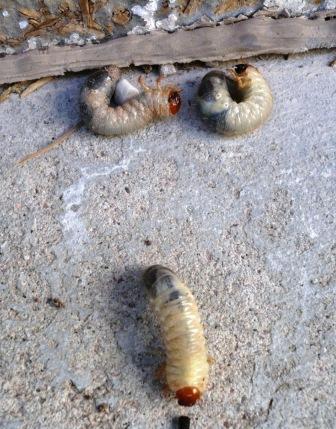
Grubs in Container of Garden Soil Killing Plants

Grubs found in our compost piles


Q. I have discovered over 200 huge grubs in a 15 x 24 inch container that is about 2 ft deep. I had filled this container with a bag of garden soil from a garden center and planted strawberry plants. Of course the plants all died, so I decided to plant some seeds and discovered all these horrible grubs!!!
I have been told that a product called Grub-Away is safe to use and that nematodes are even safer. But my main concern is all the earthworms that are in my gardens. I put in the worms last year and am seeing tons of babies. I really do not want to harm them. So far, I have been digging up sections (all raised beds) and destroying the grubs.
If the grubs were in the bags of soil I bought, do I need to treat future purchases?


A. Most of the grub control information is focused on lawns. However there are other grub problems such as those you find in the compost and even bagged compost. In most of the United States the problems in compost are considered minor compared to lawns.
White grubs feeding on the roots of a lawn grass, killing it

Here in our desert Southwest where we have fewer lawns the importance of grub control in compost piles and even bagged compost is usually just or even more important than lawns. The nonchemical control of the white grubs in lawns will also work for the most part in compost or bagged compost. Technically, to be legal the recommendation or control should include the site of application. I have to give you that warning to be in compliance with the law.

Adults of one of the compost grubs, masked chafer
For instance if the product is being sold for pest control in lawns, then it should also include your application on the label. If you choose to use it for this purpose you are doing it at your own risk of success or failure. Having given you the Party line, those pest-control products that are biological or natural should be perfectly safe to use.

There are some very expensive bagged composts that are actually very good but those producers believe in NOT sterilizing the compost. And this is a great idea in theory. The reasoning is that they want all of that biological activity added to a garden soil. You go through the expense of quality composting that produces all of this wonderful biological activity for the soil and then you kill it.

Another adult form of compost grub, green june beetle
This biological activity contributes to the breakdown of organic material in the compost and releasing plant nutrients and a wonderful chemical activity that can take years to develop into normal Desert soil. Many organic growers would be dumbfounded in the logic of killing biological activity in compost. This biological activity is precisely one of the reasons why you compost.

On the other hand, not sterilizing a bag of compost will introduce all of this biological activity to whatever you add this compost to. So if you buy a bag of compost that has not been sterilized and you use it with your houseplants there is going to be a very good chance your houseplants will be infested with dusky winged fungus gnats for example. I get many questions submitted to me on how to control this pest in houseplants. This is seldom a problem outside in the garden in our climate.

Another adult of a grub, ten-lined june beetle
So you have to be careful which type of compost you use for which application. In my opinion I would never use an unsterilized compost for houseplants for precisely this reason. Inside the house or greenhouse all of your products should be sterilized if you don’t want these problems. These are closed environmental systems and must be managed as such. You must scrutinize everything you bring into a closed environmental system because there are few checks and balances to help keep introduced pests under control.

I like these newer bagged composts very much and there is a developing market for them primarily due to the development of local markets for food. They are expensive, running $20 per bag or more. One product line that is popular right now is Fox Farm products. If they can keep their quality control as the demand for products like this climb, it will be a good product but check the bag and see if it was sterilized or not.
Worm for composting

If not and you want it sterilized then put the bags in full sun during the summer months for four days and flip the bags over every day. This should heat sterilize the contents provided the temperatures reach 160F for at least 30 minutes. That should be no problem in our environment but if you want to make sure then buy an inexpensive compost thermometer online (I have not seen any available in Las Vegas) and stick it in the compost bag, burying the probe to the hilt. In mid-day you want the temperature to hit at least 160F.
Secondly, you should inspect any compost and get rid of any grubs. These are decomposers and are working at helping to decompose plant materials but are first level decomposers and will attack the roots of healthy plants as well. So screen your bagged compost before using it if you want to maintain its biological activity.

There are natural pest control products for grubs such as beneficial nematodes and bacteria like Milky Spore but they will focus on some grubs and may not others. They are somewhat selective and may be a good alternative treatment that will leave earthworms alone.

Remember that earthworms can move pretty fast. If they don’t like an environment they usually flee. Grubs have a harder time doing this. But the earthworms must be able to flee somewhere and if they are in a bag that is getting progressively hotter they will not escape.

I hope this helps.

Constructing Raised Beds With and Without Side Walls


Q. Hello Professor Morris, I'm trying to figure out how to just post questions in the blog,  so you won't have to reply separately (if the answer is in the newsletter I'll just see it there).  I wonder if there is a best size or height for a raised bed.  I want to put in enough good soil, but don't want to make it higher if I can make it larger, to grow more plants using the same amount of soil. 
Trenching desert soil for creating rasied bed


A. The height is up to you  and what your back can handle. For root crops and asparagus they should be a minimum of 18 inches deep.
Most desert soils can grow excellent vegetables and flowers if they are amended properly at the very beginning. You can use existing desert soils at the location of the bed or you can import manufactured soils from sand and gravel companies or nurseries. If you import a manufactured soil, do not use reject sand. If you are importing a soil to use in place of your soil at the site, select a manufactured soil that resembles the soil at the site as closely as possible. Take a sample of the soil at your site when you are selecting the imported soil so you can compare the two.
Check it to match the texture (how sandy or clayey it is) so the garden bed will drain water into the existing soil. Problems with drainage can occur if the two soils, the soil at the site and your imported soil, are dramatically different from each other.

Adding compost before tilling and forming
the raised bed
Raised garden beds should be oriented north to south if at all possible. Their dimensions should be 3 to 4 feet wide if you can access the bed from either side. If the bed is accessible from only one side then perhaps 3 feet would be the maximum width. Keep garden beds at least 3 feet from foundations and block walls if at all possible.
Once established, you should avoid walking on the raised garden beds other than for possibly planting or harvesting. Use kneeling boards. Never walk on them wet.

I would recommend drip irrigation and using tubing with built in in-line drip emitters. I would use the larger drip tubing such as half-inch and not the smaller laser tubing. Visit with Timmy who runs irrigation department at the Plant World Nursery on Charleston. He will set you up with a drip irrigation system and components that you can run off of a hose bib or garden hose if you want to.


These steps will create multiple raised beds at the site without constructing sidewalls by using and amending the existing soil.
1.         Rip the soil to a depth of 12 to 18 inches with multiple trenches over the entire site. I usually use a trencher.

2.         Remove large rocks.

3.         Flood the trenches with water as best as you can.

4.         Fill trenches with compost.

5.         Collapse the sides of the trenches

Finished, planted and labeled raised
vegetable bed made from raw desert
soil and compost.
6.         Apply 3 to 4 inches of compost to the entire site and rototill as deep as possible.

7.         Remove rocks larger than a golf ball.

8.         Create pathways that are 18 to 24 inches wide between the raised beds by shoveling the amended soil onto the raised beds.

9.         Shape the beds using a landscape rake and garden rakes so that it is a level and the sides of the beds are at a 45° angle. The cross section of the width of the bed should resemble a long trapezoid.

10.       Firm the bed using a roller so that your footprints sink no more than 1/2 inch into the soil when you walk on it.

11.       Install irrigation.

12.       Your bed is ready for planting.

13.       Every time you plant, incorporate a 2 to 3 inch layer of compost subsequently for the next two years. After two years you can reduce the amount of incorporated compost to 1 inch.


These steps will create a raised bed using constructed sidewalls.

1.         Rip or at least disturb the soil to a minimum of 6 inches beneath the raised bed.
2.         Construct the sidewalls with your choice of building materials and to your desired height. For root vegetables and asparagus the depth should be a minimum of 18 inches.

3.         Line the inside of the constructed sidewalls, not the bottom, with heavy gauge pond liner.
4.         If you're using a manufactured soil that has not been amended with compost:
•        Mix good quality compost with your desired soil outside of the raised bed in a volume ratio of three parts compost to one part soil (3:1).
•        Remove any rocks larger than a golf ball. If you are planning on a lot of root crops then screen the soil so that any remaining rocks are less than 1/2 inch.

5.         If you’re using a manufactured soil already amended with compost:

•        Mix good quality compost with your desired soil outside of the raised bed in a volume ratio of one to two parts compost to one part soil (1 or 2:1) depending on the manufactured soil color. If the manufactured soil color is predominantly gray or tan, then use 2:1. If the manufactured soil color is light brown, then use 1:1.

•        Remove or screen any rocks in the soil.
6.         Fill the raised bed with the amended soil and settle the soil with water as you are filling it. Fill the raised bed so that the soil is 2 inches below the top of the raised bed.

7.         Make sure the raised bed is firm and not fluffy.
8.         Install your irrigation system.

Modesto Ash Landscape Tree Usually Does Not Establish a Tap Root


Q. I have a Modesto ash tree in my front yard.  I have had it for 12 years, so it is a big tree.  I am having a problem with its roots.  They are coming up through the grass.  Are those top roots?  They are ruining my yard.  What can I do for this problem?  I love the tree but not the roots.

Surface roots of large tree. My picture, not the readers.
A. This can be a problem with ash tree particularly if they are not watered deeply and were planted in a lawn. Lawns are typically watered with shallow irrigations because most lawn roots grow in the top 12 inches of soil. Since the tree is also growing in the lawn and receiving the same irrigation water as the lawn they will be in competition with each other for this water.
            Maybe you mean tap roots and not top roots? Tap roots by definition do not grow on the surface of the soil. Trees with tap roots in nature seldom develop true tap roots once they have been replanted or transplanted into landscapes.

            To develop tap roots trees need deep waterings or have deeper water available to them for their roots to grow into. In our desert environment most irrigations are shallow since water is expensive and we try to conserve as much as we can. In some cases you can remove a few surface roots without compromising the tree. You could explore this option.

            Trees use their roots for taking up water and nutrients as well as stabilizing itself in the soil to keep it from blowing over. Tree canopies act like sails. If too many roots are removed, obviously this could result in the tree blowing over in heavy winds.

            If you are removing more than one or two roots then you should consult with a certified arborist about the potential for blowover.

Watering Santa Rosa Plum in the Mojave Desert


Q. I read your gardening articles faithfully, and I just searched your blog for some help, but I would like more information.  I just purchased a Santa Rosa plum, but I am not certain how much I should water it.  I haven't yet planted it, and I want to make sure to give it enough emitters as it is located in the front yard which is mainly desert landscape plants and therefore do not require as much water as this will (I think). 
Santa Rosa plum
The tag indicated how much water in inches, and I wasn't certain how to convert that into gallons.  Also, although there is rock mulch in the front yard, I am more than happy to remove that in this are to give the plum the best chance.  Is that necessary?  Finally, your article on planting fruit trees from your blog mentions a "slurry" but I don't know what that means, and I wasn't able to find a definition on your blog.  I would really appreciate some help.  Thank you. 


A. Plums are not desert plants and should not be irrigated as if they were desert plants. Mixing desert plants with non-desert plants on the same valve can lead to watering desert plants to frequently or, the flip side, watering the non-desert plants not often enough. But this may be a moot point. In this town desert landscaping means surrounding any type of plant with rocks. This is kind of like calling tofu, meat. Just because people put rocks around plants does not make it desert landscaping but does give it the appearance of desert landscaping.
Hopefully your Santa Rosa plum will be on a valve that has other drip emitters on it. The first thing to do is determine your current run time for that valve on your irrigation clock; the number of minutes or hours that station or valve operates. It will be more difficult to irrigate your plum if the valve irrigates other things on it that are not on drip. Drip irrigation is designed to give small amounts of water over long periods of time, usually hours. Other types of irrigation such as bubblers or sprinklers are designed to operate in minutes, not hours. Mixing the two together on one the valve makes it very difficult to accurately apply water to either one.
I like to see true drip irrigation operate a minimum of one hour. Let's assume that the valve for your plum will operate for one hour. (Now I am going to give you some misinformation and tell you a couple of lies so that I can make my point. I will clear up the lies and misinformation later.) So, if the plum was purchased in a 5 gallon container, then make sure it gets irrigated with 5 gallons of water in that one hour. If it was purchased in a 15 gallon container, then give it 15 gallons in one hour.

As a tree in a 5 gallon container gets bigger, you will need to increase the amount of water applied to it in one hour to perhaps 10 gallons or 15 gallons next year. You can do this by adding additional emitters; perhaps a second one next year and the third one maybe three years from now. If the plum is really growing fast you may have to add emitters sooner. This is a judgment call.

Mature plums at the Orchard are getting 30 gallons every time they are irrigated. This 30 gallons is applied once every 10 days to two weeks during the winter to as frequently as twice a week in midsummer. As it gets hotter, the frequency of applied water changes, not the amount per application.

Let's say you now have discovered a problem. The valve which will irrigate your plum runs for 15 minutes, not one hour. And everything on that valve is designed to be irrigated in 15 minutes. This means we have to enter the dark side of irrigation; bastardizing drip irrigation to get it to do something it was never intended to do.
Adjustable drip emitter: the dark side
of drip irrigation.
Now we enter the realm of adjustable drip irrigation emitters. These emitters can be adjusted with flow rates of zero (shut off) to a lot. Oh, they like to say it is 0 to 10 gallons per minute but in actuality who really knows? I don't care what they call it but this is no longer drip irrigation. But in some cases it will get the job done and you may have no other choice.
Plants surrounded by rock mulch use more water than plants surrounded by wood mulch. Any type of mulch will help but rock mulch will get hotter than wood mulch and drive water use up. Some plants should never be planted in rock mulch. Your plum is one of them. Others include roses, lilies, Photinia, mock orange, heavenly bamboo and many others. It might be okay for a couple of years but I will guarantee its health will decline living in rock mulch after just a few years. Organic mulches like wood mulch will help your tree a lot. This wood mulch should cover an area not less than 6 feet in diameter around the plum tree and be at least 4 inches deep. Be sure to keep wood mulch a foot away from the tree trunk the first four or five years.
There is 7 1/2 gallons in one cubic foot of water. 1 inch of water covering one square foot is a little bit more than half a gallon, actually 6/10 of a gallon. Since rain is measured in inches of precipitation and sprinklers are also measured in inches of precipitation per hour there is a tendency to give watering advice in inches rather than gallons. They leave it up to you to determine how many square feet you are going to irrigate. A penstemon might be irrigated over an area of one square foot. A mesquite tree might be irrigated over an area of 300 ft.². This then translates into a different number of gallons.
A slurry is a mixture of water and soil the consistency of mud which can be poured. Think quicksand, smoothie. I hope this helps.

July todo: change out the pheremone traps and pheremones


Pheremone sticky trap (sticky part is removable on the bottom)
with an orange rubber thing that is impregnated with the
synthetic pheremone. These must be changed regularly.
Change pheremone sticky traps and replace the pheromones. Are you plagued by wormy apples, wormy pears, wormy peaches or nectarines, or wormy apricots? You may have codling moth in appes and pears and peach twig borer in your stone fruits.
        Pheremone traps are sticky traps that attract specific problem insects through releasing of sex hormones produced in a laboratory to mimic the opposite sex and then trapping them with a sticky surface that can be replaced.

        To control these insects you will most likely need to spray pesticide. Don't be too alarmed because the pesticides you can use are listed for organic production. The most common ones used include Bt (Bacillus thuriengensis; aka Dipel or Thuricide).
        The other chemical you can use is Spinosad. Spinosad is rougher on beneficial insects that Bt. You would spray just a couple of days when you get LOTS of these insects (the adults of these insects are small moths about 1/2 inch long. The larva or immature is the worm that gets into the fruit.

July todo: harvest onions

Walla walla grown at The Orchard in North Las Vegas.
Both northern and southern onions can be grown here well.
Check onions. Onions do remarkably well in our climate. They like to have soil that is well drained, free from large rocks and relatively sandy. Transplants are normally planted around March 15 year. If you decide to start onions from seed and grow your own transplants, you would do this about the same time you plant garlic; late September and October.
          Onions are heavy feeders of fertilizer particularly nitrogen. They do well if you put phosphorus in the soil prior to planting. I like to feed onions with nitrogen lightly, monthly, during their active growing time. It is not so important when the temperatures are cold and they are not growing fast.

Wait for the tops of onions to fall over before you harvest
unless you want to eat them fresh and not for storage
          Wait for onion tops to fall over before you harvest them. I do not recommend that you step on the tops to break the necks. They will do this all on their own and you do run the chance of developing rots if you store them for any period of time.

          So at this time of year begin to watch for onion tops that fall over. Once they fall over you can harvest the bulbs and trim the tops. You can also leave them in the soil for a week or two and harvest them fresh if you want to. Once the tops have died completely, I would get them out of the ground.

July todo: harvest herbs gently

Harvest herbs.
Lemon basil in bloom growing at The Orchard. Sometimes
the flowers are used as garnishes, cooking, arrangements,
salads and all sorts of things.
•        The four most damaging conditions which impact fresh herbs and "soft vegetables" is damage from handling, heat, low humidity, and direct sunlight after harvest.  The smaller and more delicate, the more damage.

•        Harvest in the early morning hours when temperatures are cool, humidity is higher and there is little or no wind. The volatile oils and flavors will be at their best this time of day.

•        Herbs and soft vegetables should be cut with a sharp, sterile knife or shears and lifted not pulled.  It is best to have cool water in a clean pail with you in the field so that herbs and soft vegetables can be immersed immediately upon harvest.

•        To clean fresh herbs, submerge them in a sink or large bowl (depending on the quantity of herbs) filled with cool salted water (about 2 tablespoons salt per sinkful). The salt water will drive away any insects without damaging the plant itself. Remove the herbs from the standing water, and dry in a salad spinner. To dry herbs completely, blot with paper towels.

•        The ideal time of season to harvest most herbs is just when the flower buds are forming, but before they open.

•        Gently wash herbs and vegetables down with a spray of water the night before you plan to harvest.  This helps to reduce cleaning after harvest.

Sunday, July 15, 2012

Tomatoes are All Vines and Few Fruits

Good looking tomato transplant for home
garden
Q. With five tomato plants all I really get is beautiful, huge green vine, why don't I get tomatoes? Being from East coast, I sure miss good tomatoes.

A. Tomatoes are difficult to grow here. The reasons are due to our poor soil conditions and our unpredictable weather mostly. Most homeowners fail to get a good crop of tomatoes because they plant them too late, they don't give them enough sunlight and they over fertilize them.
          The best years for tomato production are when we have a long cool spring. Some of the worst times we have for tomato production are when the spring temperatures fluctuate wildly from cool to hot.
          The best tomato transplants are about 6 inches tall, dark green and stocky. I don't need to tell you that they should look healthy and free from what appears to be disease or insect problems. Look at the plant. It should be healthy or don't plant it. Planting should occur in early March unless you have a very warm spot that can protect the plants from freezing temperatures and strong winds.

Tomato staked and caged
          Good soil preparation is important for tomato production. All that is necessary is good quality compost added to the soil and the soil give the chance to age and mature with this compost. Tomatoes should be fertilized with a high phosphorus fertilizer at the time of planting and not fertilized again until you see fruit. Fertilizing the plants regularly can cause them to produce lots of vine and little to no fruit.
          It is important that the plants have enough room to grow and produce. When they are placed in cages or staked they can be planted closer together. When they are allowed to sprawl on the ground they must have more room and we usually see higher losses of the fruit.

          If tomato plants are placed too close together they tend to shade themselves and produce very few fruit. They also tend to get more disease problems if planted too close together because of a lack of air movement.

Collection of tomatoes grown at The Orchard; sweet 100,
old ivory egg, black from tula, snow white, yellow pear
          Like most vegetables that produce something we eat from a flower, they need a minimum of 6 to 8 hours of full sunlight for good production. With sunlight less than this they tend to get leggy and not flower very much. The best sunlight for them is sunlight in the mornings and early afternoons. The worst time for them to get sunlight is if it is only in the mid to late afternoons.

          It is usually best to cage them or stake them. Don't let them grow into each other or they will shade each other and reduce air movement through the vines. This will lead to disease problems. Don't be afraid to thin out the canopy if it gets too dense.

          If you have prepared your soil well and have enough sunlight there is no reason cherry or grape tomatoes should not produce for you. These are the easiest to grow here and are usually nearly always successful.

          If you have problems with cherry or grape tomatoes, I would suggest that you pay particular attention to soil improvement, the amount of sunlight they are receiving and your planting time. I hope this helps.