Type your question here!

Friday, July 29, 2016

Forcing Bougainvillea to Be More Vigorous

Q. I am concerned about one of my three Bougainvillea plants growing on the south side.  I removed some very old and scraggly oleanders from this spot and raked out all the oleander leaves before planting these Bougainvillea.  I feed them and they have good water supply, but the one in the center is scrappy looking while its brothers on either side are thriving. 
Bougainvillea grown as a woody perennials shrub in Bullhead city, Arizona where it seldom freezes.

A. Bougainvillea do very well here during our summer heat with a minimal amount of care as long as the soil is amended at the time of planting and they are fed regularly with low nitrogen fertilizers.
They like to be pruned so if you see them struggling, prune them back, give them water and fertilize them lightly with a rose or tomato fertilizer.
They also bloom better if they are struggling rather than if they are pampered too much. Going through a dry period may encourage blooming.

Why Are My Oranges Mealy?

Q. We also have an orange tree that gets oranges (Not a lot  but some) and they are mealy and not very tasty.  How can we solve that? I do give the orange tree lots of extra water.
Oranges grown in the Philippines are not orange in color when they are harvested because it is in the tropics. To get oranges typically orange orange in color requires that they are put into the chamber with ethylene gas in a process called "degreening".The red fruit above the oranges is rambutan.

A. Mealy oranges is usually a sign of over maturity, leaving the fruit on the tree too long. Next time they are starting to ripen begin harvesting one of the time a week apart until you hit the right harvest time.

Mark it on your calendar. It doesn't change much from year to year. Unless they are ripening in the winter, you must harvest citrus when they are ripe. They cannot stay on the tree. Don't wait for an orange to turn color completely. 

Begin harvesting it when there is still some green in the rind. If you wait until it is fully orange it may be overripe. Oranges are placed in chambers with ethylene gas to turn them completely orange.

Nice vine, bitter grapes

Q. I have sent three pictures of our grape vines.  We have been getting a few bunches of grapes but they are small and bitter. How do we get them to get larger and sweeter?


A. Many grapes do well in the Mojave desert climate. Some perform better than others. Some perform Much better than others. A problem we have with grapes is uneven ripening of the berries in a cluster. This means that some of the berries will be ripe earlier than others. We see the ripening of the berries as a change in its color. Technically this is called veraison. 

Uneven ripening is still a problem with grapes in general but climates with high temperatures it is more of a problem. In cooler climates, particularly with cooler nights, berries mature much more evenly. 

Make sure that you have a variety of grape that performs well here. I noticed you did not mention which variety you have which makes me a little suspicious. All of the grapes that will do well here will mature, turn color (green grapes turn a light green or yellowish green while red or black grapes turn their respective colors; the yellow green grapes in the second picture look ripe to me) in the correct season. This can range from June through August or September depending on the variety. Your vines look healthy but healthy vines do not necessarily deliver a delicious grape. Make sure you wait long enough so that the fruit fully matures. In our climate grapes perform better with aced surface mulch of wood chips covering our desert soils. My suspicion is either the wrong variety or you are not waiting long enough until they mature when you're harvesting. The individual berries in the grape clusters do not all ripen at the same time. I usually have to harvest them when a few of the berries are actually overripe. Once grapes have been harvested, they will no longer improve in flavor or sweetness, unlike plums, peaches and even bananas.

Early Grande Peach Leaf Scorch

Q. I have a new ‘Early Grande’ peach which produced over eighty blossoms. I removed fifty of them and harvested the rest. The leaves are turning yellow and dropping off.  I am watering the tree for 40 minutes, three times a week, on alternate days right now, so the tree is getting 16 gallons a week.

A. If you're peach tree is getting yellow leaves and these are dropping and the canopy is sparse (thinning, not very many leaves) I am guessing it needs more water applied. If the soil is bare, watering every other day sounds about right for most soils. If the soil is covered with a surface mulch then you might be able to squeeze two days between irrigations.
Use the same technique to make sure the water is wetting the soil 18 to 24 inches deep. Just like fig, peaches will improve with a surface mulch. Peach trees at the University Orchard in North Las Vegas that are 7 feet tall and 7 feet wide are receiving 90 gallons of water each week in a basin that collects the water around the trunk that is 6 feet in diameter during the hot summer.

NOTE:
The term "too much water" has a double meaning. Too much water can mean that too much water is applied at a single time. Too much water can also mean that the water is applied too often. It is much more damaging to plants when water is applied too often than it is if too much water is applied in a single application. Enough water should be applied to wet the depth needed. That is a given. That will never change. What will change during the seasons is when to water, i.e. how often. Plants will use 500 to 800% more water in July and August than they do in January.

Figs Dropping Off

Q. My fig tree is receiving 12 gallons of water a week in the middle of the summer. I water it for 40 minutes, three times a week right now while it is hot. Some of the leaves are brown on the edges. The fruit did not mature and they dropped off.
Figs drying and dropping from the tree

A.  12 gallons of water a week is not enough. Trees at the University Orchard in North Las Vegas that are 6 to 7 feet tall and about just as wide should get 30 gallons of water, three times per week or a total of 90 gallons.
Fruit trees are moderate water users but the soil cannot become dry when they are producing fruit. If it does, it affects the fruit size and quality and it's possible it may not develop at all.
When figs are not given enough water (either the quantity is not enough or they are not receiving water often enough) the fruit becomes small, hard and often times drops from the tree.
I don't know how much of this water is actually getting to the roots. When watering, enough water should be applied in a single application to water roots to a depth of 18 inches, minimum, 24 inches is better.
The water should be applied under the canopy so that at least half of the area under the canopy is wet.
Take a piece of 3/8 inch rebar and push it into a wet area under the trees canopy. You should be able to push it easily to this depth. Pushing it into the soil easily means the soil is wet. It pushes with a lot of difficulty if the soil is dry.
Applying a 4 inch layer of surface mulch helps keep the soil moist, reduces fruit drop and improves fruit quality. Both rock and wood surface mulch works but wood is better for fruit trees.

I am guessing a tree that is 4 feet tall might require 15 to 20 gallons, three times per week right now.

African Sumac Leaf Drop

Q. My African sumac tree strips itself into a skeleton about the time it gets hot. It drops its leaves. This summer I tried to water earlier and it didn’t get as awful looking. But it is a real mess when it drops leaves.
Yellowing leaves of African sumac just before leaf drop
A. African sumac is not “dry deciduous”, which is true of plants such as the Australian bottle tree. But African sumac will drop its leaves if it does not get enough water. Either increase the frequency and amount of water during the summer months or put down a layer of water conserving mulch so the soil stays wetter when it's hot. This should help reduce leaf drop.African sumac is a "messy" tree in the landscape.

Removing Nutgrass by Excavating Soil May Not Work

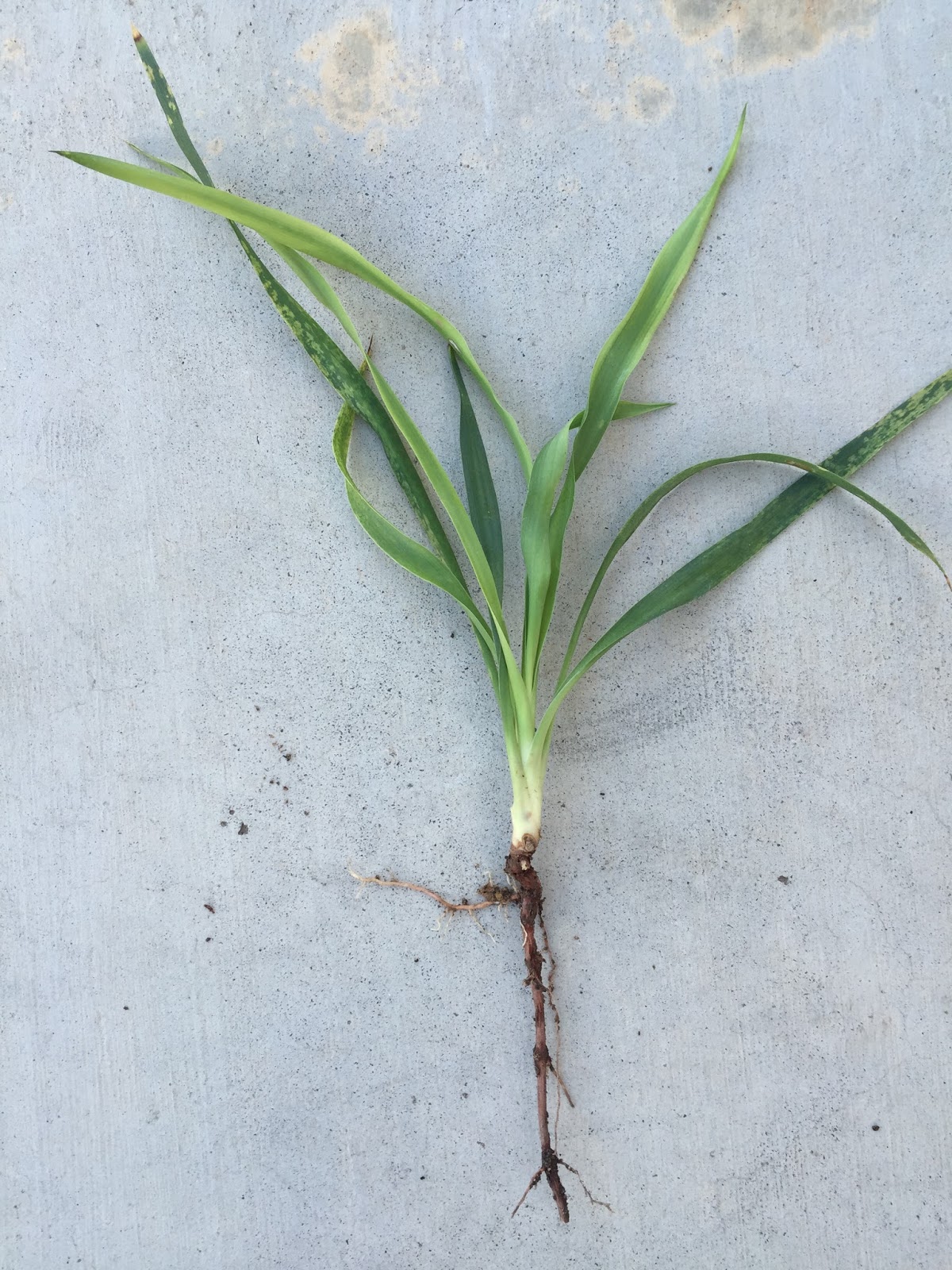
Q. We have a large garden in an area that used to be underwater. The soil is dark, has very small particles, and it clumps like clay. It also has nutgrass. We have tried several way to get rid of the nutgrass and so far, none have been successful. The soil needs amendment and we are wondering if digging up the weedy surface and disposing of it and replacing it with compost and topsoil would fix the problems, or if there is a better solution.
Nutgrass with its "nut" attached to the roots.

Nutgrass with its triangular stems because it is a sedge, not a grass.

A. Underwater? You are opening up a whole new area of horticulture that should be called scuba gardening. Yes, nutgrass is an important weed in rice paddies. Very difficult to control. I'm sure you have done your homework. They produce a nut like swollen stem that will generate new plants if it is separated from the mother plant. 

So when you pull, hoe, burn or apply pesticides the tops die but the nuts regenerate new plants. Weed killers like Roundup and dandelion killer kill the tops but not the nuts. You do all these things and nutgrass comes back with two or three times the population. 

Solid research has shown that you can exhaust these knots and nutgrass if you are diligent. The technique is to continually remove the tops at the time when they have exhausted most of the nut but not yet have rebuilt it. 

Timing of the removal of the top is critical. The most effective stage to do this is when the top of the plant has produced four leaves. If you wait longer than this, the plant begins rebuilding new nuts. If you remove them sooner than this than the nuts have not been fully exhausted. You will start to see a decrease in the population the first year you attempt this. Every year the population of plants will get smaller and smaller. 

Use anything that either burns or removes the tops. Your other option is to remove the soil to a depth that captures all of the nuts. This would be a minimum of 12 inches followed by removal of the tops of any of the nuts that remain to exhaust the mother plants.

Prune Mesquite in the Summer?

Q. I have a Mesquite tree that has gone wild. I had it trimmed a year ago and thought I could skip a year but no chance. It’s rubbing against the roof again. When is the best time to have them trimmed? Can I do it during the summer like in August?
Finding the right amount of water to give trees like mesquite so they don't overgrow can be a balancing act.

A. Let’s talk about its “wild growth” first. Mesquite trees, like most desert plants, are opportunists. When water is present, they grow like crazy. When water becomes limited, their growth slows down. If water really gets limited, they begin to drop their leaves. If water is even more limited for a longer period of time, then branches begin to die.
            It’s fun to see a Mesquite tree grow eight or 9 feet a year but this is also a signal it’s getting a lot of water. Put this to your advantage when it’s young by giving it frequent irrigations and large amounts of water. As the tree begins to reach a size that you prefer, the watering schedule should be restricted.
            When the tree reaches the size you like, then it becomes a balancing act; finding the right amount of water and applying it at the right time so that growth is not berserk but the tree still looks good.
            When the tree is the right size, cut back on how often it receives water but give it a large volume when you do water. This helps develop a deep root system.
            The trick is to determine when to irrigate next. Use the information I just gave you to determine that. When you see the tree begin to drop leaves or the canopy begins to thin, then give it its next watering.

            As for pruning, light pruning can be done anytime. Branches that are rubbing on the roof should be removed as soon as possible. But if you are pruning significantly and opening the tree for a lot more sunlight to penetrate into the interior, then do this during the winter.

Bottle Tree Leaf Drop

Q. You told someone that a bottle tree lacked water when its leaves turned brown and fell. I have a large, Australian bottle tree that was here when I bought this house 12 years ago.  Every summer it blooms and makes seedpods that eventually fall.  It also loses leaves as the person in your article described. However, it grows new leaves so it looks eventually much as it did.
Bottle tree with one side of the tree leaf drop

A. Bottle trees from Australia are “dry deciduous” trees. In other words, during the dry season of the Australian desert they drop their leaves. When rain returns, they grow their leaves again.
If these trees get water stressed in our climate and suffer from a lack of water, they drop their leaves. They “think” they are going through a dry season so they drop their leaves to protect themselves from drought.
During the summer here, if they are not receiving enough water they will also drop their leaves. They are conditioned to drop their leaves from millennia of evolution on the Australian continent.
If you want them to keep their leaves through the summer, then give them more water or, possibly, water more often. It is hard to say which is the right thing to do but my guess is they should be given more water when they are watered.
Plants use 500 to 800% more water during the months of July and August when compared to January in our desert climate. When bottle trees mature, they develop a swollen trunk that they use for storage of water that allows them to survive periods of drought, thus their name.

Volunteer Squash? Get Rid of it

Q. I had a volunteer plant in my flowerbed last summer. It looked like a squash plant, had very tiny white flowers, and grew hugely. I finally cut it down because it produced no fruit and shaded everything for several feet around. Perhaps if I left it vine I would get some fruit from it.
Squash leaves can be the source of many different types of harmful insects.
A. I wouldn't waste my time with a volunteer squash/pumpkin/melon vine. When a plant is growing where it shouldn’t be, it is a weed and should be removed if you value its neighbors.
Squash and all their relatives such as pumpkins and melon many times hybridize or cross pollinate among themselves. The seed they produce is a blend between the two parents. 99% of the time it will not be an improvement over the parents as far as eating quality.
By letting it grow their it's just a source of harmful insects that will infest the other plants because they are "dirty" unless they are cared for in a garden setting.

Big Plants Use More Water than Little Plants

Q. My wife believes 30 ft. pine trees do not need watering because they absorb water from the air. I ask you because the pine needles are turning brown Is she correct?

A. She is not correct. As any tree or plant gets bigger its demand for water increases. They do not take water from the air. Just the opposite. They lose water to the air in a process called transpiration, the same as any other tree, needled or with broad leaves.


Sago Palm Yellowing

Q. We have multiple sago palms in our yard and they have all done well for over 10 years. This year all the sago palms are turning yellow (pics below). Especially the largest one.


We have not changed any of the fertilizer or care routine and the watering is the same as the previous summers. For some reason this year they seem to be really suffering. Reading online some websites say too much water, others say not enough, some say too much sun, others say not enough fertilizer or too much!  Basically I have no idea where to begin... 😐⁉️We love our sago palms and love the dark green evergreen foliage (they normally have) please help us save these beautiful plants. 

A. It is  hard to begin. If they are healthy and growing in good soil they can handle a lot of sun and adversity. If the soil has been depleted (surrounded by rock mulch for instance) they can get quite yellow. 

If the roots are drowning and the soil stays wet they can yellow. If they have root diseases (too much water, poor soils or depleted soil) they can yellow. I would nurse them along until October and dig them up, amend the soil, inspect the roots and check for rotting roots, correct the soil/watering problem and replant them. The yellowing created by a lack of fertilizer or the right kind of fertilizer is different from this kind of yellowing. This appears to be stress related.

I think it is soil depletion which can be corrected by adding organics back to the soil. Use about a one inch layer of compost applied to the soil around them and water it in. You might also try adding wood chips, not bark, to the soil surface after the compost application.


Thursday, June 30, 2016

Meat Certification Course in Reno

Wolf Pack Meats Certification Program is being offered at Wolf Pack Meats through the College of Agriculture, Biotechnology and Natural Resources (CABNR)and the University of Nevada Cooperative Extension (UNCE) Herds & Harvest program. Each certification program will guide students through the operation of Hazard Analysis and Critical Control Points (HACCP) protocols to ensure that program participants will learn the latest food safety and sanitation guidelines. Each program will be limited to 10 students due to the size of the Wolf Pack Meats facility and the Main Station Farm classroom size. A brochure is attached with all the information regarding this class. 

July 7, 2016
Basics l Slaughter
This Basics I certification program will be for beginners who want to learn about meat processing. This training is designed to provide insight on how to slaughter and process an animal carcass under USDA inspection, this class is hands-on.

To register follow the EventBrite link. http://slaughter-july07-2016.eventbrite.com/

July 19, 2016
Basics I Processing
Processing certification for Meat Cutting Basics I will provide hands-on specialized training in the accuracy of cutting, knife handling, portion control, merchandising and the utilization of all carcass products including food safety and sanitation guidelines.

To register, follow Event Brite link. https://processing-july19-2016.eventbrite.com/

June 30, and July 1, 2016
Basics ll
This Basics II certification program will be a two-day educational program related to the meat packing industry. Day 1 will be at the UNR Ag Experiment Station on Clean Water Way in the classroom and in the feedlot learning how packers make their money. Day two will focus on the processing of carcasses focusing on grade and yield at Wolf Pack meats processing facility in the morning. In the afternoon, the class will move to UNR Fleischman Agriculture Room 104, UNR Meat Lab, to conduct meat product color analysis, tenderness and packaging techniques.

To register for the two-day event, click the Eventbrite link. https://basics2-june30andjuly1-2016.eventbrite.com/ 

Coconut Trunk Rot in Philippines

Q. I had gone thru your blogs and thanks for I got idea how to connect with you. I am from the Philippines. I had a small coconut plantation but had some problems I had observed. (Please see attached photos).


A. This looks like basal stem rot disease….Ganoderma…It is usually associated with poor drainage during the rainy season. Water accumulates around the trunks and the soil does not drain well. This standing water causes the palm to weaken and invasion by this disease pathogen which is either in the soil waiting for weakened trees or brought in with the seedlings. I attached a paper that discusses this problem and some corrective measures but the best is preventitive, making sure you have adequate drainage during heavy rains and soil that drains well.


We see similar problems with fruit trees in temperate regions and it is called collar rot. Similar symptoms but different disease organisms.

Wednesday, June 22, 2016

Viragrow Delivers! : Q. This is the 8th year for our honeysuckle plants...

Q. This is the 8th year for our honeysuckle plants...: Q.  This is the 8th year for our honeysuckle plants and, although they appear healthy, we cannot get them to produce blossoms. They do get...

Viragrow Delivers!

Viragrow Delivers! : Q. This is the 8th year for our honeysuckle plants...

Q. This is the 8th year for our honeysuckle plants...: Q.  This is the 8th year for our honeysuckle plants and, although they appear healthy, we cannot get them to produce blossoms. They do get...

Viragrow Delivers!

Starting From Seed in the Garden During Summer

Q. Just came across your site looking for gardening tips.Great stuff! Just wanted to reach out and say hello. I'm just starting to get into gardening myself. I didn't know there was so much involved with
starting seeds and pots!

I just started planting some seeds for different flowers but I've been having problems with birds hanging out and ruining my garden. I'd love to get your thoughts on it. Have you had this issue? I would appreciate your feedback!

A. I know pigeons can be a problem with grass seed but I have not seen it in garden seeds. I have experienced ants hauling off the seed in another country and resulted in the loss of about 1 lb of onion seed in about two days.

Fresh horse bedding used as mulch
Sometimes it is better to start the seed in pots or in one location and then move them as transplants when they are about 6 inches tall. This doesn’t work well with root crops but I have seen it done when I thought it would be a problem. 

Horse bedding
Covering the seed with mulch now is also a good idea because the soil/seed dries out too quickly this time of year for good germination. Presoaking large seed…soaking them in water for about six hours…. Works very well and can cut down a day or more on germination time. 


Paper cups work well as containers. Just make sure they have holes in the bottom for drainage. You have to cut and remove them when planting. You should cut are remove even peat pots when planting as they will interfere with getting established.

Sunday, June 19, 2016

Holes in Tomatoes Probably Tomato Fruit Worm

Q. I have only found about 4-5 like this. I have been getting ripe tomatoes for about 30 days, only found these in the last two days. I searched for bugs, eggs and leave damage did not find anything. Any ideas?


A. The holes in your tomatoes look like tomato fruit worm damage. These are worms or caterpillars that are about an inch and a half long and 3/8 of an inch wide. They eat holes mostly in tomato fruit, usually when they are green or when they turn red but are still hard. Frequently the fruit becomes rotten. Organic sprays of Bt or Spinosad when the fruits are starting to form usually prevent this.

Grape Vine Killed by Winter Cold

Q. I planted two vines in my backyard  3 year ago and it sprouted and grew very quickly but as you can see this year it has not done anything with the exception of the few countable leaves and the three new shoots.  I do notice some holes in the few leaves.  I live in Montreal Canada.


A. You are a little bit out of my climate zone but I'm going to take a stab at it. I am guessing, from the looks of it, it had some winter cold damage. There is a difference in cold tolerance among grapes. Those with some vinifera genetics in them (most of the European wine grapes are vinifera types) are less cold hardy than some of the American hybrids.

For instance Thompson seedless grape has vinifera in it and is less cold hardy than Concord, an American grape. I don't know where you got your particular grape and whether it was grafted onto a rootstock or not but if it was grown on its own roots than any suckers which could grow from it could be used to replace the dead vine.

Suckers growing from it should be extremely vigorous because of the already larger root system. It could be back up on top easily this growing season if you remove all but the strongest sucker. As it grows longer, tie it to the post. Strip all of the leaves and shoots off of this sucker until it finally gets on top. This way it will grow faster and you will direct the growth.

Give it a little extra water and nitrogen fertilizer and it will grow faster when the temperatures are warm. That's my best guess at it given the information I have and pictures. I saw one strong shoot coming from close to the ground in one of your pictures. You would cut it just above the strongest growth to reestablish it.


Apricot Fruit Rot Probably Due To Wet Spring

Q.  My apricots were doing very well as they have for the last several years.  After thinning a large crop this year, they were growing very well and appeared to be getting ready to pick when all of a sudden this appeared.  When I opened the cots, I found the insides to be rotting.  I've tried to do a little research without success.  Your expert opinion would be greatly appreciated. 


A. This may be ripe fruit rot, sometimes called Brown fruit rot. It can happen if there is rain near the time of harvest. There is not much you can do except hope that rain does not occur at that time. Here is some information from the University of California. See if this description matches your problem.

They recommend fungicide applications Earlier in the season but we get such a little chance of rain here to me it doesn't make any sense to make these applications.