Type your question here!

Friday, August 5, 2022

Soil Testing for Homeowners

Should I have my soil tested? 

A soil test done by a commercial laboratory like A and L Soil Testing Laboratory in Modesto, California, costs from $60-$75. It’s important that a soil test is submitted to a soil testing laboratory that uses appropriate testing. In other words, if you live in the desert don’t send it to a soil testing laboratory that’s in a wet climate.

Sample Soil Test Report for Fruit Trees in the Desert

Soil tests are mostly about what fertilizers and soil amendments should be applied to get a desired yield. I was in in the former Soviet Union years ago when a member of Parliament once asked me, “What is the maximum wheat yield in the United States?” I told him, “US farmers don’t maximize yields. They maximize profits.” Soil tests help farmers “maximize their profits".

Soil Chemistry

Soil tests are primarily aimed at a “soil’s chemistry” to aid a famers profitability. Soil tests will not tell you why a plant died, or chemicals added to the soil that killed a plant. An agricultural soil test won’t tell you that. Those tests can be done, however, but are much more expensive and requires a consultant to guide you.

How Often?

What good are soil tests to a homeowner and when should they be done? A serious gardener should submit a soil sample as soon as new property or growing area is purchased. A “first time” soil test establishes a “baseline” and tells you at the beginning what’s adequate about your soil chemistry and what’s missing. After that a soil test is submitted by homeowners about every four or five years to make sure “they are on track” with their fertilizer and soil amendment applications.

This is a soil test done by a homeowner. Garbage in, garbage out. I learned a long time ago to be careful sending soil samples in for analysis or doing it yourself. Luckily, this soil test matches what a desert soil sample report might look like.

Soil Samples or Sample?

Soil tests are a smaller sample of a larger soil sample taken from the top of the soil to the depth plant roots grow. Several smaller samples representing this depth are added together. A very clean five-gallon bucket is used for mixing the larger soil sample so that a smaller sample, a pound or so, can be submitted for testing. Expect results in about a week after they received your sample. If you’re having trouble interpreting them, hire a consultant the first time so that you are taught how to read them.

Slime Mold Found After or During the Rain

Q. About 2 weeks ago I noticed a strange growth at the base of several different plants. The largest was about 4"x6" and shaped like a smooth, white, used bar of soap; slightly moist and slippery on the outside and like a semi-hard cheese on the inside. It seemed like it was attached to the soil but was also around the stems and branches that came out of the ground.  It broke into slightly smaller pieces as I worked it out of the soil. What is it and what do I do to remove it?

Reader didn't send a picture. This is slime mold in Las Vegas after a rain. Rain will contribute to their growth when there is a lot of rain.

Slime molds are a type of mushroom or fungus. They can come in lots of different colors and forms.

A. Without a picture it is difficult to tell but it sounds like it is “slime mold.”  Search it out. 

Slime Mold

Slime mold is a type of fungus, or mushroom, which does not cause problems for plants. It is what is called a “saprophyte” and feeds on moist or wet dead wood or woody debris. It feeds on the rotting wood below the surface of wet soil. We see that a lot in soils covered in wood chips, or woody compost used for enriching the soil, buried rotting wood in the soil and even dead or dying roots. It is a plant that is a “decomposer.”

Use a shovel and pick it up and put it in the garbage so the dog or kids don’t get into it. No other treatment is necessary. One person reported a rash from it so be careful in case you are in this minority.

Homeowner Forced to Water With a Hose

Q. I have emailed you before about having only one watering zone. Our lemon tree seems to be doing worse every year. With only one irrigation zone unfortunately I am forced to water every day in the summer.  We decided we should water these citrus trees by hand. So, we have two questions please: How much water per watering and how often?

Homeowner Forced to Water with a Hose

A. Looks like fake grass was installed surrounding the tree. It is too perfect. This may be a problem in future years due to numerous soil problems, primarily air reaching the tree roots and compaction from people walking near it. Pull the fake grass away from the tree to the size of the canopy. It is important that plant roots breathe air. Some types of fake grass are better at that than others. Make sure enough air is getting to plant roots.

How To Hand Water Citrus

 Start watering this tree now with about fifteen gallons each time (judging its size from your picture). As the tree increases in size it needs more water; probably about every three or four years the area under the tree canopy will need to become bigger to give it this. The tree will max out at about thirty gallons each time it is watered. When an increase in water is needed, remove more grass, to accommodate the amount of water applied. The easiest way to give the tree more water and keep it from falling over will be to increase the size of the area where water is applied to at least half the area of the canopy.

Use Moat or Donut

This is a basin at the bottom of a fruit tree in North Las Vegas. Both basin and bubbler..which this is..and drip irrigation are both efficient at this.

Use a moat or donut shaped basin around the tree for filling each time with a hose. The basin, and the inside being flat, will hold water long enough to get it deeper in the soil. If the tree does not have a moat or donut around it, it is difficult to put enough water in that spot to wet the soil eighteen inches deep each time. Just putting a hose on it will not work unless you water with a sprinkler or let the hose run slow a long time. Using a moat or donut will fill the basin with water in about ten minutes or less and keep it contained.

HOA Removing Bay Laurel Trees

Q. Our sweet bay laurel trees face East and are watered by a drip irrigation system on a separate line for trees only. Obviously, these trees are not doing well. They were originally 24” boxed trees planted in 2013. Our HOA contends they are close to the end of their lives, and they will be removed. Any ideas?


Bay Laurel Trees HOA Wants to Remove

A. From the picture you sent (above) the leaves exposed to the heat of the sun are scorching along the edges. This means not enough water is getting to them either because there is not enough water supplied to the trees or there is damage to the trunk or limbs.

Bay laurel trees struggle when temperatures are very hot (over 105F) and there is very low humidity. Particularly if it is windy. They are treated like desert trees, but they are not. They are a “mesic” tree, not “xeric”, coming originally from the Mediterranean area of the world, and not a true desert tree like the Palo Verdes, Desert Willow, Texas Mountain Laurel, or any trees native to our Southwest deserts.

Big trees use more water than smaller trees

As trees get larger, they require more water. As these trees get larger more drip emitters must be added to give them the water they need. You could increase the number of minutes but then everything on that “line” or valve would get an increase in water as well. There are other alternatives but adding more drip emitters is the most common.

I would guess trees would need more water applied (change in the water applied) every three or four years until they reach maturity. It is better to add drip emitters to those plants getting larger than just adding more time; either is a challenge for HOAs as the cost of water increases and they are still trying to contain costs.

Ways to Reduce Trees Need for Water

There are three ways to reduce their need for water; 1) reduce their size as well as and other large plants, 2) reduce the total number of trees and shrubs, and 3) change over to desert native plants like I mentioned above. Doing any of the three does not reduce water used. Water used, irrigation, is a human landscape decision. Changes in irrigation management, as well as monitoring water applied to the soil, must be done by the landscapers.

In the desert all plants use water. Think of ways to beautify your landscape that does not include water. We cannot have a landscape full of trees and shrubs in the Mojave Desert. It doesn't make sense. Plants must have a purpose if they get water.

Canary Island Date Palm Problems

Q. I have a Canary Date Palm that developed yellowing leaves last year. I planted this palm about 10 years ago in my landscape.

Canary Island Date Palm

A. The proper name is Canary Island Date Palm. Eliminate simple possibilities first. 

Water and drainage

Make sure whatever method you are using to irrigate the tree has not changed because of a broken irrigation line or malfunctioning irrigation emitters. Check the soil around the tree to make sure it’s not still wet before it is irrigated the next time.

The soil at four or 5 inches deep should still be starting to dry when you water again. Watering cycles of palms is similar to other large trees on your property and not to other locations like lawns, flowerbeds that require frequent irrigation. Watering palm trees as frequently as you would these locations would be a mistake.

Fertilize with a palm fertilizer

Palm nutrient deficiencies such as potassium, magnesium or manganese deficiencies can cause yellowing as well. Use a palm tree fertilizer such as Arizona’s Best the next time this palm tree is fertilized.

Disease Possibilities

There are a couple of disease possibilities that have not yet, to my knowledge, been diagnosed in southern Nevada. Three palm diseases have been noted in Southern California on this Palm. The only disease which causes fronds to yellow on Canary Island Date Palm is Fusarium Wilt. This disease can be spread from tree to tree through pruning tools. Wiping or spraying the cutting blades of pruning tools with at least 70 – 90 % isopropyl alcohol will effectively keep the disease from being spread due to a lack of sanitation to other palms.

Anyone pruning these palms should never use dirty tools. Tools should be cleaned with soap and water first and then sanitized before pruning begins.

USDA Publishes Proposed Organic Livestock Rule


USDA Publishes Organic Livestock and Poultry Standards Proposed Rule

60-Day Comment Period Opens with Publication

Today, the U.S. Department of Agriculture (USDA) previewed the Organic Livestock and Poultry Standards (OLPS) proposed rule in the Federal Register. With this publication, USDA proposes requirements for organic poultry and livestock living conditions, care, transport, and slaughter.

“This proposed Organic Livestock and Poultry Standards rule demonstrates USDA’s strong commitment to America’s organic producers,” said Agriculture Secretary Tom Vilsack. “We encourage producers, processors, and consumers to submit written comments about the rule so that we can work together to create a fairer, more competitive, and transparent food system.”

“This rulemaking is an opportunity to ensure consumers’ expectations align with the enforced organic standards, building trust across the supply chain and leveling the playing field for producers,” said Under Secretary for Marketing and Regulatory Programs Jenny Lester Moffitt. “With this proposed rule, USDA is seeking to establish and clarify clear standards for organic livestock and poultry production.”

When finalized, USDA’s National Organic Program (NOP) will oversee the rule’s implementation. Read the full USDA Press Release.

NOP will also host a public webinar listening session on August 19, 2022, to hear oral comments on the proposed rule. Learn more at the link below.

 View the OLPS Proposed Rule

Includes links to the Federal Register announcement, how to access the webinar, submitting written comments, and signing up to make oral comments at the webinar.

How to Submit an Effective Comment  

NOP has a microlearning module (linked below) that provides guidance on how to write an effective public comment. Effective comments help others understand your perspective and how proposals will impact your organic farm or business. This helps USDA best balance needs across impacted participants in the organic market.


Monday, July 25, 2022

Pear Tree and Fireblight Disease

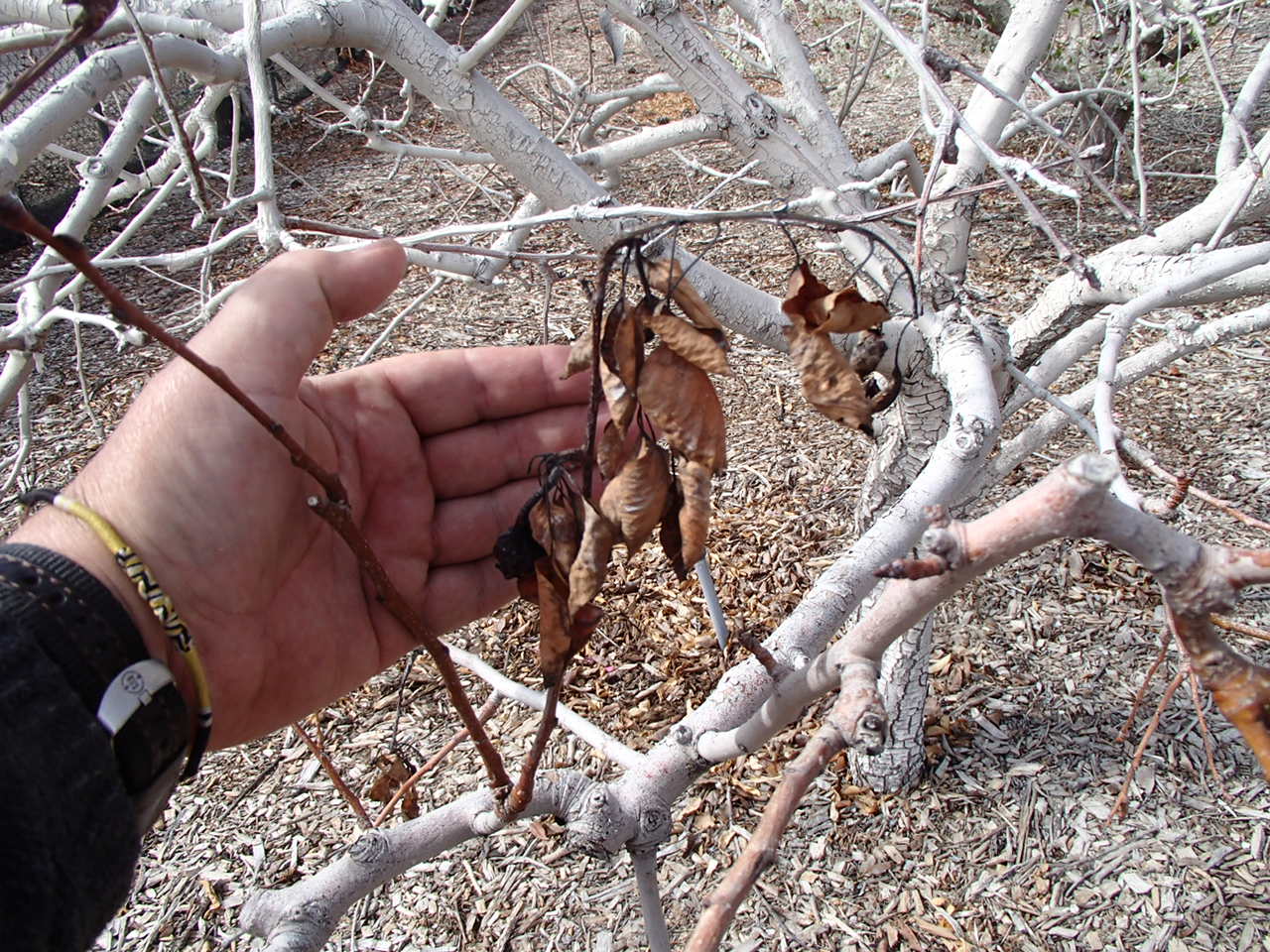
Q. I  attached pictures of my pear tree. Do you have any idea why the leaves are doing this strange browning and dying out? Never seen anything like this.


Both pictures were submitted by the reader. Sure looks like fireblight disease to me.

A. I'm going to state the obvious. The leaves turned brown because they are dead or dying. I know you want to know why they are dead.

The usual reasons can be wide-ranging and related to either diseases, damage to limbs or the trunk or soil problems. The possibility that concerns me the most is a disease called ‘fireblight’. Search the Internet or my blog for pictures of what fireblight disease looks like. Check the entire tree for this kind of damage.

Advanced stage of fireblight disease. The tree can still be saved by pruning back about 12 inches to stop the disease from spreading.

If you are at all suspicious of fireblight, then prune out these branches 6 to 8 inches below this area and use a sanitized pruning shears. If more than one cut is needed, then sanitize your pruning shears between each cut. Use 70% isopropyl alcohol or higher or a cigarette lighter and heat up the blades to kill any possible disease organisms that you could transfer to the cuts.

Make sure the tree was planted with compost mixed into the soil as an amendment at planting time. Never surround fruit trees with rocks or gravel on the surface of the soil. Woodchips that can decompose and benefit the soil are much preferred over rocks for any kind of fruit tree.

Fireblight disease on recently planted 'Bartlett' European pear.

If you are watering daily, the tree roots could be suffocating because the soil stays wet and not draining properly. Root suffocation can also cause the leaves to die and turn brown or black. Stop daily watering. Water every other day or every third day during the heat of the summer. Apply enough water when irrigating to cover a large enough area under the tree to initially wet and keep this soil from totally drying out until the next watering.

Pear trees grow very well in our climate if the soil is prepared at the time of planting with compost and if the soil surface is covered in woodchips after planting. You should never have to water daily if you are giving the trees enough water, over a large enough area, when you are watering.

Soil Testing for Home Gardens and Landscapes

 Testing the soil for home landscapes doesn't need to be done every year. They are expensive. Start with a baseline soil test (beginning) and test the soil every three to five years or when you think it is necessary. Many of these retail home soil tests can also be marketing tools for selling amendment products.

Home soil testing come in kits like La Motte's or a soil sample you can send in for analysis like the one below. Testing raised beds for gardening is no different than a small garden area without sidewalls. Make sure ALL the important plant nutrients have been tested in desert soils.

There has been a lot of negative endorsements in general info about home soil tests. But in my opinion they aren't too bad if you are looking for general numbers. 

This is an example of a home soil test result from Las Vegas, Nevada. It was not too bad. Not as precise as a commercial agricultural soil testing lab but not too bad.

Agricultural Labs

For more precision I would recommend a commercial agricultural soil testing laboratory that can invest  hundreds of thousands of dollars in important equipment. For research we use A and L Soil Testing Laboratory in Modesto, California, or do it ourselves but a good soil testing labs are considerably less expensive than doing it yourself for research. The major advantage of a lab doing it for a fee and home testing is usually the numbers of tests you can run. Home testing usually involves several tests for the same price while a commercial lab you only can submit one soil sample for a fee.

Use a Local Lab

It is important to submit samples to a lab that represents your type of soil. Some of the big labs need to know a bit about your soil sample before you begin. Soil testing can be different in different parts of the country. If you live in an arid/desert part of the country, submit it to an arid/desert soil testing laboratory.
This is an example of a commercial agricultural soil testing laboratory report. 

Commercial agricultural soil testing laboratories invest a considerable amount of money in testing equipment. They are expensive but when accuracy is needed they do a very good job. 

Examples of commercial agricultural soil testing laboratories in desert areas to consider include A and L in Modesto, and  IAS in Phoenix,

In some states an agricultural soil test is available from the University. These are a good bargain and give you valuable and accurate information.

What to Test?

Most soil testing includes nitrogen, phosphorus and potassium and a few other nutrients. Besides these, in desert soils make sure your soil is tested for iron, manganese and zinc as well. Don't forget the pH (alkalinity) and EC (salts) to include the salts of sodium, chlorides and boron. Boron is important for soil testing in desert soils.

Remember..."garbage in, garbage out." Always submit a good soil sample.

Planting During our Desert Heat

Leaf scorch can be a reminder that the plant might be in a hot location, soil not amended properly or it was not surrounded by wood chips when it should be.

 Avoid planting anything during our desert heat. All planting should stop if it's windy or temperatures are above 100°F. Sometimes you must plant but think about other times. They will be better and you will have more success. Planting during cooler weather is better for the plant. Planting during cooler weather and you will have more success.

If you must plant during the heat:

Plant in areas of the landscape appropriate for the plants. Some plants tolerate desert heat better than others. No plants like heat. They prefer growing at temperatures they like (45F to 85F depending on the plant).

Dig planting holes and amend the soil a day ahead. Fill the planting hole with water when you're finished.

Plant only during early morning hours.

Avoid planting on windy days. Check your phone weather app.

Have water ready and available. Would you like some coffee you like some coffee no?

Always plant in a "wet hole", never a "dry hole".

Plant as soon as you get home. Never wait for tomorrow.

Keep plants roots wet. Feeder roots in without moisture die within 15 seconds. How many roots die determines the degree of "transplant shock". Transplant shock isn't "normal".


Thursday, July 21, 2022

'Red Push' Chinese Pistache Damage

Q. I have two ‘Red Push’ Chinese pistache trees planted about three years ago and doing well. Recently one was shocked and I’m not sure what happened. This occurred almost overnight. I gave it a few extra gallons and added two drippers to each plant. I don’t use any Round up or anything like that. Can it be saved? 

'Red Push' Chinese pistache are damaged with high winds


A. It will take a while, but the tree should be fine. The tree will use its stored energy to put on new leaves and replace the dead ones. In the future it’s important to note the weather occurring during that time because we did have some strong winds a few times this summer. 

Strong Winds are Damaging and Trees Use More Water

Strong winds are particularly damaging in the spring when leaves are new and tender. Strong winds equals increased water lost by plants. Sudden death of leaves right after strong winds signals a need for water. But that water application is usually just once. 

However, frequent watering coupled with poor drainage might also cause this problem. My guess is that leaf death was coupled with the wind. So be careful with applying water to landscapes. It can be the “giver of life” in the desert, but it also can be the "giver of death". 

Established Trees Have Stored Food

A three-year-old tree like ‘Red Push’ has stored “food” in its branches that it relies on when pushing new leaves. It takes a bit longer for the tree to respond during the spring and early summer months because it has “used up” all its “spring” buds putting on new growth. It’s like a double whammy. It may take the tree a bit longer to produce new buds and new growth. 

Chinese Pistache is Mesic not Xeric

Tree response to leaf death occurring in late summer and fall is much more rapid since the buds are already formed and new growth happens much faster. Remember that any of the Chinese pistache trees are mesic in their water use; they can tolerate desert soils but need a little bit of irrigation help. They grow best when surrounded by other plants that require water. As with most mesic trees, they can tolerate lawns when there is decent drainage.

More "White Fuzzies" in Landscapes

Q. I live in the central Las Vegas Valley and noticed a creep of linear white deposits on the stems of plants in my raised vegetable garden that has recurred in some desert-adapted plants elsewhere in the yard. It first appeared on sunflower stems, then lacinato kale, some basil, tomatoes and their stems, and now on new growth from a Vitex tree and turpentine bush. It seems to be spreading, in other words. Can you advise what this is, and any way to remedy it?


A. Those “white deposits” are probably tiny “cocoons” of tiny insects in the landscape. I reorted these on my blog in previous years, calling them “white fuzzies”. I didn’t know what they exactly were either, but I knew that they were insect related.

A horticulturist in the Phoenix area guessed that they were sharpshooter (insect) pupae, and he may be right. In any regard, these insect pupae “were just passing through” the landscape where they were “incidental” and probably not damaging these plants.

Generally speaking, when we see white deposits on many different kinds of plants it’s usually not disease-related but may be related to insects. If guessed that these white deposits in this case are “insect related” then look at the plant and note any damage you might see. If there is no damage, then these insects are “incidental” to your plants.

If you see insect damage to the plants, then they might not be “incidental” and it’s best to use your favorite least toxic insect spray and see if that stops the problem. Soap and water is usually a good first, least toxic spray and readily available. You can always try something more toxic as your second spray if that doesn’t stop the damage.

USDA National Organic Program (NOP) Quarterly Fraud Claims June, 2022

 Does this give you confidence in the organic claims in the US?

Yes

No

Not Sure

Vote below now. Your vote counts. Comments are welcome.


Sunday, July 17, 2022

Walker River Paiute Trible Signs Local Food Cooperative Agreement with USDA


USDA Announces Walker River Paiute Tribe Signs Local Food Purchase Assistance Cooperative Agreement

Date: Friday, July 15, 2022 - 3:00pm

Contact Info

Public Affairs

PA@usda.gov

(202) 720-8998

Release No. 090-22

WASHINGTON, July 15, 2022 -- The U.S. Department of Agriculture’s (USDA) Agricultural Marketing Service (AMS) today announced it has signed a cooperative agreement with Walker River Paiute Tribe under the Local Food Purchase Assistance Cooperative Agreement Program (LFPA). This is the first LFPA cooperative agreement between USDA and a tribal government. Additional agreements with tribal governments will follow in the coming weeks.

“USDA is excited to partner with Walker River Paiute Tribe to promote economic opportunities for farmers and producers and to increase access to locally sourced, fresh, healthy, and nutritious food in this community,” said USDA Under Secretary for Marketing and Regulatory Programs Jenny Lester Moffitt. “The Local Food Purchase Cooperative Agreement Program will improve food and agricultural supply-chain resiliency and increase local food consumption around the country. I am so honored to partner with Chairman Torres on this first-of-its-kind tribal agreement.”

The federally recognized Walker River Paiute Tribe is located on the Walker River Paiute Reservation, located in Schurz, Nev., a rural community in midwestern Nevada about 100 miles southeast of Reno, Nev.

Through LFPA, the Tribe will work with the Agai-Dicutta Local Food Purchase Program to source and distribute locally and regionally produced eggs, dairy, and produce at the Walker River Paiute Reservation. This two-year project will increase local food consumption among historically underserved populations while building economic opportunity for local, regional, and underserved farmers and producers.

“We are excited to collaborate with USDA by being the first tribal nation to sign a Local Food Purchase Agreement. Our partnership will benefit local producers throughout the Great Basin area and provide our tribal citizens access to healthy foods. We are happy to be a part of promoting tribal nutrition security, keeping dollars circulating within our local economy and building relationships with local farmers, ranchers and producers,” said Walker River Paiute Tribe Chairman Amber Torres. “I truly believe no one knows the needs of our tribal citizens better than the tribe and the people we serve. Despite the challenges the Covid-19 pandemic presented the tribe over the past two years, this program continues to show our resiliency as a tribal nation. We appreciate the flexibility and trust to administer our own program and the acknowledgement of our tribal sovereignty. Our congressional leaders made sure that Indian country was not an afterthought through tribal allocations in the CARES Act and American Rescue Plan Act, both of which provided seed funding for our Food Sovereignty project.”

The LFPA program is authorized by the American Rescue Plan to maintain and improve food and agricultural supply chain resiliency. Through this program, USDA will award up to $400 million through non-competitive cooperative agreements with state and tribal governments to support local, regional, and underserved producers through the purchase of food produced within the state or within 400 miles of delivery destination.

AMS looks forward to continuing to sign agreements under this innovative program that allows state and tribal governments to procure and distribute local and regional foods and beverages that are healthy, nutritious, and unique to their geographic area.

More information about the program is available on AMS’s Local Food Purchase Assistance Cooperative Agreement Program webpage.

Saturday, June 18, 2022

Spanish Dagger (Yucca) and Curve-Leaf Yucca are Not Cacti

Q. I have a five-foot yucca tree that I cannot get to be disease free after two years of trying.  I have tried the following chemicals; Bayer Advanced complete Insect Killer, Bonide Thuricide and Bonide Tree and Shrub Insect Control Systemic. Any suggestions on how to save it.

Judging from the picture and your problems it might be Spanish Dagger, a native of the SE part of the US. Spanish Dagger, Yucca gloriosa, does not handle the heat and should not be planted in south or westerly landscapes. Not sent to me by the author.

A. Judging from the picture you sent to me your yucca tree is Yucca gloriosa, a.k.a. Spanish dagger. Spanish dagger is a yucca native to the SE that gets brown spots on its leaves that resemble disease but it is either planted in the wrong location or planted incorrectly or both. This plant is both mesic (high in its water use) and not a desert yucca native.

Looks like Yucca recurvifolia (aka Y. pendula) another yucca native to the southeastern and southern US that may scorch if planted in a hot location. Readers picture.

Spanish dagger is an Eastern coastal native from South Carolina to Florida. If planted in our desert Southwest, this yucca will look diseased if it’s planted on the West or South sides of a home, surrounded by rock, or watered like a cactus.

Because it’s a native of the southeastern United States, Spanish dagger should be planted so that it gets shade in the afternoon; on the East or north side of a home landscape in afternoon shade. Also, plant it with compost amending the soil and surrounded by other mesic plants to help moisten the soil.

Increase Grape Berry Size by Thinning Fruit Early

Q. When do you harvest green grapes and how do you increase their individual size?

'Italia' seeded grape ready for harvest in North Las Vegas.

A. Increasing the size of the berries (individual fruit) is a two-step process starting when the berries are very small. The correct time to begin this operation in our climate could begin as early as the end of March or the first part of April. At this time the berries have already begun to increase their size. The correct time to begin is when the berries are about the size of a young, early pea.

Remove small clusters of grape berries when this size


            First, leave only the large bunches and remove any small bunches. You want the average distance between bunches of about eight or 12 inches depending on how much was set. You want the remaining bunches to be big and long.

Remove the bottom 1/3 of the grape cluster by pinching.

            After removing the smaller bunches and getting the correct average distance apart, next reduce the size of each bunch by one third. Pinch the bottom one third of each bunch of grapes and remove it. It will decompose on the soil or mulch surface. The result is a fewer berries and fewer bunches. This results in larger fruit.

1. Keep an eye on your grapes in mid Spring.

2. When grape "berries" are young and pea-sized thin out the clusters.

3. Next pinch each remaining cluster so it is reduced by 1/3.

            This is the “organic” method. There is an “inorganic” method involving spraying the bunches with hormonal sprays when they are increasing in size but the “organic” method should be adequate for most homeowners.

            When to harvest is more difficult with green grapes than red grapes. Green grapes have a slight color change when they are ready to harvest. This change in color of the berries is from green to yellowish green or “bronzy” in color.

To determine the harvesting date, taste a few of the berries. If the berries are to your liking, then harvest them. Birds begin their damage (pecking or stealing berries) when the sugar content rises in fruit. Seldom do they damage fruit when the sugar content is low unless they are a stupid or young and inexperienced. Whenever you start to see significant bird damage, begin harvesting ripe fruit. After the grapes are harvested there is little to no change in “sweetness”.

Grape Berries Drying Up and Shriveling in Early Summer

Q. The berries on my ‘Red Flame’ grape are shriveling and turning gray but the vine looks healthy. Do you know what the problem is?

This is probably one of the bunch rot diseases, either powdery mildew or botrytis. Nothing can be done now.

A. From the pictures you sent it’s one of the “bunch” diseases. The bunch diseases attack only grape bunches. At the beginning of summer is when we notice disease problems on the berries of grapes such as the so-called “bunch rots”. But that’s not the time to treat. Grape fruit (the berries) develop nicely up until that time and everything appears normal. But you can’t see the disease yet.

This particular disease is either botrytis or powdery mildew of grape bunches. The cause was a fungal disease, and the grape vine needed a chemical spray for protecting the grapes in about late March or early April. There’s nothing you can do now. Fungicide sprays must be applied shortly before or right after the berries start developing.

            Fungicides act differently than insecticides. Disease control using fungicides and bactericides must be applied months before the disease is seen. For homeowners, copper fungicides should be applied to these bunches (you must spray the entire vine) to protect the bunches from this disease. The exact disease name is not necessary but the fungicide is.

You can apply a fungicide to your ‘Red Flame’ grapes now, but it won’t do you any good. The disease will continue and more grapes will turn “gray”.. The infection is already “inside” the berries but can’t be seen. The graying of the berries is a visual “sign” the disease is present. Using chemicals to control diseases is usually a “protective” spray. Controlling insects by applying insecticides are different. Very seldom are insecticides applied as a “protectant”; a.k.a., applied before we see the problem. Insecticides are applied usually as a “curative”; after we see they are present.

How to know when to apply fungicides? Commercial growers use the weather and understand that if they don’t apply the right disease control there are risks that they could lose their fruit. If the weather is right, fungicides and bactericides may be applied to susceptible plants. Any time windy or wet weather precedes fruit development or flowering, disease control (fungicides, bactericides, viricides) are applied to highly susceptible plants.

Sunday, June 5, 2022

Correcting Lemon Mistakes Through Proper Pruning When Young

Q. Your Xtremehorticulture blog is an awesome source of information! I live in Phoenix and question why my ‘Lisbon’ lemon tree is failing after two years. It flowers in the early spring as it should, and produces fruit, albeit, its fruit is nasty and dry. The canopy is about 10% of what it should be, and I suspect sunburn has been choking the plant. I think the tree is a goner and thinking of removing it.

'Lisbon' lemon tree grown in Las Vegas and sun damage to the leaves.

A. Yes, I think your tree may be sunburned. Give it a chance still. At two years of age, you might be able to nurse it back to health if you follow some easy directions.

You live in the northern part of the Sonoran Desert. Las Vegas is in the eastern side of the Mojave Desert. All citrus including ‘Lisbon’ lemon are subtropical; this means the tree, unlike ‘Myers’ lemon, doesn’t survive freezing temperatures very long. And in your case our very strong desert sunlight. As the canopy increases in shade and size, giving more shade to the fruit and the tree itself, the fruit will improve. Guaranteed. Don’t let the fruit overripen before you pick it. That’s a no-no.

This citrus tree was limbed up too soon and the trunk may develop sunburn in hot locations.

You might be able to get away “limbing it up” like in the seaside and Mediterranean area of Portugal, where ‘Lisbon’ lemon probably originated, but it won’t work in the desert Southwest. Leave the tree shrub-like the first few years until it gets established and then slowly limb it up, making sure the trunk and limbs stay shaded, as it gets older.

Citrus with a full canopy but exposed fruit still developed sunburn in Arizona.

Make sure the soil has been amended at the time of planting. This is a subtropical fruit tree and requires more organic matter in the soil than we have in most of our desert soils. I would not surround this tree with rock or rock mulch on the surface of the soil. Instead, use a layer of 3 to 4 inches of wood chips keeping the wood chips away from the trunk the first few years of its life. As the wood chips on the soil surface decompose or rot in the presence of water, it will slowly add “organics” back to the soil. Rock doesn’t do that.

The last thing to consider is planting the tree on the north or east side of your landscape, or at least 3 or 4 feet away from a hot west facing or South facing wall. It may or may not need it but it can help the tree. All fruit trees need about eight hours of sunlight each day, but subtropical trees can do without the 120°F heat common in Phoenix. If they are in good health, they will withstand the desert heat.

A Black Fig is a ... Black Fig

Q. A friend gave my husband some fig fruits. This friend said the fig tree is just so full of fruits enough for all his friends and birds. They're so sweet, very deep (almost black) purple, and small; about an inch around. Can you identify this fig please?

Unknown "black fig" from homeowner. 

A. There are many different black or dark purple fig fruit varieties. All the fig varieties do well in Las Vegas if there given enough water. I need more to go on than just the size and the color of the fruit. Varieties of black or purple figs include ‘Black Mission’, ‘Blackjack’, ‘LSU Purple’, ‘Violet de Bordeaux’. Celeste and others. From your description my guess would be ‘Black Mission’ but it’s just a guess.

'Celeste' fig ripe.

Next March try rooting about ten stem cuttings from the tree if you want to preserve the fruit. You will have to label in “Unknown” unless you can discover the variety. Use a rooting hormone like Hormex #16 when you do it just to improve your chances of success.

These are grape cuttings but it gives you the approximate size of stem cuttings. Dip the cut ends in rooting hormone to improve your chances of success.

Birds can be a big problem since this fruit is ready to harvest the same day birds like them. Unlike some other fruit, figs are what we call “non-climacteric” which means they must be left on the tree until they are ripe and ready to be harvested. Other non-climacteric fruit include grapes, apples, pomegranates, and a few others.

Bird pecked fig fruit.


Desert Problems with Star Jasmine

Q. I have a Jasmine plant and it was flowering but not it’s not and not looking good. What is your call on it?

A. Most times when people say they have a “Jasmine” plant they mean star jasmine. Star jasmine is not a true Jasmine, but the fragrance can be delectable which is true of most in that plant family.

Star Jasmine, a vine or groundcover from warm areas of China, may develop iron chlorosis when grown in a rock mulch.

            Star jasmine comes originally from China so it will like improved soils and dislike rock mulch. Whenever a plant comes from a non-desert area then try to plant it on the East side of your landscape. This area receives shade in the afternoon and is more hospitable to plants that are not from the desert. It can be grown as a groundcover or as a vine, but it must be tied to a trellis to get it to perform as a vine.

Star jasmine grown near a door or window will provide a great fragrance to a home. Star jasmine needs an organic soil with woodchips covering it to look its best.

            Most star jasmine in poor health are surrounded with rock mulch. If your star jasmine is in poor health, then surround it with wood chip mulch rather than rock mulch. When it’s planted, make sure the soil is amended with compost. Dig the hole three times wider than the container or its root system and add the amended soil to this planting hole. If it’s a 5 gallon or larger plant, then stake it. The wood stake that comes with many local nursery plants is adequate for smaller plants as long as it is pounded into the solid soil beneath it and retied with nursery tape. Most plants require only one season of staking and then it’s removed.

            The only way to re-green yellow leaves is by spraying it with an iron solution. Early next spring, apply any iron chelate to the soil. For difficult yellow plants to “green-up”, use the EDDHA iron chelate applied to the soil in early spring.

Weed Control Around Saguaro

Q. I have a 25-foot Saguaro cactus with at least 7 arms in my Palm Springs landscape. My gardener just put Roundup around it to control weeds. We had this done a few years ago, and since then the Saguaro leans dramatically.  I didn't want him to put it there.

Saguaro cactus in a Sonoran landscape in Parker, Az.

A. I wouldn’t spray Roundup close to it unless you protect the Saguaro. It says on the label to protect anything green because it is a general killer. It was developed originally is a grass killer but it will kill nearly everything if you apply the right concentration.

The base of Saguaro will develop tough brown "bark" areas as it gets older. Even though it might be there, protect the base with cardboard when spraying systemic weed killers like Roundup.

            An older Saguaro like yours should be developing some woody brown areas towards the base as parts of it remain green but that’s not enough. Anything you don’t want damaged or killed, protect it. An easy way to do that is a cardboard barrier to protect the Saguaro. After you’re finished spraying you can either remove it or just use it as a shield when you’re spraying Roundup close to it.