Type your question here!

Wednesday, November 2, 2011

Broccoli Remains Packed with Health Benefits

USDA Research Demonstrates New Breeds of
Broccoli Remain Packed with Health Benefits

OCTOBER 13, 2011.—Research performed by scientists at the U.S.
Department of Agriculture (USDA) and published recently in
the journal Crop Science has demonstrated that mineral levels
in new varieties of broccoli have not declined since 1975, and
that the broccoli contains the same levels of calcium, copper,
iron, magnesium, potassium and other minerals that have made
the vegetable a healthy staple of American diets for decades.

“This research provides data on the nutritional content of
broccoli for breeders to consider as they further improve this
important vegetable,” said Edward B. Knipling, administrator of
the Agricultural Research Service (ARS), USDA’s principal
intramural scientific research agency. “The research demonstrates
how ARS is helping to find answers to agricultural problems
that impact Americans every day, from field to table.”
A team of three scientists evaluated the mineral content
of 14 broccoli cultivars released over a span of more than 50
years: ARS geneticist and research leader Mark Farnham at the
agency’s U.S. Vegetable Laboratory in Charleston, S.C.; plant
physiologist Michael Grusak at the USDA-ARS Children’s
Nutrition Research Center (CNRC) in Houston, Texas; and
Clemson University scientist Anthony Keinath.

The researchers grew the 14 cultivars in two field trials in
2008 and 2009, and harvested florets for testing.

“Our studies show that not much has changed in terms of
mineral content in the last 35 years in a crop that has undergone
significant improvement from a quality standpoint and that was
not widely consumed in the United States before the 1960s,”
said Farnham.

Broccoli florets in the study were tested for levels of calcium,
copper, iron, potassium, magnesium, manganese, molybdenum,
sodium, phosphorous, sulfur and zinc. Results indicated signifi-
cant cultivar differences in floret concentrations of calcium,
copper, iron, magnesium, sodium, phosphorous and zinc, but
not of potassium, manganese, molybdenum or sulfur. There
was no clear relationship between mineral concentration and
release year.

“For broccoli cultivars grown during the past 35 years, when
hybrids became the standard cultivar, evidence indicates that
mineral concentrations remain unchanged,” said Farnham. “As
broccoli breeders continue to improve this crop in the future,
data from this study can serve as a very useful guide in helping
breeders understand the variation in mineral concentrations they
should expect among their breeding stocks and also provide a
realistic baseline that should be maintained as other characteristics
are manipulated in the future.”

As USDA’s chief scientific research agency, ARS is leading
America toward a better future through agricultural research
and information.

www.ars.usda.gov/is/pr/2011/111013.htm

Monday, October 31, 2011

Silk Tree (Mimosa) Should Not Be in Rock Mulch


Q. You had a timely article for me on the mimosa tree. Mine started to struggle with leaf scorch. I started deep watering and I added iron, zinc, used a 15-15-15 fertilizer. After about three weeks and I had new growth on all branches and no scorch on new growth. I should have started when the
Silk tree growing in rock mulch will always struggle
temperature increased. Why never plant them in stones? My mimosa is in an area of about 250 square feet with stones surrounding it.

A. I think you just proved my point. Mimosa is difficult to manage in a rock landscape because these rock landscapes add nothing back to the soil. Over time, the soil becomes depleted of nutrients and organic acids because nothing is added back to the soil. The organic acids from decaying organic material help these nutrients to become available to plants.

With organic mulches they are constantly decomposing and replenishing the soil with nutrients and helping to stimulate important soil microorganisms and even worms. So by adding iron, zinc and the 15-15-15 fertilizer you began to replenish those nutrients that were depleted from your soil due to the presence of the inert rock mulch.

Some plants just do not do well under rock mulch and mimosa is one of them. Your other option is to add these fertilizers every year and in some way try to compensate for having that rock mulch. Either way is fine. Your choice. But you will have to add your fertilizer combinations annually for your mimosa to do well.

Lilacs Will Work in the Mojave Desert - Just Be Careful You Get the Right One


Q. I wish to transplant a lilac bush.  It is facing west and struggles during the heat of the summer. I believe a better spot is on the north side of a south wall with more shade. I would like to transplant now while it is cool, so I can continue my landscaping.  Is this the time?

A. In cooler climates, lilac can be planted in full sun and withstand full sun all day long. You are right, your lilac in our climate will do better in a different location. But if it is too shady, it may not bloom very well, if at all.

Morning sun is typically less damaging to plants than afternoon sun during the summer. Plants that produce flowers typically need more sunlight than those plants which we appreciate just for their foliage. If it is possible, try to find a spot where the plant can receive full sun in the morning and shade in the afternoon.

Regarding transplanting this time of year, we would like to have some root  growth after transplanting. Root growth is very dependent on soil temperature with very little of it occurring when these temperatures drop into the 40’s. It is getting late for that right now and you are moving the plant from a place that has warmer soils than its new home.

Plants are easier to move by hand if they have been in the ground less than three years. It seems to me, that once they hit that three year mark, the root system can be very established and make the plant difficult to move. Plants watered with drip irrigation with emitters close to the trunk are easier to move since most of the roots have restricted growth.

Unless you can be sure that you can take a very large root system with the plant, I would wait to spring. What you can do this time of year which will make moving the plant in the spring more successful, is to root prune now. Take a sharp shovel and slice the root system with this shovel just to the inside of the root ball that you will move in the spring. This will sever the root system, causing its regrowth closer to the plant. Be careful not to cut any drip lines.

This is kind of a judgment call this time of year. It is on the tail end of transplanting season. I hope I have given you enough information to make a decision regarding your situation.

Be careful when you buy lilacs. You have to plant lilacs with a low chilling requirement if you expect them to bloom in our climate. Common lilac may not bloom in the lower elevations of Southern Nevada because they do not get enough cold during the winter to form flower buds. Low chilling requirement common lilacs such as ‘Lavender Lady’ or ‘Angel White’ will bloom here. You may also want to select Persian or Chinese lilacs instead of common lilacs.

Basic Rose Primer for the Desert and Some Recommended Varieties


Q. Please advise me on how to trim roses properly. Also if you have any other suggestions regarding growing roses.
Yes, these roses are growing in southern Nevada
A. That's a whole treatise in itself. The basics of rose growing are the following. Fertilize in January with a good rose fertilizer or flower fertilizer plus iron.
 
Follow it up with fertilizer applications about every 8 weeks, avoiding the hot summer months. Use compost applied to the soil around roses and make sure it is watered in well. Use wood mulch around roses to a depth of three to four inches.

Water as you would any other nondesert shrub. Enough water should be applied each time to wet the soil to a depth of 18 inches. Use at least two emitters if using drip irrigation.

Remove old roses from the bushes as the flowers are spent. Prune roses in late January after the worst of the winter is over.

Here are some great roses to plant in our hot desert climate from Weeks Roses.

Plant Garlic Now


Volunteers planting garlic

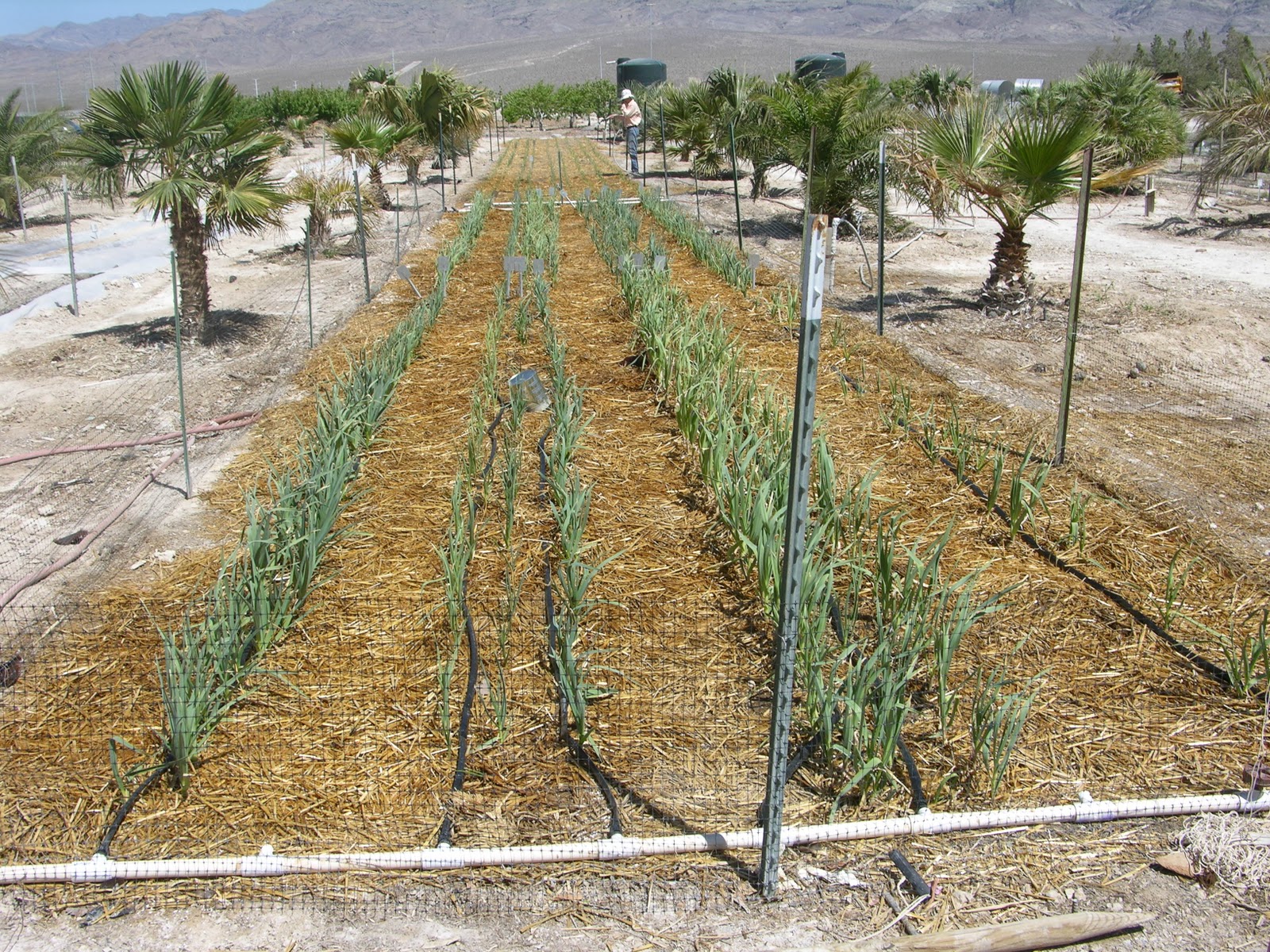
We planted garlic at the Orchard about two weeks ago. It should be in the ground and irrigated by mid-November. Garlic is planted in the late fall when the soil is still warm but the air temperature is dropping. The concept of late fall planting is to produce roots but keep the top growth from getting away from  you.

Just as a side note, we are always looking for volunteers out there. The Orchard has a “learn-by-doing” philosophy.

The soil was prepared for garlic with compost and a good starter fertilizer high phosphorus. Rocks larger than a golf ball are being removed from the planting beds. Since garlic is a root crop, we must have good drainage. The soil is being prepared to a depth of 18 to 24 inches to accommodate for these root crops. Other planting beds are being prepared to a depth of 12 inches.
Garlic plots at the orchard mulched with straw
The garlic commonly found in the grocery stores is a mild form that accommodates for the taste of the general public. However, if you like to experiment with food, the garlic palette is huge. But planting garlic from selections at the store will give you some hands-on experience if you have never grown garlic before.

You can produce a lot of garlic in a very small area and it is relatively easy to grow. They can also be produced in containers. Pick up some garlic bulbs from your local grocer and separate it into cloves. You can leave the papery outer covering still attached to the clove when planting. Next year you can order some from online vendors but for now, just get the experience of working with garlic.

One of our specialty garlics pushed for size
As I’ve mentioned before, the hardest part about growing garlic is the soil preparation. You cannot skimp on this part of the growing procedures. I like to soak the cloves for a few hours before planting if the cloves look a little dehydrated. The bottom, flat plate of the clove should be pointing down when planting. This means the pointy end is up. Space the cloves about 4 inches apart and about 2 inches deep. Firm the soil above the cloves but do not compress it with your feet. In fact, never put your feet on the prepared rows. Mulch the soil with straw or shredded paper to help keep it moist.

I like to give garlic a small amount of high nitrogen fertilizer once a month during its growing season and hold off on it the last two months before harvest (April and May). Make sure they don't go dry between irrigations when the bulbs are expanding (when you see new growth in the spring).

You should be harvesting late May or June depending on the variety. When the plant browns about 1/3 of its height then use a spading fork and lift them from the ground.

Someone's Drilling Holes in My Tree's Trunk! Or Maybe Its Borers!

Sapsucker damage on almond (Neplus)
not borers and not my neighbor's drill
Q. I have a nine year old semi-dwarf green gage plum tree in my yard. About a month ago I noticed about 20 small holes grouped together on one of the limbs. Each hole is a little less than 1/4 " in diameter. I can see no other holes on the tree. It is as if someone had taken a drill and drilled several small holes on the limb, and deep enough to get through the bark and slightly into the flesh of the tree. Any idea what may be causing this? This has never happened before. I did dormant spray the tree in early January. Do I need to spray the tree with insecticide?


A. This is most likely sapsucker damage to the tree. Sapsuckers are birds in the woodpecker family of birds that make holes in trees and feed on the sap or look for insects. I believe they are migratory here and cause damage as they pass through this part of the country.

There's the varmint! Who, me?
 If I am seeing the image in my mind correctly this is not due to insects or borers. This is what the damage looks like. The best control is to protect the trunk or limbs with wire cloth or chicken wire. We have trees that get damaged in the orchard by these birds and they have survived this way many years as long as they are healthy. It is definitely not good for the trees but there are not many other alternatives They seem to like some varieties of fruit trees more than others.

Tree Leaning Due to Shade


Q. I recently moved into a home in Henderson and I have a large back yard with about seven pine trees lining the property.  The trees are spaced approximately 8 feet apart.  I am contemplating planting fruit trees between the pines and once they reach maturity I would remove the pine trees.  What do you think about this approach?

Tree growth of young tree due to shade
A. Fruit trees will need about 8 hours of full sun to produce a goodly amount of fruit. If the trees are limited in light by the pine trees then the amount of fruit produced is affected. If you can provide near optimum light for the trees by leaving the pines then it should be fine. If the pines are too large and too close together then the fruit trees will not do well in these locations.
            If light is restricted during part of the day they will tend to grow (lean) toward the light. If most of the light is from above and shaded by trees early and later in the day then they will tend to grow upright with narrower branch angles and be less productive.
            If most of the light is coming from the east, they will grow (lean) toward the east. If light is from the west then they will grow toward the west. How light is received early in their lives determines the branch angles and the tree’s overall architecture. It is always best to give them as much free light, evenly, throughout the day as possible. In other words, I would not do it.

Plum Transplant Shock and Dieback ..Or is it?

Readers plum tree with dieback
Q. Attached are some photos of my semi-dwarf plum we just planted in September.  The left side of the tree seems to be dying.  The leaves are all browning.  We have it on a drip system along with a few other trees and shrubs which are all doing fine.  We water about 15 minutes each day. I sent these photos to the nursery and they said it’s transplant shock and it should be fine.  What is your opinion? 

A. After seeing your pictures I do not believe it is just transplant shock. Trees that large, when transplanted, go through a lot of shock which is true. It is always best to buy the smallest container size possible as it will catch up and surpass a larger tree due to a lesser degree of “transplant shock”.
            Transplant shock is when a plant has to “reorganize” and “renew” its root system as it leaves a container in a protected environment like a nursery and is put into a different, usually harsher environment.  Up to and from an
            The root system grows differently in a container than it does in the ground. When growing in a container, roots gather where there is the best water/air/nutrient environment; usually at the bottom and sides of the container.
First of all this is not my picture. I borrowed it from
Washington State University
(https://sharepoint.cahnrs.wsu.edu/blogs/urbanhort/archive
/2011/03/23/plant-containers-does-size-really-matter.aspx)
but it does demonstrate how roots grow in containers nicely.
            Once in the ground, the best environment for roots shifts and is nearer the soil surface. This results in a “reorganization” of the roots as it adjusts to this totally new soil environment. During this shift new roots grow near the soil surface and older roots deeper in the soil die resulting in “transplant shock”. The degree of transplant shock results from the condition of the plant going into the ground as well as how it was handled at planting time.
            Now on to your tree and how it was handled at planting. Hopefully you dug the hole three to five times wider than the container. It did not have to be deep, just deep enough for the roots to be planted below the soil level.
            Next, hopefully, you amended the soil going into the hole with lots of compost and a starter fertilizer to mix in the backfill. The plant should be planted the same depth as it was in the container, no deeper and staked to keep the roots immobilized.
            In one picture you sent the tree appears to be planted fairly deeply but it is hard to gauge from a picture. If planted too deeply it can kill or damage the tree.
            Next the tree must be staked to prevent movement in the wind during the first complete growing season. Sometimes on larger trees that have more severe “transplant shock” it may require a second season. The stake should prevent the movement of the roots in the soil, not necessarily top movement. This is extremely important on container trees especially older container trees.
            I don’t think 15 minutes is enough time for irrigation unless during that 15 minutes you are giving the tree at least ten or maybe 15 gallons each time.
            Thirdly, every day watering is not necessary and may cause a problem similar to what you are seeing. Every day watering is fine in containers but once in the soil there is alot more soil available to hold water so every other day or even every three days is probably adequate during the summer. Planting in the fall you probably will get by watering twice a week.
            Lastly, the tree will do much better with a thick layer of mulch around the tree extending about three feet from the trunk in all directions but keeping the mulch six inches away from the trunk to prevent the trunk from rotting.

Apricot in Rock Mulch May Mean Sap


Q.  Thanks for the response to my almond question.  I saw that it actually ended up in the paper!  Good, I hope it helped some folks.  Now I need help on my apricot tree.  I notice what appears to be sap oozing from the trunk in a couple spots.  Is this normal?  Or should I be concerned? 
Readers apricot with sap and rock mulch..
tsk,tsk,tsk...

A. Thank you for sending the picture.  On apricot, yes, you should be concerned.  On plum I would not be quite as concerned. 
            If you have been following my answers to questions in the newspaper than you know I am going to chastise you for putting rock around a fruit tree . This should be organic mulch, not rock mulch.
            Sap coming from a fruit tree does not always mean an insect or borer problem. Sap can also indicate stress. I am guessing but it looks like the tree is on the north side of a wall if the picture was taken in the morning. So we can probably ignore the chance of sunburn on the trunk.
            The tree is relatively young from the picture. I think we can narrow it down to three possibilities. Borers or boring insects are a possibility but they usually attack damaged wood due to sunburn.
            The other two possibilities are irrigation and how it was planted. Pull the rock mulch away from the trunk. It is possible to rot the trunk of the tree at soil level if mulch is placed directly against the trunk and the mulch is kept wet. Keep it at least 6 inches from the trunk.
Plum without borers losing sap after being pruned
            Once the rock mulch is pulled away from the trunk, next pull the soil away from the trunk.  Begin to pull soil carefully away from the trunk so that you do not damage it. Find the location where the roots begin to come from the trunk. That should be the depth at which it was planted.
            If these roots are deeper than ½ inch more than this, pull the soil away from the trunk and keep it away. Planting a fruit tree too deeply can cause a disease to begin called collar rot which can also cause sap to ooze from the trunk.
            The third thing is watering too often. Shallow, frequent irrigations can cause root dieback which can lead to stress which can lead to sap oozing from the trunk. You should not be watering daily. You should be watering deeply and less often. I hope this helps.

Monday, October 24, 2011

My Top Choices in Fruit Trees for an Edible Landscape


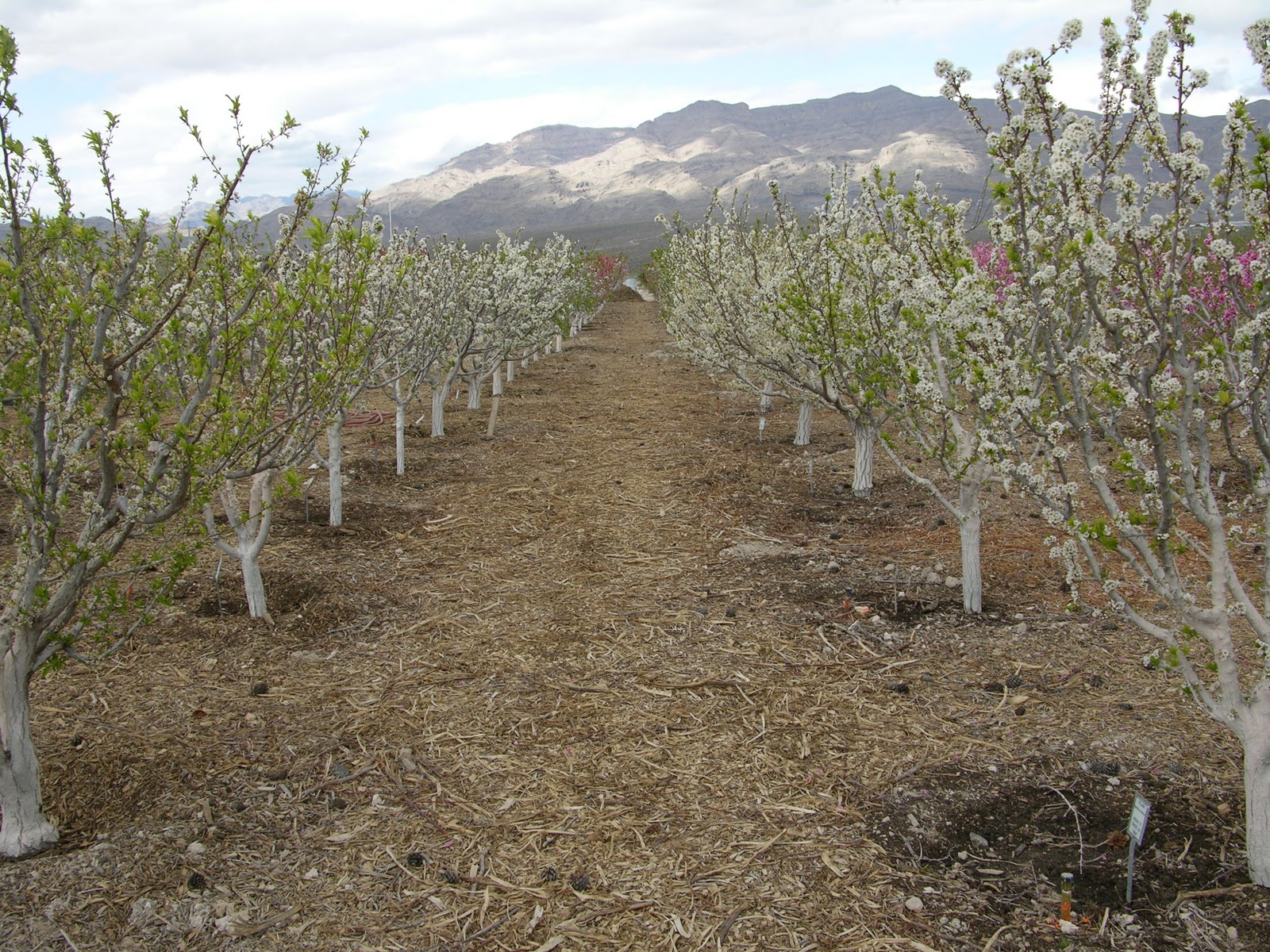
I have been tracking how fruit trees have been performing at our Orchard in North Las Vegas for fruit quality and how good they would be dual purpose; ornamental and fruit production. Here are my choices for an edible fruit tree landscape.

Almonds in bloom
Almond. Garden Prince or All-in-One. Both are smaller trees than a standard almond and self fruitful, you dont need a pollinator tree. Garden Prince has a slight edge because its flowers have a purple tinge rather than all white. The nuts are fabulous in size and taste. Try using them as green almonds in salads.


Peach. Red Baron. On a five point scale (there are only a handful of trees that EVER make five points at our Orchard) this is a solid 4,0. What puts this tree "over the top" are its flowers. They are are a gorgeous almost neon red/orange.
Red Baron peach


Nectarine. Arctic Star. I don't care to grow apricots that much in the Orchard because of the potential scarring of the fruit by the Western Flower Thrips but this fruit scores a 5.0! OMG. It is hands above the other nectarines in the Orchard. We spray with Spinosad (an organic pesticide) to keep the flower thrips at bay and the Mario Batali chefs come out to pick it for sorbet. Try this with fresh mint sometime. Brix will hit over 20. Thin so fruits are four inches apart.


Wonderful pomegranate not quite ripe
Pomegranate. Wonderful. Wonderful has beautiful fruit color and aril (seed) color and it is a lovely plant if pruned into a single or multiple stem tree, not a shrub. There are other pomegranates to consider for the quality of the fruit but if you wait till Halloween to pick the fruit or later you will not be disappointed. Put the fruit in the fridge an extra week or two. Try it and let me know how you like it. Make sure you thin the fruit so that only one fruit arises from a single location. This will give you cannonball sized fruits on older wood.


Jujube 'Contorted'
Jujube. Contorted. Remember this is for ornamental value as well as fruit. So when the leaves drop in the winter the branches have this beautiful contorted form and the fruit is great as well. Remember, Jujube will sucker ten to fifteen feet away or closer to the mother plant. Anywhere there is water it will sucker. There are not lots of these suckers so take a sharp shovel and sever the suckers from the mother plant in the fall and replant them or use them for decoration.


'Pink Lady' apple
Apple. Pink Lady on M111. Another 5.0! Martha Stewart said of this fruit from our Orchard grown in the Mojave Desert "It is the best apple I have ever had!" This tree will stay pretty small if you keep it under control by winter pruning. We have kept it at 6 1/2 feet for 17 years. The fruit exposed to sunlight will turn red by early to mid November with Brix levels hitting 20! Thin to one fruit per cluster. If extremely heavy set, then thin by removing some fruit too close together so spurs have no fruit.


'Sensaton Red Bartlett' pear
Pear. Sensation Red Bartlett. The color of the fruit in the fall when it is ripening are a great red color and the flavor is phenomenal. When you grow European pears in the desert expect they will not be perfectly smooth skinned. That is what distinguishes a desert European pear from the tame pears of the Northwest and other locales. Thin to one fruit per fruit cluster.


Asian Pear. Chojiro. If you spend some time thinning Asian pears there is no reason you cant get the same size and flavor you could if it were growing in Japan. Thin to one to two fruit per branch very early for some very sizable Asian pear fruits.


'Fuyu' persimmon
Plum. Weeping Santa Rosa. We actually removed the weeping Santa Rosa plums from the orchard a few years ago because the weeping branches were getting in the way of harvest BUT the weeping form is beautiful and Santa Rosa plum is a very reliable and delicious soft plum for the desert.

Persimmon. Fuyu. Fuyu persimmon is nonastringent so you can eat them when they are still very firm and orange in color OR you can leave them on longer and let them turn bright red, like Christmas ornaments, after leaf drop.

A large fig at the orchard
Fig. Yellow, Kadota; Dark, Black Mission. Figs make a beautiful landscape tree and can be cut back in the winter to just about any size you want. Save the wood for grilling and smoking. It is great used with chicken.

Gold Kist Apricot on Nemaguard a Great Choice for Home Landscape


Q. Before I plant my apricot tree this spring, I would like to know how much space I should allocate for it. Does a Blenheim apricot lend itself to close pruning?


Gold Kist apricot on Nemaguard rootstock kept at 6 1/2 feet
for the past 17 years with very little pruning each year
A. The size of an apricot tree depends on the variety and what roots it is growing on. An apricot on its own roots can be quite large, over 20 feet tall and quite a bit more. When a variety is grafted onto a rootstock there is usually some dwarfing that goes along with that. Although in the case of apricots the rootstock is not usually chosen for its dwarfing characteristics.

The amount of space you allocate for your apricot depends on how you manage it. We keep all of our apricots at the orchard at 6 ½ feet in about 7 feet wide all of their lives. This size control is mostly done by pruning. You can do this with any apricot but some stay naturally small more than others.

An excellent selection is Gold Kist apricot grafted on Nemaguard rootstock.  This apricot on this rootstock stays naturally small and provides very high quality fruit.

Rhubarb a Real Challenge to Grow in the Hot Desert

Q. We had a cattle ranch in Glade Park, Colorado, at a 7,000 foot elevation and had a terrific stand of rhubarb that was estimated to be 50+ years old.  We sold the ranch in 2010 and transplanted some starts eventually to Mesquite, Nevada. We have seven starts now and none has produced any usable product.  Some of the starts grew a leaf about the size of a Frisbee but grew no higher than ground level.  The rest of the starts grew a single stock of about 4" high.  Now, the starts looked dormant. Is there anything we should do other than fertilize and water?
Compost pile at the orchard using horse manure

A. We also tried to grow rhubarb at our orchard. We did not have much success. Admittedly, we did not do a very good or thorough job in managing the plants so I was not ready to throw in the towel. The common agreement among gardeners and horticulturists is that rhubarb is out of it’s appropriate climate in the hot desert. This is very true. The common explanation is that the plant doesn’t have enough chill hours or our just too hot climate.
Compost added to plots in the second year
before tilling it in

Just because this is the common agreement does not mean that it is necessarily true. We have grown things at the orchard which are not supposed to grow here. There are some management techniques that we can try to see if we can get it to grow here. There is no guarantee that if we can get it to grow in the hot desert and in our soils or what the quality of the product might be if it is successful.

So the first thing to do is soil improvement. This would mean lots of additional compost added to the soil along with the right fertilizers. So make sure that any compost you use is the highest quality you can find.  This means make it yourself. If you can’t make it yourself, then purchase one that comes in bags that has a good reputation.

Don’t be afraid to add lots of it, over 50% of the blend in the backfill using a native Mojave Desert soil.  Mixed with your garden soil add a high phosphate starter fertilizer. I would also add a good quality iron chelate. This should get your garden soil up to speed. Garden soils amended from desert soils can take a couple of years of growing to get up to prime.
Hoophouse with 30% shade. It does not look like enough
shade but it is about right for flowering/fruiting vegetables
The next thing I would do is try to put it in an area that is not excessively windy and does not have a lot of reflected light or heat. The north or east side of the building would be ideal. I would try it first without any shade over it. If the leaves are scorching during the heat of the summer and the plant seems stunted I would put some shade cloth over the plant.

Do not use more than 30 or 40% shade when purchasing a shade cloth. With leafy crops such as leafy vegetables or rhubarb could go higher but certainly never go into the 60 or 70 percent shade level.

Fall and Early Spring Are Great Times to Plant Fruit Trees


Q. Is there a link on your blog that I am missing with all your fruit tree recommendations? How long will it be before a bareroot fruit tree produces fruit? Should I still be planting fruit trees in January if I am buying something at a local nursery?
My blog with the search engine you can use to find things

A. On my blog at Xtremehorticulture of the Desert there is a search engine at the top of the page. It says, “Search This Blog” with a long box under it. To the right of the box it says “Search”. Enter the words “fruit tree recommendations” in the box of the search engine and click “Search”. That should bring up my recommended fruit tree list.

If you can find the variety of fruit tree you want at a local nursery then please buy it. Our local businesses can use your help. However if you cannot find a variety of fruit that you feel will give you the quality of fruit that you want then you might consider buying a bareroot selection.

Arrival of bareroot fruit trees to the orchard in January from
Dave Wilson Nursery
The reasons the Orchard is involved in selling fruit trees are two reasons. First, local nurseries did not have an extensive supply of fruit trees we recommended. Secondly, none handled any bareroot trees. Bareroot plants grow more quickly when planted, will overtake a container plant in growth or production and are less expensive.

On the downside for the nursery, there are more plant deaths by homeowners because they do not handle or plant bareroot plants correctly which leads to unhappy customers. Plus nurseries have better profit margins on container plants than bareroot materials.

Bareroot trees come into production at about the same time as container plants because the bareroot plants “catch up” to container plants quickly and have less overall shock if handled correctly.

When a tree comes into fruiting or production depends on the type of fruit tree. Peaches and nectarines come into production about the earliest. Trees that produce fruit on spurs, like apricots, plums, apples and pears, are usually a year or more later. You can plant in January here, no problem.

My Pomegranate is Splitting; Should I Pick?

Q. My pomegranate fruit is splitting (early October), should I pick them now or wait until November?
This pomegranate has great color and is splitting.
Time to get it off the tree before it splits more and birds
and bugs get into it.

A. As far as your pomegranate goes, anytime they begin to split and as close to their harvest time it is a good idea to get them of the tree. A number of birds, insects and diseases will take advantage of the pomegranate fruit once it is split. Depending on the variety, harvesting can occur from September through November.

Early Leaf Drop (October) in Modesto Ash


Q. My 18 year old Modesto ash tree has been dropping green leaves for maybe 2 months now.  Unlike my other 2 Modesto ash trees that had entire branches die last summer and the dead leaves wouldn't even blow off. Any ideas?
Limb dieback for unknown reasons in Modesto ash

A. There could be a number of reasons for early leaf drop off but if your tree seems healthy and has been growing well then I would ignore it. Just make sure that it is getting deeply watered if it is in a rock landscape. Fertilize it once in January or February; there is no need to fertilize it more than that.
Probably the biggest problem is putting ash trees in rock landscapes. Modesto ash has problems of its own here in our valley so you may experience limb dieback at some point in its life. I do not recommend it for our valley anymore because of this.
Large ash tree in a lawn. You must overwater the lawn
so that large trees like these get enough water.

Also remember that as ash trees get larger they require more water. The amount of water required is not a simple doubling of the amount as the tree doubles in size. For trees, the amount of water the required is much more complicated than a lawn.

Sunday, October 23, 2011

Order Your Bareroot Fruit Trees Now!

            The deadline for ordering bare root fruit trees for a January or February delivery date will be in about two weeks. They will be ordered from my recommended fruit tree list. This list can be obtained by emailing me at Extremehort@aol.com or here on my blog.

RLLM

Thursday, October 20, 2011

Will Feeding Ourselves Be the Crime of the Century in Wisconsin and Elsewhere?


Wisconsin: No Right to Produce or Eat Food

NONAIS.org
Tuesday, September 27, 2011


In scary legal news a Wisconsin judge had gone completely loopy declaring that citizens have no right to produce or eat the foods of their own choice.


In response to a request from the Farm-to-Consumer Legal Defense Fund, the judge issued a clarification of his decision last week regarding his assessment of the constitutionality of food rights. The judge expanded on his original statement that such constitutional issues are “wholly without merit.”

He explained that the FTCLDF arguments were “extremely underdeveloped.” As an example, he said the plaintiffs’ use of the Roe v Wade abortion rights case as a precedent does “not explain why a woman’s right to have an abortion translates to a right to consume unpasteurized milk…This court is unwilling to declare that there is a fundamental right to consume the food of one’s choice without first being presented with significantly more developed arguments on both sides of the issue.” Gee, I thought they both had to do with the right to decide what to do with your own body.

As if to show how pissed he was at being questioned, he said his decision translates further that “no, Plaintiffs to not have a fundamental right to own and use a dairy cow or a dairy herd;

“no, Plaintiffs do not have a fundamental right to consume the milk from their own cow;”

And in a kind of exclamation point, he added this to his list of no-nos: “no, Plaintiffs do not have a fundamental right to produce and consume the foods of their choice…”

You have to wonder if maybe even the regulators are getting a tad uncomfortable with the rulings coming from the nation’s judiciary on food rights. Many of these individuals, biased as they are against raw milk, dabble in farming to some extent, or grew up on farms. This judge has gone way beyond what many of them have come to assume–that everyone has the right to own a cow and consume its milk Even in places that ban raw milk sales, there’s nearly always a provision in state law that anyone who owns a cow has the right to consume its milk.

It seems Judge Fiedler is saying it’s not a “fundamental right,” but rather a right granted us by the state.
-The Complete Patient

The original judgement can be seen here. To quote from the main points:
1) no, Plaintiffs do not have a fundamental right to own and use a dairy cow or a dairy herd;
2) no, Plaintiffs do not have a fundamental right to consume the milk from their own cow;
3) no, Plaintiffs do not have a fundamental right to board their cow at the farm of a farmer;
4) no, the Zinniker Plaintiffs’ private contract does not fall outside the scope of the State’s police power;
5) no, Plaintiffs do not have a fundamental right to produce and consume foods of their choice

A FOOD CHAIN RADIO RELEASE FROM METROFARM.COM
Across the nation armed government SWAT teams arrest private citizens for buying and selling fresh whole foods from each other. This leads us to ask…

This Saturday at 9am Pacific, the Food Chain Radio show with Michael Olson hosts Mali McGee from the Milk Mama Goat Farm for a conversation about private food clubs.

Topics include how private citizens are organizing to feed each other; why government is raiding these private food systems with armed SWAT teams; and how Mali’s milch goats inspired one county to recognize the right of people to grow and eat their own food.

Listen on your radio, computer or IPOD: Food Chain Radio

Monday, October 17, 2011

Order Your Bare Root Fruit Trees Now for January 2012 Delivery

The UNCE Orchard is taking orders for fruit trees to be delivered in January. These will be bare root fruit trees selected from our list of recommended fruit trees for our valley. Please email me at Extremehort@aol.com for more information.

Fruit trees will include peaches, plums, apples, pears, almonds, pluots, and others. We will only be ordering from our list of recommended trees due to ordering restrictions that varieties must be ordered in multiples of fives. All trees will be shipped from Dave Wilson Nursery.

Chill Hours May Not Be As Important As We Think When Selecting Some Fruit Trees


Q. I am in the process of ordering a couple fruit trees online. What are the chill hours for Sun City Anthem in Henderson?  I thought it was 300 hours or less. A couple of apricot trees you have recommended have been 400 and 500 hours (Blenheim and Royal Rosa) and I am wondering if that is too many chill hours of my area.

Apricots grown at the UNCE Orchard
A. Chill hours are the number of hours at low temperatures during our winters so that the tree “recognizes” that winter has arrived. It can be important in commercial production but in home orchards it seems to be less important on some types of fruit trees.

            On peaches and apricots in particular we have not seen a big impact from a lack of chill hours in our area. We have varieties in the 800 to 900 hour range that have done well.

            I would be most concerned with how the fruit develops in our climate. The recommendations on my list have all proven themselves for a decade at the orchard. I do not release names of those varieties that have a track record of only a couple of years. They remain under test even if they show extremely good potential.

            One variety of peach has been recommended by volunteers at the orchard because of some good qualities in the first year of production. This is way too soon to tell. I prefer at least five years of good production. I hope this helps.

Tree Dieback after Converting Lawn to Desert Landscaping


Q. I am writing because of a problem I have with my 20 year old, long needled pine (I forgot the name). The needles are 6-7 inches long and fluffy.

Long needles of chir pine
            When I converted my lawn to drip, the pine began to turn brown in several areas.  I added more and more drippers. After four years, this poor pine, once a beautiful, fluffy tree, is now in serious trouble.

Dieback of large tree after converting lawn
to desert landscaping

            Many small branches and a few medium sized ones have died back. Every spring, it has rallied and I think it will be okay but, by the end of the summer, it looks very sad. Is there anything more I can do to save this tree?
A. I am guessing you have Chir pine. This pine is beautiful and does very well here provided it gets enough water and at the right times. When they are growing in a lawn their roots can extend long distances from the trunk and in home yards typically close to the soil surface.

            If they were growing in a turfgrass landscape converted to desert (drip) they frequently do not get enough water after the conversion. They first suffer needle drop resulting in a thinned canopy, needle tips brown, growth slows and then limb dieback begins. I think this is what is happening to your tree all due to the conversion resulting in the big trees not getting enough water.

            The water previously supplied by watering the lawn is frequently substituted with six to eight drip emitters placed fairly close to the trunk. You will need to provide more water to the tree and in many more locations to compensate.

            These are big trees and big trees require lots of water even if they are considered lower in their water use than perhaps other large trees. There is no research to tell us how much water this tree will require during an irrigation but I would assume it would probably be in the 100 gallon range or more per irrigation, evenly distributed over its root system.

            I personally don’t think trees that get over 20 feet tall should be on drip but on bubblers with a basin (depression or moat) surrounding the trunk. This depression should be large enough to hold enough water to keep the tree in good health and penetrate to a depth of 24 inches after an irrigation.

            Some people have suggested using inline drip irrigation in concentric rings around the trunk. Perhaps. But devices do not apply water, people do and people must make the decision about how much to apply and where to apply it. Drip irrigation can be deceiving because it takes hours to irrigate instead of the minutes we are used to when we water a lawn.

            Another possible approach would be to plant other plants heavily under the dripline of the tree for additional water. No one likes to do this because you have to fight with tree roots to plant.

            To save the tree you need to be proactive now. Apply water under the canopy to a depth of about 24 inches during each irrigation. Couple this with an application of fertilizer next February. You will not see improvement at this time of year from applying more water as most trees are going into dormancy. With properly placed, deep irrigations you should see a change next year during the growing season. You should see a big change in 2013.

            As it sounds to me, if you do not change your irrigation system and how you are watering you will lose the tree. We have lost MANY trees in this valley when landscapes are converted to desert landscapes principally because the irrigation system supplied to established large trees is under engineered. Most do not understand this or will not do it right because it is “too expensive”.