Type your question here!

Sunday, November 3, 2013

Fig Limbs Hollow and Not Because of Borers


Q. I have a fig tree that is close to 30 years old. It was getting out of control so I have been pruning it. I noticed some holes in the trunk but as I am cutting the branches I find that some are completely hollow inside.  Other than a few dead areas that I am pruning out, the tree looks generally ok and is putting out new growth, even from the hollow branches. Since the main trunk seems to be involved I can’t really cut out all the part that is affected.  Can you tell me what is causing this and if there is anything that I need, or can do about it???  I noticed the hollow where I had cut out a branch from the trunk a long time ago, but did not worry about it.    I would like to save the tree, it has sentimental value and provides needed shade.   I have attached some photos.  
Readers fig tree with hole in the trunk

A. Your pictures through me for a loop a bit. I have not seen that on fig before but I have seen something similar on other trees. I knew it was not from borers but I was not sure why you lost the center of your fig trees.
            When trees grow, they grow both upward and in girth. We know that upward growth is from the buds on trees. Growth in girth is not as obvious. Growth in girth is from some cylindrical layers just under the bark.
            As a fig tree gets fatter, the center of the tree dies. As it continues to grow fatter and fatter, the dead wood in the center of the tree gets larger and larger. As long as the tree remains healthy and doesn't get any infections, the deadwood in the center of the tree remains intact.
            On some occasions, organisms such as fungi and bacteria can invade the center of a tree and begin feeding on this dead wood. These organisms are almost always feeding only on deadwood and not the living parts of the tree.
Fig limb hollow
            So these organisms technically are not disease organisms but wood-rotting organisms. Since the center of a tree is dead, these organisms continue to feed on this dead center of the tree and can hollow out a tree very effectively. I think we have all seen pictures or cartoons of animals living inside of trees. Well, this can actually happen.
               The center of the larger trunk and branches of a fig tree are filled with dead wood that is fairly soft and pithy. Once these wood-rotting organisms get going they will clean out that central core of large branches and the trunk. The living portion of the tree is unaffected.
               What you have is not a borer problem but a wood rotting process going on. There is nothing you need to do about it but keep in mind that these branches may snap more easily than branches which do not have the central core hollowed out.
            This is one of the reasons I emphasize so strongly to clean your pruning saws and pruning shears before you start pruning. It is best to clean and sanitize them between each tree, not necessarily between each cut unless you know the limb is diseased.

Tree Selection for Mesquite Nevada


Q. Can you suggest some trees that could be planted in the Mesquite, Nevada, area?

A. I am not trying to avoid your question about a recommended tree. However I do not like to recommend trees to homeowners because the selection of trees is not purely logical, it can be emotional as well. I do not know what trees you like or do not like and I do not know what is available to you.
Trees out of scale with the house. They shade the roof okay but we really want to shade the west and south facing walls where the insulation is not as thick and has a lower R value.
            Because trees can require a lot of water, tree selection can also have a huge impact on our natural resources. If you can come up with four or five trees that you like I can help you from that point.
            Try to base your selection on the size, whether you want deciduous or evergreen and whether it should flower. The size of the tree should be in scale with your house. If your house is single-story, it should be no more than 20 to 30 feet tall when it is mature.
            Big trees use more water than little trees. If your water bill concerns you or might concern you in the future, use smaller trees and use fewer trees. Trees in the desert should shade South and West facing walls or windows on those walls when possible.
            Woody plants are deceiving in their water use. They don't use much at first when they are small but when they get bigger their water use goes up proportionately. Just what that proportion is depends on the type of tree it is. There is no clear cut answer for that.
            If they are being used for shade it is best to select deciduous trees, trees that lose their leaves in the fall. If the trees are going into desert landscaping, it would be best to select desert trees. If the tree is going into a lawn area or an area that we consider to be high water use such as a sitting or patio area than you do not need to use desert trees. Make sure your trees are hardy in Mesquite to at least the mid teens in the winter. I hope this helps.

Chili Peppers a Good Crop for the Mojave Desert


We had such great luck with chili peppers last year I thought I would compile this information for you on the types of chili peppers. It is too early yet to say that our climate is good for chili peppers but I thought last year was a good indicator that we should continue to test them. 
 
Field grown peppers in Sonora, Mexico

There has been some interest by volunteers to pursue the Hatch type of chili pepper at the UNCE Orchard. So I thought I would compile this list of types of chilis for reference. We will be looking more closely at chilis this coming year and for several years ahead. Remember we need about three years worth of good data to make recommendations but at this point the peppers look promising. 
 
Field grown peppers bagged for shipment in Sonora, Mexico

If you have interest in chilis I would highly recommend that you visit the Chili Pepper Institute’s website at New Mexico State University and can be found at http://www.chilepepperinstitute.org

Types of Chili Peppers

Pasilla chili pepper: 250 - 3,999 Scovilles: Pasilla or "little raisin" properly refers to the dried chilaca pepper. The chilaca, when fresh, is also known as pasilla bajio, or as the chile negro or "Mexican negro" because, while it starts off dark green, it ends up dark brown. It typically grows from 8 to 10 inches long.

Paprika chili pepper: 250 - 1000 Scovilles. A large, cone-shaped chili pepper. It is dried and ground to make the more familiar powdered spice.

Santa Fe Grande chili pepper: 500 - 700 Scovilles. Also known as the yellow hot chile and the guero chile. Approximately 5 inches long and ripen from greenish-yellow, to orange-yellow to red.

Anaheim chili pepper: 500 - 1,000 Scovilles. Also known as the yellow hot chile and the guero chile. Approximately 5 incheslong and ripen from greenish-yellow, to orange-yellow to red.

Poblano chili pepper: 1,000 - 2,000 Scovilles. The poblano is an extremely popular chili peppers. 4 inches long, very dark green in color, ripening to dark red or brown.

Ancho chili pepper: 1,000 - 2,000 Scovilles. An Ancho pepper is dried form of the poblano chili pepper.

Hatch chili peppers: 1,000 - 2,500 Scovilles. Hatch chili peppers are grown and harvested in Hatch Valley, New Mexico. They are harvested in late July and early August and have a mild to medium flavor. The peppers are long and curved, much like the Anaheim chili pepper, and are perfect for stuffing.

Cascabel chili peppers: 1,000-3,000 Scovilles. Capsicum annuum. The Cascabel Chile is grown in several areas of Mexico. It is small and round, 2-3 cm in diameter, and matures to a deep red.

Picuante/ Peppadew chili pepper: 1,177 Scovilles. Capsicum baccatum. The Peppadew is grown in the Limpopo province of South Africa, and is actually the brand name of sweet piquanté peppers.

Aji chili pepper: 1,177 - 75,000 Scovilles. Also known generally as the Peruvian hot pepper, aji is the common name primarily in South America and areas of the Caribbean for chili peppers.

Mulato chili pepper: 2,500-3,000 Scovilles. Capsicum annuum. The Mulato is a mild to medium dried Poblano, similar to the Ancho, but with a slightly different flavor.

Guajillo chili pepper: 2,500-5,000 Scovilles. Capsicum annuum. The Guajillo is one of the most common and popular chiles grown and used in Mexico. It is mild to moderately hot, and has dark, reddish brown, leathery skin.

Jalapeno chili pepper: 2,500 - 8,000 Scovilles. The world's most popular chili pepper! Harvested when they are green or red if allowed to ripen, about 4-6 inches long. A chipotle is a smoked jalapeno chili pepper.

Chipotle chili pepper: 2,500 - 8,000 Scovilles. A chipotle is a smoked jalapeno chili pepper. You'll notice the distinctive smoky flavor of certain foods like salsas that have been prepared with chipotle peppers. Very delicious.

Morita chili pepper: 2,500 - 8,000 Scovilles. A smoked red jalapeno, similar to a chipotle pepper.

Fresno chili pepper: 2,500-10,000 Scovilles. Capsicum annuum. The Fresno pepper looks and tastes almost like a jalapeno, but they can be much hotter. Fresno peppers change from green to red as they grow, and increase in hotness, but they are often harvested and sold as green.

Serrano pepper: 5,000 - 23,000 Scovilles. A smaller version of the jalapeno, similar in color, but smaller, about 1 to 2 inches long, 1/2 inch wide. Dark green to redish in color. Getting spicier!

Bishop’s Crown chili pepper: 5,000-30,000 Scovilles. Capsicum baccatum. This chile is a member of the Capsicum Baccatum species, which includes the Ají pepper.

Aleppo: About 10,000 Scovilles. Capsicum Annuum. The Aleppo pepper, also known as the Halaby pepper, is named after the city of Aleppo in Northern Syria. It is commonly grown in Syria and Turkey, and is usually dried and crushed.

Chile de Árbol chili pepper: Sources rate this chile in 2 categories- 15,000-30,000 and 50,000-65,000 Scovilles. Capsicum annuum. Chiles de Árbol are small and thin Mexican peppers, growing to 2-3 inches long and less than a ½ inch wide.

Tabasco pepper: 30,000 - 50,000 Scovilles. Yep, this is the chili pepper used in Tabasco sauce. The fruit is tapered and under 2 inches long. The color is usually creamy yellow to red.

Cayenne pepper: 30,000 - 50,000 Scovilles. A thin chile pepper, green to red in color, about 2 to 3 inches long. The "cayenne pepper" spice you use is the dried, ground version of this pepper.

Chile Pequin chili pepper: 30,000-60,000 Scovilles. Capsicum annuum. Also spelled Piquin, this chile is also called Bird Pepper, because it is consumed and spread by wild birds.

Rocoto chili pepper: 30,000 - 100,000 Scovilles. AKA the Manzano pepper. This chili pepper is normally found in South America. It is among the oldest of domesticated chili peppers, and was grown up to as much as 5000 years ago. It is probably related to undomesticated chili peppers that still grow in South America.

Guntur Sannam chili pepper: 35,000-40,000 Scovilles. Capsicum annuum. The Guntur Sannam chilli is grown in and around Guntur and Warangal in the state of Andhra Pradesh in India.

Tien Tsin pepper: 50,000 - 75,000 Scovilles.  The Tien Tsin is named after the province in China where its harvest originally took place. 

Chiltepin chili pepper: 50,000 to 100,000 Scovilles. Capsicum annuum. The Chiltepin, or Chiltepine, is a tiny, round or oval shaped, red to orange-red chile, measuring about .8cm in diameter.

Thai chili pepper: 50,000 - 100,000 Scovilles. Despite the common belief, there is no single "Thai chili pepper" though most candidates for the title are small in size and high in heat or pungency. There are at least 79 separate varieties of chili that have appeared from three species in Thailand.

Dundicut chili pepper: 55,000-65,000 Scovilles. Capsicum annuum. These small, round chili peppers from Pakistan grow to about ½ inch to 1 inch in diameter, and are dark red in color.

Scotch bonnet: 100,000 - 350,000 Scovilles. This pepper is a cultivar of the habanero and is among the hottest peppers anywhere.  Its name derives from its resemblance to the Scottish Tam o’ Shanter hat, though it appears primarily in the Carribean and in Guyana and the Maldives.

Habanero chili pepper: 100,000 - 350,000 Scovilles. Related to the Scotch Bonnet. This one is the granddaddy of all the hot peppers in terms of heat level. Grown mainly on the Yucatan Peninsula in Mexico, its coloring is yellow-orange, orange or bright red, depending upon when it's harvested. Average Size 1 to 2 1/2 inches long and 1 to 2 inches diameter and tam-shaped.

Caribbean Red Habanero: 300,000 - 475,000 Scovilles. This extremely hot pepper, originally from the Yucatan peninsula in Mexico, is now also cultivated in the Carribean and around North America.

Red Savina Habanero: 200,000 - 580,000 Scovilles. This pepper is a cultivar of the habanero.  It once held the Guinness Record for the hottest chili pepper, but the Bhut Jolokia now claims that prize. 

Bhut Jolokia: 1,001,304 Scovilles. Now, truly the hottest chili pepper around!

Naga Jolokia - It's just another name for the Bhut Jolokia chili pepper.

Ghost Pepper or Ghost Chili - It's just another name for the Bhut Jolokia chili pepper.

Naga Viper - 1,359,000 Scovilles. A hybrid created in late 2010, this pepper is hotter than the Naga Jolokia (or Bhut Jolokia) by 300,000 Scovilles.

Tuesday, October 22, 2013

Membership Climbing Fast in Desert Horticulture Discussion Group


This is a discussion group for all of you who want to exchange ideas about desert horticulture... a very different breed of gardening. You have to know what you are doing to be a good desert gardener and it will test your limits!

  •   Attachments are permitted. You can post pictures (approval is necessary), documents and all sorts of things that you think might help members.
  • No spamming. If you have a product you are selling its okay but you have to be pre-approved. The best way to promote a product is to participate as a member and gain peoples trust regarding your level of knowledge and a products benefit.
  • Members cannot hide email address. We will ALL know who you are! This is a community, not a place to hideout.
  •  Listed in Yahoo! Groups directory. People can search and find this discussion group.
  • Membership requires approval. The Administrators must approve you before you can see posts or comment.
  • All members can post messages.

Rabbits Do Not Jump Over Fences


Q. We are planning a wall to surround our yard so we can keep the rabbits out. We live in Sun City Anthem in Henderson. We have been told that the local rabbits can jump very high, and our three foot wall will not work to keep them out. Can you let me know? I want to build it at least that high, and maybe a little higher.


A. I don’t agree with the advice you were given. Our chicken coop wire (with 1 inch holes) at three feet tall was very effective at keeping them out of our vegetable plots as long as they could not lift the bottom edge of it with their noses or dig a little bit and get under it.

            However, baby cotton tails can squeeze through a 1 inch hole at a dead run.

            Usually animals will not jump walls if they cannot see the other side. If they can jump to the top of it and look, then that is different. I have never seed rabbits do that.

            But check and make sure there are no gaps in the wall itself. If they can get their head through a hole, they can get the rest of their body through it as well. We had to bury our chicken wire only about two inches deep to keep them from getting under it.


Fixing holes in rabbit fence around vegetable plots at the UNCE Orchard

Recommended Varieties of Almond, Pluot, Nectarine, Pear for Hot Desert Climates


Q. We have had several trees die over the past year so we are looking for replacements that will do well here.  We do have a Kiefer pear which produces really small, rock hard pears that never seem to ripen. Some suggestions please for almond, nectarine, pluot and apricot.


A. If I were to plant only one almond tree, it would be Garden Prince. It is smaller than the other almond varieties and the flower is a beautiful purplish white instead of plain white. For a home landscape that needs a smaller-sized tree, beautiful flowers and wonderful nuts, Garden Prince can't be beat. It is self-pollinating so doesn't need a second almond for pollination.
Almonds in bloom at UNCE orchard

            Arctic Star nectarine has a remarkable flavor in our climate. It is floral, buttery and one of the best fruits I have ever tasted. It makes wonderful sorbet. But you must remember that you will have problems with thrips with that will result in horrible scarring of the fruit if you don't keep it under control. It must be sprayed.
Nectarines at the UNCE Orchard.

            Remember that pluots require a pollinator tree for improved fruit set. A good pollinator for pluot is also a great plum for our area called Santa Rosa. If you already have a Santa Rosa plum or your neighbor does, you don't need a pollinator tree for pluot.

            Among the pluots, the best tasting in my opinion is Flavor Supreme. Second on my list would be Flavor King. The problem we have had with Flavor Supreme is low fruit production even with a pollinator. Flavor King has such a large fruit set, it must be thinned.
Flavor Supreme Pluot at the UNCE orchard

            The second problem with all pluots is our late spring freezes in the developmental fringes of our valley which are typically colder.

            When we get a freeze and they are in flower, you probably will not get any fruit that year. So expect fruit in two or three years out of every five if you live in these colder fringe areas of the Valley.

            A great apricot, that is not really an apricot but a cross between an apricot and plum, is the aprium. The fruit looks identical to and is marketed commercially as an apricot. It has flavor attributes of plum and apricot in the fruit. The best aprium out there is called Flavor Delight which will be available from the UNCE Orchard.
Flavor delight aprium 15 yrs old kept at 7 feet height at the UNCE Orchard

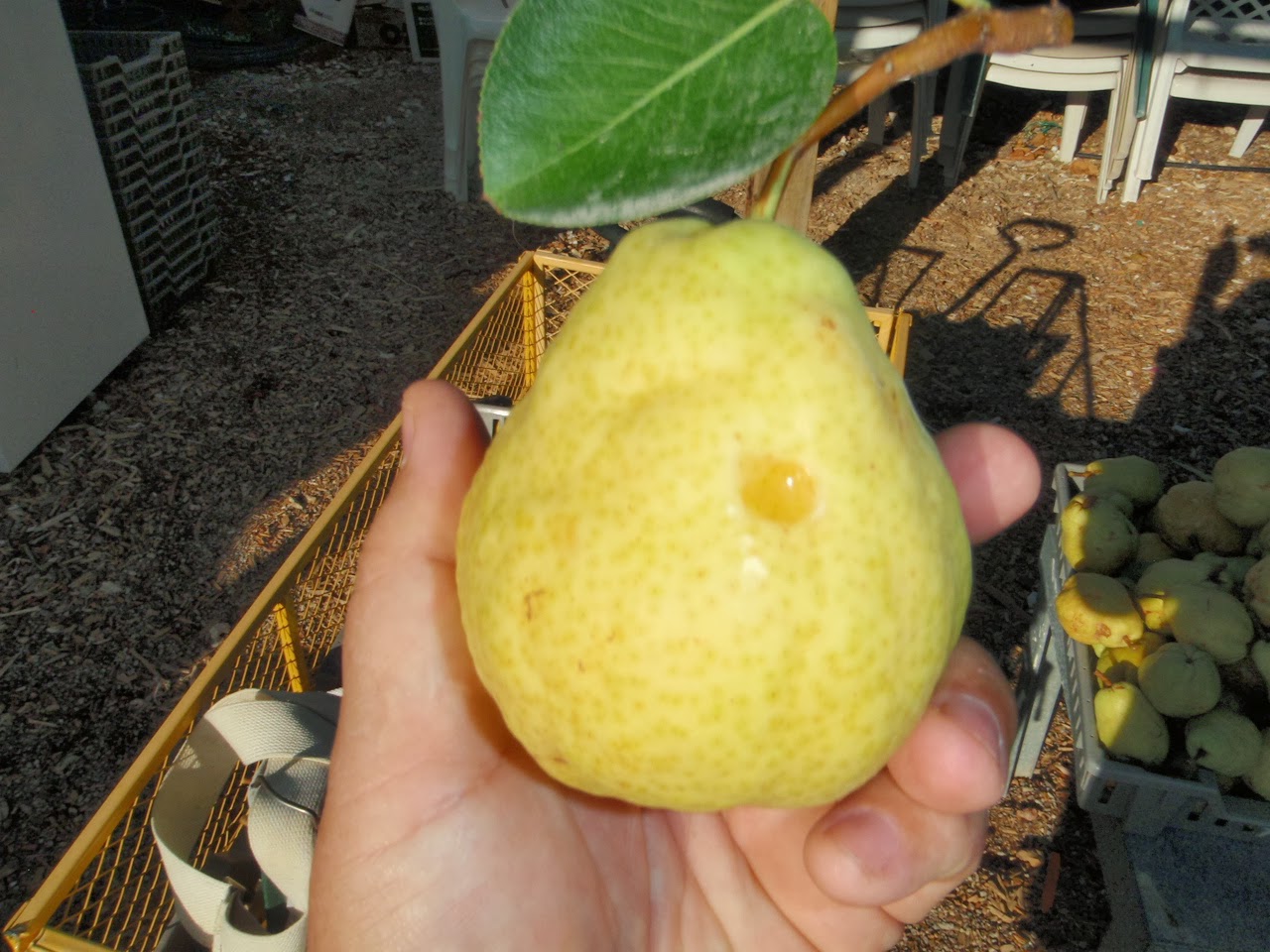
            Your Kiefer pear is very different from pears like Bartlett or d’Anjou which are desert pears. Desert pears will get soft and buttery in texture if you harvest them slightly early and let them ripen at room temperature off the tree. Kiefer pear is a salad pear that is also great for canning and used in stuffing for fowl like turkey or chicken.
Keiffer pear ready for harvest. Note the color change.
            Kiefer pear should be harvested just like you would a desert pear. To judge when to harvest I use a change in color of the fruit and smell. The fruit color will change from green to yellowish green and you will detect a distinct pear aroma from the fruit. They will still be hard when harvested.
Bartlett pear ready to be eaten and should not be harvested at this stage but earlier when there is still a hint of green

            You can also sacrifice a fruit and to cut it open and check the color of the seeds. They should be dark brown when the fruit is ready to harvest. But if you compare Kiefer pear with a desert pear, you will be very disappointed. They are both great, but in different ways.

Dont Prune Big Branches in the Heat


Q. My plum tree is 10 years old and I dumbly cut some secondary branches two or three months ago. The tree was infected or inhabited by some bug that had dozens of points with sap dripping for a few years now. It’s lost most of its leaves already. Should I cut and run?


A. You can usually cut small branches from the tree at any time. But if you cut larger branches from the canopy and it opens the tree and the interior limbs to direct sunlight during the summer months you could be in big trouble.
Plums are very sappy trees. they produce alot of sap when injured. Here a limb was cut when the tree was actively growing and it exudes sap as a reaction to being wounded. the sap helps cover the wound and protects it. if bugs like borers are in the damaged area there is a good chance they will be suffocated.

            Never remove major branches from a tree just prior to, or during, the summer months. Larger branches should only be removed in the winter.

            Your plum is not tender to winter cold but if a tree is tender to the low temperatures of our valley there might be freezing damage during the winter. In cases like these you delay pruning until you just start to see new growth coming out in the spring.
Here Pittosporum was cut back and sunburn resulted and dieback of the plant to shaded areas.

            Cutting some branches will not cause the leaves to fall off of the tree unless there were some major problems going on. Make sure that the leaf drop did not just happen for other reasons such as the water was accidentally turned off or the source of water was plugged.

            I would water deeply now with a hose and again in about one week and see what happens over the course of the winter. If the branches are dead, they will snap like a twig. If they are still alive, they will be supple and bend without snapping. If they are supple, then wait and see what happens this next spring.

Peach Miniature Selection for Containers


Q. I'm super excited to order some fruit trees this year from the UNCE Orchard but it only makes sense for us to have them in large containers. Which varieties would do well in containers?


A. It really would be better for you if you get miniatures for your containers. Unless you are a super Duper gardener I wouldn't recommend standard size trees in containers. They are just a lot of work compared to miniatures.

Genetic dwarf or miniature apple from Dave Wilson Nursery, "Apple Babe"
            We are not ordering miniatures for the public at the UNCE Orchard. Typically, the fruit from miniatures is not as high quality as we can get from standard sized trees. That being said, if I were putting a fruit tree in a container I would be selecting something that stayed as small as possible. We will see if we can come up with some miniatures for next year.

Miniature Peaches with Descriptions from Dave Wilson Nursery

Miniature or genetic dwarf peach from Dave Wilson Nursery


Amargosa Valley Fruit Tree Selection for Bees


Q. Do you have any suggestions on fruit trees for the Amargosa Valley area? I have an apiary out there so I try to plant things that are good for the bees but that will survive the heat and cold out there.


Amargosa vineyard in its first year in 2006

A. Nearly all of the fruit trees that do well in the Las Vegas Valley will do well in Amargosa Valley. You have a commercial winery there that sells its grapes to Pahrump Winery and this same orchard began producing olive oil this past year.

            The problem with fruit trees is that they have a narrow window for flowering and so the bees only get to work them for a short period. Fruit trees that have a longer flowering period would be pomegranate or spread your flowering time out with different types of fruit trees.


Bee in a peach blossom at the UNCE Orchard
            Early bloomers are the stone fruit like peaches, apricots and plums and later the pome fruits like apples and pears begin flowering.

            Vegetable crops and flowers would give your bees a lot to work for a longer period. You should have a lot of leafcutter bees out there from the alfalfa.
Leafcutter bee damage to apricot leaf at the UNCE Orchard
            Make hauling water to their hives as easy for them as possible during the hot summer. Make sure the source of water available to them is clean and you should have no shortage of bees. This could be irrigated basins at the fruit trees that are operating when bees are flying.

Low Chill Cherries and Other Fruit for the Desert


Q. I heard about a cherry tree from the Dave Wilson Nursery website that has very low chill hours. Can we order these from the UNCE Orchard?

Low Chill Fruit Trees for the hot desert

A. There are low-chill sweet cherries but they have been in such high demand we have not been able to secure any in past years.

            However, we have had no problems growing high chill hour apples, peaches, apricots and plums here in the valley. They have been productive for over 15 years. So the idea of chilling hours being an “on or off switch” for producing fruit should not always be a consideration for homeowners when selecting fruit varieties.

            Sweet cherries are a problem in southern Nevada unless you can plant them in a backyard where they have protection from wind and there is some humidity from a pool or a lawn. We had many different varieties of sweet cherries and produced only about 12 cherries from all of them in 15 years at the UNCE orchard.


We could not get sweet cherries to produce at the UNCE Orchard even with good flower production and lots of pollination opprotunities from many different sweet cherries planted in the same area

            Sweet cherries flower extremely well so chilling has not been the problem. The problem has been in setting the fruit and keeping it on the tree. Poor flowering is what you would more likely expect if you didn't have enough chill hours.

            Other people in town have had success with sweet cherries but nearly all of them appear to be in backyards that are protected and have a higher humidity. The people in Las Vegas who have been growing sweet cherries successfully tell me that they have grown Bing, Lambert and other common varieties.

            You might have more luck with sour cherries and they are more versatile anyway. We have no reports to give you yet whether they will work here or not because they are still being tested.

Buffalograss an Alternative Grass for Southern Nevada


Q. Is Buffalograss an acceptable turfgrass for our climate?  I am aware its appearance is nothing like tall fescue or hybrid bermudagrass. We are looking for a grass-like look without the high-water use and also the medium to high maintenance that conventional turfgrass demand.

One of the improved Buffalograss varieties which compete with hybrid bermudagrass for looks in southern Nevada.

A. Actually the newer varieties of Buffalograss look as good as anything else. Buffalograss is similar in its growth to hybrid Bermuda since both are warm season grasses. In other words, both Buffalograss and hybrid bermudagrass will turn brown in the wintertime.
            Bermudagrass can be overseeded in the fall to maintain a green lawn during the winter. Buffalograss should not be overseeded.
            The newer Buffalograsses have come a long way but the problem is getting the good varieties locally. You would have to order out of state off of the Internet. I would use plugs rather than seed.
            Research done by Arizona State University has demonstrated that Buffalograss uses about the same amount of water as hybrid bermudagrass which is 25 to 40% less than tall fescue. So there would be no water savings over hybrid Bermuda if you were to plant Buffalograss.
            Buffalograss grows more slowly and requires less fertilizer than either tall fescue or hybrid bermudagrass. In fact, Buffalograss does not like nitrogen fertilizer and does more poorly if you fertilize it.
            The advantages of Buffalograss is that you don't have to mow it as often and it does not require, nor should it ever have, high levels of nitrogen fertilizer applied to it.
            You can purchase Buffalograss as plugs but make sure you get one of the newer varieties if you want a well-manicured look to your lawn.

Reputable online source for Buffalograss plugs
I would select University of California's Verde variety for the desert southwest or desert conditions in general.


The following is from a University of Nebraska publication by Terry Riordon

Vegetative Plugs and Sodding – Stand establishment with sod of improved turf-type buffalograss will decrease time required to cover the planted area. Plugs are helpful when early landscape aesthetics or soil stabilization are important.

Vegetative Plug Establishment – Plugs should be 2 inches or more in diameter with a minimum depth of 2.5 inches. Spacing between plugs can be varied, depending upon how quickly full coverage is desired. Vegetative plugs should not be placed further than 24 inches on center. If site conditions and preparation are less than optimal, reduce placement interval to provide a full stand within the first growing season.

During establishment, it is important to keep weeds to a minimum. Periodic mowing at a 2 to 3 inch height will help minimize weed competition.

Plug condition is important to establishing a successful stand. Plugs harvested from an established field, placed in trays, fertilized and watered in a greenhouse or under clear plastic for 4-8 weeks are called pre-rooted plugs. For early spring and summer plantings, pre-rooted plugs have been shown to establish more quickly than those not pre-rooted. Plugs harvested in March, pre-rooted and planted in May will, under proper growing conditions, establish an acceptable stand by fall.

Plugs not pre-rooted need 3-4 weeks to initiate growth and may not provide complete cover by fall. Newly harvested plugs may "go brown" after planting due to transplant shock. Proper establishment methods can help minimize this off-color period and insure good rooting of the plug. Applying a starter fertilizer at 1 lb of phosphorus and 1 lb of nitrogen per 1,000 sq ft will aid in establishment and growth. Irrigation will not only help maintain active growth but also will decrease the length of time required for establishment.