Type your question here!

Monday, October 23, 2017

Most Asparagus Varieties Grow Well in the Desert


Asparagus used to be marketed only if the spirit diameter was pencil -sized or larger. Now smaller diameter asparagus is popular.
Q. Do you have a recommended type or brand of asparagus that does well here in Southern Nevada?  I read your blog and you noted the purple varieties are "sweeter”, but do they grow as well as other types?
 
Asparagus is allowed to grow to its full height after harvest season is over
A. Yes, I do have recommendations on varieties of asparagus for the Las Vegas Valley climate. I grew 17 different varieties of asparagus for many years at the University research and demonstration orchard in North Las Vegas. The varieties included a few older European types, some old heritage types, varieties released from Rutgers University, University of California releases and a couple of commercial purple varieties.
Purple asparagus called Purple Passion
            All varieties grew well but some produced higher yields, some produced longer, good quality spears for a longer time when it started getting hot. Chefs who evaluated these varieties said different varieties had slightly different flavor profiles and could be paired with different foods.
Asparagus in emerging from seed the 2nd year after planting
            Generally speaking, University of California releases such as UC 157 give higher yields and produce quality spears for a longer period of time when it got hot than varieties such as Jersey Supreme and Jersey Knight, heirloom types such as Mary Washington and European varieties.
Female asparagus plants can be rolled out or eliminated because they drop seeds in the growing beds.
            Asparagus harvest can begin as early as mid-January in Las Vegas Valley and harvesting stops about 8 to 10+ weeks later when new spears are smaller than pencil diameter. The remainder of the year asparagus is not harvested but grown to its full height, between 5 and 6 feet, to rebuild itself for next year’s spring production. This is when fertilizer is applied, plants are inspected for insects and diseases and low yielding, female plants are removed.
Asparagus bundled in the cooler post harvest
            Purple varieties, such as Purple Passion, are unique and grow well in the desert but don’t yield as well as green improved varieties like UC 157. Purple spears are sweeter. The purple color disappears when they are cooked. In my experience, purple varieties are not as productive for the same number of years as green varieties.
            Any of the green varieties can be used to produce “white asparagus”.
            Asparagus plants are either male or female. Male asparagus plants produce more spears than female asparagus plants. Asparagus can be started from seed, not just from crowns, but the female plants should be “rogued out”or eliminated during the first couple of years if your focus is on higher yields.
            I have written an asparagus production guide for Southern Nevada and will post it on my blog in the next couple of weeks.

Use Citrus Fertilizers for Other Plants


Espoma Citrus-tone Organic Dry Plant Food | eBay
Many fertilizers labeled for a specific plant can be used to fertilize other plants as well
Q. I bought Citrus Tone fertilizer for my citrus trees. What other fruit trees can I use this fertilizer on besides citrus trees?  My other fruit trees are as close as 4 feet away from my dwarf orange trees. Is there a problem using this fertilizer?         
                                                                                              
A. Citrus Tone is a citrus and avocado fertilizer by Espoma. I looked at the ingredients on the label and it seems to be a good fertilizer formulation for any fruit trees as well as roses and other important flowering shrubs and trees.
            This is a mineral fertilizer and geared towards improving flower production which results in more fruit produced. It is labeled as a citrus and avocado fertilizer so the general public knows what to use it on but it can be used on other flowering plants as well.
            The manufacturer is trying to capture uninformed consumers with this fertilizer and why they give it such a specific name. Informed consumers know they can use it on other plants as well.
            The only precaution I have for you is not to apply any nitrogen -containing fertilizers to winter tender plants after August 1. This includes citrus in our location. All fruit trees should be fertilized before this date anyway.

Leaf Drop of Container Plants after Planting


Q. We planted a five-gallon tree three weeks ago. At first, we watered this tree every day as the nursery directed. Then we began watering it every other day but the leaves started falling off. Daytime temperatures are 80 to 85° and drop to 40° at night. 
 
A. Leaf drop after planting falls under the general category of "transplant shock”. The plant was "traumatized", in human terms, sometime after it was at the nursery through when it was planted.
            This "trauma" can result from a lack of care in transporting the tree from the nursery to its new home, a radical change in locations such as growing under shade cloth and then plunged into full sun as well as rough handling during planting.
Transplant shock when planting from nursery containers can happen for a number of reasons.
            The plant went through a radical change or changes in its environment. Once adjusted to one environment, moving them to a radically different environment can cause “trauma”. It dropped its leaves in response. Plants can’t move. A reaction to trauma can be sudden leaf drop.
            The tree is not dead but needs time to recover. Our immediate response to leaf drop is to give the plant more water. We think leaf drop = drought. This would be the wrong thing to do if the problem was not from a lack of water.
Fruit trees frequently drop their leaves after planting if the conditions aren't perfect. This can be for a number of reasons but there are buds on the stems and trunk that will replace the lost leaves in a short time.
            When given time, “traumatized” trees produce new leaves and readjust to a new environment. New growth is better adjusted to the new environments. Be patient and don’t overreact.
            The nursery was right to tell you to water it every day immediately after planting. Back off and water only when it “needs it”. Give the plant a one day “break” between waterings. Let the water drain from around the roots. Let the roots “breathe” and the plant will recover on its own.

When to Start Tomato Seeds Versus First Frost


Q. Tell me when the first frost occurs in Las Vegas? I have tomato seeds that require planting indoors 5 to 6 weeks before the first frost.
Freeze damage to plants can be as early as March 15 in the Las Vegas Valley

A. If I give you that date, you will start tomato seeds too late. I start tomatoes from seed right around January 1 in the Las Vegas climate. The “first frost date” in the Las Vegas Valley is considered to be March 15.
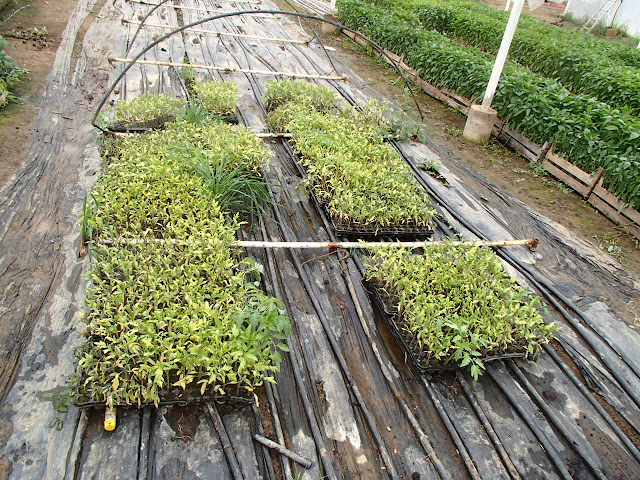
Tomato seedlings grown in the greenhouse
            March 15 is when, historically, there is a 10% chance frost will occur after that date. But in most years using this date is too late for calculating when to start seedlings. In some years you might put out tomato seedlings, with some protection, the middle of February. Other years it might be the first week in March. Rarely will it be the middle of March.
Picture of a tomato transplant I got online but lost the source. Nice-looking transplant.
            By starting tomatoes from seed on January 1 you will be ready to put tomato seedlings into protected areas outside by mid February. If you discover this date is too early, delay putting them out for one or 2 weeks or until the weather gets better.
            Watch weather reports for the coming week. This gives clues whether you can put tender seedlings out early in the season or if you must wait until later.
            Seedlings need to be “hardened off” 2 weeks before putting them in the garden, particularly when starting them inside or in a greenhouse. Hardening off seedlings means moving them outside into protected locations and gradually getting them adjusted to a much harsher environment. Plunge them into this harsh environment gradually.
            Protect tomato new seedlings if temperatures drop into the 40s. Freezing doesn’t occur until 32°F but tender plants like tomatoes can suffer “cold damage” at temperatures in the 40s. Think about what happens when you put a banana in the refrigerator. Tomato plants are also tropical, just like bananas.

Various Problems Cause Damage to Large Trees Growing in the Desert


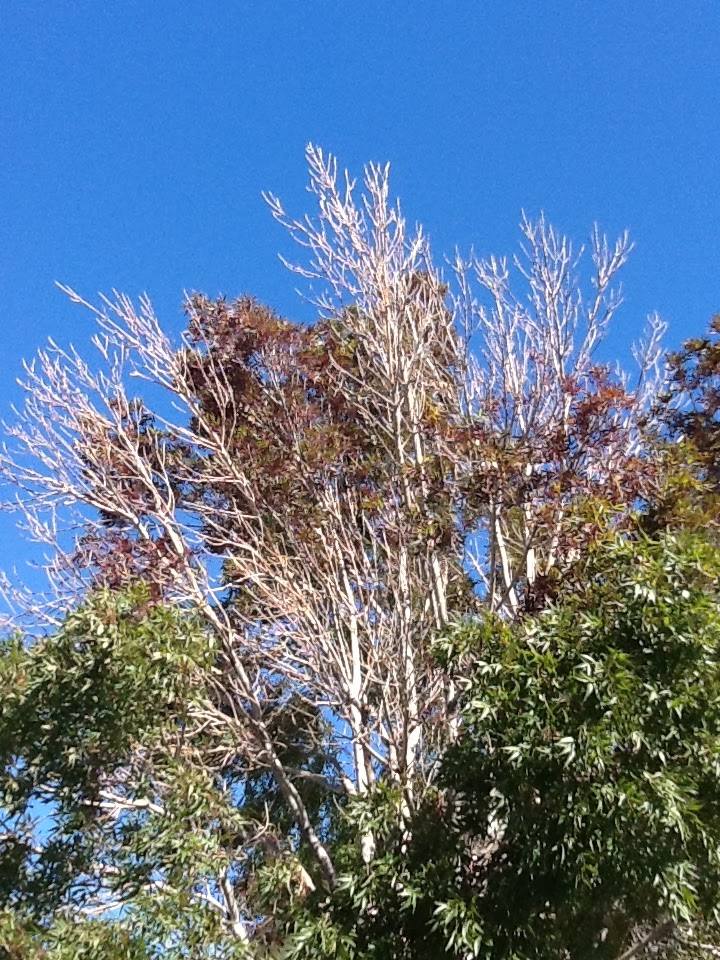
Ash decline disease hits younger ash trees if they are water stressed. Hits older ash trees for simply no reason at all
Sooty canker disease in Chinaberry. It hits many different trees including Mulberry.Frequently associated with stress. The stress can come from drought.

 
Aleppo pine blight usually happens in the winter months and associated with a lack of water.

Q. I have noticed that many trees including elm, pine, ash and mulberrry have dead and dying branches.  I am a native of Las Vegas and have never seen this before.  It is not the lack of water.  The branch suddenly dies and then eventually the whole tree in the case of one pine.  Thought it was a lightning strike but not so sure now.  I am speaking of the northwest  area  of town near Texas Station.
A. There isn't a life-threatening disease that is spreading community-wide among all of those different plant species that your mentioning. Ash trees do get a disease called ash decline that causes branch die back. I've mentioned that several times in my blog. It hits younger ash trees when they are water stressed. Older ash trees seem to come down with it.

Mulberries seem to get hit fairly hard with a different disease called sooty canker and I've mentioned that in my blog. It's often times associated with trees that are stressed. 
Possible sooty canker of Mulberry

Aleppo pine is hit in the winter time with a disease called Aleppo pine blight which causes tip die back and branch die back when the disease is extreme. It is usually associated with drought.

And Siberian Elm, well, good riddance. It's a horrible tree, trashy, soft wood that breaks in the wind. Not to be confused with Chinese Elm which is a beautiful large tree with very few problems.But Siberian Elm's usual problems are related to water and dieback.
Chinese elm not to be confused with Siberian Elm is a wonderful tree
I think a lot of what you're seeing is related to water. I moved here in 1984 when water was abundant, cheap and everyone watered with abundance. In the late 1980s and into the early 1990s there was a campaign in town to get rid of all the lawns. 


The campaign was called "Cash for Grass" program where water utilities were offering people money if they converted their landscapes from grassy landscapes to rock landscapes. Those big trees that survived for years on water given the lawns were suddenly put on small drip emitters and surrounded by rock. 90% of the time these large trees either died or had severe setback because they were not getting enough water. You see this kind of problem less often where these large trees are growing surrounded by lawns. Now you have my $.02 worth.