Type your question here!

Sunday, November 26, 2017

Control Cottony Masses on Cactus


Q. I have small white nodules growing on my Indian cactus. Are they harmful? If so, how do I get rid of them?
 
Opuntia Or beaver tail cactus heavily infested with one of the cochineal scale insects. These insects can decimate cacti over time if left uncontrolled.
A. I think you are talking about cochineal scale on the Opuntia or beaver tail cactus. This scale insect produces a white, fluffy mass on the pads on top of itself for protection. This insect is feeding underneath this white mass. Rubbing these white masses lightly with your finger, you find a royal purple color staining it.
The insect beneath this cottony mass is dark red or purple. This is cochineal scale and makes a royal purple dye. Contrary to what some people have said, this is not the same cochineal scale the Spaniards sent back to Spain in the 1600s but a very close relative.
            Depends on the cactus but they can devastate a cactus if not controlled.
            First, control the ants. Ants pick up baby scale insects and transport them to pads that are underpopulated. These new pads are wide open pastures for scale insects to feed. Cochineal scale populate pads quickly. The ants harvest excrement from scale insects to feed their colony.
This is a short video of a Weaver ant protecting another type of scale insect from its food supply. In this case, it's my finger that is seen as a threat and the Weaver ant is protecting its horde aggressively. Video taken on our family farm in the Philippines.
            Most ants are subterranean. One of the best methods I found to control ants is using a poison bait lightly sprinkled at the entrance to the colony. Usually these “ant holes” in the ground are easy to find but sometimes you must follow the ant trails to find them. (This doesnt work with Weaver ants because they don't nest in the ground!)
            I use an ant bait manufactured by Amdro. Follow label directions precisely. When applied correctly, it kills the entire colony, including the queen, in less than twenty-four hours.
Borrowed a picture of the am drove container at Home Depot. Thanks to paulmirocha.com
            Scale insects suck plant juices from the pads and build their populations quickly. Ants help them spread faster.
            To remove white fluffy masses, spray the pads with a strong stream of water using a spray or sweep nozzle. This knocks the white fluffy covering off but doesn’t kill the insect hiding underneath it. They soon repopulate the pads. In summertime this could be weekly. In winter, perhaps monthly.
Hosing off cochineal scale from the edible Opuntia cactus donated to the UNCE orchard by the University of Sonora – Hermosillo for demonstration trials. In the middle of summer, this had to be done weekly which none of the Master Gardeners like to do. If you don't want to do it organically, which means frequently, then you're faced with using conventional pesticides.
             After spraying the pads with water, use organic or conventional insecticides to prevent scale insects, called crawlers, from repopulating the pads. Organic insecticides do not stay in the environment long so spray them more often than conventional insecticides.
Neem oil varies in quality from different manufacturers. Unfortunately, there is not much quality control but if you find a good one, stay with it
            Useful organic insecticides include Neem oil, soap sprays and other plant-based oils. Apply soaps and oils the day after spraying the pads. Reapply organic insecticides often. Organic insecticides I mentioned are total killers; they kill any insect sprayed so direct your sprays accordingly.
Conventional systemic insecticides like this one works very well and requires fewer applications. But it is tougher on the environment.
            Conventional insecticides last longer but are tougher on the environment. Useful conventional insecticides are systemic and applied to the “trunk” or soil. The poison moves into the pads from the point of application. Spray as soon as you see the cotton balls start to form.

Pine Tree Recovery from the Heat


Q. I have fifteen-year-old, 20 to 30 foot pines on a half-acre. They suffered during the heat this past summer. After your advice, I am doubling the amount of water and hosing off the needles once a week. How long is the recovery time using vitamins? 
 
Too much water? Probably not. But they don't need it as often as a lawn does. When you look at the amount of water that pine trees need, the total amount of water is not far from what an efficient lawn would need. The difference is in frequency of application. Trees, this includes pine trees, should be watered much less often than a shallow rooted lawn.
A. I am not a big fan of applying vitamins like Super Thrive. Some people swear by them, It can be cheap insurance though if you're not sure. Your call on that one.
Who can argue with success? The research doesn't support it but the use of products like these (and other "me too" products) are not supported by research. However, some landscape professionals and homeowners disagree. In the long run, it's cheap insurance to use it.
            Washing the needles of pines is not necessary. It is true of Italian cypress because they tend to get spider mites. Pines do not.
            They might need more water than 15 gallons. Play that by ear by watching the new growth next spring and early summer. You should get at least 12 inches of new growth every year and not experience severe needle drop during the hot months. Those are indicators the tree is not getting enough water.
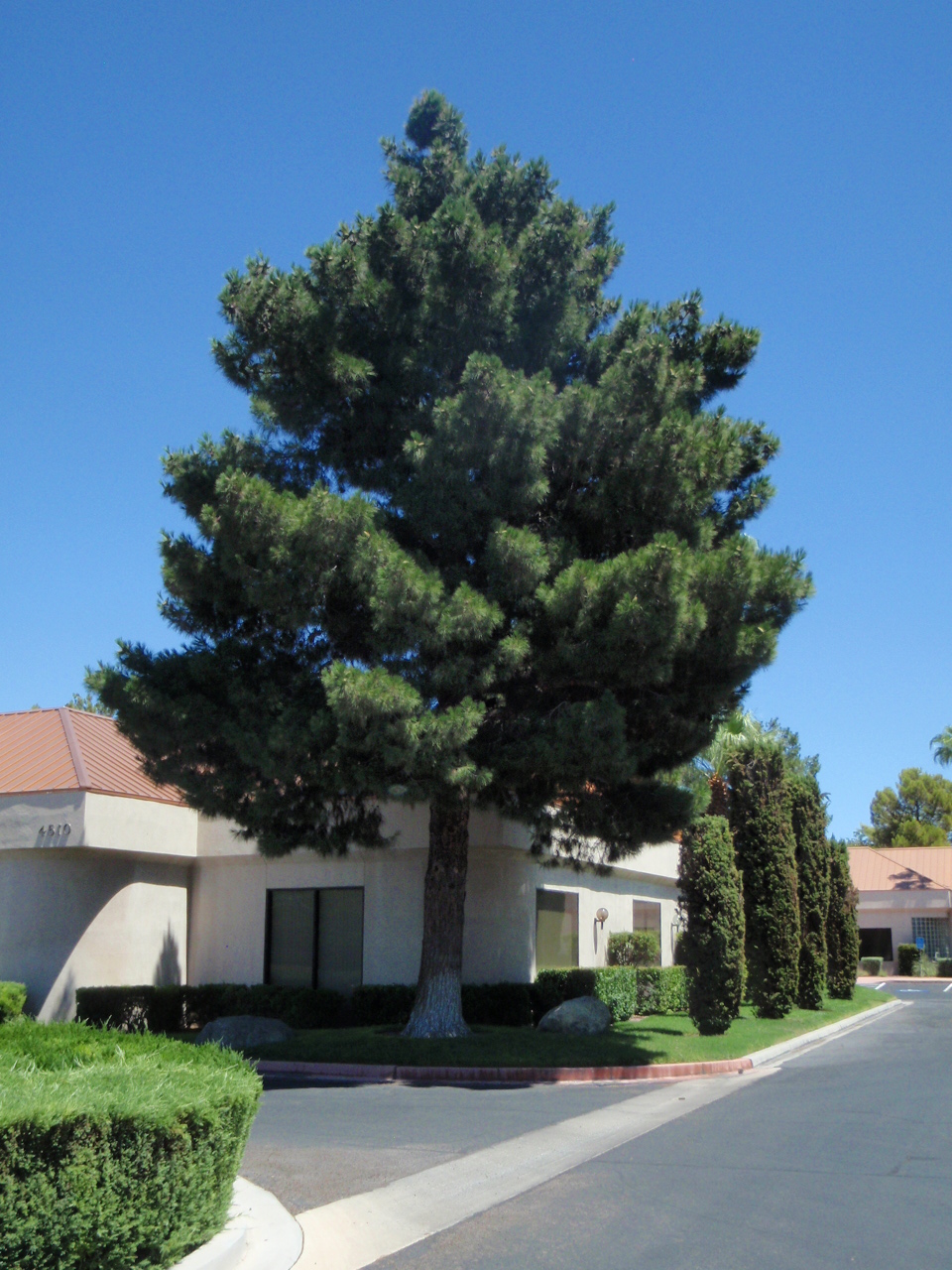
When you see this in a pine tree growing in the desert, it usually means a lack of water. The amount of water pine trees need is grossly underestimated by most homeowners and landscape professionals. They need a lot of water all at once but they don't need it that often.
            Once you find the right amount of water (minutes and gallons), keep it consistent through the year. The amount of water they are given should not change much throughout the year. It's like filling a gas tank. Instead, change how often they receive the water. Summer months water more often. Winter months, water less often.
One of the best ways to irrigate large trees is to "basin irrigate". This is a modification of an irrigation technique called "flooding". Rather than drip irrigation, a landscape bubbler (not a drip bubbler) is used to fill a flat basin. The basin around the tree, doughnut if you will or moat, must be flat! This basin is increased in size every few years to accommodate a larger tree. The bubbler emits water at one or 2 gallons per minute. The basin is full in 10 to 15 minutes.
            As plants get bigger, they require more applied water, not watering more often. Watering frequently with small amounts of water produces shallow roots and trees that blow over in strong winds.
            You should see an improvement in the first half of next year. Nothing this year.

Monday, November 20, 2017

Normal for Vertical Limbs to Become Horizontal

Q.  My Seville orange tree has been growing in my yard for 20+ years. About a month ago, I noticed one of the branches that grew straight up is now parallel to the ground. Any idea what caused this?
 
Pomegranate growth is a little different from citrus growth. But there are similarities. According to the owner of this tree, it has not yet flowered and fruited. Its branches are vertical. After it begins fruiting the weight of the fruit will pull the branches to a horizontal position.
A. The reason upright limbs of fruit trees with large fruit become horizontal is from the weight of the fruit. The fruit tree which demonstrates this the best is pomegranate.
This orange tree has not yet produced fruit. Its major branches are vertical.
            The upright shoots of pomegranate bend nearly horizontal after they flower and bear fruit. The weight of the fruit bends the branches downward. To a lesser degree we see this in ornamental trees and nut trees as well as they get older.
This fifteen-year-old pomegranate tree has produced an abundance of heavy fruit. The fruit has waited the branches and open the canopy. Opening the canopy allows more sunlight to enter it and the tree produces more fruit. Relate this back to natural selection and evolution.
            In these cases, the weight of the branch as it gets longer and heavier begins to bend the branch into a more horizontal position. Often times young trees are described as being "upright or semi upright" while the mature forms of the tree may be called vase shaped or even round.

Sunday, November 19, 2017

Best Time to Plant Trees and Shrubs Is for the Fall


Proper method for planting large trees: hole is at least three times the width of the root ball, stakes are pounded into the solid soil at the bottom, tree trunk is allowed to flex without moving the roots.
Q. My son and I are thinking of landscaping his front yard in December.  Will plants and trees survive when planted that time of year?
 
This Orchard planting the holes were dug and the soil amended before the trees arrived. The hole was much wider than the roots but not much deeper. Soil was amended with compost. Basins were constructed around each tree for hand watering over the next two weeks.
A. Plant all through the winter. Is it the best time to plant? No. The best times to plant are reserved for the fall and spring months. In the Las Vegas climate it is best from late September to mid-November.
Good advice!
            The second-best time for planting is during the spring months of mid-February to the end of April. The absolute worst time to plant is just before and during the hot summer months. In our climate this is from May through the early part of September.
Add water to the planting hole at the same time you backfill around the roots of the tree or shrub. This helps to remove air pockets and secures the plant roots in the soil. Sometimes staking is not needed when this is done correctly.
            Make sure that the holes for planting are at least three times the diameter of the container and not much deeper than this unless there are drainage problems. In a few soils that have layers of caliche there are. But if your neighbors have landscape plants that are doing well then you probably don't have a problem.
            During planting make sure you are watering the amended soil around the roots WHILE you are planting. After planting water these plants by hand for three consecutive days to make sure you have removed air pockets around the roots.
            Construct a basin around the plants and hand water them for the first two weeks before turning them over to drip irrigation.

Let's Get Ready to Prune Fruit Trees!

Q. Can I prune fruit trees now or do I need to wait until they are dormant in January?  Will you be giving fruit tree pruning classes again this year?
 
A. Prune fruit trees lightly with a hand pruner any time there is a problem at any time during the year. Heavy pruning that requires a saw or loppers should be done during winter months after leaves have dropped.
Hand pruner or hand shears for making cuts less than 1 inch in diameter
            Removal of limbs with loppers or a saw is easier after leaf drop when you can see the arrangement of limbs and branches and where to cut. Avoid using loppers or a saw during summer months because of sunburn and damage to the trees by our intense sunlight.
Loppers used for large cuts greater than 1 inch. The maximum size for a lopper depends on the lopper and how well it's maintained and the person doing the pruning. Some people are not physically capable of making some larger cuts. Once cleaned and sanitized, they should never be placed on the ground because of sanitation.
            The majority of pruning cuts for fruit trees will remove entire limbs and not leaving “stubs” where branches are cut off. Many of the desirable pruning cuts remove vertical growth, upward or downward, which produce little to no fruit and interfere with light entering the canopy.
One of my favorite tools for cutting large limbs is a Sawzall with the appropriate pruning blade.
            I will offer pruning classes of fruit trees on Saturdays beginning in mid-December. Watch the newspaper or my blog for exact dates and locations.