Type your question here!

Sunday, December 17, 2017

How to Harvest Butternut Squash


Butternut squash fully mature and ready to harvest

Q. When do you harvest butternut squash?
A. Butternut squash, a winter squash, should be fully mature before it is harvested. Knowing when to harvest comes from experience.
            Look at the color of the squash fruit and the condition of the vine. Squash fruit should be tan, brown or orange brown depending on the variety and the vine at the point of connection to the fruit should look like it’s dying.

            In early winter, another way is to let the vine die from a light freeze and cut the vine from the squash fruit. A common method talked about is to press a thumbnail into the “skin”. When mature, the skin should be difficult to scratch or puncture. This is a rather subjective method and I don’t like it much.
            I don’t particularly like this method because it can puncture the outer skin. This puncture or wound is a possible entry point for rotting microorganisms if squash fruits are stored for any length of time. All fruits and vegetables should be handled carefully without creating damage.
            Don’t pull squash fruits from the vine because the wound left when the vine separates from the fruit damages the outer skin and leaves an open wound, unless you’re going to cook or process it right away.
             Cut the vine from the squash fruit, leaving about ½ inch of vine attached. They store better at garage temperatures than house temperatures.

Tree Stump Removal Can Leave Problems Behind


These pictures are all from the same plant or plans located where the African sumac was removed. This type of leaf discoloration can be from many different things including mineral deficiency, overwatering, damage from salts, chemical damage such as some weed killers.

Q. I had an African sumac tree removed. I believe that the removal crew treated the stump with something to prevent the tree from regrowing. Now the xylosmas I planted in that spot have yellow or brown leaves. Is flushing the soil with water the best treatment?

A. A common treatment to use on the stumps to prevent regrowth is applying potassium nitrate, a.k.a. saltpeter, one of the so-called “stump removers”. There is nothing poisonous to plants about the potassium or the nitrate. It’s the concentration of this chemical that does the job. It’s a salt.
This is a stump remover marketed in Australia. It clearly shows that it's made from potassium nitrate. Notice the fertilizer analysis on the right of the label. In light applications, it's a fertilizer. When it's applied in large amounts, it's a plant killer because it is a fertilizer salt. http://i.ebayimg.com/00/s/MTYwMFgxNjAw/z/7OAAAOSw-ndTnilN/$_35.JPG
            Any salt applied in high concentrations will kill plants. It is not a good idea to apply table salt because this salt contains sodium and chloride, both poisonous to plants. But potassium nitrate is also a fertilizer. The dose makes the poison. This fertilizer is applied at a concentrated rate that kills.
            As with all salts, they flush easily from soil if you run lots of water through it.
            There are other chemicals besides salt used to control regrowth from stumps. These are specific weed killers or herbicides that are very good at killing woody plants. Hopefully, these chemicals were not used.
This is a stump remover that uses a chemical herbicide instead of potassium nitrate. http://images.lowes.com/product/converted/071121/071121564207.jpg
            The pictures you sent to me looks like some form of chemical damage. Hopefully, they used potassium nitrate and you can simply flush the soil with water several times. If herbicides were used, the soil might need to be replaced in that area.

Sunday, December 10, 2017

New Commercial Orchard in Downtown Las Vegas


Cart paths bordering the block of two-year-old fruit trees at Ahern Orchard
A cart path through the One-year-old plum and plot block of fruit trees at the air Ahern orchard

There is a new Orchard about 1 ½ miles from Las Vegas Blvd., in Las Vegas Nevada and located in the Mojave Desert. It has been called “historic” by some because there is nothing like it anywhere in the United States.
 
Grape trellising at the Ahern Orchard Of two-year-old grapevines
The Ahern Orchard currently has a mixture of about 1600 fruit trees and 400 grapevines, both table and wine grapes. It will expand to over 3000 plants in 2018 after spring planting. It sits on private property, owned by Ahern Rentals, Inc. and fed water from two agricultural wells that have been in existence for decades.
 
First year fruit tree planting at the Ahern Orchard, 2016
The area where it’s located is historic as well, rich in pre-Las Vegas and Las Vegas history. The land was formerly horse and residential property. Before the 1960s, there were artesian springs in the vicinity where the Ahern Orchard is located.
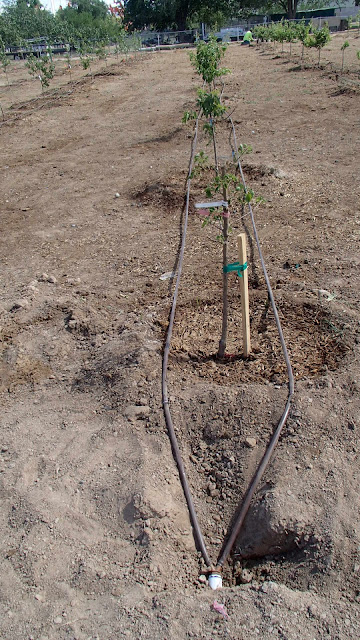
In-line drip tubing used for irrigating fruit trees in the rows
I have been working as a consultant on this Orchard since it’s beginning starting February, 2016, with Lloyd Benson, a VP of Ahern, who is the visionary behind this Orchard.
 
Irrigation valve, filter, pressure regulator and flow indicator (Ecoriser) for a block of fruit trees using in-line drip irrigation tubing
Fruit trees on the property include traditional peaches, nectarines, plums, apricots, apples, European and Asian Pears, figs, pomegranates, pistachios, quince, persimmons and jujube. Not so traditional are the interspecific and inter-generic hybrid fruit trees as well including pluots, plumcots, apriums and others. Complicating this mixture are over 80 varieties that spans a production season from mid-May to the end of December.
 
Delivery of woodchip mulch to use on the fruit tree rows
The layout of the Orchard is with tree spacings 10 feet apart in rows with spacing between rows alternating between ten and 14 feet to accommodate management of fruit tree operations. Trees will be managed to a maximum height of 10 feet. Covering the surface of the soil in the rows are woodchips from local arborists, diverting this rich resource from landfills to beneficial use.
 
Irrigation pattern of the in-line drip tubing when the water is being applied to the row
Trees were planted bareroot using a mixture of about 25% compost from Viragrow, Inc. and triple super phosphate (0-45-0). First year trees were painted with whitewash to protect them from sunburn. Many of the second-year trees were protected from sunburn using white, plastic tree guards.
 
Fruit tree planting holesAre marked with a mixture of compost and triple super phosphate.
Grapevines are supported by either single or double high tension steel cordon wires together with “catch wires” to protect the fruit from sunburn. End posts and line posts are traditional vineyard posts.

All fruit trees are drip irrigated using in-line drip irrigation tubing down tree rows on both sides of the trees. PVC headers and footers are located at the beginning and end of each row that connect all of the in-line drip irrigation tubing in a “closed loop”. This type of irrigation irrigates the entire row while keeping the spaces between rows dry. Fruit tree roots will “follow the water” and eventually spread their roots throughout the entire row.

Grapevines are irrigated more traditionally with drip irrigation emitters, one on each side of a vine, with water supplied from polyethylene tubing.

Currently we are involved with winter fruit tree pruning at the Ahern Orchard. Some grape pruning will be done now but “fine-tuning” the grapes with their final pruning will not occur until February.

Soil in Containers Needs Periodic Replacement

Q. We have two citrus trees (Meyer lemon and Bearss lime) which we put in clay pots. The pots are deteriorating and the trees need to be transplanted into other pots. In the desert, what time of year is best to transplant these trees into new containers?
 
Fruit trees growing in containers should have the soil amended or replenished every 3 to 4 years.
A. Put them into new pots in late Winter or at the beginning of Spring. In our Las Vegas climate around the end of February or so. Containerized plants need the soil in the container “refreshed”, or the plant repotted, every 3 to 4 years or they will begin to decline.
Grapefruit tree in container
            This is not difficult if the containers and plans are relatively small; the plant is gently eased from the container, the roots and soil around the edge of the root ball is shaved off, and the plant is put back in the container with fresh soil or container mix.
            If these plants are large, refreshing the soil still needs to be done every few years. Perhaps the best way to do that is to auger vertical holes throughout the root ball inside the container and fill them with a new container soil or soil mix.
            Yes, this damages plant roots but the soil mix needs to be refreshed.