Type your question here!

Sunday, March 31, 2019

Selecting the Best Apricot and Plum for the Desert


Listen to my podcast, "Selecting the Best Apricot and Plum while you read through this list. 

Apricot – Most apricots do well in southern Nevada and have wonderful flavor

Recommended rootstock: Nemaguard preferred but others have performed adequately over the long term.

Top Choice
·       Blenheim (Royal) - early
·       Flavor Delight (Aprium; actually a plum apricot hybrid but fruit marketed as an apricot) very early
·       Gold Kist – very early
·       Moorpark - early
·       Royal Rosa – excellent landscape tree, very early

Notable Mention
·       Canadian Blenheim White - early
·       Chinese - early
·       Early Golden - early
·       Flora Gold – very early
·       Katy – excellent landscape tree, very early

Under Review (Early results are good on all)
·       Autumn Glo
·       Early Autumn
·       Goldcot
·       Harcot
·       Tomcot

Aprium – Plum apricot hybrid that does extremely well in our climate

Recommended Rootstock: Nemaguard but others have performed adequately over the long term.

Top Choice
·       Flavor Delight – See apricot since the fruit is marketed as an apricot, very early


Plum – Plums do well in our climate. The most common fresh plums are Japanese plums.

Recommended Rootstock: Citation but other rootstocks have performed adequately over the long term.

Top Choice
·       Santa Rosa
·       Santa Rosa, Weeping – landscape tree form of Santa Rosa
·       Emerald Beauty

Honorable Mention
·       Beauty
·       Burbank
·       Burgundy
·       Elephant Heart
·       French Improved – Prune
·       Italian Prune – Prune

Under Review
·       Catalina
·       Green Gage – European plum

Plumcot – Apricot plum hybrid
Under Review
Plum Parfait

Pluot – A very complex hybrid of apricot and plum that has developed a very high sugar level and complex flavors when tree ripened

Recommended Rootstock: Citation but other rootstocks have performed adequately over the long term.

Top Choice
·       Flavor King
·       Flavor Queen

Honorable Mention
·       Flavor Supreme

Under Review

·       Dapple Dandy
·       Flavorosa
·       Flavor Delight
·       Flavor Finale
·       Flavor Grenade
·       Geopride

Desert Horticulture Podcast: Picking the Best Nectarine and Peach for the Desert

Selecting the best nectarine and peach tree is confusing - there are so many different varieties to pick from! This podcast helps you sort through some of the varieties that grow best in our desert climate. Learn some tips about selecting varieties by an expert who has grown dozens of varieties and conducted blind taste tests on each to determine which are the best. Learn why nectarines take an extra commitment when growing this fabulous fruit in a desert climate.


Pick the Best Nectarine and Peach for the Desert


Read this extract from my list of recommended fruit trees while you listen to my podcast titled, "Pick the Best Nectarine and Peach". Connect to it through my blog.

Nectarine – Nectarines do well in our climate but vary in fruit quality and some taste pretty bad.

Recommended Rootstock: Citation but others have performed adequately over the long term.

Top Choice
·       Arctic Star

Honorable Mention
·       Arctic Glo
·       Arctic Rose
·       Desert Dawn
·       Desert Delight
·       Double Delight

Under Review
·       Arctic Gold
·       Garden Delight – Miniature
·       Goldmine
·       Independence
·       Liz’s Late
·       Necta Zee – Miniature
·       Panamint

Peach – Peaches do extremely well in our climate and have received praise from internationally recognized chefs.

Recommended Rootstock: Citaton but others have performed adequately over the long term.

Top Choice
·       Babcock – White, mid season
·       Eva’s Pride – Early season
·       May Pride – Early season
·       Mid Pride – Mid season
·       Starks Saturn – Donut peach, white flesh, mid season

Honorable Mention
·       Arctic Supreme - white flesh, mid season
·       Desert Gold -
·       Earlitreat – Earliest producer
·       Early Amber – Early season
·       Early Elberta -
·       Elberta – Mid season
·       FlordaPrince – Early season
·       Red Baron – Showy flowers, good landscape tree, mid season
·       Red Haven – Mid season

Under Review

·       Arctic Jay – White
·       Carnival
·       Double Jewel
·       Elegant Lady - White
·       Fairtime
·       Gold Dust
·       Harken
·       Indian Free
·       July Elberta (Kim)
·       Nectar White - White
·       O’Henry – Late season
·       Rio Oso Gem
·       Snow Beauty - White
·       Snow Giant - White
·       Snow King - White
·       Strawberry Free - White
·       Sugar Lady - White
·       Summerset
·       Sweet Bagel – Donut peach, yellow
·       Tra Zee – Late season
·       Tropic Snow -White
·       White Heath Cling - White
·       White Lady – White


Peach, Miniature – These are typically peaches which are genetic dwarf and fruit quality is often not as comparable to standard peach trees.
Top Choice
·       Bonanza – Mid season

Honorable Mention
·       El Dorado – Mid season
·       Pix Zee – Mid season

Under Review
·       Honey Babe
·       Garden Gold
·       Garden Sun


Saturday, March 23, 2019

Viragrow: Heavy Metal Concerns in Compost Made from Municipa...

Viragrow: Heavy Metal Concerns in Compost Made from Municipa...: Viragrow thought this Fact Sheet from Cornell Composting might be interesting to those who have concerns about heavy metals and human health...

40 Years of Research on Organic Agriculture

I hope you enjoy this summary on the past 40 years of research in organic agriculture.


Friday, March 15, 2019

Desert Horticulture Podcast: tomato planting, pheromone traps, flowering plum, raisins and grape poor production

Join me in this episode of Desert Horticulture. I will talk about planting tomatoes in Cole soils, using pheromone traps for fruit trees, making raisins, when to plant flowering plum tree, and how to correct grapes that are producing so well. These topics and more in Desert Horticulture.


Poor Grape Production Maybe Not Fertilizer

Q. What type of fertilizer do you suggest for table grapes. Mine have been in ground 3 years now and the production has been less than I hoped. I have been using compost and worm castings twice a year.

A. The problem may not be the fertilizer or how much you are applying but how the vine is pruned. There are two general methods of pruning grapes. Some grapevines are pruned using the “spur” method while others are pruned using the “cane” method.
            Grapes that should be pruned using the cane method may produce little or no fruit if they are pruned using the spur method. However, grapes that require spur pruning WILL produce fruit if they are cane pruned. I am thinking you have a great that may require cane pruning but you spur pruned it instead.
            The difference between the two is the amount of last year’s growth left attached to the vine. In spur pruning, last year’s growth is cut back severely, leaving less than an inch remaining. In cane pruning, last year’s growth is cut back so that about eight or 10 inches of growth remains attached to the vine.
             Bottom line, if you are not sure how to prune your grapes, leave last year’s growth 8 to 10 inches long. Last year’s growth will be a different color than the older parts of the vine. Sometimes it’s reddish-brown and sometimes it’s yellowish-brown. When the fruit emerges, re-cut the cane to a better length.

Re-Planting Flowering Plum - Why Did it Die?

Q. Is it too late in the year to replace a flowering plum tree? Another in my yard is starting to blossom.

A. Whether to plant a new flowering plum tree or not has nothing to do with its flowering time. The best time to plant is just before new growth begins in the spring which is a week or two before flowering. But there is nothing wrong with planting any time during the spring of the year. It just so happens planting time also corresponds to flowering time as well.
            Another great time to plant is during the fall months when temperatures are beginning to cool, when it is not yet cold, and before leaf drop. In the Mojave Desert in the spring begins around the first week of February, give or take, and the Fall begins toward the latter part of September.
            I’m curious about why you are replacing a flowering plum tree. If this was because of borers that tunnel into the limbs and trunk, then you are fine planting in the same hole. These insects do not get into the soil but spend their entire life above ground.
            However, if you are replacing this tree because of overwatering problems then it’s best not to plant in or near the same hole. Root diseases like collar rot stay in the soil and could pose a future problem for most trees and shrubs planted there. Plant several feet from this area.

How to Make Raisins

Q. What type of grapes should I grow to make raisins? Is there any special trick to making raisins or do you just dry the grapes?

A. Traditionally, Thompson Seedless is used for raisins but you can use any seedless raisins (usually table grapes). Whichever taste of grapes you like make good raisins. Allow them to dry on the vine (unless birds or ground squirrels are a problem) or remove them from the vine and dry them by themselves.
            Remove the berries from the bunches and remove the stem from the berry.  If there is a secret to drying fruit in the desert, then it is to control the temperature used for drying. I made a solar dryer a few years ago but the air temperature in the dryer was too hot. I ended up using this dryer but put it in the shade rather than in the sun.
            Cover the drying grapes with cheesecloth or any breathable material that helps keep birds and dirt off it. Temperatures should be below 140F, but suggestions will vary. Generally, the lower the temperature and high wind movement the better. So, drying them in the shade in open air in the summer is about perfect here. Just avoid high temperatures (above 140F) and dry them as quickly as possible.

Using Pheromone Traps in Fruit Trees

Q. I was reading about pheromone traps for insect control on fruit trees. What insect pests occur here that I can use with pheromone traps and reduce the need for chemical spraying?

A. Pheromone traps release insect pheromones, or “scents”, that attract other insects needed for their reproduction or survival. Pheromone traps are used to either determine when spraying insecticides is most effective or, in some cases, to reduce the need for spraying insecticides altogether. A different pheromone trap is required for each insect.
            Pheromones are not available for every insect, but a different pheromone is required for each insect you want to control. Two insects I have successfully caught in pheromone traps include the peach twig borer (wormy peaches) and coddling moth (wormy apples and pears). I have been successful using them in what is called “mating disruption” and totally avoided the need for spraying chemicals to control these two pests.
            The trap is made from cardboard with a sticky bottom surface combined with a rubber lure impregnated with a chemical pheromone. Buy the winged traps and not the Delta traps and the highest concentration of pheromone you can buy in a lure. The trap combined with a fresh lure is hung in the branches of trees you want to protect.
            Hang traps with the lures in the trees beginning in about April. Replace the old lure with a fresh one about every thirty days. The sticky surface of the trap should be replaced when it gets dirty or full of insects. Watch for a class on pheromone traps offered by me here in Las Vegas in early April on Eventbrite.

Planting Tomato in Cold Soils

Q. I have some tomatoes and pepper plants in pots.  They are about 18" tall. Is it too early to plant them in my raised bed garden? It's been too cold lately to plant. 

A. You’re right, it’s been unusually cold. Both the air temperature and soil temperature are excessively cold for good plant growth of warm season plants like tomato and pepper. These are tropical plants, what we call “warm season”, and grow best at temperatures 60 – 65 ° F to about 95 ° F. They need enough new leaf, stem and root growth to get established and stay ahead of damage from disease or insects.
            How do you know if the soil temperature is warm enough? It is important that day temperatures are warm but nighttime soil temperatures can be cooler, down to about 45° F. A soil thermometer stuck several places in the soil, 1 to 2 inches deep for transplants, will give you a good idea of its temperature. I use an inexpensive AcuRite soil thermometer to do this.
            Garden soil, covered in plastic for a few days before planting, helps warm it up. The plastic should be sealed tightly against the soil. Then cut slits in the plastic where you plant. Covering the soil in plastic raises the soil temperature quickly. Covering the soil for 2 to 3 days is usually enough.
            I prefer tomato and pepper transplants to be about 6 to 8 inches tall when I put them in the ground. At this size they can handle a little bit of abuse and they are not so large they suffer from noticeable transplant shock after planting. Expect large plants like yours to go into a few days of shock before they start growing again. Warmer temperatures help them to recover faster.
            If plants are big, I pinch the tops back so the top and roots are in balance. It’s inevitable to have some root damage due to planting. Pinching the top back helps to compensate for this root damage.
            Transplant shock is an adjustment period the plant goes through when removed from a container and planted into a garden soil; from a protected environment in the nursery or greenhouse to a more hostile garden environment. All plants go through transplant shock. Smaller plants adapt quicker to a new environment than larger plants.

Tuesday, March 12, 2019

Desert Horticulture Podcast: Which Grapes, Why Western Redbud, Control Bermudagrass and Frost Blankets

Join me in another Desert Horticulture Podcast. This time our topics are which grapes to plant in the Mojave, why choose a Western Redbud over an Eastern Redbud, chemical control of Bermudagrass using Fusilade, and why pull those frost blankets over your plants when  you don't need to.

Sunday, March 10, 2019

Desert Horticulture Podcast: Making Cold Soil Warm, Snow and Cold, Apple Tree Not Flowering and Planting in a Mimosa Hole

Join me in Desert Horticulture. I discuss how to make your garden soil warmer when its cold, what to do if your apricot is flowering and its going to snow, why do fruit trees produce little fruit one year and lots the next, why doesn't my apple tree flower and can I plant in the same hole where I removed a silk tree? These topics and more on Desert Horticulture.

Making Soils Warmer in the Spring

Many people contacted me whether they could plant seed or put transplants into the ground because of this unusually cold weather. My answer is the same to them as it is here. It depends. Soil preparation and soil temperature are very important for successful seed germination, preventing plant diseases and encouraging root growth of transplants.

Fluffing Up the Soil


Soil preparation and increased soil temperature are interrelated, which we tend to forget. “Fluffing up” the soil with amendments like compost allows warm air to enter the soil. These soils also cool off rapidly at night but can be planted earlier than soils not “fluffed up”. Amended soils warm up quickly, particularly if they are in full sun. This means amendments like compost are rototilled into the soil or “double dug” into these future growing areas.

Preparation of the soil before planting, the location of the garden spot in relation to the sun and the type of seed or transplant affects what and how soon we can plant after cold temperatures pass.

Warm Season Plants


 Warm season plants come from the tropics and include tomatoes, peppers, potatoes, squash and melons, annual flowers like impatiens, marigolds, petunias, geraniums, salvia, celosia and zinnias. These require warm soil temperatures, 60-70 F, at the time of planting.

Cool Season Plants


Cool season plants like peas, beans spinach, radishes, beets, pansies, snapdragons, sweet alyssum, California poppy, godetia, larkspur, violas, and bachelor's buttons can handle cooler air temperatures and soils, 40-50 F, and so can be planted earlier than warm season types.

Variability Within the Groups


Within the cool and warm season groups different plants, and even varieties within these plant groups, vary by quite a bit. If you aren’t sure, check seed packets for the best soil temperature for germination or online sources for the best root growth of transplants. Use a soil thermometer, with its tip pushed into the ground about 1 inch deep, to measure soil temperatures and to gauge when to plant seed and transplants.

Soil Thermometer I use

Apricot Blooming and Snow is Coming!

Q. My neighbor with an apricot tree is concerned about the forecast of snow. She said her tree is in full bloom and was worried about the forecast of snow later in the week. Any advice?

A. There is nothing that can be done to lower the freezing temperature. The most susceptible parts of fruit trees to freezing temperatures are the flowers when they are fully open. Generally, open flowers can tolerate temperatures to freezing and nothing below that when they are fully open.
            Very young fruit and unopened flowers can handle temperatures slightly below freezing, only a couple of degrees lower, and then they are damaged or die. Commercially, sprinklers apply water to fruit if air temperatures dip slightly below freezing. Ice formation on the fruit acts as an insulator. But not for the flowers.
            A couple of days after freezing temperatures have passed, squeeze the base of the flower and see if there was fruit set or not. If you can feel a small swelling at the base of the flower, then the flower and future fruit made it through the freeze. If it feels flat and there is no bump at the base of the flower, then it didn't make it.
            The second whammy was the cold weather preceding the freeze. Honeybees were not very active because of cold temperatures and overcast skies. If there are no honeybees visiting the flowers, then there'll be no pollination and no fruit produced.

            I put a short YouTube video together demonstrating how to squeeze the flowers to check if there is fruit or not. It’s available on my Xtremehorticulture YouTube channel. Otherwise, just wait and you will eventually find out.


Light Fruit Load Due to Many Possibilities

Q. Yesterday my neighbor was kind enough to share a jar of apricot jam she made from her 2017 crop of fruit. She mentioned, however, that her trees in 2018 produced hardly enough fruit to go through the jam-making process. Is it possible that our warmish winter was a factor? I believe my neighbor's trees "came with the house," so she doesn't know if they are the low chill variety.

A. The weather was too cold for early flowering apricots and peaches in 2018 and again in 2019. In 2018 it was so cold and overcast that honeybees didn’t come out to pollinate the flowers, but temperatures were above freezing so the flowers didn’t freeze. The result was poor fruit set in many early apricots because of poor pollination.
            In 2019 it was also cold when early flowering fruit trees began blooming. These low temperatures, again, limited honeybee activity and resulted in poor pollination. On top of that though, freezing temperatures occurred at least 3 times in February. Open flowers and their potential for fruit production do not survive even the slightest freeze. If you had an apricot tree that was flowering during freezing temperatures, there is a strong chance it won’t produce much fruit this year.
            The chilling requirement for apricot to produce fruit was met in both 2018 and 2019. A lack of winter low temperature was not the problem. In 2019 poor fruit production will be a combination of low honeybee activity and freezing temperatures.

Getting to the Root of an Apple Production Problem

Q. My Fuji apple tree is six years old and has never had any flowers. Is it still maturing, or should I get rid of it?

A. Most of what you're talking about depends on whether your apple tree was grafted or not and which type of Fuji apple tree you have. If you bought a tree grafted onto a dwarfing rootstock, you should see spur and flower development by the third to fifth year after planting. If it is not grafted but growing on its own roots, then it could take 6 or more years before it starts flowering.
            Try reducing the amount of fertilizer applied to this tree by half. If the tree is growing well, then don’t fertilize it again. A young apple tree like yours should grow about 18 inches a year. If the average new growth is more than this, reduce or eliminate the fertilizer applied next spring by at least half.
            Fruit trees that were planted in soil amended with a good quality compost may not need a fertilizer application for 2 years after planting. It depends on the amount of new growth each year. The high nitrogen content of fertilizers, and some types of rich compost, may push new growth excessively at the expense of making flowers.
            When winter pruning apple trees, prune back last year’s growth to no more than 18 inches. Pruning back excessively long growth encourages fruit production closer to the trunk.

Mimosa Silk Tree Planting Hole

Q. Thanks for your article about mimosa trees and their short lifespan. Ours appears to have a disease problem and falls within that 15-20-year age span you mentioned. Can I plant a new mimosa tree in the same spot if mine was diseased and removed?

A. I double checked recommendations from plant pathologists before I got back to you just to make sure. You should not plant in the same hole, or in the same vicinity of a previously diseased mimosa tree. The disease organism can survive in the soil and enter a susceptible new tree if planted in that area. Trees resistant to this disease include redbud, oak such as Heritage Live Oak or Holly Oak, ornamental pear, honey locust and pine trees.

More info on this disease

Monday, March 4, 2019

Class on Thinning Fruit Trees in April

Thinning Fruit on Fruit Trees to Get Larger Fruit
April 19, 20 and April 26, 27

Thinning fruit, technically categorized as a form of pruning, is selective removal of fruit so that the remaining fruit get larger. On some fruit crops this is done with chemicals but we will only be using our hands. You will be taught how to thin fruit of apple, European pear, Asian pear, peach, nectarine, plum and pluot and even pomegranate! You will get hands-on experience learning how and when to do this very important form of orchard management.

Class fee is $25.

Sign up on Eventbrite.

Experience Summer Pruning Fruit Trees at the Ahern Orchard

Summer Pruning of Fruit Trees
April 5, 6 and April 12, 13
Summer pruning of fruit trees is done in late spring through early summer which keeps fruit trees smaller, manages their growth, improves fruit production and decreases the need for winter pruning. Summer pruning routes the tree's energy into better fruit production rather than into new growth. This keeps trees smaller and more efficient. If done early and at the right time, pruning equipment is not needed, only your hands. Learn how, when and where to do this simple technique that encourages smaller, healthier and more productive fruit trees.

Class fee is $25

Sign up on Eventbrite

Tired of Putting Frost Blankets Over Your Tender Plants?


Q. You talked about the freezing temps in the valley. When we had the first freezing temp, I covered what I thought were my most tender plants with freeze cloths. But they were damaged anyhow. If we have another freeze, do I cover them again been though their damaged? It’s a pain covering tender plants!
Wow! This looks great! That means in February my lowest temperature in Las Vegas will be 45°F and my highest temperature is 66°F. The  uppre temperature estimate from those weather people was probably right. But that bottom temperature was wrong. Average temperatures presented by Weatherspark.com. February low temperatures were at or below freezing seven times. Do you smell a tourism conspiracy here?


A.  So, you thought having freeze-tender plants requires no work? Whenever landscaping with plants that do not belong in our climate zone, expect them to “cost” you in time, energy and money. That’s “our agreement” with these plants when we use them.

   Don't trust what you read about low temperatures in Las Vegas. 

We had 3 hard freezes come through the valley in February. Those crop covers or "anti-freeze blankets", only protect tender plants to about 5° F below freezing. If it gets colder than this, they get damaged anyway. The amount of damage depends the condition of the plants, how cold it gets and for how long.

Tropical and even semi tropical plants don't grow here.

            Tropical plants like Moringa, which has become popular Locallybecause of its reported health benefits, won’t handle any freezing temperatures at all. Compare it to Bougainvillea and handle it the same way; cut it back to within a few inches of the soil and let it sucker from its base.I grow it on our farm in the Philippines but I don't have to protect it. If it gets too large and I can't harvest the leaves anymore, I cut it back about 6 to 8 inches off the ground and let it sucker from the base.
Moringa, called malungay in the Philippines, is a tree common to our farm because we use it for a lot of cooking. There are probably about 15 trees that are continuously cut back and suckered again from the base so that the leaves are easy to harvest.Freezing temperatures acts just like a chainsaw and, once established, it will re-sucker again from the base after a hard freeze. Just protect the base of the tree during extremely cold weather.This tree is a weed in the Philippines and we don't have to do much for harvest.

            Semi tropical plants like many citrus show different degrees of damage depending on its age, if it was flowering or has tender fruit, and how it was fertilized the previous season.
Dalandan, or sweet orange, stays green in the hot tropics and is ripe when it's green and easily peels with its thin skin but it will freeze in Las Vegas. The amount of damage depends on how old the tree is, how low the temperature got and for how long. One of our citrus on our farm.We don't have to do much to grow this tree in the Philippines; water, fertilizer and horticultural oil to reduce scale infestations is about all it needs. We don't have to cover it.

            There are 3 things you can do to reduce plant losses prior to freezing temperatures; don’t fertilize after August 1 the previous year if using mineral fertilizers, construct windbreaks around your plants to minimize damage caused from combined low temperatures plus wind, pile mulch or dirt around the trunk of these plants just before freezing temperatures. 

Soil is a pretty good insulator from the cold and wind. If you’re using compost as a fertilizer, then apply it only once in the spring and no more.

Sunday, March 3, 2019

Controlling Bermudagrass with Chemical Sprays

Q. We are doing a lawn conversion to desert landscaping in the front. Our lawn has a lot of Bermudagrass along with the fescue. Our contractor told us to wait until May before spraying the lawn and killing the grass otherwise the Bermudagrass will grow back. Is that accurate? 
Common Bermudagrass and how it spreads from place to place with horizontal grow called stolons. In common Bermudagrass this kind of growth is extremely aggressive and invasive. When selecting Bermudagrass as a lawn grass, common Bermuda grass is not used unless you are nuts or cheapskate. It's going to cause nothing but problems. Common Bermuda grass is a pasture grass for feeding cows and horses during the summer months.

A. I need to do a podcast on controlling Bermudagrass, particularly which chemicals to use and why Roundup sometimes works and sometimes doesn't seem to work and alternatives to Roundup.

Your contractor timing is right. Bermudagrass “wakes up” around the end of March or early April. Spraying a weed killer for Bermudagrass before that has limited success, if it kills it at all. Bermudagrass should be growing happily to get the best control. The worst control comes by spraying it when it is first waking up or when it is under stress. So, don’t stress it with a lack of water or fertilizer for spraying.
            The second part is wishful thinking and maybe a little bit of sales. Don’t expect 100% control of Bermudagrass after it is sprayed. It will never happen. You might get 75% or more but not 100%. The only way of getting it under control is with repeat killing, pulling or hoeing of anything green as it pops out of the ground.
            If you stay on top of controlling it the first year, you will probably get about 95% control by the end of the season. If you let its new growth get out of control, you will probably be fighting it for years and never get rid of it. It is important to get rid of new growth as soon as you see it.
            The safest weed killer to spray around landscape plants is a product called Fusilade. Yes, I have actually used it around fruit trees and it works. Have some around after the landscape has been installed. Roundup is usually used for the first kill by a contractor. But Fusilade, unlike Roundup, only kills grasses. 

Another similar product to Fusilade is Poast. It just works slower. So, both can be sprayed near flowers, trees or shrubs that have Bermudagrass invading their spaces. If you accidentally spray landscape plants, it won’t harm them. If you are really careful and know how to apply a spray evenly and the proper amount, it can kill bermudagrass growing in a fescue lawn. But if you are not careful and damage your lawn, don't blame me!

Western Redbud Better Choice for Desert Landscapes


Q. You mentioned Western Redbud as a better choice for landscapes in the Mojave Desert than Eastern Redbud. You warned me it might be hard to find, and you were right. What’s so special about Western Redbud when compared with Eastern Redbud?

A. Eastern Redbud can be found as a native tree growing from the southeastern United States from Northern Florida up into Canada. Western Redbud has a more limited range, growing as a native in dry, desert regions of southern California, Southern Nevada, southern Utah and stretching into Arizona and Mexico. Sometimes the nursery trade doesn’t differentiate between these two trees and calls Eastern Redbud, just simply Redbud. So, it gets confusing.
One example, and it's not a particularly good example, of Western Redbud growing at the Springs Preserve in Las Vegas Nevada. In my opinion this is an extremely underused plant considering how many red bites planted of the Eastern kind.

            But there are major differences between the two, not so much in looks but how they perform in dry desert landscapes. The Western Redbud, sometimes called California Redbud or Arizona Redbud in the nursery trade, is more tolerant of our alkaline soils and high temperatures. It can also handle the heat better than the Eastern Redbud. It is a better choice for desert landscapes in the Southwest.
These are the leaves of an Eastern Redbud sent to me by a reader wondering why the leaves look like this. Eastern Redbud is not drought tolerant or salt tolerant to our alkaline soils.

           
You will probably have to search online for Western Redbud but also include the names California Redbud and Arizona Redbud in your search. They are basically the same tree.
If you're not careful, Eastern Redbud can be a little difficult to establish in desert landscaping. It may look pretty after its first planted but then some problems may develop because of our alkaline soils and droughty conditions.

            Some landscapers say they have better luck with Eastern Redbud, but I think it’s because the Western Redbud is watered too often. It is more drought and heat tolerant than Eastern Redbud. Western Redbud is better adapted to our soils and climate. You might try looking at the Nevada State Forest Nursery located atFloyd Lamb State Park and see if it’s in their inventory.

Grapes to Grow in the Desert

Q. I am from San Miguel Community Garden, a non-profit garden located near the North Las Vegas Airport. We are considering adding more grape plants to the Garden.  We have Flaming Red and Thompson grapes.  You said you have grown many different varieties in the Las Vegas Valley, and I was wondering if you would share with me other varieties that were successful for you so we can explore them as well. 
Barbera Wine grape grown in the Eastern Mojave Desert. Notice the unevenness in berry ripening during the time of harvest. This is a common problem when growing wine grapes in the hot desert.

A. I grew about 20 different table grapes and 18 wine grapes in the Las Vegas Valley starting in 1996. Some perform better than others. Still lots out there to try!
Grenache wine grape grown in the Mojave Desert.If wine grapes are grown with proper soil amendments and the soil around them covered with woodchip mulch, I had no problem with their acid and sugar balance. None of the grapes that I have grown were allowed to "struggle" as some of the romantics have suggested.

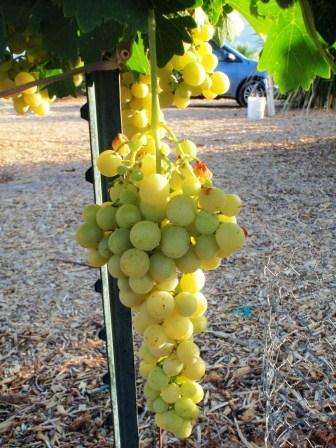
            Some table grapes to consider growing include Thompson seedless and Flame which you mentioned, as well as Concord, Thomcord, Perlette, Italia, Black Monukka, Fantasy and Ruby. Right now, the jury is still out on Canadice, Summer Royal, Suffolk Red and Crimson Seedless since they are only into their third year.  These table grapes should get you started.
Alicante bouschet wine grape with uneven berry ripening. Some of this might be controlled with changing the irrigation schedule which we could not do.

           
Table grapes are usually seedless (except Italia) and used for fresh eating, make seedless raisins or eaten frozen. Table grapes aren’t as demanding as wine grapes since wine grapes are oftentimes used for high quality juice or wine must.
Fantasy table grape grown in the Mojave Desert, one of my personal favorites particularly for making raisins.

           
Don’t forget wine grapes. You don’t have to make wine with them. Wine grapes come in an assortment of different flavors, more than table grapes, and can be pressed into juice and the juice used by itself or to make a variety of different jellies and fruit leather. They can make excellent raisins if you don’t mind their small size and seeds.
Zinfandel wine grade demonstrating particularly good bunches even under unusual nighttime temperatures.

            Some wine grapes to try include Zinfandel, Golden Muscat, Malbec, Syrah, Tempranillo, Barbera, and Sangiovese. These should get you started. Basically, the grape varieties grown in hot dry climates worldwide are best for growing in the Mojave Desert.
Italia, a seated variety and one of my favorites because of its musky flavor, develops very large berry size in the desert heat if it's given regular irrigations without much thinning.

           
I would strongly suggest improving the soil at the time of planting with compost and then covering the soil around them with a thick layer of woodchips. Many people agree wine grapes should “struggle” to make good wine. I think just growing in this heat and lack of humidity is plenty of “struggle”. So I grow them "happy" and don't let them struggle too much. Let them do what they do best...produce fruit!
Some said it couldn't be done. I don't recommend growing this grape in our desert climate but I always love this variety. This is Pinot Noir, a cool season variety and is not recommended for the hot dry desert. But it developed good flavor and acceptable sugar acid ratios.

           
So far, we haven’t needed to grow grapes that are grafted, unlike growing grapes in California. Most of the grapes grown in the US and sold here can be grown in the Eastern Mojave Desert on their own roots. However, if you are faced with buying grapes that are grafted, most grow well in our desert soils on these rootstocks: 1103P, 110R, Schwarzman, Salt Creek, Harmony and many others.

Monday, February 18, 2019

Dormant Oil and Controlling Borers

Q. We found borers in a large sumac as well as a Chinese pistache ornamental tree. My ash and oak tree have aphids. I want to spray dormant oil but do not have enough information about it. Do I spray only trees without leaves or can I spray evergreen trees like Holly oak and African sumac?

A. Read the label of your Dormant Oil product to make sure your trees are safe to spray but there should be no problem spraying most trees that have leaves. It just requires applying more liquid spray because there is more surface area to cover.
One Dormant Oil available to consumers. There are many out there with different names. Some are called Dormant Oil, some Horticultural Oil, some have their own name for marketing purposes. Read the label.

Dormant oils themselves are not toxic. But using these oils to put a layer or blanket over your plant to "suffocate" bugs and eggs that might survive the winter is important. It’s important to spray the undersides of the leaves because that’s where most of the bugs will be hiding.
Another Dormant Oil in a 2 1/2 gallon container for large jobs. There are many out there. Shop around.

Dormant oils sold to the public are considered "summer oils". That is they are safe to spray even when leaves are present in the spring and fall months. But DONT SPRAY PLANTS WHEN THEY ARE FLOWERING. WITH ANYTHING. Honeybees and other pollinators will be harmed.

FYI. I was curious one year so I sprayed a "dormant oil" (summer oil) in June when I knew air temperatures would get about 105F on about ten different kinds of fruit trees and I was prepared that I might see damage. I sprayed the oil at about 500 am when it was cool. It would get to 105F by about noon. There was no damage.

I am not suggesting that you do this. I was curious what would happen. This is how safe summer oils sold to the consumers are now. Oils can be sprayed after trees have flowered and as new spring leaves have appeared. Good aphid control from a delayed application of "dormant oil" applied in the spring.

Desert Horticulture Podcast: Pruning Grapes in the Desert


Pruning grapes for growing in the desert requires some "tweeking" the current thoughts about pruning grapes. Besides deciding if you should "cane prune" or "spur prune" your own grape vine, protection from the desert elements must be considered. This podcast discusses my experiences and results when pruning grapes in the Mojave Desert.