Type your question here!

Sunday, August 1, 2021

Adding Cacti to Your Landscape

 Not all cacti are the same. Remember that. Just because its a cactus, or looks like a cactus, does not mean they can go out in very hot locations. Some can and some can't. Mojave Desert cacti. Most of these are cholla, hedgehog, beavertail (Opuntia), barrel cactus, some of the yuccas, and others. They can handle the heat from a southern or western exposure in the landscape. As well as a few of the cacti types not from the Mojave Desert but from the Sonoran (ocotillo, and Chihuahuan (Nolina, Dasilyrion, Ehphorbia, and some Agave) 

Most of the opuntia type cacti come from the dry regions of Central America; the Sonoran and Chihuahuan Deserts.

But when it comes to other cacti from other places, watch out! They may not be able to handle a south or west exposure all alone. Some of these cacti to be careful include the silver or red torch cactus or the Peruvian apple cactus. or even our native Spanish dagger yucca.

Low Winter Temperature

Some Sonoran cacti like the Blue agave used for making tequila is hardy to about 25F. When temperatures approach 25F or drop below it, as it often times does in the Mojave Desert, it will be damaged. There is a compromise. The Blue Glow agave found at higher elevations (around 4500 ft) is good down to about 15F (safe to grow in the Mojave) but not as hardy at temperatures above 100F. So it is best to grow this cacti with some afternoon shade. 

Be careful where you get your opuntias or beavertail cacti. If they come from the warmer Sonoran desert then they might not handle the lower temperatures of the Mojave.

Win
Freeze damage to beavertail cactus (Opuntia) from the Sonoran desert when grown in Las Vegas
 and winter temperatures drop below freezing.

Sun Damage to Cacti

You would think a "cactus" type plant would be good in a hot dry location. 

Plants like the Gloriosa yucca (Spanish dagger) even though they are a yucca, are not good for hot locations in the desert. It can fool you. They are good as a native in the Southeast but not the Mojave. It is mesic needs rainfall and protection from the hot desert sun. Yes, they are sold in Las Vegas nurseries. Dont get it confused with yucca and cacti that are for dry areas in full sun (watered once a month like soaptree yucca, Nolina, ocotillo) and desert spots watered quarterly (cholla, most opuntia, barrel cacti, ferro cactus).

Bottom line, just because its a cactus, doesn't mean you can put it in anywhere you want. Some need a little bit of shade (Peruvian apple cactus, Silver or Red Torch) Some need winter protection (Blue agave, Sonoran opuntia), Know your cacti. Dont mix and match. Know your cacti. Know your cacti 2 and cross reference your list.

Almonds for Backyards in the Mojave Desert

Probably the two varieties I would chose for almond production in backyards are 'Garden Prince' and 'All-in-One'. 

Almonds are some of the first fruit trees to bloom in the spring. Traditionally almonds have a white flower but the 'Garden Prince' variety has a purple hue to its color.

The nuts taste the same in my opinion (they are both sweet almonds), not the same flavors you can get from other parts of the world which focus on nut production and flavor. But both 'Garden Prince' and 'All in One' varieties stay small. There is a marketing push right now more for planting 'All-in-One' than 'Garden Prince'. Not sure of the reason but I suspect it has to do with MONEY. Just a hunch :-).

 Probably if I were to get a standard sized almond I would get 'Nonpariel' and keep it smaller through heavy pruning each winter.

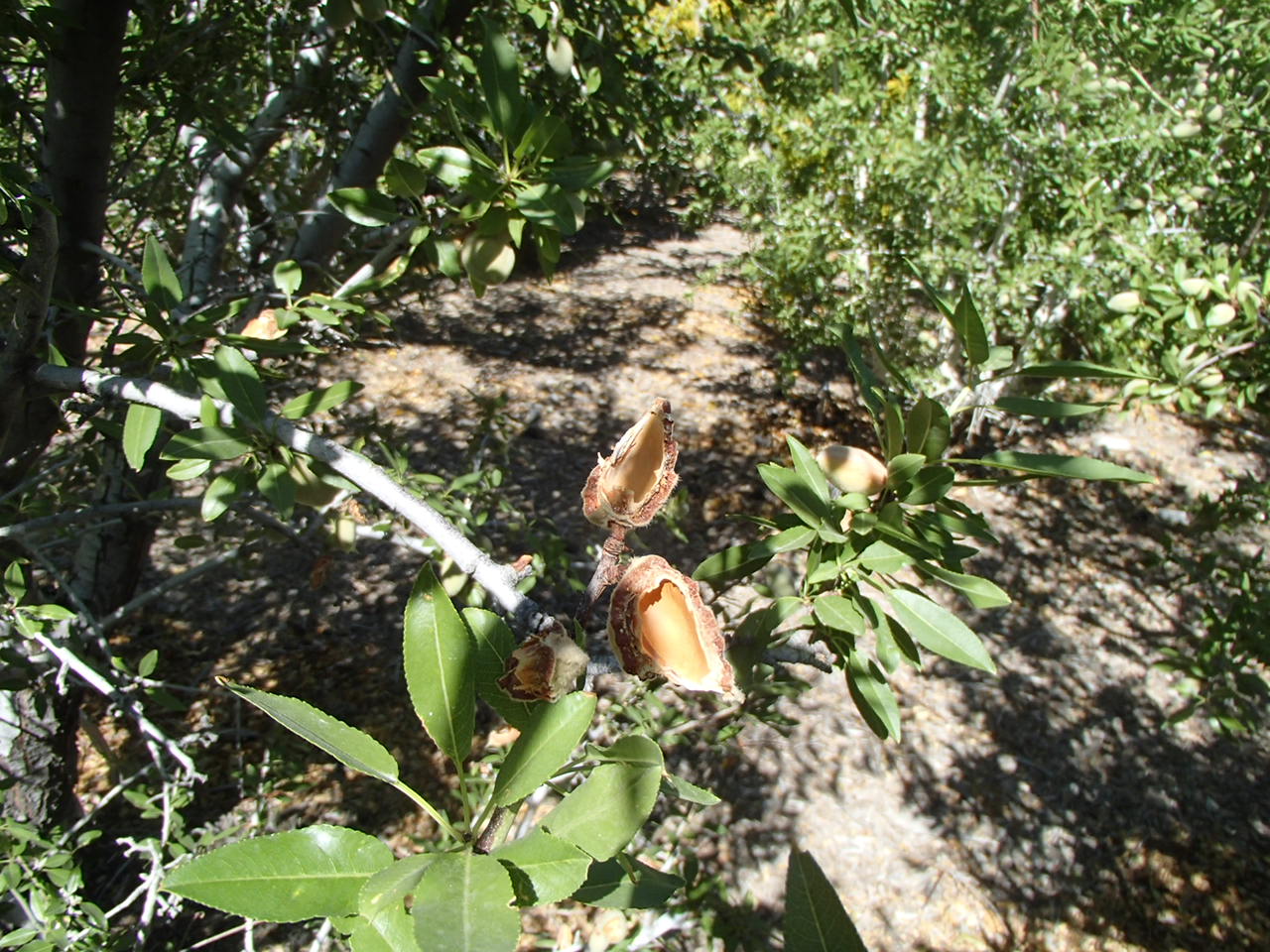
Fresh market in Khujand, Tajikistan, with all the different types of nuts available. Here the different types of almonds ranged from sweet to bitter with many different types of flavors.

Almonds in the US are focused on the sweet types of almonds. Bitter almonds are ignored due to taste preferences. 


Almond selections from a major wholesale almond grower in the US.


Some of these bitter types are "dual purpose" and the fruit can be used (resembling apricots) and the nut can be consumed. Reminds me of the days at the University Orchard in North Las Vegas when I just could not get all of our almonds shelled for fresh market. So I made the decision to market them with their husks still attached....yes, the fruit. We sold it as a novelty item at reduced prices (which in actuality resulted in better profits due to no labor involved and the "oddity" of fresh almonds sold in their dried fruit (husk). People did could not believe they were almonds and bought them out of curiosity to "show their kids". 

Some almond trees can get big (up to 30 feet tall) while others remain smaller from semi-dwarfing rootstocks or by breeding. Contrary to some information on the web, the most popular dwarf and semi-dwarf almonds ('All-in-One' and 'Garden Prince') are due to plant breeding and not rootstocks. So for backyard production the smaller dwarf and semi-dwarf types are preferred.

Another picture of the market in Khujand and the varied selection of almonds, both sweet and bitter as well as dried grapes (raisins), yes, even the famous Afghan variety, 'Kismet'. Kismet is taken from the Persian word as well as the grape.

Planting of Almonds

Plant in the spring or fall months when it is cooler. Ignore the temptation to plant when it is hot. I have had luck planting as early as the end of January (early peaches will start to flower the first week of February and later varieties throughout the month). The hole is pre-dug the day before purchasing the tree so that it is AT LEAST  three times the width of any container it might come in (digging deep is not necessary unless there is a drainage problem). If it is bareroot, then make sure the hole three foot in diameter. 

Desert soil low in organics needed by nearly all plants. So add organics or compost to enrich the soil at the time of planting.

Desert soils are usually low in organics so if the color of the soil is light brown to tan then add one shovel full of organics, such as compost, together with three shovelfuls of the soil taken from the hole. If this advice is ignored then use a pre-plant soil mix such as Viragrow's Garden Soil Mix. If a rich soil mix like Viragrow's is used, no pre-plant fertilizer (high in the middle number, phosphorus) is needed. High quality compost is all inclusive and high in phosphorus. No additional fertilizer is needed. But if you create your own soil mix or plant without it then mix with it either bone meal or MAP fertilizer at the time of planting. Use lots of water when planting and stake the tree before trusting your irrigation system.

Growth of Almond Trees

Sometimes almond trees grow slowly, die or dieback after planting. This is not what should happen!

Sometimes almonds are planted too deep or any surface mulch  can cause problems with young trees.

Check to make sure it was planted at the correct depth or that woodchip mulch has caused the trunk some problems. Pull all mulch away from small trees about a foot after planting and keep it there!

Pests of Almonds

Pests of almonds in southern Nevada arent nearly as involved as they are in almond (pronounced regionally as a' mund without the "L" sound) production areas of California. Primarily it is due to our isolation from that growing region.

Aphids on almonds. Aphids like to hit up fruit trees from their overwintering locations oftentimes at the base of trees. That's one of the reasons why dormant oil applications can be so terribly important on fruit trees in particular.


Sapsucker (woodpecker) damage on 'Neplus Ultra' Almond in North Las Vegas


Probably root weevil damage on the leaves of almond. Not sure 100% since they come out at night to feed. It can be seen on ornamental trees and shrubs as well.


Ground squirrels can harvest the nuts from the tree overnight. They do this by cracking open the husk and shell and taking the nut.


Sometimes we see some squiggly sap coming from the nuts when they are immature. This can be from feeding damage by insects with piercing-sucking mouthparts (like the leaffooted plant bug or stinkbugs which are quite common in the spring or even diseases.


This feeding on young almonds results in what are called 'Blanks' or almonds that are empty of a nut. This shriveled nut can be left inside the otherwise empty husk and shell.

It takes about three years before you start harvesting the nuts from the trees if all goes well.

Almond Nuts Dry and Hard. Why?

Q. I have a 10 yr. old ‘All-in-One’ almond tree that is healthy and produces an abundance of nuts.  Most of the nuts are not edible because they are dry and hard.  Is this due to the desert conditions here? I have tried picking at different times, boiling and roasting them.  Any suggestions?


Feeding by insects, and sometimes even disease, can cause almonds to not produce a nut.


A. 'All in One' is a good variety of almond for this climate. It is a self-pollinating, semi-dwarf variety introduced from Zaiger Genetics and marketed by Dave Wilson Nursery with good nut production here. Great for a backyard. Although I have to admit I like 'Garden Prince' almond (another almond introduced by Zaiger Genetics) more because of its flower color. The flavor of the nut is the same in my opinion. You can't go wrong with either semi-dwarf tree for backyards.

Something is wrong. Check for damage to the nuts from insects like the leaf footed plant bug. The mama insect can fly in from your neighbors yard around the end of March or early April and start raising her young. It doesn’t take long and she and her brood start feeding by sucking the life out of the nuts as they are developing. This causes the nut to abort leaving a husk that shrivels and dies.

Leaf footed plant bugs require weekly hand picking, a cordless vacuum cleaner or a one-time pesticide application to kill or remove them.

You say you are checking the nuts as they develop but start splitting the husks open in about late March or April. Check the nut development inside the husk and look for these bugs causing damage at the same time. They are normally harvested in Las Vegas in July or August.

Silver Torch Cactus Stems (Columns) Shrinking

Q. I have a clump of silver torch cactus about 7 years old and some of the columns appear to be shrinking in diameter. It appears to me that the smallest column is narrowing in diameter about 4 inches above the soil line.  The largest one also appears to be narrowing at the bottom as well. I don’t water from November through February and start watering again in March and April and September and October and fertilize twice a year with a cactus fertilizer. In the summer months of May through August I water twice a month. There are no soft spots near the ground and no pests I can see. What do you think?

Silver Torch cactus. A beautiful cactus from the high elevations of Argentinia and Bolivia.
 THEREFORE it does not like high temperatures of our Mojave Desert. Protect it from high light intensities of the late afternoon...that means dont plant it on the West or South side of a home.
A. This is a clumping cactus that grows to about four feet and can handle winter temperatures to about 20F. It also likes high intense sunlight but cooler temperatures than ours in the summer. For that reason, it performs better if it does not get intense heat during the hottest time of the day in the summer. Make sure it gets some shade if it is on the west side. Also, I would give it one more irrigation during the cooler months but your timing of irrigations look good when its hot and the soil does not stay wet. Don’t water more often than that. 

Silver torch cactus is from the dry higher elevations of Bolivia and Argentina and not from one of our deserts. It struggles during our hot summers starting in the low 100’s and particularly in hot locations (such as a western or southern exposure in full sun during June - August). It is not from the Mojave Desert! Surrounded by rock in these locations make it even hotter! So be careful when using this plant and plant it in the correct location!

Want info from Tucson on this plant?

            Many cacti have narrower stems at the bottom as they get older. Older stems get “woody” at their base and cant expand and contract as they store and use water. They also develop constrictions along the length of long stems when their growth ends. Constrictions along the stems make convenient places to propagate them. Just make sure you sanitize hand shears when cutting! If you are checked for soil drainage and root rot, then I don’t think their narrowing is a problem.

Strong Winds Damage Bottletree and What to Do

Q. I have several bottle trees, now over 7 feet tall, damaged by two windstorms close together. After the windstorms, the branches were sagging, and the tree looked pitiful; the tree looked like it was in shock. Next morning I watered it thoroughly for about 5 minutes with a hose. The tree looked happier. The trees are watered twice each day for eight minutes by drippers and surrounded by rock mulch.

Bottletree loss of leaves due to high winds. Make sure when you water these trees that they are given enough water, maybe 20 to 30 gallons depending on their size, and distributed over a wide area. Then hold off on your next irrigation until the soil has a chance to dry out. This helps the roots of the tree to breathe and not get suffocated by the water.


A. I’m not a big fan of watering daily and watering trees for only a few minutes each time. Basically you give them a sip of water every day instead of a big gulp all at once. I understand that some irrigation systems will allow different irrigation scenarios. Now is the time to bite the bullet and change all that.

Put trees and shrubs on different irrigation lines from the much small plants that must be watered daily. Please realize that as trees get bigger they need more water, and they need this water applied to a wider area. This means adding more drip emitters under the tree every three or four years as large trees and shrubs get bigger.


            Tree roots grow where water is applied. If water is applied close to the trunk, that’s where roots will grow unless there are other plants nearby also getting water. Roots growing close to the trunk (because that’s where all the water is!) increase the chance of the tree blowing over in a strong wind. They must survive on the water that you give them and where it’s applied. Where water is applied is where plant roots will take up the water. They know enough NOT to take water up from dry soil. They can't! This is why partial root zone drying works. Its science you truthsayers.

How to give it more water without changing the time on the irrigation clock?

            What to do? Add more emitters under the tree canopy about 18 inches apart. Spread them apart. Apply water to a larger area under the tree canopy. And water for a long time. Add these emitters to previously dry areas further away from the trunk. Instead of watering twice a day, water every other day, only once, but water for 30 or 40 minutes instead. Pretend you are filling a reservoir of water and let the tree use half of it, then water again and fill it.

Rebar and how deep to water? Pretty easy and cheap to do. Push it into the soil into the wetted soil several spots just after an irrigation. 

Want to Know How Much to Water?

Want to know how much to water? Buy a thin piece of rebar about 4 feet long and push it into the soil after you finish an irrigation. The rebar slides easily into the wet soil where water is applied and then it stops. If it stops at 15 inches deep and you want 18 inches, add another ten minutes to your irrigation to get it deeper or change to a larger emitter. 

Dont want to add more minutes to the clock? Add more drip emitters and increase their size if needed. Put them 18 inches apart and let them fill the soil to the proper depth. Remember with trees, it is important to water deeply AND apply it wide enough under its canopy. This is what is meant when people say, "Water trees deeply and not frequently."

Rebar is difficult to push into soil where the applied water no longer reaches. A tree like a bottle tree should have wet soil from an irrigation about 24 inches deep when it is young.

Why are Pomegranate Fruit on the Ground?

Q. Something has been eating my almonds! I heard it was ground squirrels or rats. I've never seen either in my yard or neighborhood in the 12 years we've lived here. Any other possibilities?

When almonds are gnawed from the husk and shell it is most likely ground squirrels this time of year

A. The varmint was chewing the outside husk and stealing the almond inside the husk, leaving part of the husk behind. They drop the husk chewed off onto the ground. This sounds like ground squirrels to me. Ground squirrels are the number one pest for stealing almonds. I have had ground squirrels clean out an entire 15 year old almond tree of nuts overnight.

Pomegranate fruit is lying on the ground. A no-no. Always prune the tree so that these limbs support the weight of its fruit. As the limbs get older and stronger, removal of side limbs to about knee height is good enough. When the limbs are young they are more flexible and cannot support the fruit adequately.

But rats will eat anything so they have a lot more to pick from in the summer. Like garbage. I don’t know if they will want the nuts at this time of year. Because it is just the nuts and there is plenty of other food around, I am putting my money on the ground squirrels. I don’t know of any other critter that will take almonds this time of year. To control this problem, I removed the ground squirrels with concealed poison bait but traps are available.

Saturday, July 31, 2021

Why Do Fruit Split Before Harvesting?

Q. What causes cantaloupe melons to split before they slip the vine?

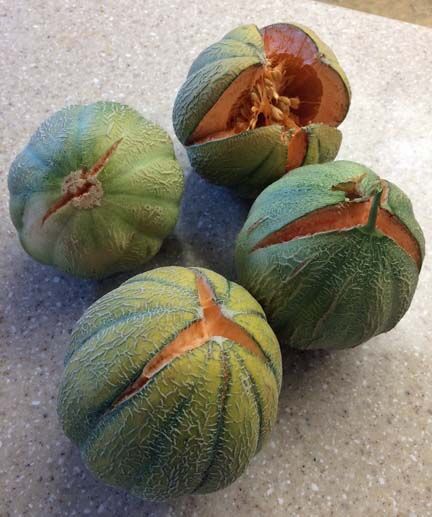
Melons splitting as they are ripening

A. Like any fruit, when the melon nears maturity and the outside rind hardens and irrigation water is “pumped” into fruit, they split. This can happen with melons, cherries, peaches, tomatoes, cucumbers, and other botanical fruits. Fruit with a thin skin like cherries are more susceptible to splitting after a rain than thicker “skinned” melons. Fruit splitting can happen soon after an irrigation when the temperatures have created a lot of stress or right after a rain.

Peach splitting on the tree

Rainwater enters the fruit through the “skin” or rind and causes it to swell and burst. It is due to an “osmotic effect” and susceptible fruits will split when nearly ripe and their sugar content is peaking. Nearing maturity is the time these fruits are full of sugar and primed for rainfall and the “osmotic effect”. “Nearly ripe” is a dangerous time for a combination of fruit and rain.

Orange split

What to do? First of all, note the variety. Some varieties are more susceptible to splitting while others are not. Secondly, harvest climacteric fruit (those fruit that continue to ripen after they are picked) early. before a rain and let them ripen protected after harvest. Unfortunately, melons are non-climacteric and do not ripen further after picking. Protect the fruit from rainwater and apply a surface mulch during hot weather.

Cupping or Rolling of Plant Leaves During the Heat

Q. Why are the leaves of my fruit trees cupping or rolling?

Leaf roll or cupping on pepper plant even though its mulched

A. Fruit tree leaves of apples, pears, pistachios, tomatoes, and other plants in full sun all day long will sometimes cause the leaves of some varieties to cup or role. Excessive irrigation and fertilizer, high temperatures, the variety of the tree or plant, overly dry soils, root damage and planting shock are some of the environmental factors that can cause physiological leaf roll in fruit trees. Over time all the leaves on the plant may be affected.

Tomato leaf (probably 'Early Girl' cupping or rolling

If your plant is showing lots of leaf roll first blame the high temperatures of summer. Leaf rolling won’t hurt the leaves as long as they remain soft and pliable. Next, be careful of irrigations. Irrigations should keep the soil consistently moist for most garden plants and not allow the soil to dry out rapidly. Apply a surface mulch to slow water loss from the soil and reduce plant stress. Woodchips, straw, shredded newspaper applied a few inches deep will slow water loss from the soil, reduce fruit cracking due to irrigation and conserve moisture.

Leaf roll of mockorange landscape shrub (Raphiolepis spp.)


Retract Your Statement About Poisoning Ground Squirrels!

Q. I am wildlife biologist and a gardener. You should retract your statement about poisoning ground squirrels as the poisoned bodies will appear in the food chain of hawks, owls, coyotes, foxes, and snakes.

Ground squirrel taking the nut from almonds by chewing the outer hull and shell

A. You are right. Poisoned carcasses of any animal can enter the food chain of other animals. It is important to make sure that individuals are following all federal, state, or local laws or ordinances pertaining to the use of a pesticide (whether it is used to kill weeds, insects, protect plants from diseases or terminate the life of a critter) and that any pesticide is used as a last resort. Make sure to read the pesticide label and follow its directions.

After ground squirrels are finished harvesting the nuts, they leave behind the hull and husk which can drop to the ground

            Ground squirrels can rob a tree of almonds overnight. One method to avoid this from happening is to harvest the nuts earlier in the calendar year and dry them in a protected location.

There are different ways to eliminate ground squirrels. Pest control companies exist that focus on “humane methods” and market these options for concerned gardeners. I would refer anyone interested to follow the advice given by the University of California regarding controlling ground squirrels (http://ipm.ucanr.edu/PMG/PESTNOTES/pn7438.html). Please remember that trapping and releasing an animal to another area is illegal in most states and potentially cruel. Check with your local laws.

Nuisance wildlife in Nevada

Bottletree New Growth Dying in Phoenix

Q. The new growth on my bottletree I bought in 2018 is dying (crusty), starting a month or so ago. After talking to the local nursery, I increased the watering and soaked it for about an hour and it now looks worse. I’m watering 6 days a week and each time the tree is getting 22 gallons.

Branch in bottletree dying back.

A. Not sure why you thought the tree looked worse after you watered it. This trees roots are sensitive to watering often and keeping the soil wet. It’s a “deserty” kind of tree, but not truly “deserty”. As a young tree, it needs about 20 – 30 gallons each time it is watered. You are watering the right amount, but the soil shouldn’t be continuously wet six days a week. That’s a mistake. Read what someone else says about this tree in the Phoenix area.

Roots Must Breathe

The roots need a chance to “breathe” after the tree is watered. Knowledgeable people from the Phoenix area suggest watering this tree only twice a month during the summer. Remember, Phoenix is a bit wetter than we are because of their summer monsoons and they get more cloud cover.

My advice is not as dramatic, but I think not giving the soil a chance to dry out between irrigations is a mistake with this tree. Starting this October, try watering less often, maybe twice a week. Apply water to the soil starting 12 to 18 inches from the trunk. This water should wet the soil all the way to the ends of its branches (canopy). This tree likes to have other smaller “deserty” plants getting water near it. Other plants help cool things down.

Apply Water Less Often but Deeper

Apply enough water so the soil is wet to a depth of about 24 inches. This takes somewhere between one and 2 inches of water so that will take about an hour or so. Then hold off on your next water application until the top four or five inches of soil starts to dry out. Then water again. This might result in watering once, twice or three times a week depending on the time of year. Watering fills the soil again with water and then wait long enough for the tree use it. The upper surface of the soil will begin to dry. This drying of the soil encourages deeper rooting of the tree and helps avoid root diseases due to frequent watering. That’s normal.

Inexpensive soil moisture sensor you can buy at any box store
...

            Use an inexpensive soil moisture sensor (like the kind sold for houseplants) and gently push it to into the soil about 4 to 5 inches deep, soon after an irrigation and in several other spots. When the soil moisture averages about “5” on its meter, water again and fill up the soil.

Bottletrees and Leaf Drop

Are Bottletrees Really Desert Trees?

Problems with Bottletrees Growing in the Desert

Bottle Trees Dropping Leaves Probably Water Related

Friday, July 30, 2021

Rosborough and Womack Blackberries Can Be Grown in the Mojave Desert

Q. I am growing Bababerries. What small berries do you recommend for our Mojave Desert climate?

'Rosborough' and 'Womack' blackberries grown at the University Orchard in North Las Vegas.
\

A. Growing berries is tough in our desert climate due to summer heat primarily. Bababerry (a heat tolerant raspberry) is a good choice to try due to its heat tolerance. I have not grown it but others claim it works. 

I have had luck growing two blackberry varieties for several years: ‘Rosborough’ and ‘Womack’. I was led to this decision by a publication out of Tucson, Az, regarding some research done in Yuma. I also tried 'Brison' but did not have the luck growing it as I did the other two. Both are “thorny” and grow erect so they don’t need much trellising. Both varieties were released from Texas A and M University in 1977 with very similar traits.

Other varieties (particularly varieties released from the University of Arkansas with native American names) have not been very successful here. All that information is anecdotal as I have not tried them. 

In our climate these berries mature during the heat in May and, like figs, must be picked the same day they are ripe. So mark your calendar for picking when growing these berries. They do not keep well after they are harvested.

You can buy starts of either of these or both by mail order here.

Value of Manure in Landscapes is Not Just for Fertilizer

Q. What is the range of N-P-K value in cow manure that I see some landscapers use for grass?

Manure can be a valuable source of many different plant nutrients, good and bad microorganisms, 
and organics. It is best composted first but in a pinch you can use it raw. Just be careful.

A. The fertilizer content (N-P-K value) of steer or cow manure varies because of what they eat and how the manure is collected and processed. It is considered “low” in fertilizer content as far as fertilizers go. It would take a very small amount of bagged fertilizer to equal the fertilizer content in a ton of manure. Both manures contain about 4% nitrogen and lesser amounts of phosphorus (P value) and potassium (K value). They can both be high in salts and rich in both good and bad microorganisms.

Difference Between Cow and Steer Manure

There is a difference between steer and cow manure. Cow manure is typically derived from cows used for dairy farming. Steer manure is derived from cows fed for meat production. Steer manure typically contains more salt than cow manure and it is considered “hotter” when applying it to plants.

Value of Manure

The value in manure is due more to its potential for soil enrichment rather than its N-P-K content.  For that reason, it can be mixed into a “hot” compost pile. The heat from these compost piles will help to change the microorganism content and decrease or possibly eliminate those microorganisms which are a potential human health problem. 

Research has shown that applications of composted manure can reduce lawn diseases due to its high microorganism count. Application of dry manure is done best with a barrel-type compost spreader.

Winter Pruning of Pomegranate Helps Remaining Stems to Remain Erect

Q. Why do my pomegranate trees have large branches lying on the ground?

Young pomegranates sucker from the base every year when they are young. These suckers need to be removed in winter pruning so that 5 to 6 larger stems remain. This winter pruning and sucker removal helps build the future fruit supporting structure of the pomegranate tree.

A.  I dont have a picture of these limbs on the ground but just went through this at an orchard where I am consulting. The pomegranates were three to four years old and had not been pruned for one or two seasons due to a poorly undiagnosed disease problem (probably crown rot due to frequent irrigations and lots of wood chip mulch applied near the base). This disease problem was spread between plants through pruning. When they were finally pruned this past spring, some of the larger stems laid on the ground. 

Pomegranate dieback disease (probably crown rot due to mulch keeping the stems wet and spread on hand pruners at pruning time), Yes, you can water pomegranate too often.

This happened for a couple of reasons. First, there was ALOT of new sucker growth from the base that caused some crowding because they were young. Sucker growth slows done considerably after about 8 to 10 years of growth and an established canopy. Secondly, they were growing like gangbusters with most of that disease gone. They are flowering and fruiting heavily causing a lot of weight on the ends of these stems.

This pomegranate was not pruned every winter and got out of hand. By this age, the tree should have hand its architecture established so the fruit does not lie on the ground.

This can happen to pomegranates when they have been in the ground for a short time and not pruned regularly. Pomegranates should have emerging suckers removed from so that only five or six of the larger stems remain. Then side growth is pruned from these main stems to about knee height to help prevent fruit born on thick woody stems from lying on the ground. This results in larger fruit produced on the older and thick 5 to 6 stems remaining and fruit produced on these smaller, side, lower branches will not lie on the ground.

This pomegranate has been pruned so that five or six larger stems remain. All the smaller suckers were removed. These remaining larger stems will bare the weight of a full load of fruit in the future. The next step is to remove the side branches to knee height.

The remaining stems will begin flowering and bend toward the ground as the heavy fruit bends them over. As these stems get older, they will get stronger. New growth comes from the remaining bent stems and not as sucker growth from the base. Removing the sucker growth from the bottom encourages the remaining stems to grow strong and erect without crowding them. Removal of sucker growth must be done frequently when they are young until the new growth emerges from the larger stems and not as suckers at the base. You are nearly done. Remove side growth from any of these major stems to about knee height so the fruit produced by these branches do not lie on the ground.

Melon Splitting after a Rain

Q. What causes cantaloupe melons to split before they slip the vine?

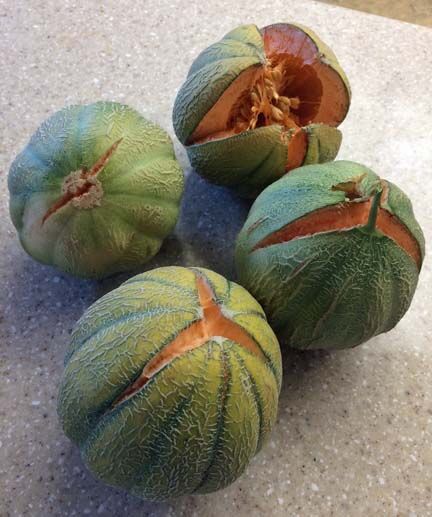
Melons splitting can be from several things but usually applying a surface mulch on the ground to slow evaporation from the soil will help

A. Like any fruit, when the melon nears maturity and the outside rind hardens and irrigation water is “pumped” into fruit, they split. This can happen with melons, cherries, peaches, tomatoes, cucumbers, and other botanical fruits. Fruit with a thin skin like cherries are more susceptible to splitting after a rain than thicker “skinned” melons. Fruit splitting can happen soon after an irrigation when the temperatures have created a lot of stress or right after a rain.

Peach fruit split

Rainwater enters the fruit through the “skin” or rind and causes it to swell and burst. It is due to an “osmotic effect” and susceptible fruits will split when nearly ripe and their sugar content is peaking. Nearing maturity is the time these fruits are full of sugar and primed for rainfall and the “osmotic effect”. “Nearly ripe” is a dangerous time for a combination of fruit and rain.

Tomato fruit split

What to do? First of all, note the variety. Some varieties are more susceptible to splitting while others are not. Secondly, harvest climacteric fruit (those fruit that continue to ripen after they are picked) early. before a rain and let them ripen protected after harvest. Unfortunately, melons are non-climacteric and do not ripen further after picking. Protect the fruit from rainwater and apply a surface mulch during hot weather.

Leaf Rolling (Cupping) of Fruit Trees, Ornamentals and Vegetables

Q. Why are the leaves of my fruit trees cupping?

Leaf roll of tomato ('Early Girl' variety, I think) during summer heat but the leaves look fine otherwise

A. Fruit tree leaves of apples, pears, pistachios, tomatoes, and other plants in full sun all day long will sometimes cause the leaves of some varieties to cup or role. Excessive irrigation and fertilizer, high temperatures, the variety of the tree or plant, overly dry soils, root damage and planting shock are some of the environmental factors that can cause physiological leaf roll in fruit trees. Over time all the leaves on the plant may be affected.

Leaf roll of mockorange (Raphiolepis) during the heat of summer (in northern climates the common name of mockorange is a different plant, Philadelphus). Had me confused for awhile.

If your plant is showing lots of leaf roll during the summer first blame the high temperatures of summer. Leaf rolling won’t hurt the leaves as long as they remain soft and pliable. Next, be careful of irrigations. Irrigations should keep the soil consistently moist for most garden plants and not allow the soil to dry out rapidly, a balance between watering too often and not watering often enough. Apply a surface mulch to slow water loss from the soil and reduce plant stress. Woodchips, straw, shredded newspaper applied a few inches deep will slow water loss from the soil, reduce fruit cracking and leaf roll due to irrigation and conserve moisture. Sometimes its just damn hot!

Ground Squirrel Damage vs. Poisoning the Food Chain

Q. I am wildlife biologist and a gardener. You should retract your statement about poisoning ground squirrels as the poisoned bodies will appear in the food chain of hawks, owls, coyotes, foxes, and snakes.

Ground squirrel harvesting of nuts from almonds

A. You are right. Poisoned carcasses of any animal can enter the food chain of other animals. It is important to make sure that individuals are following all federal, state, or local laws or ordinances pertaining to the use of a pesticide (whether it is used to kill weeds, insects, protect plants from diseases or terminate the life of a critter) and that any pesticide is used as a last resort. Make sure to read the pesticide label and follow its directions.

Ground squirrel looking for handouts at Hoover Dam

            Ground squirrels can rob a tree of almonds overnight. One method to avoid this from happening is to harvest the nuts earlier in the calendar year and dry them in a protected location.

Harvested table grapes by a ground squirrel. I challenged him/her/it and saw it jump from the grape vine about 2 pm in the afternoon

There are different ways to eliminate ground squirrels. Pest control companies exist that focus on “humane methods” and market these options for concerned gardeners. I would refer anyone interested to follow the advice given by the University of California regarding controlling ground squirrels (http://ipm.ucanr.edu/PMG/PESTNOTES/pn7438.html). Please remember that trapping and releasing an animal to another area is illegal in most states and potentially cruel.

Sunday, June 20, 2021

Do You Want Dark Green Sago Palm (Cycad)?

Let me talk about sago palm (cycad; Cycas revoluta) and growing them in the desert or in desert landscapes. We should be aware that they are NOT palms, they grow best with some relief from the late and midday sun (best on the east side of a home), they prefer to grow in soils high in organics and kept fairly wet. 

Cycads are not palm trees

Canary Island Date Palm growing in artificial grass. They will handle temps below 20F and above 110F but they like some afternoon relief from intense sunlight.

A reader didnt want me to call them sago palms because he thought people might get them mixed up with other palms, like our true palms. He is right. They are far removed from true palm trees. So lets look at a few of the palm trees that do grow in the Mojave Desert and their scientific names. Scientific names (genus, species and even variety or cultivar) say something about their appearance, how they flower or other physical descriptions. If you step back one further in classification, to their Family, it is even more general in nature. Where the sago palm and other palms diverge from other palms is in their Family name; a category of classification more inclusive than their scientific name. 

Palm Family

Palms, as we know them, are in the true palm family, Aracaceae. Sago Palm is not in the true palm family but in its own Family; Cycadaceae. Is it a palm? Technically it is. But it could be called a false Palm, not a true Palm. A more familiar Family to us is Rosaceae or the true rose family. This family not only includes true roses of all kinds but most of our temperate fruit trees (peach, apricot, plum, apple, pear, strawberry) as well as many landscape plants (rose, pyracantha, flowering plum, photinia, and cotoneaster). So compare the true palm Family to the true rose Family. In fact, sago palm is so far removed from palms it is closer to a pine tree than a palm tree!

Common name                        Scientific name                        Family

Mexican Fan Palm                   Washingtonia robusta                Arecaceae
California Fan Palm                 Washingtonia filifera                 Arecaceae
Mexican Blue Palm                  Brahea armata                          Arecaceae
Date Palm                                 Phoenix dactylifera                   Arecaceae
Canary Island Date Palm          Phoenix canariensis                 Arecaceae
Sago Palm (Cycad)                   Cycas revoluta                          Cycadaceae

This is a girl plant. Sagos are dioecious, boy and girls are separate from each other like mulberries and date palms. This is a dainty girl plant. You can tell by the round flower like thing in the center. The boy plants have flowers that look like a penis.

Sago Palm is not a Desert Plant

That's true. It is not but it can handle some of the low humidity, high temperatures and intense sunlight if it is in good health. If your sago palm is surrounded by rock chances are it will not handle the south or west sides of a hot landscape. But if it is in good health, it might. They will prefer growing on the east sides of buildings getting some relief from the afternoon sun or in light to medium shade of a tree.

Sago palm prefers growing in soil with lots of organics in it and then covered with wood chips. They will not grow well surrounded by rock, in rock landscapes or hot sides of buildings (south or west sides).

Plant them in Compost and Cover the Soil with Wood Chips

Will they grow in soils not amended with compost? For a time, yes. Will they grow in landscapes surrounded by rock? Yes, for awhile. But that is not where they prefer to grow. They prefer rich moist soils. To get them in good health to handle the heat then plant them in soils with compost in it and water them like a peach or apple tree.
These sago palms (okay, cycads) are planted on the north side of a home and the soil covered with wood chips.

If you want a sago with healthy dark green leaves that are vibrant and healthy then plant on the east or north side, use compost in the soil mix at planting and cover the soil with wood chips. Oh and dont forget to use about four drip emitters when they are a few years old and water them at the same time as your fruit trees, roses, and most landscape trees and shrubs.