Type your question here!

Friday, July 29, 2016

Some Bees are Stingless to Humans


Q. I noticed numerous several small bees swarming around one of my brick planters.  The bees were not aggressive and small … about ½ to ¾ inches long.  There wasn’t a hive of any type, but I did notice a small hole (about ¼ in diameter) in the dirt where the bees would enter and exit.   I did some quick internet research and these appear to be type of Solitary Bee.  Attached are two pics of one that I caught with my pool net…sorry the pictures aren’t very good, but I was hoping that you could confirm that these are Solitary Bees.  They have a black/gray body and the underside is yellow.
If they are Solitary Bees, the research I did indicates that they aren’t aggressive, rarely sting, and are great pollinators.  However, they are a nuisance where they are located.  Do you have any suggestions on how I can get them to move ground nest to another location without killing them?
One of the solitary bees we frequently see signs of in the garden include the leaf cutter bee.
 
You can build bee boxes or homes for these bees to use for egg laying by drilling one 2:45 eighths inch holes deeply in large blocks of wood.
A. Joe yes these are solitary bees. I am no be expert but my understanding is that solitary bees do
not make be colonies, they do not make sizable amounts of honey, they are not aggressive and they cannot sting. However, I think they get a late start in the season and so early crops such as tree fruits may not be the best for them to pollinate. They are better for pollinating plants that bloom later in the season like summer vegetables and flowers. 

An example of a solitary bee are the leaf cutter bees. You can attract more bees by putting out clean water. They need water to keep cool, honeybees in particular to cool their hives. Honeybees are constantly carrying water back to the hive during hot weather. But the water has to be changed regularly. 

As far as moving them, I don't know any way to move them. I think many of them lay their eggs in these holes and the young bees emerge from them later. That is the way with leaf cutter bees so I'm guessing these guys are similar.

White Flufffy Insects Common Problem on Many Cacti


Q. I appear to have a massive infestation of Cottony Cochineal Scale on my prickly pear cactus. I can usually get most of it off by hosing, but much is hard to reach. Beyond hosing, what insecticide or other kind of solutions do you recommend? Permanent, if possible!


A. Yes, scale is quite common on cacti in general and prickly pear in particular. This one in particular is most likely cochineal scale rather than cottony cushion scale. This cochineal scale is a close relative of the cochineal scale that was used by the Spaniards in Mexico centuries ago and die making. This scale leaves a purple color on your finger when you rub it.They can be hosed off the pads with a strong stream of water as you are doing but they reinfest the pads very quickly and in full force again in a week or two.
            When I am growing prickly pear as a food I am more concerned with insecticides and getting them into the food we eat but if they are grown just as an ornamental plant and not used for food then I feel better about using something stronger than water, soap and water sprays.
            The problem with a strong stream of water is that the force from this water is not enough to knock the insect off of the pad, only the white, fluffy coating surrounding the insect. So it is a short time before it regrows this protective cover and the unsightly mass of cotton is back again.
            Knocking the fluffy covering off first with a strong stream of water will make these insects more susceptible to an insecticide spray. Most of the common insecticides will work after that; malathion, pyrethrins, Sevin, just about any common insecticide will work after the fluffy covering has been removed. This does not mean they won’t be back. They will. But it will take longer for them to get established on the plant again.

Grapevine Had No Grapes for Two Years

Q. My grapevine had grapes for the first of four years but this and last year it had none. What is wrong with my grape vine? By all appearances it looks perfectly healthy but it didn’t produce grapes for the last two years.

A. The fruit or berries of grapevines are produced only on the wood which grew the previous year. Growth this season and three-year-old wood and older will not produce any fruit. Two-year-old wood is the only place that can produce flowers and fruit.
If all of the two-year-old wood is removed or dies, there will be no flowers or fruit. If the vine is left to grow without any pruning it will produce lots of fruit. But over the years this tangle of growth will create problems from crowding, fruit rots, disease, and it will be difficult to harvest the fruit.
Next spring do not prune. Let the vine grow. At least this way you will get some fruit from it. Your other option is to learn how to prune grapes correctly.

Figs Not Ripening

Q. We have two fig trees loaded with figs. Problem is they are not ripening. What is our problem or do they take a long time to ripen?

A. Most of the main crop of figs is still green in June and have developed to maturity. If the tree is getting plenty of water, the figs should be enlarging rapidly. If the figs are not enlarging, then the tree is not getting enough water.

Figs that produce fruit need a lot of water so that the fruit will enlarge. If you don't give the tree enough water the fruit will stay small and fall from the tree, hard as rocks.

Keep Irrigation Water Off of Plant Leaves to Reduce Powdery Mildew

Q. I have powdery mildew on lower branches on my shrubs. Should I remove the dying leaves? Since the temperature will be 114 tomorrow, should I wait until Fall?
Powdery mildew on Japanese euonymous. These plants are famous for mildew.

A. Powdery mildew on these plants is probably left over from this wet spring. Powdery mildew disease does not require high humidity. As far as diseases go, it probably has the lowest requirement for humidity or moisture.
            The usual reasons for powdery mildew besides cloudy, rainy weather is shade, poor air circulation and poor plant health. If you can reduce the shade with some light pruning that may help.
Make sure there is no splashing water from an irrigation system. This will spread the disease from leaf to leaf or plant to plant.
Sulfur dusts as well as neem oil have been known to work as preventive sprays. Otherwise use traditional fungicides that list powdery mildew control on the label. But with these high temperatures the disease should subside. It is a cool temperature disease.
If the leaves look pretty bad, then go ahead and remove them. At least then you are removing disease inoculum. But consider some light pruning instead. You won't hurt anything with light pruning this time of year and you may give the lower parts of the canopy more sunlight.

Small Round Holes in Tomatoes is Tomato Fruitworm

Q. I found about 4 to 5 tomatoes with holes in them. I have been getting ripe tomatoes for about 30 days and found these with holes in them during the last two days. I searched for bugs, eggs and leaf damage but did not find anything. Any ideas?
Probably tomato fruitworm damage

A. The 3/8-inch diameter and larger holes in your tomatoes look like damage from the tomato fruit worm. These are worms, or caterpillars, are about an inch and a half long and 3/8 of an inch wide. They eat holes mostly in tomato fruit, usually when they are green or when they turn red but are still hard or firm. Frequently the fruit becomes rotten from these holes.

Organic sprays of Bt or Spinosad when the fruits are starting to form will prevent this.

Saguaro Should "Rest" Between Irrigations

Q. We have a concern about our Saguaro planted in 1988. It now has three large arms and we recently noticed a crack on the outside of one arm at the bend of the “elbow”.
Saguaro growing near Parker, Arizona

A. Don't water it too often. Watering about 10 or 15 gallons around the base of the plant in a 5 to 6 ft radius once a month is enough. Those plants expand like an expanding accordion when they swell up with water.

Let them use this water before you give them another drink. The plants will shrink in size when they use their internal water supply. If they are given water too often they can swell up and split. The splitting may have happened during the rains this spring and early summer. Regardless, the crack should heal and give the plant a little bit of character.

Watering Saquaro

Q. I have a healthy Yucca tree (10 years old) in my desert landscaped yard (similar but smaller to what is pictured below). The homeowner before me watered it daily in summer and weekly in winter along with the rest of the drought-resistant plants in the yard and did so for many, many years. I have continued that practice but have read that Yuccas should not have daily watering. Since everything looks healthy and vibrant, would it be OK to continue daily watering in summer? Thanks.


A. Exactly right. They are not supposed to be watered this way. However it appears the previous owner found a happy medium between watering frequently and not watering too much. My guess is the tree was getting very small amounts of water daily. 

I would not worry about it if the plants are doing okay and I wouldn't change anything. However, you should be aware that you are doing it entirely wrong but it's working. Be careful if you change anything because these plants are now adjusted to that watering schedule.

Forcing Bougainvillea to Be More Vigorous

Q. I am concerned about one of my three Bougainvillea plants growing on the south side.  I removed some very old and scraggly oleanders from this spot and raked out all the oleander leaves before planting these Bougainvillea.  I feed them and they have good water supply, but the one in the center is scrappy looking while its brothers on either side are thriving. 
Bougainvillea grown as a woody perennials shrub in Bullhead city, Arizona where it seldom freezes.

A. Bougainvillea do very well here during our summer heat with a minimal amount of care as long as the soil is amended at the time of planting and they are fed regularly with low nitrogen fertilizers.
They like to be pruned so if you see them struggling, prune them back, give them water and fertilize them lightly with a rose or tomato fertilizer.
They also bloom better if they are struggling rather than if they are pampered too much. Going through a dry period may encourage blooming.

Why Are My Oranges Mealy?

Q. We also have an orange tree that gets oranges (Not a lot  but some) and they are mealy and not very tasty.  How can we solve that? I do give the orange tree lots of extra water.
Oranges grown in the Philippines are not orange in color when they are harvested because it is in the tropics. To get oranges typically orange orange in color requires that they are put into the chamber with ethylene gas in a process called "degreening".The red fruit above the oranges is rambutan.

A. Mealy oranges is usually a sign of over maturity, leaving the fruit on the tree too long. Next time they are starting to ripen begin harvesting one of the time a week apart until you hit the right harvest time.

Mark it on your calendar. It doesn't change much from year to year. Unless they are ripening in the winter, you must harvest citrus when they are ripe. They cannot stay on the tree. Don't wait for an orange to turn color completely. 

Begin harvesting it when there is still some green in the rind. If you wait until it is fully orange it may be overripe. Oranges are placed in chambers with ethylene gas to turn them completely orange.

Nice vine, bitter grapes

Q. I have sent three pictures of our grape vines.  We have been getting a few bunches of grapes but they are small and bitter. How do we get them to get larger and sweeter?


A. Many grapes do well in the Mojave desert climate. Some perform better than others. Some perform Much better than others. A problem we have with grapes is uneven ripening of the berries in a cluster. This means that some of the berries will be ripe earlier than others. We see the ripening of the berries as a change in its color. Technically this is called veraison. 

Uneven ripening is still a problem with grapes in general but climates with high temperatures it is more of a problem. In cooler climates, particularly with cooler nights, berries mature much more evenly. 

Make sure that you have a variety of grape that performs well here. I noticed you did not mention which variety you have which makes me a little suspicious. All of the grapes that will do well here will mature, turn color (green grapes turn a light green or yellowish green while red or black grapes turn their respective colors; the yellow green grapes in the second picture look ripe to me) in the correct season. This can range from June through August or September depending on the variety. Your vines look healthy but healthy vines do not necessarily deliver a delicious grape. Make sure you wait long enough so that the fruit fully matures. In our climate grapes perform better with aced surface mulch of wood chips covering our desert soils. My suspicion is either the wrong variety or you are not waiting long enough until they mature when you're harvesting. The individual berries in the grape clusters do not all ripen at the same time. I usually have to harvest them when a few of the berries are actually overripe. Once grapes have been harvested, they will no longer improve in flavor or sweetness, unlike plums, peaches and even bananas.

Early Grande Peach Leaf Scorch

Q. I have a new ‘Early Grande’ peach which produced over eighty blossoms. I removed fifty of them and harvested the rest. The leaves are turning yellow and dropping off.  I am watering the tree for 40 minutes, three times a week, on alternate days right now, so the tree is getting 16 gallons a week.

A. If you're peach tree is getting yellow leaves and these are dropping and the canopy is sparse (thinning, not very many leaves) I am guessing it needs more water applied. If the soil is bare, watering every other day sounds about right for most soils. If the soil is covered with a surface mulch then you might be able to squeeze two days between irrigations.
Use the same technique to make sure the water is wetting the soil 18 to 24 inches deep. Just like fig, peaches will improve with a surface mulch. Peach trees at the University Orchard in North Las Vegas that are 7 feet tall and 7 feet wide are receiving 90 gallons of water each week in a basin that collects the water around the trunk that is 6 feet in diameter during the hot summer.

NOTE:
The term "too much water" has a double meaning. Too much water can mean that too much water is applied at a single time. Too much water can also mean that the water is applied too often. It is much more damaging to plants when water is applied too often than it is if too much water is applied in a single application. Enough water should be applied to wet the depth needed. That is a given. That will never change. What will change during the seasons is when to water, i.e. how often. Plants will use 500 to 800% more water in July and August than they do in January.

Figs Dropping Off

Q. My fig tree is receiving 12 gallons of water a week in the middle of the summer. I water it for 40 minutes, three times a week right now while it is hot. Some of the leaves are brown on the edges. The fruit did not mature and they dropped off.
Figs drying and dropping from the tree

A.  12 gallons of water a week is not enough. Trees at the University Orchard in North Las Vegas that are 6 to 7 feet tall and about just as wide should get 30 gallons of water, three times per week or a total of 90 gallons.
Fruit trees are moderate water users but the soil cannot become dry when they are producing fruit. If it does, it affects the fruit size and quality and it's possible it may not develop at all.
When figs are not given enough water (either the quantity is not enough or they are not receiving water often enough) the fruit becomes small, hard and often times drops from the tree.
I don't know how much of this water is actually getting to the roots. When watering, enough water should be applied in a single application to water roots to a depth of 18 inches, minimum, 24 inches is better.
The water should be applied under the canopy so that at least half of the area under the canopy is wet.
Take a piece of 3/8 inch rebar and push it into a wet area under the trees canopy. You should be able to push it easily to this depth. Pushing it into the soil easily means the soil is wet. It pushes with a lot of difficulty if the soil is dry.
Applying a 4 inch layer of surface mulch helps keep the soil moist, reduces fruit drop and improves fruit quality. Both rock and wood surface mulch works but wood is better for fruit trees.

I am guessing a tree that is 4 feet tall might require 15 to 20 gallons, three times per week right now.

African Sumac Leaf Drop

Q. My African sumac tree strips itself into a skeleton about the time it gets hot. It drops its leaves. This summer I tried to water earlier and it didn’t get as awful looking. But it is a real mess when it drops leaves.
Yellowing leaves of African sumac just before leaf drop
A. African sumac is not “dry deciduous”, which is true of plants such as the Australian bottle tree. But African sumac will drop its leaves if it does not get enough water. Either increase the frequency and amount of water during the summer months or put down a layer of water conserving mulch so the soil stays wetter when it's hot. This should help reduce leaf drop.African sumac is a "messy" tree in the landscape.

Removing Nutgrass by Excavating Soil May Not Work

Q. We have a large garden in an area that used to be underwater. The soil is dark, has very small particles, and it clumps like clay. It also has nutgrass. We have tried several way to get rid of the nutgrass and so far, none have been successful. The soil needs amendment and we are wondering if digging up the weedy surface and disposing of it and replacing it with compost and topsoil would fix the problems, or if there is a better solution.
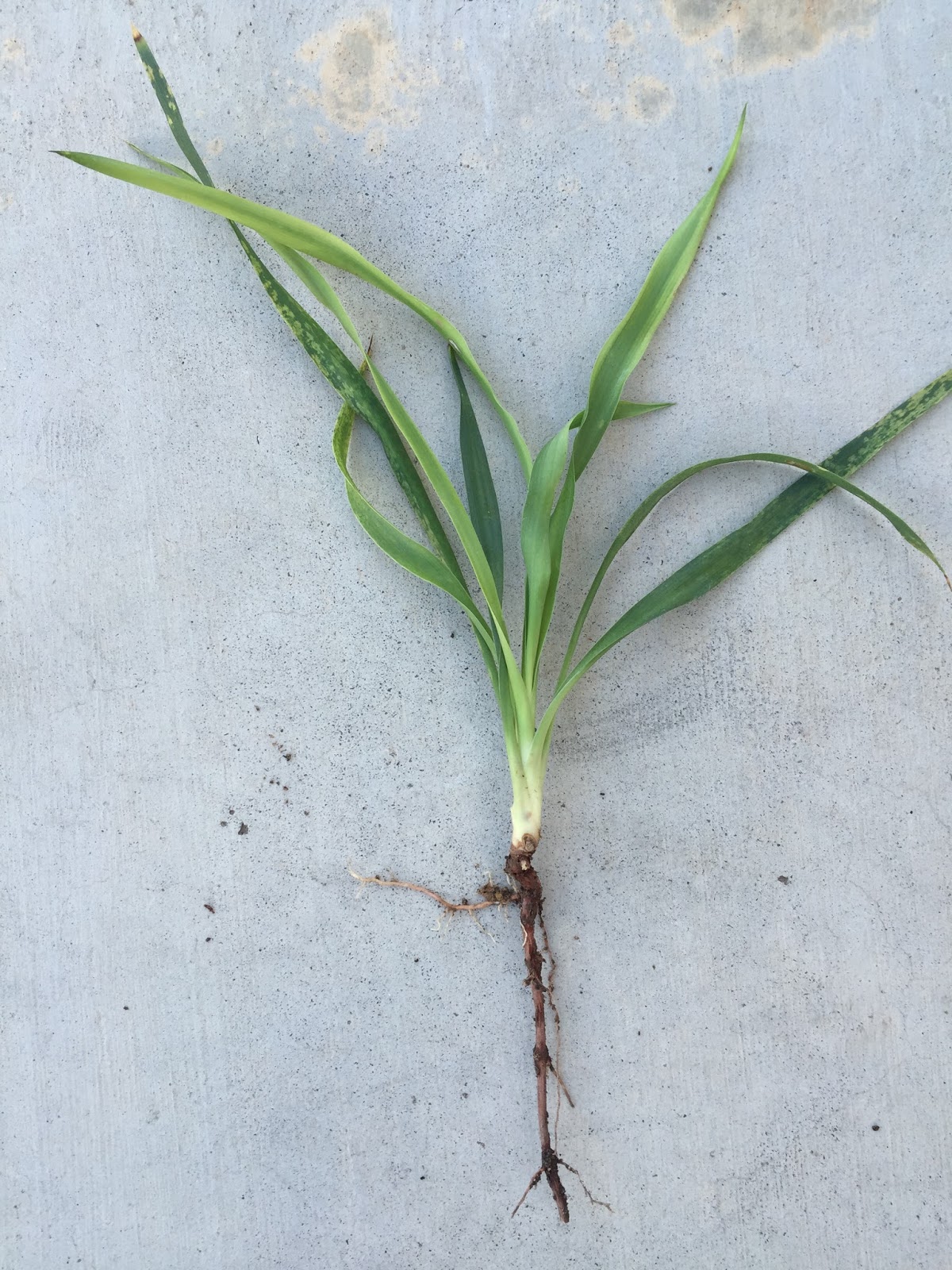
Nutgrass with its "nut" attached to the roots.

Nutgrass with its triangular stems because it is a sedge, not a grass.

A. Underwater? You are opening up a whole new area of horticulture that should be called scuba gardening. Yes, nutgrass is an important weed in rice paddies. Very difficult to control. I'm sure you have done your homework. They produce a nut like swollen stem that will generate new plants if it is separated from the mother plant. 

So when you pull, hoe, burn or apply pesticides the tops die but the nuts regenerate new plants. Weed killers like Roundup and dandelion killer kill the tops but not the nuts. You do all these things and nutgrass comes back with two or three times the population. 

Solid research has shown that you can exhaust these knots and nutgrass if you are diligent. The technique is to continually remove the tops at the time when they have exhausted most of the nut but not yet have rebuilt it. 

Timing of the removal of the top is critical. The most effective stage to do this is when the top of the plant has produced four leaves. If you wait longer than this, the plant begins rebuilding new nuts. If you remove them sooner than this than the nuts have not been fully exhausted. You will start to see a decrease in the population the first year you attempt this. Every year the population of plants will get smaller and smaller. 

Use anything that either burns or removes the tops. Your other option is to remove the soil to a depth that captures all of the nuts. This would be a minimum of 12 inches followed by removal of the tops of any of the nuts that remain to exhaust the mother plants.

Prune Mesquite in the Summer?

Q. I have a Mesquite tree that has gone wild. I had it trimmed a year ago and thought I could skip a year but no chance. It’s rubbing against the roof again. When is the best time to have them trimmed? Can I do it during the summer like in August?
Finding the right amount of water to give trees like mesquite so they don't overgrow can be a balancing act.

A. Let’s talk about its “wild growth” first. Mesquite trees, like most desert plants, are opportunists. When water is present, they grow like crazy. When water becomes limited, their growth slows down. If water really gets limited, they begin to drop their leaves. If water is even more limited for a longer period of time, then branches begin to die.
            It’s fun to see a Mesquite tree grow eight or 9 feet a year but this is also a signal it’s getting a lot of water. Put this to your advantage when it’s young by giving it frequent irrigations and large amounts of water. As the tree begins to reach a size that you prefer, the watering schedule should be restricted.
            When the tree reaches the size you like, then it becomes a balancing act; finding the right amount of water and applying it at the right time so that growth is not berserk but the tree still looks good.
            When the tree is the right size, cut back on how often it receives water but give it a large volume when you do water. This helps develop a deep root system.
            The trick is to determine when to irrigate next. Use the information I just gave you to determine that. When you see the tree begin to drop leaves or the canopy begins to thin, then give it its next watering.

            As for pruning, light pruning can be done anytime. Branches that are rubbing on the roof should be removed as soon as possible. But if you are pruning significantly and opening the tree for a lot more sunlight to penetrate into the interior, then do this during the winter.