Type your question here!

Monday, June 26, 2017

Viburnum Leaf Browning Probably NOT Spider Mites


What’s happening to my Spring Bouquet (Viburnum Tinus)?  It bloomed beautifully in the Spring for several years (including this past Spring), but many of the leaves are turning brown, and appear to be burnt.  I didn’t see any evidence of spider mites or other pests.  I checked the drippers and it is getting sufficient water.  Is this damage caused by Fire Blight, Spider Mites, or something else?  I was planning to spray it with Bayer 3 in 1 Insect, Disease, & Mite Control (which contains Imidacloprid, Tau-fuvalinate &Tebuconazole). .

Any assistance would be appreciated.


A. You are correct to inspector for spider mites this time of year. We usually see them when weather has been hot and dry. Spider mites can be a problem even if we don't see webbing. Webbing isn't always present. Spider mites love dusty leaves so washing the leaves off with water after windy weather is a good idea.
 
Two spotted spider mite. Actutally the size of this period......
That being said, I don't see spider mites as a problem in the pictures you sent to me. Spider mites don't live very long so their dead bodies leave behind kind of a dusty appearance to the leaves. I also use a hand lens and look for their tiny eggs which are round translucent balls. Finally I take a branch and slap it against a white piece of paper. I look for tiny crawly things about the size of the period at the end of the sentence.
 
This is spider mite webbing but doesn't always happen
I don't think you have them. I think this problem is water related. Either the plants are watered too often, they are not given enough water when they are watered or they are given too much water. You didn't tell me how often you water but I think you are may be watering too often. That's my guess. Root suffocation or rot is relatively common on viburnum unfortunately.

Water less often.  When you water, give them a lot Of water at one time and then hold off until they need it again. Never water these every day. At the very least you should be able to water them every other day. Maybe even every 3rd day.

Increase the number and size of the emitters. The easiest way to Give them more water is to increase the number of emitters and the size of these emitters to this plant. For example, if this plant has 2 emitters Watering it, increase it to 4 emitters. If this plant has 2 gallon per hour emitters, change them to 4 gallon per hour emitters.

it is better to give them too much water all at once and then wait than it is to water them every day.

Improve drainage. Soils that have little amendment in them to improve the drainage get worse over time. This is because the organics in the soil decomposes and disappears. This causes the soil's to collapse and drain poorly. This causes poor drainage and leaves water around the roots and suffocates them.

Get a 1 inch diameter or larger auger that can attach to a drill. Make sure this auger is at least 18 inches long. Drill 8 to 10 of these holes within 12 inches of this plant without hitting your irrigation lines. Leave these holes open and drill more of them when they collapse or fill them with compost to help keep them open. You are creating a French drain or a sump, sometimes called vertical mulching. This helps move water away from the roots that might be suffocating them.

Replace the rock mulch with wood chips. Wood chip mulch on the surface of the soil decomposes and improves the surface layer of the soil. Rock mulch doesn't. It actually makes the soil worse for drainage.

Friday, June 23, 2017

Vertical Hydroponic Conversion in Jackson Wyoming

I received this link regarding a vertical "greenhouse" constructed in Jackson, Wyoming and growing vegetables hydroponically. I thought this might interest some.The business was begun with some public economic assistance. Its goal was to replace food being transported to the Jackson Wyoming area and sold in local stores. Its aim was not to compete with local farmers. The reality is that competition is inevitable. That is the nature of our free market system.


https://www.verticalharvestjackson.com/

Tuesday, June 20, 2017

Growing Edible Fruiting Bananas in Las Vegas

It isn't often I post other people's work on my blog. Several people have contacted me they have grown bananas here in our hot and cold desert but I thought the information here should be posted for comments and discussion. Harrison sent it to me in 2015. Yes, I'm slow.
 - Xtremehort


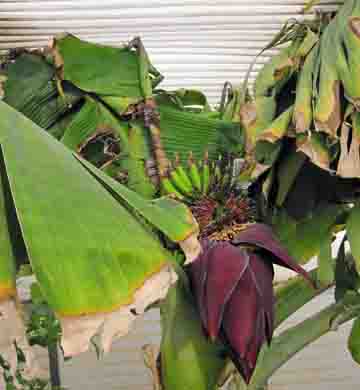
A successful strategy for growing edible fruiting bananas in Las Vegas has not yet been found; it is a challenge to match our environment with the banana’s requirements. That said, it is marvelous to watch the huge purple flower emerge and slowly expose tiny green bananas, even if they are not able to mature into sizable yellow fruits.


Edible bananas, Musa acuminata, are herbacious perennials that grow with a large pseudostem through which leaf stalks emerge at its tip until the growth cycle nears completion, about 2 years under favorable conditions. Then, instead of a leaf stalk growing from the pseudostem, a single flower stalk emerges, enlarges, the petals peel back from the “bud” and in between at the base of the petals are the fruits in bunches called hands. [See pictures, changes over 7 days.] After fruiting, the pseudostem dies back.

Banana plants are usually not available in local nurseries so mail order is customarily
required. Common cultivars are a good choice, and note that not all banana plants are edible fruiting. Search the Internet for their current availability. Order from resources that provide safe packingand shipping, and the shorter the travel time the better (the expense of air or two day shipping is sometimes worth it.) The plants will be shocked from travel in any case. Best time of year to order is spring. Fall ordering leaves short time for the plants to acclimate before winter protection must be placed.

Location. Daylight and sun light are two considerations. When the days get short, say less than 12 hours, their growing slows. That is why overwintering them in a dark garage is not a
good idea. They may never recover, and it can get dangerously cold there in winter. In our climate, bananas can tolerate heat but do not tolerate direct sun; broken shade is probably a best location. They should be planted in the warmest microclimate on your property. In my opinion, the growth of the plant is best if it is continuous and not interrupted by cold, wind, or heat. Banana plants tolerate wind, but not a hot, dry desiccating one, so limiting exposure to wind is also a consideration. In-ground (not in greenhouses) bananas require serious winter protection, strategies for which are available in nursery catalogues.

Container planting may seem a reasonable option, especially when considering seasonable portability in anticipation of hostile weather. In warmer weather, relocating the plant should maintain its orientation to sunlight. An urn of at least 20 inches is desirable, with a radius of about 5 feet around it to allow proper leaf spread. I prefer clay to plastic or pottery. Since the duration of the plant’s life is about 36 months, accumulation of salts from hard water should not be a problem. Emerging plants in the same urn, however, should be transplanted to replacement soil. Hand watering may be necessary, and moving the watered urn is a challenge. It is a good idea to “double pot” the urn so that, in the heat of summer, roots are not “cooked.”
Soil. Planting either in the ground or container, native soil is alkaline and bereft of nutrients. Various formulations have been given to improve the soil, for example, perlite, peat moss, potting soil, 33% each. The ultimate pH should be on the acid side, between 5.5 and 6.5. Well draining medium is preferred, and a generous bottom layer of cactus mix will enhance drainage.

Fertilizing. A well-balanced product, either 6-6-6 or 12-12-12 should be satisfactory. I recommend applying fertilizer first when the weather warms up and once in early fall. Some recommend more frequent fertilizing and special fertilizer combinations of nutrients.
Watering. For container plants, mulching and using a “water stick” is a useful guide to determine plant watering needs. In-ground plants, also mulched, are regularly watered, once per week for 15 minutes in Winter, increasing to twice per week in Spring, and perhaps once more per week at the height of Summer. Observation of the leaves, drooping when dry and discoloring when too wet, is also helpful in modifying watering schedules.

Fruiting. Between 9 and 12 leaves suggest the plant is potentially able to fruit. If you count the leaves on pictures of fruiting plants in nursery catalogues you will note they almost all have at least 10 leaves. Preventing leaf loss is critical to successful fruiting. After fruiting, it will take 2-4 additional months for fruit to ripen. I have not found measuring the girth of the pseudostem helpful in predicting flowering.

Pests. I have not noted any specific pests, but focused observation on plant growth should detect harmful conditions.

Propagation. Bananas are easily propagated, once you are able to grow them, even if they don’t grow edible fruit. From the base of the mother plant, little plants surface, and can grow to be mature plants. These offshoots are called “pups,” and are the same cultivar as the mother plant.


Following the suggestions above, I have found complete success, i.e., growing edible fruit, elusive. I have been able to get fruiting but the fruits do not grow or ripen; they are small and inedible. There are still adjustments to try, for example, timing the cultivation of “pups,” the root offshoots from the mother plant, to allow for a longer uninterrupted season may be one strategy. 
 For me, growing edible bananas in Las Vegas is a work in progress.

Resources
Francko, David A. Palms Won't Grow Here and Other Myths. S.l.: Timber, 2011. Print.

Kepler, Angela Kay, and Francis G. Rust. World of Bananas in Hawai'i: Then and Now: Traditional Pacific & Global Varieties, Cultures, Ornamentals, Health & Recipes. Haiku, HI: Pali-o-waipi'o, 2011. Print.

Lessard, William O. The Complete Book of Bananas. Place of Publication Not Identified: W.O. Lessard, 1992. Print.

Morton, Julia Frances, and Curtis F. Dowling. Fruits of Warm Climates. Miami, FL: J.F. Morton, 1987. Print.

Roth, Susan A., and Dennis Schrader. Hot Plants for Cool Climates: Gardening with Tropical Plants in Temperate Zones. Boston: Houghton Mifflin, 2000. Print.

Waddick, James W., and Glenn M. Stokes. Bananas You Can Grow. New Iberia, LA: Stokes Tropicals Pub., 2000. Print.

"California Rare Fruit Growers." California Rare Fruit Growers. Web. 11 Sept. 2015. .

"Growing Bananas in Phoenix Arizona." Web. 
.

Web. .

Mattocks, David. "Growing Bananas Is Easy." Central Florida Farms. Web. http://www.centralfloridafasrms.com/bananacare.htm

"Welcome to Going Bananas of Homestead, Florida!" Welcome to Going Bananas of Homestead, Florida! Web. 11 Sept. 2015. .

Harrison Sheld
Las Vegas, Nevada
September, 2015

Friday, June 16, 2017

Plums Blown Off? Veggies Windtorn?

Has fruit been blown off your plum or pluot tree? Just too much wind for a vegetable garden? Put up a windbreak.
Large-scale windbreaks affect the wind on the Windward side from 5 to 8 times its height

Wind damage to purple leaf Plum
This is a fact sheet on windbreaks I did years ago when I worked for the University.It was aimed more at those living on larger properties and had water to spare.

Download my fact sheet on windbreaks for large areas in the desert

Windbreaks do not need to be big or even use much, if any, water. All it has to do is slow down the wind to make it manageable for plants. Once this is done, you will see plums and pluots staying on
the trees and not blown off. Water use will go down because there is less wind. Vegetables will be more succulent with less tearing of the leaves and they will be more soft and succulent..

Why put up a windbreak in your backyard?

  • Fruit stay on your plum or citrus
  • Vegetables more delectable and eye appealing
  • Use less water
  • More pleasurable to work in the garden or backyard
A series of windbreaks can be used close to the growing area
Some "do not do" facts about windbreaks in the desert
  • Do not make them solid
  • Do not put them on the edge of your property
  • Do not make them out of plants
  • Do not make them out of wood
  • Do not put water near them
  • Do not use plants if you need a 12 month windbreak
Image result for chain link pvc slats windbreak
Chain-link fence with PVC slats gives almost the perfect 80:20 spacing for slowing wind
Some "do" facts about windbreaks in the desert
  • Windbreaks should be 80% solid with 20% open space
  • Put them close to where they are needed
  • Use steel or cement whenever possible
  • Construct windbreak height in a 1:5 ratio with the protected area
  • Consider using several smaller windbreaks instead of one big windbreak

Try using chain-link fence combined with PVC slats within a couple feet of the area that needs protection. The steel is very durable in the desert provided it stays dry. Diverting the wind with a solid wall causes wind turbulence in other areas. Having open spaces between solid spaces slows the wind rather than only diverting it.

Reed fencing also works well for slowing the wind but needs replacement every other year.

Windscreens will also work as long as they allow some wind through it to slow it down.