Type your question here!

Wednesday, October 18, 2023

Wormy Apples a Problem with Honeycrisp Apples

Q. I have had wormy apples in our 'Honey Crisp' apple tree. Last year we had the same problem. I was told to spray a fungicide. I also sprayed Neem oil. I waited until the apples started to form. I still have these worms in every apple on my tree. HELP!!! 

This is codling moth stuck on the sticky side of a pheremone trap. It is about 3/8 inch long and a true moth. Since the adult is a moth, the juvenile or immature form is a "worm" or larva. When populations are large they produce "wormy apples".


 A. I am guessing that you are dealing with codling moth. This is a common pest of apples and pears. They appear as "wormy apples". They are creamy white and about 3/8 inch long when they are mature. Usually, they have a brown head. They start getting into the fruit when the fruit is small and may continue to feed as the fruit gets larger. You can read more about codling moth control by searching for "codling moth" and "IPM". 


The most reliable site is from the University of California. If this is codling moth, then picking and get rid of small fruit which is infested is the first step. 


When the codling moth is flying, the moth will "sting" a small fruit causing it to drop. If it happens when the fruit is larger, it may stay on the tree. Look up for "stung" fruit or look at the ground for fallen fruit. Fruit produced later will have a larger percentage of stung fruit. Look for fruit tree species that are produced and harvested early. 

Otherwise, their population continues to increase as the apple stays on the tree longer. Apples that stay on the tree longest are the most heavily infested. On the flip side, apples harvested early are the least infested. Populations of this pest increase with each generation produced. In our climate, expect codling moth to have three or four generations each year so start getting rid of infested fruit when the fruit is small. With each generation the numbers of these moths will increase and increase as the year progresses. 

Start picking and getting rid of infested fruit starting about six weeks after it flowers. You can recognize infested fruit because of the brown frass coming out of it. The places where frass coming from the fruit are called "stings". Stings are egg-laying sites by the female moth. Fruit that has frass coming from it will either fall from the tree or stay on the tree and get "wormier". When you remove this fruit early, the population of “worms” has a better chance of staying low. 
As fruit gets older, the "worms" get bigger and tunnel into the fruit deeper. They might feed on the seeds of these fruit before they pupate into a moth.


 I have had good luck spraying either Bt or Spinosad several times over one season. Follow label directions. I have also had good luck if I use pheromone traps and get rid of them using these traps. I use one trap for every three or four trees. 

This codling moth has already exited. Notice the "frass" left behind when it exited.


Usually, pheremone traps are used for timing the application of sprays but when populations are low, I have had good luck “trapping them out”. Those traps should be put in the trees when the trees begin flowering or at least a couple weeks after they start to flower. Pheremone traps for codling moth can be bought from several places online. Look for them. The pheromone must be replaced regularly as per the instructions. Those wormy apples you got probably came from a neighbor who did not control them.

This is a winged trap. More popular are the three sided "delta traps". The winged traps, in my opinion, are better for repelling the moths. That is, better for using pheremones to keep fruit free of "worms". The pheromones have better air circulation in those kinds of traps, the pheremones must be changed out more regularly, and the traps more concentrated. The delta traps are best for monitoring moths and telling you when to spray pesticides.


When to Fertilize Cacti

Q. I have some cacti in my backyard.  Should I fertilize them and when?

When cacti flower they need high phosphorus fertilizer. A rose or tomato fertilizer should work.

A. The standard answer is to fertilize them lightly in the spring of each year. That is the standard answer. The purpose of fertilizer is to give the plants what they need or what is lacking in the soil. Once plants have what they need, stand back, and give them a chance to grow. Giving more fertilizer than they need, and watering plants more often, does not necessarily make them grow faster.

Fertilizers are not a magic “on and off” switch; you can’t force plants to get larger and bigger by giving them more fertilizer than what they need. All plants have a genetic “maximum” at which they can grow. That is why most cacti grow slowly, and other plants may or may not, depending on their “genetics”. For cacti, it depends on the fertilizer level, watering and soil mix besides their “genetics”.

There is one fertilizer exception and it is a bit tricky. Nitrogen fertilizers increase the speed at which any plant, including cacti, get larger but you must be careful. There is a danger from “growing too fast” for all plants including cacti. The fancy term is “luxury consumption”. To maximize growth, apply nitrogen fertilizers no more than twice during their growing season. Be judicious when watering them and don’t let the soil stay wet. But if your cacti are growing well without it, then don’t use it.

How Does 'Little Miss Figgy' Perform in Southern Nevada?

Q. I just purchased a dwarf fig tree (“Little Miss Figgy) at the fall plant sale at the Springs Preserve. I was planning to put it in a planter on the north side of my house which in the summer gets full sun, but which now is getting a lot of shade. Is that a dealbreaker for the fig?

I have never grown Little Miss Figgy in our climate but, like most figs, it should do well. It is smaller and may be suitable for container growing. The trend now is for smaller plants and earlier production. 

A. It should be fine with that amount of light on the north side of a home. All fruit trees require at least six and prefer to get a minimum of eight hours of sunlight every day when in production. That includes fig trees.

It is a small tree (suitable for container production, 6 to 10 feet tall by 4 to 8 feet wide) and develops dark purple fruit with red “pulp” or interior. It was a chance mutation of ‘Violette de Bordeaux’ fig from South Carolina. I have not grown that variety, but all varieties of figs seem to do well in our climate. At that size, a 15-gallon nursery container should be adequate.

Most people growing fig trees in the ground don’t water it often enough when it starts into its second batch of fruit and temperatures are higher and therefore its water use is higher as the season gets warmer. Because it’s smaller, it should use less water (but not watered less often) when planted in the ground and can rely on other sources of water that the soil might provide.

Saving Water Through Landscape Design

           Designing a landscape for only energy conservation (an example is lowering the cost of running the air conditioner) is quite simple. All you must do is ask yourself, “Which sides of the home are the hottest?” Create shade on the walls and windows close to the house for these hot sides. Try not using plants when you do this. Use them if you must. Creating shade that doesn’t use water requires more “brainwork” but may be necessary in the desert. Usually, the hottest areas are the exposed South and West walls and windows of a home.


If you don’t know which sides are hot, use a “temperature gun” (infrared laser for measuring temperature) during the hottest times of the day. You can buy an inexpensive but accurate gun for less than $25. The hottest areas are typically handled by shading the walls and windows on these hot sides rather than shading the roof. Roofs are usually better insulated than the walls and, in particular, windows.

Selecting plants to save summer electrical cost is quite simple since shading the south and west walls and windows is most important. Select plants that are “winter deciduous” so that the sun warms the house during the winter months. If water is plentiful, how much water these plants use is not important. To lower electrical costs, regardless of water, always shade the hot walls and windows of a home.

Irrigation design is important. I can’t stress the importance of using “hydrozones”. Hydrozoning is when the valves control when to water plants. Xeric (desert) versus mesic (nondesert) plant water use relies on how frequently each are watered. Use mesic plants when water is provided to them at the same time. How deep plants are watered is adjustable by adding or subtracting drips. How frequently they are watered is not. 

Xeric plants are not watered as often as mesic plants if you want to conserve water. This means plants are matched to a specific irrigation valve; xeric plants are put on one valve and mesic plants are put on a separate valve. This means you must know the difference between xeric (desert) and mesic (nondesert) plants. Xeric or desert plants will grow more rapidly than mesic, or non-desert plants, if they are watered like mesic plants. That's just they way they are. Xeric plants are more “adjustable” in their growth if they are all watered at the same time, and you can adjust the frequency of watering. When mesic and xeric plants are placed on the same valve, mesic plants will signal you to water and not the other way around.

When water is scarce, xeric plants (desert plants) tolerate dry soil better than mesic plants. They have capabilities of saving water through many different traits including leaf drop, changes in leaf and plant size, as well as changes to the plant at the genetic/molecular level. Xeric plants handle water shortages more efficiently than mesic plants. Being from the desert, xeric plants have evolved to soil drought. Water xeric plants less often. This means watering them with a separate irrigation valve (hydrozones). Because of this, xeric plants can get by (and often benefit) when watered less frequently than mesic plants.

For instance, foothills (not Blue or ‘Desert Museum’) palo verde (Parkinsonia microphylla or Cercidium microphyllum, depending on the source of its scientific name) is a true xeric, desert, or low water use plant. It grows in flat, dry areas throughout the Sonoran Desert of the American southwest. It can survive in dry soil for long periods of time. They can’t survive without any water, but they will require watering, deeply, less often.

When water is limited, xeric plant growth first begins to slow or stop. That can be hard to see. Controlling their size, controls their water use. If dry soils continue, xeric plants start dropping their leaves. That is easier to see. Fewer leaves mean there are fewer leaves present to lose water. The canopy begins “thinning out.” It’s time to water! If the soil continues to remain dry, then remaining leaves begin scorching and branches begin dying. Plants are starting to look bad. In the case of cacti, their stems may begin to shrivel. You don’t want limb dieback, or cactus shriveling, in a landscape. That’s not pretty. On the flipside, they may not look the best when that dry spell is over, but at least they have survived! In a landscape, deeply watering these plants once every 4 to 8 weeks is usually enough. Observing xeric plants regularly (once a week in the summer) will tell you if it’s time to water or hold off.

Branch dieback in palo verde and other trees (mostly mesic) can be confused with the palo verde root borer. Occasionally a single, isolated branch will begin dying back to the trunk during the summer if these insects have been feeding on the roots. In cases like these, a systemic insecticide for borers might be the only solution available. As with other plants, apply this insecticide only after flowering to avoid the risk of hurting pollinators like honeybees.

How much water is applied is controlled by the size of the emitters (two-, three-, four-, or 5-gallon drip emitters) or a moat surrounding trees and shrubs. For 10- to 12-foot-tall trees, flat moats about 6 feet in diameter, and 2 to 3 inches tall, will work. Figure that in most level soils, 1 inch of water will wet roots about 15 to 18 inches deep. My experience tells me that at least half the area under the tree’s canopy should receive this water. Once the roots of a tree are watered deeply enough, the only changes that need to be made to an irrigation timer are seasonal.

If you try grow deep-rooted, xeric (desert) trees in a fescue lawn (called a mixed landscape which I don’t recommend), the tree frequently dies, or “wiggles” in the soil. This is because it is watered every day the tree may have a fungal disease called “root rot.” Xeric trees don’t need daily watering, like a lawn, in the summer. It’s watered every day because fescue lawn needs it, not because the trees need it. True xeric plants are very susceptible to root or collar rot.

Not true of Chinese pistache or bottle trees. We don’t know how much water these trees use but both trees are mesic (nondesert) in their water needs, not xeric. This means they can survive dry soil very well. However, both bottle trees and Chinese pistache, because they are used to handling more frequent watering, will do okay in lawns. Their roots will grow shallower because of the lawn, but they will survive.          

If you want to control the other applied to your landscape (or about 70% of the water used) then take control the irrigation timer. Once control is gained of the irrigation timer, the next steps are easier.

Black Spots on Octopus Agave Leaves

Q. Is there something we need to do for these spots on the leaves of my octopus agave?

A. I think this is a fungal disease that favors a higher humidity than we normally have in the desert. The disease was caused and spread by the rain and wind that we had earlier. You don't want any fungal disease spreading to the mainstem. To prevent that, you can apply a common landscape fungicide to the cactus after you have a repeat of the rain and wind event. Watch your weather app. If your weather app says the rain is returning, apply the landscape fungicide the day after it occurs.

Broad-based landscape fungicides are meant to prevent the spread of many different types of disease.

Fruit and vegetable growers use copper-based fungicides as a protectant for many different kinds of foliar diseases. To be used effectively, and like most fungicides, they must be applied before the presence of disease. Organic fungicides are the only organic option worthwhile against diseases such as late blight and downy mildew. Think tomatoes, peppers, eggplant, and potatoes. These diseases have the ability to kill plants. Copper is also an essential nutrient for plants but use it sparingly.

Copper fungicides, like this one from Bonide, help prevent widespread infections of many more diseases when they are caught early enough. When used occasionally, copper is also an essential minor element for plants.

In the meantime, prune out any black “spots” or lesions that you see in the stems. I think these are fungal lesions with dormant fungi waiting for the next rain event to make it active again. Sanitize between any cuts to eliminate re-infecting the plant. Use 70% ethyl alcohol to sanitize a knife or pruning shears. Using both the fungicide after wet weather and cutting out the black spots helps eliminate future problems.

Make sure you're not overwatering it and improve soil drainage around its roots. Octopus agave originates in the Sonoran Desert of Mexico therefore it doesn’t like getting watered too often. For instance, it will not survive in a lawn. Take it off the irrigation controller and hand water with a hose. Watering these plants once with a hose only gets the water 3 or 4 inches deep. Water these plants five times a year; only three or four times during the summer and once during the winter. The soil must be dry between waterings!


Fertilizing in the Fall?

Q. Is it too early to fertilize now my oleanders, lantana, rosemary, and chase tree?

This could be temperature, nitrogen or iron. Try different fertilizers. If you find the right fertilizer it will become darker and greener. That's how you know its a fertilizer problem.

A. You can fertilize now (October) and skip the spring application. Woody plants put nitrogen fertilizer (whatever is "left over") into “storage” until spring. The only plants you want to skip are the so-called “winter tender” plants which you don’t list (except the tops of lantana which are damaged at 32F). Those are the plants which are sensitive to winter cold damage and include most of our citrus and freeze tender plants like bougainvillea. You don’t want to stimulate new growth that could be damaged by freezing temperatures. This might include the more tender dwarf salmon colored flowered oleanders (5 foot and tender at 20F) but not the traditionally big ones like the reds and white flowered types (18 foot) which are cold hardy to about 10F.

            Skip fall soil applications of iron fertilizers and wait to correct yellowing due to iron in early spring. Plants will respond to soil applied iron fertilizers best in the early spring. Fall applications of iron fertilizers are best when sprayed on the leaves. Use liquid detergent like dishwashing soap or (best) use a spray surfactant such as a wetting agent when you spray. Also it is best to use distilled water so the pH is not alkaline or acid. Better for iron uptake by the plant through its leaves. Makes more iron available.

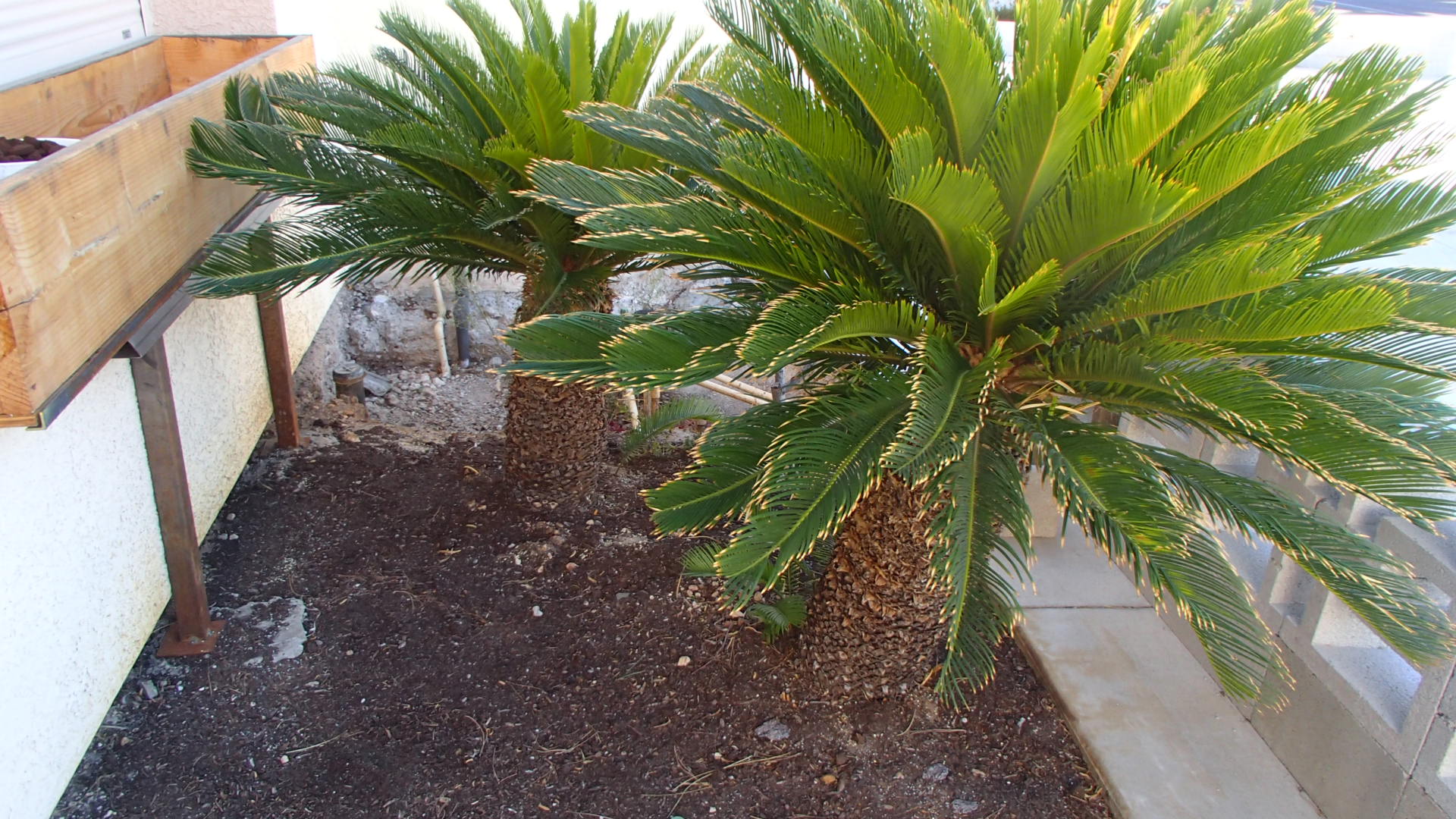
Different Types of Sago Palm (Cycad)

Q. Have you ever seen a sago palm that has different types of leaves and fronds? I can't find any pictures of a sago that look like this.  Also, mine grew extremely fast, in a matter of weeks. I purchased the sago with the original fronds that are dark colored.  The tree had been living about 6 feet from a windmill palm tree.  Do you think it could have crossed?

Even if sago palm (cycad is a better term, Cycas revoluta) is located on the north side of a home it still has a browning on the leaflet tips because of our low humidity. This sago palm can handle colder temperatures than other types.

A. First of all, the sago palm is not a palm at all. It is just called a type of palm which its not. Each sago palm has evolved different strategies to handle where they are from.

There are different types or species and even genera of sago palms. These are based upon their appearance, how big they grow and where they are available. Most are classified as the King sago palm, Queen sago, Queen sago palm and (a totally different genus and species) and the true sago palm to name just a few. The king sago palm, or Cycas revoluta, is the most widely grown type and most commonly available. The king sago palm is quite small, growing only to about 8 feet tall and 8 feet wide, making them small enough to qualify as an “indoor plant”.

This is a queen sago palm (Cycas circinalis) is from a large nursery in central India. It is native to southern India and grows about 12 feet tall and 12 feet wide in hot, humid climates.   https://www.naturenursery.in/product/queen-sago-palm/

            Sago palms come from a variety of climates but mostly tropical or semi tropical. Lots of different kinds to pick from if you can search online or buy them from out-of-the-way places. I occasionally look at Lowe’s and Home Depot’s garden centers for occasional “deals” but you have to know what you’re buying or at least willing to take a loss if you don’t. Rare sago palms can also be purchased from nurseries online as well as eBay.

            All the information is the same regarding the fast-growing sago palms. They prefer to grow on the east side away from direct sunlight or at least in what we call “filtered” or speckled light. They also prefer to grow in amended soils and not in rock mulch. Some of them like warmer climates than others. Each one has evolved differently.

            Be careful of fast-growing sago palms or cycads. It usually means they become larger than most others. Most sago palms are characterized as “slow growers”. I don't know which type you have but some are meant for interiors and not the winter cold outdoors. Be careful unless you know what you are looking for. Use the scientific or Latin name when possible. Sometimes nurseries will confuse them and sell you one that you are not expecting. Even the pros get it wrong sometimes.

Do Pine Needles Make a Good Compost?

Q. Should I leave the pine needles around the basin of the trees, or should I rake them out and pick them up? I feel that cleaning them from under the trees helps the water penetrate into the soil quicker and not sit on top of the needles.  My part-time gardener says I should keep them around the trees so that they act as a mulch.  Which is correct?

In the desert, pine needles mixed with other ingredients for compost, add nutrients to the soil. 

A. Your gardener is correct but in a reverse sense you are too! If you can stand leaving the pine needles in place, (they do not make the soil more acidic, and if they did, what’s wrong with that?) they will decompose (provided the soil is kept moist) more slowly than fine woodchips. But they will decompose. These decomposing pine needles add to the soil nutrition and soil organic content. If there is enough of them (2-3 inches deep) they conserve soil moisture, add organics to the soil as they rot, keep the soil cooler and help prevent annual weeds.

Pine needles make a good compost even if they don't rot as easily as some other ingredients and, in desert soil where a lack of acidity is a problem, can maybe help to pH lower! A common problem reported has been that they create acidity when they rot. In the desert, who cares? Our soil needs it.

            Rake the pine needles so they are 2 -3 inches deep under at least half of the canopy of the pine tree. If the trees are not yet ten years old (or bark has not started to develop on the trunk) then keep them away from the trunk 6 to 12 inches (keep that soil uncovered and dry).

Explosion of Caterpillars in the Desert

Q. This is a photo of a caterpillar that is on most of the plants in our neighborhood. Do you know what it is and what we can use to get rid of them?

Caterpillar explosion in the desert after a rain. This probably the caterpillar or larva form of a sphinx moth.

A. A caterpillar explosion, just like in the picture, has occurred all through Las Vegas and Arizona where it’s been raining and, because of the water, food supply is abundant. Caterpillars like these can be a common sight where there are so-called “summer monsoons” and rains such as found in central and southern Arizona and this year as far north as Las Vegas. Southern Arizona (Sonoran desert) gets more than double the water than the Mojave desert so there is a lot more food to sustain “caterpillars”.

https://dbg.org/yellow-hornworms-invade-phoenix/

https://www.usatoday.com/story/news/nation/2014/09/24/monsoon-season-leaves-arizona-crawling-with-caterpillars/16186181/

            They should be easy to control with soap and water sprays, Neem oil as well as any commercial pesticide available such as Sevin. It’s important to follow any label directions present for the right dosage and spray these immature insects. After they die from any kind of pesticide, then there’s always the cleanup.

            However, this year’s “hatch” has been particularly large in southern Nevada compared with previous years. Two years ago in Tucson, Arizona, the hatch was a large one due to summer monsoons like we had in Las Vegas. The conditions must be perfect; several large rains following each other which cause plants to grow and provide food and coverage. Sometimes this food might be our vegetables, landscape plants, and fruit trees. Sometimes this food is found only in the desert.

            These caterpillars are usually the white-lined sphinx moth (hummingbird moth) painted in a lime green or yellow with black longitudinal stripes, with or without a spine on the end. These insects sometimes act as pollinators just like butterflies, flies and other flower loving insects. After they have gained the right size, they drop to the ground and develop into the sphinx moth in moist soil. On the negative side we might see a burst of pest problems in our tomatoes and grapes due to their munching. So be prepared!

Monday, October 16, 2023

Mushrooms Compared to Plants (Mushrooms ((Fungi)) are Considered "Plants")

Q. The area where mushrooms grow best gets full sun all day. I had my almond tree removed. The roots were ground out, also a year ago. I think the mushrooms came with the dirty lawnmowers from the people that did my lawn last year. But two days ago, I poured straight vinegar on them. Yesterday they looked dead. But just to be safe, I bought some more cheap vinegar to pour over them if there are new mushrooms. I turned the lawn sprinkler off for 2 days so far. No more water!

These were mushrooms after they lost their "caps". Notice how mushrooms grow best with some food (woodchips), water (rain or irrigation) in contact with soil.

A. Mixing soil with wood chips, together with water, is the perfect environment for mushrooms to grow during warm weather. Using a “stump grinder” and mixing those woodchips with the soil, in the presence of water, makes mushrooms. This is why mushrooms, in the presence of rotting wood, magically "appear" after a rain. The woodchips that are constantly being irrigated are gone. The wood has decomposed. The wood did amend the soil, but the small “chunks” of wood (woodchips) are gone. They were "dissolved" or decomposed. But not woodchips exposed to the rain! Those are in usually dry areas. Mushrooms (and the mycelia produced) are part of the decomposition process. Too bad some are disgusting or toxic and cause dogs that eat them to vomit.

Mushroom are what we see after it rains. Just like flowering plants that flower after a rain, mushrooms "flower" after a rain as well. Except we see mushrooms. Underneath those "caps" are gill slits that release spores or seed. Some mycelia don't produce mushrooms but many do. It can get quite complicated.

The only things missing compared to plants is light (mushrooms grow best in darkness) and roots. Instead, mushrooms have "mycelia" (a "mycelial mat", as its called, which spreads wherever mushrooms grow). Just like plants, the first to grow are the mycelia or "roots" of mushrooms. The mycelia are responsible from breaking down the "wood" and taking up nutrients. If there is enough water present (rain or increased humidity) then appear the mushrooms. Oftentimes mushrooms are not visible until after it rains but the mycelia (if there is some irrigation) are still responsible for getting the nutrients out of the woodchips. They are digesting wood even if we don't see "mushrooms". Mushrooms are just there for reproducing.

My guess is that the mushrooms were not brought in by the mowers, perhaps the spawn (mushroom “seed” or mycelia) were but not the mushrooms themselves. Mushrooms are just evidence that sex was involved. Once established mushrooms (mycelia) continue to feed on decaying wood until the wood has decomposed and is gone. Their food is then gone. Some mycelia have a "waiting stage" and others die. But the soil is improved and becomes darker.

Mushrooms are easy to kill. They last about two or three days when it’s warm. Next time use a rake and knock them down. Or let them have some fun! Save your vinegar, along with the seasonings, for pickling.


Fall Months a Good Time to Plant Tomatoes in Las Vegas?

Q. Is it time to plant tomatoes or still too warm? My garden is a raised bed on the south side of the house. We have a shade cover for the summer. Do I need it for the winter? Tomatoes seem to be the only vegetable I have luck with.

Most squash are indeterminate as well like this one. Indeterminates just keep getting longer and longer. Indeterminates are used in greenhouses and large gardens. If you want to keep it flowering through the season, get the indeterminate form. 

https://www.southernliving.com/early-girl-tomato-7550728

If you are growing in a raised bed, use predominately compact or determinate forms. 

https://bonnieplants.com/products/bush-early-girl-tomato

https://www.burpeehomegardens.com/Vegetables/PlantDetails.aspx?plantid=5093

https://www.edenbrothers.com/products/tomato-early-girl

If you want to try a variety of the traditionally indeterminate type of  'Early Girl' and still have it fruit early, then try the bush or determinate form of 'Early Girl'. It was bred for small spaces like raised beds and containers.

A. If you have an indeterminate variety (keeps getting longer and producing, such as the old-fashioned indeterminate type of ‘Early Girl’) you can cut it back now for fall production. In fact, it should have been cut back in September actually when temperatures are still hot but, looking at your app, first starts to cool. But try it now. Give it a shot. Alot depends on the weather after you cut it back. Sometimes you will luck out and it stays warm through most of the winter. The compact determinate types are pulled out after they produce fruit. Indeterminate types are cut back in the fall and then pray there is good weather.

Judging from its green shape, I think it will be a grape tomato, not cherry.

Tomatoes are tricky in this climate. Any time the temperature gets above about 95F tomatoes have trouble setting fruit. You will continue to harvest tomatoes that set earlier when temperatures were cooler, but tomatoes stop setting fruit when air temperatures are consistently above 95°F. Tomatoes probably produced well this past year if you kept fungal diseases at bay. This past year air temperatures would drop below 95°F erratically so tomato production may have been erratic as well in some parts of the valley.


That's what we want to accomplish is the perfect slicing tomato. This tomato was grown in Northern Afghanistan when I was there. Northern Afghanistan. although dry, had humidity more like the areas around Modesto, California.

Always grow a couple of tried-and-true varieties such as the compact ‘Early Girl’, ‘Patio’, ‘Celebrity’, ‘Jet Star’ and others that you have had success with in the past. Always throw in a Roma type such as ‘San Marzano’ and cherry or grape tomatoes such as ‘Sweet 100’. If you are trying a couple of "new" varieties of tomatoes, do that carefully and remember what you planted. If you are serious about growing tomatoes, evaluate its production and care for it for three or four years in a row. You always want some older tried-and-true varieties as backups.

Tomato suckers can be rooted in more humid climate or in a propagation house in the desert. Otherwise they are removed to improve air circulation through the plant.

Planting in the spring Between February 15 and March 15 is better most years than cutting back indeterminate types in the fall. The weather can play havoc on gardens. You may luck out and have a non-freezing winter or location. Look at your weather app and which varieties of tomatoes you planted to determine the precise timing.

When to plant, the varieties to plant and soil improvement are always important when growing tomatoes. Soils that have been "fluffed up" (rototilled or spaded) warm up faster than those that haven't. If you're using a soil thermometer, temperatures above 55°F are good for root growth on tomatoes.

Agave with Black Spots on Leaves

Q. I cut out the leaves with the large black spots and lesions on my agave.  There are a few leaves with fairly small black dots speckling all over the underside (too many to cut out), should I cut off the entire leaf? Additionally, there is another photo showing the edge of the leaf that's kind of perforated - is this age or some kind of bug/mite/disease?

Agave with black spots

A. I think this is a fungal disease that favors higher humidity than we normally have in the desert. The disease was caused and spread by the rain and wind that we had earlier. You don't want that fungal disease spreading to the mainstem. To prevent that, you can apply a common landscape fungicide to the cactus if you think there is going to be a repeat of the rain and wind. Watch your weather app. If your weather app says the rain is returning, apply the landscape fungicide. In the meantime prune out any black spots that you see in the stems. 

I would sanitize between any cuts to eliminate those black spots that you make. Use 70% ethyl alcohol to sanitize a knife or pruning shears. Both the fungicide during wet weather and cutting out the black spots will help eliminate problems.

 Octopus agave originates in the Sonoran Desert of Mexico and Arizona. Make sure you're not watering too often. Get it off of the irrigation controller and hand water with a hose. If you using a hose, water these plants five times a year; three or four times during the summer. Water with a hose three or four times each time you water these plants to get the water 12 to 18 inches deep as it gets bigger. Otherwise the water will only get three or 4 inches deep if you water them only once. Once you establish how often to water, don't deviate from that except for the seasons. The number of minutes stays the same. How many times you water each month changes...that's all.

The leaves of agave won’t totally die back to the stem when part of their leaf is cut. It will just sit there, usually edged with brown where it has been cut. If it doesn’t look “funnier” and out of balance, I would suggest removing the leaves entirely. Your call.

It is up to you if cutting the leaves of agave is acceptable or not. Some people don't mind. Others do.

Remember that fungicides prevent fungal diseases from getting worse. Right now, the humidity is above 15% so I don’t expect diseases to get any worse unless the plant is in poor health. I would recommend “dusting” the leaves with a fungicide dust to prevent the spread of those black spots that you are talking about.

https://edis.ifas.ufl.edu/publication/PP154

Most fungicides are liquid now and not a dust. Dusts were more popular 50 years ago. If the fungicide exists as a spray, it is a different formulation from a dust. Read the directions. An alternative to dusts is to spray over the black spots as “insurance” to keep the disease from spreading if the weather or plant health changes. If it rains again, reapply the fungicide within 24 hours after it stops raining.

Fruit Trees for Rocky Soil

Q. Which fruit trees are best planted in rocky soil?

The smaller amount of rich compost or soil is present, the more fertilizer fruit trees need. I fertilize fruit trees depending on the previous years growth. If the fruit tree grew abundantly during the previous year, I may skip a year of adding any fertilizer. If it grew adequately, then I know that's how much fertilizer is needed. If it didnt grow very well, then I will put on a full compliment of fertilizer. Rocky soils dont have much soil so, once I found how much to give it I use that amount of fertilizer each year in the spring.

A. As long as trees get the right amount of water and the right kind of fertilizers you can grow fruit trees in marbles!!! The more soil is present, the less often fruit trees are watered and fertilized. The more rocks means fertilizer needs to be applied more often. Granular, quick release fertilizers (many inexpensive fertilizers) should be applied about every 8 to 10 weeks. Slow release fertilizers are applied about every three months.

Fruit trees that are tender to winter cold (they will freeze) should be finished with their fertilizer applications in time for cold weather. So if cold weather usually comes no later than mid December (the Las Vegas area is an example of this) then fertilizer applications should be finished by about August 1. 

        Rocky soil, to me, means soils low in organic content as well as full of rocks. In the desert, these soils may be growing fruit trees that are productive but can handle soils covered in rock on the surface of the soil better than some other fruit trees. I am guessing this definition could be extended into a prepared soil covered with a two to three inch layer of rock.

            Stone fruit trees are like apricots, plums, and peaches; those trees that produce fruit that have a hard “pit” in the center. Stone fruit trees are among the best trees, in general, to grow in rocky soil because of their root’s tolerances to low soil organics, root structure and ability to suck up water from the soil at low levels of soil moisture.

Fig trees can get large, over 40 feet tall, but they also can handle severe pruning to keep them smaller. We have done that over and over at the University orchard in North Las Vegas and have had no issues with it for 15 years! Remember to give them extra water, above and beyond what they need for their growth, if you want them to hang on to their fruit and be productive. Unlike their water needs for growth, they need more water to produce fruit during the hot summers.

Olive trees a make it onto my list of recommended fruit trees to grow in rocky and low organic soils even though it is not used that much by some. Olives can be grown (outside Clark County) for fruit production. The fruit is either used as a condiment (green or black fruit) or the fruit is extracted for its oil (olive oil) or both.

Citrus is probably the most often asked about fruit tree regarding soil organics. Yes, there are huge differences among citrus and their organic requirements. Most citrus are tropical to semitropical which include the true lemons, oranges, clementines and grapefruit. All four of these types of citrus do okay in rocky soils or grown under rocky surface mulch.

Will Argan Trees Survive in Las Vegas?

Q. Can argan trees thrive in Las Vegas climate? I live in Summerlin and am thinking about planting a few because they provide a nice shade canopy. Would rats be attracted to eat the fruit? I don’t want to encourage a rat population.

Argan tree (Sideroxylon spinosum) growing in Morocco on the fringe of the Sahara Desert. 
Argan is a multi-purpose tree and each part of it is usable as a food or economic resource.  The fruit can be eaten, oil can be extracted from the nuts and the tree’s wood can be used for fuel. (Wikipedia).

A. You have the right idea. The argan tree comes from the fringes of the Sahara Desert so potentially it could be used for lower amounts of applied water to a landscape. It has been reported to take the heat of the desert because of its deep roots. This is what tree gurus call a phreatophyte. Its water use is probably similar to other desert phreatophytic trees such as mesquites and palo verde, native to the Mojave and Sonoran Deserts respectively. Argon oil is popular right now. It’s pressed from the seeds of its fruit.

Fruit from aragan tree
https://www.feedipedia.org/node/54

            This tree might be hard to find in the size you want. The tree is native to parts of Morocco, in the seasonally dry parts of sub-Saharan Africa. There has been some interest in propagating this tree for use in Africa. Research needs to be done before it’s available to the public elsewhere as trees. For instance, nothing is available on the best method of propagation to be used, the soil (microbiology), or selections preferred for landscapes.

            Make sure that trees with a similar water use are on the same irrigation line. “Water lines” turn the water on and shut it off, all at the same time. The depth that water penetrates is dictated by the number of irrigation emitters used.

            As far as attraction to rats, I would have to guess. Rats are omnivorous which means they will eat plants or animals. Like other animals they have food preferences and choices. My guess is that argon fruit might be low on their list of preferences. But if nothing is around for them to feed on, it should attract them.


Lawn Diseases Struggle When the Humidity is Higher than Normal

Q. I live in Henderson where we enjoy having a lawn as part of our yard. It was thick and beautiful when we moved in, but it soon withered after we made some changes to sprinkler layouts and had the water off for awhile. I laid fresh sod and it too struggled. I tried a fungicide and that seemed to help but it then died completely.  Now the rest of the lawn is headed in the same direction. I’m at the point of desperation and could use some sound advice in the midst of some differing opinions.

This is the lawn the reader talked about. It is dying in patches. The reader asked me to look at it (consult) but I think the disease problems we had (high humidity) earlier had a lot to do with it.

A. Outside of watering, some lawns experienced disease problems earlier in the season that lingered after we had high humidity due to the rain. That change in our weather encouraged plant diseases to occur. In the desert, it’s usually the higher humidity that’s the problem.


I will take a look at this lawn and see if the disease is advancing or has stayed put. That will tell me what his options are. Now he must stop the lawn disease (if advancing) and get the grass to come back.

The humidity is now below 15% (except directly above lawns) and lawns should not need a fungicide application to keep the disease from spreading if we allow the lawn to dry after we apply water, and it is in good health. When there was higher humidity, some lawns along with some other plants, may have needed a fungicide. A lot of it had to do with the lawns current health.

If you applied a lawn fungicide, it should have stopped needing the applications if the general humidity was above let’s say 25%. Plant disease susceptibility is sometimes compared to a three-legged stool. Plants are susceptible to fungal disease if: 1. the disease organism is present, 2. general health and susceptibility of the plant is good, and 3. the current weather. In this case, all diseases like moisture. A couple of months ago the weather (humidity) was the problem. The higher humidity is now over. The relative humidity is now in the “desert” range. I think you are seeing old lawn disease damage (unless the lawn grasses are in poor health).

Make sure you follow label directions when you apply any fungicide. Any traditional broad-spectrum fungicide should work, but generally the higher-priced fungicides for lawns are usually a better choice in that respect.

This fall we should be watering lawns about two to three times each week. No more than four times each week for sure! Water early in the morning (imperative) and wet the lawns from 8 to 10 inches deep in a single application when you water. Sloped areas, or hard soils, may need multiple starts, about 30 minutes to one hour apart, to keep the water from “puddling” into low spots.

            Your lawn may not need it but try “aerifying” your lawn with a gasoline driven core aerifier. Then “topdress” your lawn with a rich compost to fill the aerification holes. Irrigate your lawn immediately after this. This process of filling the aerification holes, followed by topdressing and irrigation, improves the rooting depth of the grass. This will improve a lawns (grass) health.

Friday, August 18, 2023

Planting Desert Spoon During the Heat

Q. I purchased six each, 5-gallon sized desert spoons but I haven’t planted them since it’s been so hot. Should I plant them in the early morning when it’s about 90 degrees F? I have watered them three times a week.

This desert spoon is in a container. The container is too small and it may not have enough soil or amended soil in it. Also it may need to be watered more often.

Two headed desert spoon. The central growing point (bud) probably died and the plant suckered.

A. It's not the best time of year to plant them but yes, if you are going to plant them, plant them at a time during the day when it's cooler and plant in wet soil. I think the major problem is the sunlight and not temperature. Never plant in a dry hole. In other words, make sure the hole has been filled with water the day before, or at least the soil is wet when it's planted. If you elect to plant during the heat, plant as quickly as possible so the roots don’t dry out. Planting in a dry hole during the heat of the day is a common mistake made by contractors.

The hole dug for this container was a bit larger than needed but you get the idea. University of Arizona recommends a planting hole three times wider than the container. So in your case three times the width of a 5 gallon container. How deep its dug is only important when the soil does not drain well. A hole filled with water should drain overnight.

            The hole for planting should be dug three times the diameter of a 5-gallon container, even if it’s a “xeric” or desert plant. It’s not important to dig the hole deep unless it’s necessary. Every time you water, the water should wet all the roots to a depth of 12 to 18 inches.

Root depth of plants is directly related to their height. Refer to https://wateruseitwisely.com/saving-water-outdoors/plant-watering-guide/

Wednesday, August 9, 2023

Growing Blueberries in the Desert

Q. Can we grow blueberries here? How difficult is it?

Yes, these blueberries were grown in Las Vegas. But at what cost?

A. It is one of those questions that “we can but with what degree of difficulty?”. I am a lazy gardener and don’t like to put a lot of effort into “out of place” plants. I have a saying, the more out of place a plant is in its needs, the more time, money, and effort we have to put into it to get it to grow or produce. Take mangoes for instance. We can grow them here but what would be our “cost” of production?

Yellowing of the plant leaves is just one of the hurdles that must be overcome when growing blueberries in the desert.

            We know that blueberries prefer soils that are lower in pH (about 4.5) and don’t care much for the highly alkaline soils (closer to 8.0) of the desert. That’s a 1000 percent difference! Soil pH is our first hurdle to overcome. Are we willing to monitor the soil and amend it year after year? Use very fine ground (injectable) soil sulfur, not granular or “flowers” of sulfur for lowering the soil pH.

I didnt get a picture of blueberries growing in a container per se but if you look closely you can see that this blueberry is growing in a container in Las Vegas. More than a curiosity? I wouldn't go into commercial blueberry production in the Mojave Desert.

Use containers so the soil is “contained” and easier to amend. Plants need good drainage. Use pine bark for good drainage and amend it with a very small amount of sand for stability. Blueberries have shallow roots so containers should be shallow; 10 inches deep. Place plants on the east side of a building so they get shade in the afternoon.  Southern highbush blueberries can tolerate the heat but not direct sun. Blueberries need at least 6 hours of full sun every day.

            If you are willing to monitor and amend the soil annually (and grow blueberries as a cuiosity) then grow at least one of the Southern Highbush blueberries such as ‘Reveill’, ‘Sharpblue’, ‘Misty’, or ‘Southmoon’. Many of the Southern Highbush blueberries are self-fruitful but you may get larger berries and increased production if they can cross pollinate. But stay away from commercial production unless you do it (and is cost effective) in a greenhouse.

            Apply fertilizer once every two months when they are growing to get good crops. The biggest hurdle to overcome when grown in our climate and soil is the soil pH.