Type your question here!

Thursday, December 6, 2012

Jeeesh. So You Want to Grow Magnolia in Las Vegas. Here's How.


Q. I'm probably going to be at the mercy of the stock at the local nursery this weekend. I really liked the 24 gallon Magnolia tree they had but do you think my space of 18' x 14' will be too small for a Magnolia?


Southern magnolia growing near Decatur
and Red Rock in Las Vegas
A. As long as you understand I am not endorsing the planting of a magnolia but if that is what you want, then read the following. Magnolias can get huge and so if you want to enjoy it for a few years and yank it out when it no longer does well, then go for it. You might get ten or more years before this happens.

            Do not put it close to a hot (south or west facing) wall. BUT you must plant in a hole that is three or four feet wider than the container. Mix good compost (bagged and good stuff will be expensive) half and half with the soil you take from the hole and remove large rocks (baseball sized or larger).

            Mix a fertilizer like 16-16-16 with this backfill; about one handful for each ten gallon bucket. Mix it all together and put this modified soil back into the hole surrounding the rootball of the plant.

            As you are putting this soil back into the hole, add water from a hose so it makes it the consistency of quicksand to get rid of air pockets and the slurry flows all around the root ball.

Another Southern magnolia growing near Eastern and
Harmon. Notice the dieback beginning in the top.
Roots cannot provide enough water to the tops during
mid summer and the low tolerance of this plant to
temperature and humidity extremes.
            Plant at the same level as it was in the container. Water it deeply, three times, immediately after planting and when the soil has drained each time. It will be watered after planting best with something that can deliver a lot of water because this tree will require lots of water each time it is watered.

            The amount of water should be equivalent to filling a basin around the tree with three inches of water; if it is a 15 gallon plant then apply 15 gallons of water. You don’t have to use a basin but this basin idea should give you an idea of the amount needed.

            If you use drip emitters, then you should have initially at least three emitters for a 15 gallon tree. If it is a 24 inch boxed tree, then you should put at least at four emitters. As the tree gets larger, you will need to add more emitters and more water, perhaps one or two gallons more at each application per year of growth. Big trees use more water than little trees.

            Lastly, dig out an area around the tree that will allow you to put about four inches of wood mulch in an area covering a circle, at least eight feet in diameter, around the tree. The key with this tree is the right location, soil modification at the time of planting, adequate irrigations and wood mulch under the tree.

The Truth About Deep Root Fertilization of Trees and Shrubs


Q. Is deep root fertilization a good way to fertilize our African sumac tree, purple sage bushes and the purple plum tree?  I’ve seen advertisements from some landscapers for this process.  


Where are the roots of trees and shrubs growing
in a lawn?
A. There is nothing special or magical about deep root fertilization from landscapers or done by yourself. If done properly, and many do not, the fertilizer is injected into the soil at the depth of the roots. This is usually only a few inches beneath the surface of the soil.

            Deep root fertilizer applications have made a name for themselves mostly where trees and large shrubs are growing in a lawn. By applying it beneath the surface of the lawn, high rates of fertilizer are applied without damaging or killing the lawn or causing the lawn to have dark green spots of tall grass where the fertilizer is injected. The rates of fertilizer applied is quite high so the “saltiness” of the fertilizer (all fertilizers are salts of some sort) would normally kill the grass if that fertilizer is applied directly to the lawn.

These are the brown spots in your lawn that will occur
if you drop fertilizer on one spot or place it too shallow
under the lawn. It should be 6 to 8 inches under the surface.
            Also, lawn grasses are fertilizer “hogs”. Because of their fibrous root system they take fertilizer, nitrogen in particular, easily and quickly from the soil thus robbing it from deeper rooted trees and shrubs. By placing a complete fertilizer (one containing all three elements, nitrogen, phosphorus and potassium) several inches beneath the soil surface, it places the slower moving phosphorus and potassium right at where the roots are feeding.

            Commercial companies will usually use a liquid fertilizer and inject it with what is called a “soil needle” or deep root feeder. This is a probe that is connected to a tank on the back of a truck containing a fertilizer solution. A hose comes from the tank through a pump and, under high pressure, the liquid fertilizer is injected into the soil.

Granular fertilizer placed next to a bubbler in wood mulch so
the fertilizer will be moved to the roots by the water
coming from the bubbler.
            Real fancy units will allow the operator to squeeze the handle on the injector (a probe with holes in it to allow the fertilizer solution to injected into the ground) and inject a precise amount of fertilizer solution with each injection. The operator can inject the soil in dozens of places under the tree very quickly an be on his or her way.

            You will know if they are doing it correctly by how deeply they push the injector. If they push it too deeply, the fertilizer will be placed beyond the plant roots and a large amount will be wasted. If they don’t push it deep enough and it is in a lawn, then you may have burn spots in the lawn. Burn spots are usually less of a problem in the winter months.

            You can do deep root fertilize your own trees and shrubs by using tree and shrub fertilizer stakes and pounding them into the soil beneath the soil surface a few inches. You can also do it by irrigating the lawn and, while the soil is still moist, pushing a shovel into the soil in spacings about two feet apart under the canopy.

Fertilizer stake. The plastic cap is placed over the fertilizer
stake so that it does not shatter when pounded into the
wet soil under a tree near the source of water.
            The shovel is pushed into the soil all the way, pushed forward so that the slit cut by the shovel is open, and dropping some fertilizer into the open slit. You then pull the shovel out and push the slit closed with your foot. Irrigate immediately after you are finished.

            If your trees are in a desert landscape with drip irrigation then the whole idea of deep root fertilizer comes into question. When trees and shrubs are watered by drip irrigation then I would question whether deep root fertilizer applications are necessary. All the fertilizer will be “pushed” by watering from the drip emitters.

            Roots of trees and shrubs in a rock or desert landscape will not grow like they would in a lawn. Instead, with drip irrigation, roots grow profusely near the emitters and do not go “searching” for water or grow toward water. They are not psychics.

            With drip emitters is best to drop your fertilizer in slits next to the emitters or use tree fertilizer stakes at the emitters.

The Birdsnest Mushrooms in Your Mulch - Kids Will Love Them!


Reader's "pods found in the garden. All of these might nearly
fit on a quarter to give you a rough idea of their size.
Q. I figured I can't let more than three months go by without pestering you with a question! Attached are two photos of some mystery pods I found in the garden when doing some clean up. One is with the pods closed, and the second is with them open and with what appears to be small black seeds. Any idea what this is?
 

A. These are not pods at all but what is called birds nest mushrooms. These do look like tiny little pods with black seed like things inside them. Like other mushrooms or saprophytic (feed off of dead things) fungi they “feed” of off decaying organic matter in the soil. We can see these fairly commonly in compost heaps, decaying mulches or other places where organic waste is decomposing. They are interesting and kids love these little things.
Unopened or just opening "pods" of the reader

            Nothing to worry about. They feed off of DEAD plants so no harm to living plants or you. They are decomposers so they help to break down litter on or in the soil after or during a warm wet period. I attached a fact sheet from Texas A and M on this interesting form of plant life. I will post your pictures on my blog for others to see them.
 

Science in Action: Part II. Designer Plants

Designer Plants
Robert Ll. Morris

Genetic engineering has changed commercial plant breeding forever. In years past we always thought of obtaining new plants by simple breeding and hybridizing. But to get for instance elms resistant to elm leaf beetle or turfgrass resistant to Roundup these plants had to be permanently changed in ways that simple breeding and hybridizing had not been able to accomplish. The major limitation was that the plants had to be relatively close in their evolutionary history so that a transfer of new information from one plant to another by traditional breeding techniques could occur.

All that has changed with genetic or bioengineering. Over the last twenty years scientists have discovered that all living organisms have genetic information that is interchangeable, even between plants and animals. Unlike traditional breeding, bioengineering has made it possible to select exactly the traits desired from nearly any living organism and insert them into a plant and create a genetically modified organism (GMO).

In Part I we talked about how the bacterial disease, crown gall, played a role in bioengineering by providing a biological model for scientists to use to insert desirable genetic information permanently inside plants. It was known that the crown gall organism, a bacterium, could infect a plant and insert its own information causing the plant to do something it normally would not do. In the undesirable case of the crown gall disease, produce a tumorous swelling of plant tissue that housed and protected the disease.

More on Crown Gall Disease Organism

Scientists realized that packets of new, desirable genetic information might be inserted into plants following the same method that crown gall bacterium used. Early in the development of this technology the crown gall bacterium, modified with desirable genetic information, was used as the vehicle for transferring genetic information to plants. The crown gall model of gene insertion eventually led to the development of new more efficient technologies like “gene guns” which could “shoot” new information inside of plants.

Terms like “gene splicing”, which scientists use to recombine genetic information inside plants in an attempt to bioengineer a new organism with more desirable traits, results in “transgenic organisms”. This is a term that can be daunting at first until it is realized that it just means an organism that was altered or changed as a result of new genetic information which was purposefully inserted by some method.

More on Gene Splicing

Transgenic organisms usually have some sort of benefit passed on to it from genetic engineering resulting in an economic benefit to the horticulturist and ultimately the consumer. These might be new plant traits such as improved resistance to plant pests like viral yellows or ringspot diseases, acquired resistance to pesticides such as the Roundup Ready® line of crops, some dwarfing characteristics in agronomic crops like wheat, the preservation of food flavors such as in Flavr Savr©  tomato lines, and improved resistance to insect pests by inserting genes from biological organisms that produce toxins poisonous to insects such as the bacterium Bacillus thuriengensis (Bt).

Bt pesticide sprays for controlling insects have been available to commercial applicators and homeowners as a form of “natural” or “biological” pest control since the early 1960’s under a variety of different names. The first release of a Bt spray had a very narrow range of insects that it would control. Larvae of moths and butterflies with an alkaline gut pH and that fed largely on leaf surfaces were the only targets. This narrow range in pests that it controlled was both good and bad. It was good since it was very safe for humans and other animals that weren’t larvae of moths and butterflies such as beneficial insects. It was bad since it controlled such a narrow range of insects and these only in their larval stages.

We now recognize this particular strain of Bt as the variety kurstaki. Since the 1980’s there have been 50 strains of Bt developed that are specific to not only moth and butterfly larvae but larvae of other insects such as the elm leaf beetle (Bt var. tenebrionus), fungus gnats (Bt var. israelensis), and a wide range of agricultural pests including beetles. All the different Bt’s had the same basic scenario however; the susceptible juvenile insect eats plant foliage that has the bacterium on its surface, Bt spores are ingested by larvae, the spores grow and reproduce inside the insect producing toxins, toxins paralyse the digestive tract of the larvae causing it to cease eating, insect death. Death can range anywhere from a few hours to 5 days after ingestion. This depends on the amount of Bt ingested, the size and variety of the larvae and variety of Bt used for control.

Bt became popular in the past because it had some distinct advantages over other pesticides: it had a low hazard to humans; there was no waiting period from time of application before re-entering the field; different strains of Bt didn’t harm beneficial or non-target insects; insects that died from Bt were not dangerous to predators; Bt was not known to cause injury to plants on which it had been applied and was not considered harmful to the environment; and, little or no insect resistance had been reported.

More on Bacillus thuringiensis or Bt

The major problem with Bt applied as a pesticide was its lack of persistence in the environment (sunlight and rain shortened its life) and it had to be eaten by the insects to work and only the larval stages of the insect were susceptible. Multiple applications needed to be applied with just the right timing or its chances of success were limited.

            But what if the Bt toxin could be inserted into the plant? The toxin would always be present so timing was not a problem. Persistence was not a problem since the plant protected and even produced the toxin. To insert the Bt toxin gene (lets call it X gene) the scientists first identify the right Bt. Next they isolate the X gene and remove it from the Bt bacterium. They then attach a second gene, a gene that provides resistance to a toxic chemical such as an antibiotic or herbicide, to the Bt gene. Lets call the second gene the Y gene. The X gene, with the attached Y gene, is inserted into plant cells. Any plant cell that has the toxic X gene now is given resistance to an applied toxic chemical due to the presence of the Y gene.

Researchers then multiply the plant cells in the presence of the antibiotic or herbicide and kill all cells that do not have the Y gene. Because the X and Y genes are attached, the resulting cells will contain the Bt toxin. These genetically transformed plant cells are then grown into whole plants by a process called tissue culture. The modified plants produce the same lethal Bt protein produced by Bt bacteria because the plants now have the same gene.

The insertion of the toxic genes from Bt into plant lines so that plant itself becomes toxic is under quite a bit of controversy. First and foremost is that growing plants that continually have the Bt toxin present increases the chance that insects feeding on these plants may become resistant to the Bt gene.

There is some recent research that has demonstrated that this has already happened. Problems arise primarily because the Bt toxin is always present through the plants life cycle and that it is in all plant parts. Because susceptible insects must ingest the Bt toxin to be poisoned, genetically engineered cells could be directed to plant parts that only the target pest will eat or at certain times of the year. Scientists have been working on a Bt gene that will “switch on” in plant parts that are green (leaf tissue) or “switch off” in other plant parts that are not green (flowers, pollen and seed). Plants receive genes with a genetic “promoter switch” that results in production of the Bt toxin only in certain plant parts.

My article was previously published in Southwest Trees and Turf

Tuesday, November 27, 2012

Science in Action: Part I. Engineering Plants Using Crown Gall Disease

Science in Action: Part I. Engineering Plants Using Crown Gall Disease
By Robert Ll. Morris

Ever since Mendel discovered that characteristics in pea plants could be inherited, scientists have been improving plants through hybridization; two related plants were crossed and the resulting offspring had characteristics of both parent plants. Breeders then selected and reproduced the offspring that had the desired traits. These conventional plant breeding techniques were relatively imprecise because they shuffled thousands of genes around and distributed them to the offspring just to get one important change in a plant that was economically worth pursuing.

One challenge encountered in Mendelian breeding is that generally only closely related species of plants could be crossed. If no closely related species with desirable traits existed, breeders had no way of passing on these traits to the other plant. Another problem was that some of the genes were linked to each other. This is seen today in tomatoes that have been bred so that they can be shipped long distances but with a substantial loss in flavor.

Since the early 1980’s scientists have been using the tools of modern biotechnology to insert a single gene, or just two or three genes, into a plant giving it new, advantageous characteristics. With this technology a single gene could be inserted into a plant giving it a desired characteristic instead of the mixing all the genes from two plants through traditional plant breeding and hoping for the best. This technique could develop a new plant with much more control and precision and at a rate much faster than ever before.

The bioengineering of plants emerged from discoveries by researchers in previous years on how bacteria caused plant tumors, how viruses protected plants from other viruses and what enabled some bacteria to kill insects. Some first major step toward biotechnology occurred early in the twentieth century with a plant disease called crown gall. Crown galls are tumor-like plant growths that occur on many woody plants including fruit trees, grape vines, and ornamentals. In 1907 researchers at the USDA discovered that the cause of crown galls was a soil bacterium, Agrobacterium tumefaciens. Other bacteria were known to cause plant diseases but A. tumefaciens had the unusual ability to cause the plant that was hosting it to grow a disfiguring tumor.

Forty years later in 1947 researchers at the Rockefeller Institute for Medical Research (now named Rockefeller University), curious about the crown gall bacterium and using it for insight into how tumors developed, grew crown gall tissue culturally free of any associated bacterium AND free of the plant host as well. They found that these uninfected crown galls could continue to grow, as crown gall tissue, independently of the crown gall bacterium and of the plant host for many years. It was concluded that normal plant growth in some unknown way had been permanently and irretrievably transformed by A. tumefaciens. Understanding how would have to wait nearly another thirty years.

During the 1950s and 1960s, scientists discovered DNA’s role in transmitting information from plant to plant and ultimately controlling plant growth. Armed with this new information, scientists began looking more closely at DNA’s role in the formation of crown gall. The crown gall mystery was attacked again when several investigators began, logically, looking for the tumor-inducing factor in the bacterium's DNA.

Bacterial DNA is relatively simple compared to other types of organisms since it can be normally found on a single chromosome. It wasn’t found there. Instead it was found by Flemish researchers on a smaller, mobile DNA unit called a plasmid that was not part of the bacterium's single chromosome. In a series of experiments at the University of Washington ending in 1977 researchers found that this bacterial plasmid was spliced into the chromosomes of plant cells when the bacteria infected the plants.

This was at the same time that researchers in other fields were just beginning to understand how to manipulate genetic information by a technique called, in lay terms, gene splicing – to cut and splice foreign DNA into the genetic code of an organism.

It became clear now that A. tumefaciens transmitted the genetic information needed to cause a plant to produce tumor-like growth through the transfer of a “packet” of information called a plasmid.  This plasmid altered the genetic makeup of the plant so that the infected cells of the plant were induced to divide continually, developing galls containing the genetic information from A. tumefaciens.

What if scientists could manipulate A. tumefaciens so that it no longer transferred the genetic information for creating crown gall but instead transferred genetic information into plants that produced desirable traits such as resistance to insects or disease?

To convert the A. tumefaciens plasmid into a beneficial plasmid (now called a vector) researchers first had to locate and then replace the tumor-inducing genes. By 1983, plant molecular biologists had developed the first plasmid vector for plants susceptible to crown gall from A. tumefaciens. The crown gall disease had changed plant breeding forever.
A tool for introducing genes into plants is useful only if scientists have found genes that they want to transfer. Enter Monsanto. In the late 1960’s researchers at Monsanto wanted to know what made the nonselective herbicide glyphosate (RoundupTM) a potent killer of so many different kinds of plants; weeds and crop plants as well. It seemed reasonable that if you could alter crop plants so that they were resistant to glyphosate, then spraying an herbicide like glyphosate “over the top” of a mixture of emerging combination of resistant crops and weeds would kill the weeds but not the crop.

Through combined research starting early in the 1970’s glyphosate’s genetic “mode of action’, destruction of an enzyme vital to all plants, was specifically identified by research performed at Monsanto and by German researchers.

In 1983 researchers at Calgene and Monsanto identified the gene, and Monsanto modified the gene, so that the enzyme it produced was no longer sensitive to glyphosate. The A. tumefaciens plasmid vector was used to introduce the modified gene into crop plants. The new tomatoes, petunias and other modified plants were resistant to damage from glyphosate which was reported in the research in1985.


Gene gun. More on this subject at
The USDA requires field testing of genetically modified plants for several seasons before its release and that testing includes potential changes in food safety, nutrient levels, development of potentially toxic substances and safety to the environment. In 1996, the first glyphosate-resistant soybean, cotton, canola, and corn seeds were made available to farmers.

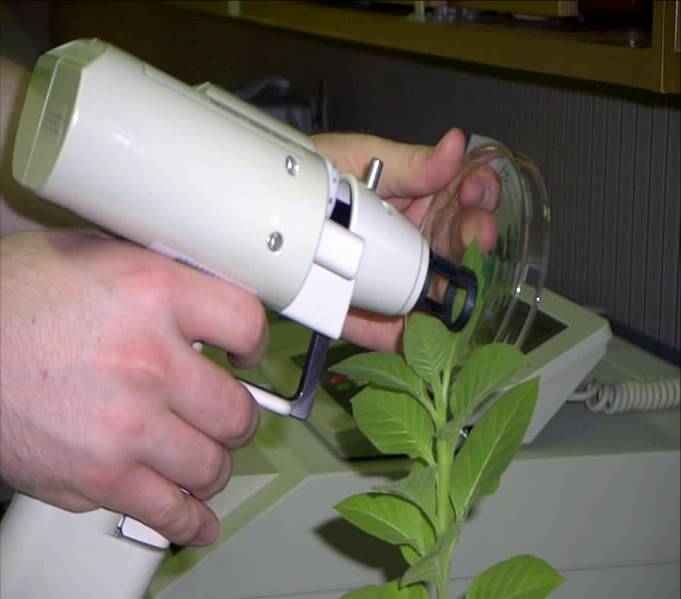
During the1980s and 1990s other ways were developed to introduce beneficial genes into plants. One is called a "gene gun," which literally shoots DNA-covered particles attached to metal “bullets” through plant cell walls and membranes to the cell nucleus. Inside the nucleus the foreign DNA combines with the plant's own DNA and transforms the plant. Other techniques involve electrical or chemical treatments assisting DNA molecules to pass through plant cell walls and membranes barriers and combine with a plant’s genetic information, a high-tech form of plant breeding. Wouldn’t Mendel be impressed?

Previously published in Southwest Trees and Turf

My Beans Emerged From the Soil and Died


A good indicator of collar rot is when the plant shows less vigor than it
should or less vigor than its neighbors
Q. I recently planted bean seeds in pots on my porch here in Las Vegas.  However, after the bean stalks were half a foot tall, they bent over, turned dark and died.


A. This is probably crown rot. If you plant beans when the soil is too cold they have a huge chance of developing crown rot at the point where the bean stem enters the soil. This causes the stem rot, the plant dies or we say “collapses”. If you plant them when the soil is warmer, they have less chance of this happening.


Once the plant is lifted from the soil you can inspect the stem at the soil
level. Where the brown part of the stem and the green part starts was
the soil level. This is also the place where the bean stem was attacked
by collar rot fungi. Avoid planting in soils that are too cold.


What to do When Your Indoor Palm Has Sticky Leaves


Q. My indoor palm plant has developed a sticky-looking, shiny appearance on the leaves.  Also, small, 1/16" brown spots/bumps on the leaves and stems.  What is this?

Scale on palm leaf but unfortunately the plant also has spider mites
judging from the yellow speckled appearance of the leaf
A. This is probably one of the scale insects. It is living under this brown bump and sucking plant juices while totally protected by this bump or shell they build on top of themselves.

            This brown bump is what keeps them alive when pesticides are sprayed on the plant. BUT they are susceptible to poisons or insecticides that are taken up into the juices INSIDE the plant.

            So, systemic insecticides, those that are applied to the soil or sometimes sprayed on the leaves and taken up through the leaves, can be quite effective on these protected insects. Since it is a palm and you are not eating anything from it you can use these types of poisons on these plants.

            You will have to try to find one at a nursery or garden center that carries a systemic insecticide that has a label specifically for houseplants and controlling scale insects. The shiny stuff on the leaves is sticky since this is the sugary excrement of these scale insects falling on the leaves. Frequently it attracts ants.

Is Now a Good Time to Fertilize Shade Trees?


Apply fertilizer to the irrigated areas and just
outside the irrigated areas, just below the
soil surface, no deeper than this
Q. There are six trees on our property; a Raywood ash which is 10 years old, Arizona ash also 10 years old, California pepper (taller than our 2 story house and 8 years old), Bradford pear also 10 years old, a young African sumac and a young palo verde. Is now (October - November) a good time of year to deep feed these trees? Also, we've got a three foot long tree root from the pepper that's growing along the top of our lawn. Can I cut that part out this time of year?

A. You can deep root feed these trees (put the fertilizer in the root and watered area at about half a foot, no more) now that the trees are preparing for winter and stopped growing but they should still have green leaves on the tree.

            If there is no grass there then apply it to the surface of the soil and water it in. Water the fertilizer in the root zone three times over the period of one week and then continue to cut back on your irrigation for these trees as you normally would for the winter.


            The living green leaves on the tree will help move the water laced with fertilizer into the trees and into storage for next spring's growth. It also places fertilizer in the area of the roots for next season provided you don’t water too much. You can then skip a spring application of fertilizer.

            If the leaves have turned yellow or are starting to drop, you missed it for this year. Wait until next spring. There is no advantage to applying it in the fall vs. spring except possibly convenience.

Not All Cactus Fruit Are Desirable for Eating


Bird damage to nopal fruit called tunas in Mexican Spanish.
Bird damage to cactus fruits is a good indicator tunas will
have good quality for human consumption. Tunas are high
in vitamin C.
Q. I have a large cactus garden in my front yard and much fruit.  My cactus are the"bunny ears" type.  Is the fruit of this type good to eat and does it have health benefits?  I am a retired teacher and just read your article on cactus fruit.  I have made jelly from them in the past.  I suffer with Crohn's disease and wonder if this fruit is comparable to the Nepolia (sp?) health drink that costs so much. Since Crohn's is an auto immune illness, I wonder if this fruit has some good anti-inflammatory properties? Thank you for your time and any help you can give me.

A. Sorry to hear about your health concerns. The fruit would definitely be edible BUT not all Opuntia type cacti are as desirable as others for eating. The nopal cactus is also a “bunny ears” type but the fruit may not be as edible.

            In some nopal cactus the sugar content may be as high as 30% which would rival fully mature wine grapes in sugar content. I normally will get about 16 to 18% which would rival a really good apple or peach.

            A good indicator about whether it is going to be a good one is how the birds use the fruit. If birds are devouring the fruit then it will have some really good characteristics for human consumption. If the birds leave it alone, well… it probably has low desirability.

            So look for bird damage to ripe fruit. Nopal or bunny ears cactus is selected for edibility so not all of these cacti are as desirable as others for food.

            As far as health benefits goes, I have heard that it is of course high in fiber content, helps to lower cholesterol, helps reduce high blood pressure, is normally high in Vit C (reds are the best) but I have not heard anything about auto immune system benefits unless you want to count the Vit C content as part of that. But I am no health expert and you would probably have to do some digging in the literature online for that information. There are some good papers out of the University of California with the University of Sonora on this subject in the past.

            Also if you want to start growing cactus for food you will have to alter your irrigations to push new succulent growth starting in about March. A deep irrigation every two weeks is all that is needed along with a fertilizer application high in nitrogen in the spring. Compost applications at the time of planting and on the surface each year will also help push new growth.

How Far to Cut Back Ash Without Killing Them?


Example of a thinning cut made to peach. The cut is made
directly above a side branch going in a preferred direction
or a smaller one that will help to reduce the size of the plant.
Q. We have two fantex ash trees, 15 years old. They are spreading out too far. How far can we cut them back without killing them?

A. The problem with ash is that it does not have much ability to come back from cut limbs if you cut back too far. You can begin structuring the tree if you do it fairly early and stay on top of it but if you let it go too long and then cut it back you may have some problems.
 
            You can cut it back to side branches that are growing in a desirable direction but you cannot prune it back by what we call heading cuts (stubbing it back) and hoping these dead end cuts will resprout. You can cut back into about second or maybe three year old wood (there are still side buds remaining that can grow) but if you cut into a limb with no buds present it will probably die back to a major limb.

            So cut back to a branch at a crotch going in the direction you want it to grow. When limbs are growing the wrong direction, eliminate them back to a crotch or another limb. Do not leave any stubs (dead end cuts).

The Modesto ash on the right was "topped" and because of the nature of
ash it never came out of it but had to be removed. The one on the left was
cut back early enough so that it could resprout from young wood.
Consequently the one on the left developed swellings just under the cuts
that are full of tissue that can generate new growth. The one on the right
could not.
            I hope this makes sense. I attached a picture of a thinning cut made removing a larger limb going up…to a smaller limb going out and toward the camera. The direction of growth of the limb was changed without leaving a stub.

Wednesday, November 21, 2012

Marketplace at The Roots

~ Marketplace at The Roots ~

A new Saturday market is opening at the Vegas Roots Community Garden.

The first market day is November 24th, from 10:00 AM to 3:00 PM.

Please read the flyer and additional information below.

We really hope to meet you!

(Vendors, please see below)
Vegas Roots Marketplace at The Roots Flyer

Free Admission -

We have lots of room down here.  Parking and admission to the market are completely free.

Local Vendors -

We will strive to have between 25 and 30 vendors at each market.  Their wares will range from locally grown produce and honey to various artistic creations.  All local and all in need of your support.

We’ll try to provide a pre-market update of the vendors we expect, so you can plan your shopping accordingly.

Tour the Property -

We’d love to have you come down just to view the garden and its spacious four-plus acre grounds.  So, if you’ve ever been curious about the Garden or even if you’re just now hearing about it, our new Market will give you a great reason to pay us a visit!

You-Pick Garden -

Part of your tour of our sanctuary will include the chicken coops, the permaculture garden and the You-Pick garden.  Throughout the year, garden staff (volunteers) plant various crops.  Since Las Vegas has such favorable year-round growing conditions, local residents can usually find something to harvest.  There’s nothing quite like picking and enjoying a fresh tomato, squash or other vegetable right off the plant.

Kids Playground -

You are welcome to bring your children with you.  In fact, we encourage it.  Not only is it a great learning environment regarding food production and quality, but the young ones won’t get bored for a moment.  We have a very nice playground that frankly, doesn’t get enough attention.   Of course, we’ll need you to keep an eye on them, because the chicken coops are right beside the playground…

Music -

The Garden is a peaceful, restful and grounding place.  We’ll have some nice background music going, thanks to DJ Coco, to add to the enchantment.  Eventually, we hope to have some live musicians perform.  One step at a time…

Support Your Community -

This is a great way to make a difference locally.  A couple of times a month you can buy super-fresh produce and other perishables as well as various other goods, rather than shopping at your favorite grocery store or supermarket.  The Garden benefits, the vendors benefit, the community benefits.  Just the way we love it!

JOIN US! -

Please do!  This is a non-profit community garden.  It’s open to everyone.  The Marketplace at The Roots event is your official invitation to come on down and see the place.  Look around.  Shop.  Meet new folks.  Find out about all we have going on down here.  Maybe even volunteer?

This Clover-Looking Weed is Hard to Get Rid Of


Q. I have clover growing at the base of my spike plants. I pull them, and pull them, and pull them. Do we all just enjoy each other and smile or is there some way to get rid of them I've split off babies from the base of the plants and have four separate pots with spikes in them now and they are about one and a half feet tall now. I cleaned around the roots and put them in new potting soil, but their "friends" are hanging right in there with all four plants also. We do have other larger clover growing with our main clutch of aloe vera and have no idea how to approach that type (and tight) group without starting a full scale aloe army throughout our garden.

Symbiotic yin and yang or what, Professor?

A. I am not sure what you are calling Spike plants. The common name, spike plant, usually refers to a house plant called bcdefghi DY'`IY{L8n you may be referring to aloe as a spike plant.


Oxalis or wood sorrel.
            I am also not sure the plant you're calling clover is really a clover at all. I am wondering if this is oxalis, a plant whose leaves are very similar to clover in appearance. But this plant is much more difficult to control or eradicate than clover. It is also called wood sorrel.

            Oxalis can be spread through seed from the flowers, bulbs from the roots and also by bulbils. If you are going to control this weed you will need to clean all soil from your “spike plant” roots thoroughly and sterilize any soil you are using when you're a replanting these plants.

            Clover is not that difficult to control but oxalis is a terrible weed to control particularly among nursery plantings and in landscapes in our climate. An easy way to tell if this is oxalis is to taste a few of the leaves. Clover leaves will be slightly sweet to the taste. Oxalis leaves contain oxalic acid, the same chemical in rhubarb, spinach and brussels sprouts and will be sour to the taste. But my guess is you have oxalis.

Should I Cut Back Bareroot Apricot After Planting and Leafing Out?


Q. I planted several bare root fruit trees about three weeks ago.   They were shipped to me about four foot tall. I did not want to trim them until I could see some growth. They have started to leaf out except for the apricot. The apricot is the one that concerns me. It has no branches below the 2 ft level, six branches above 2 feet, and no visible growth yet.  Everything else looks good. My question is will it harm them if I cut them down to the 2-1/2 ft level at this time.  Or, should I leave them alone to establish themselves, then prune and cut them down to size in the winter when they are dormant.

A. They all appear like they can handle being cut back somewhere between your knee or no more than a foot above the knee. Use your judgement as to the exact location as it should be just above a branch or a bud.

                     It would have been better to cut them back before they leafed out.

            Limb up branches at the bottom that are too close to the ground (bend the branch and if it can touch the ground then eliminate it). On spur producing fruit trees (pear and apricot) cut the branches back to about 18 inches in length or no closer than 18 inches to the closest spur if any have been produced.

Sap Dripping from Tree Trunk a Common Problem


Q. We love your advice. Please explain and tell us any info about our trees. We sent you some pictures. I removed the dried area and flushed with water. We lost large cottonwoods years ago having same condition.

Slime flux or wetwood on a large established tree
which is not the readers.
A. The pictures show a liquid coming directly from the trunk of the tree. This may be a disease called wetwood or slime flux that can infect many different types of trees. The liquid coming from this disease will have a putrified, yeasty smell which quite often attracts flies. In many cases, the liquid does not seem to be coming from any cut or damage to the tree. It seems to come directly from the limb or trunk.

            This particular disease is normally not lethal. However, there are some trees where it seems quite deadly. One of them is Navaho globe willow. In this case it has been noted that it has killed trees. In any regard, this disease in poplars, elms, mesquite and other trees is usually not deadly. It is considered more of a nuisance than anything else.  

            Check to see if there is an odor to the liquid. See if flies are attracted to the liquid on a warm day when flies are present. If this is the case, there is nothing you can do about the situation but have the tree live with it. There are no fungicides or other pesticides that will make any changes. Hopefully the tree will have a long life living with this problem.

Yellowing of Apricot Leaves and Possible Causes and Cures


Q. I have an Apricot tree I planted in January (bareroot from the farm).  It has been doing really well until a couple of week ago I noticed something was eating some of the leaves.  More recently I have noticed yellowing of some of the leaves.  Any ideas as to what is causing this and how to remedy the problem?  I have attached pictures.  Thanks.
 
Typical of iron chlorosis is that the newest leaves will have a lighter green leaf than older leaves AND the veins remain a dark green compared to the leaf itself. (Newer leaves are farther out on the limb than older leaves).
A. Photos 2, 3 and 4 looked like a nutrient or watering problem. The leaf or leaves were light green with some scorching around the edges. There might also be some wind damage. In photo it looks like a critter could have been eating the leaves but that is no big deal if it only affects a few leaves and doesn’t bother the fruit. In the photos 2 – 4 it does appear to be a nutrient problem.
 
Not a clear picture from the reader but you can see the scorching of the leaves on apricot.

See how the leaves on the ends of the branch are yellowing more than the older leaves coming from the thicker part of the branch? This is a good indicator it is most likely an iron or irrigation problem. Irrigation, too much, can also mimic iron shortages or actually cause an iron shortage. This is what you need to do. If there is mulch, pull the mulch away from the trunk. If there is no mulch, then pull the soil away from the trunk until you start to see the roots that were in the original container. I am concerned you might be developing collar rot. Planting the tree a little too deep can also cause similar looking problems.

Again not the best picture but it does look like an insect could have taken a chunk out of the leaf but chances are, if there were strong winds recently, it was wind damage.

If you are on a watering pattern that is every day, try to get off of it. Go at least every other day or even best every third day in the summer but add enough water to get the water down at least 12 inches into the soil. If it is hard to do this, build a donut around this young tree at least 18 inches from the trunk. Two feet from the trunk is even better.

One of the many iron sprays. Just make sure you adjust
the chemistry of the water to be on the acidic side so that
the iron is not lost when you mix it with water. To be
on the safe side I would use distilled or RO water
and use it all up. Don't keep it premixed for any length
of time.
This donut or moat should be high enough to hold about three to four inches of water. Fill it twice until the next watering. Because we are now in July, spray the leaves early in the morning with an iron fertilizer spray. Pick an iron product made for correcting iron chlorosis, an iron chelate is best. I usually recommend EDDHA iron but that is for applying to the soil. It is expensive and you do not need this chelate for spraying on the leaves.

Any iron spray made for applying iron to the leaves should work fine. However, some plants, in fact many plant leaves will not turn green from an iron spray without multiple applications. So I would make a fresh spray of iron for the leaves about four times and apply the iron on four separate applications a few days apart. Remember to apply it in the cool of the morning.

I would use distilled water or RO water. I would also put a tsp of liquid dish detergent (one with no addatives like scents or lotions) in one gallon of spray mix. Shake it to mix the spray and detergent together but not allow it to foam. Spray immediately.  Do not hold it overnight. Make a fresh spray each time you spray. Next January make your normal fertilizer application to the tree and include an iron chelate to the soil that contains EDDHA chelate.

Pruning Citrus: How to do it


Q. I have a dwarf lemon tree that is about 14 years old. It produces plenty of fruit and I keep it relatively small. I trim it in the winter but have never professionally pruned it. Could you recommend to me a source on how to properly prune this tree?

A. I don’t know of a source to help guide you in pruning your citrus tree except the one I wrote and posted below this entry.  It was published by the California State Parks; Citrus State Historic Park. I will try to give you some basic directions but read below for more specifics.  Light pruning can be done anytime but heavier pruning should be done right after harvest. 

            Light pruning would include the removal of small branches that are interfering with growth or causing too much shade inside the canopy. You can judge if there is too much shade in the canopy by looking at the ground beneath a canopy. There is enough light passing through the canopy if you can see speckles of light throughout the shadow of the canopy on the ground. 

            First of all, remove branches that are crossing or any branches growing back toward the center of the tree.  Next, remove branches which are growing straight up or straight down.  Once you have done this, stand back and look at the shadow of the canopy on the ground.  Is light passing through the canopy and causing speckles to form throughout its shadow on the ground?  If this is now happening, perhaps you should stop pruning until after harvest. 

            Citrus does not require much pruning but getting rid of problem branches such as those that are crossing, growing to close together or growing back to rid the center of the tree would be recommended.


Lets Hope for a Gradual Drop in Temperatures This Fall


            Normally we enjoy very nice fall weather in Las Vegas until about the first week of December and oftentimes without frost. This would be pretty normal. To have freezing weather before this, or unusually cold weather, would be a bit odd. As long as the temperatures continue to drop slowly to our winter minimum lows our perennial plants that can withstand some light freezing weather will survive the winter.

Cold temperature damage to cycad. Notice there is more damage closer
to the ground where cold temperatures lay.
            If November temperatures drop suddenly, or we have snow before trees drop their leaves, then we can have problems. If we are enjoying, for instance, night time temperatures just falling below 50F and then it suddenly drops to 30F the next night, then we might see major freezing damage in plants that normally might tolerate temperatures to 20F. To survive the winter minimums, winter-tender plants need time to acclimate to these low temperatures so that they can create their “antifreeze” if they are to survive.

            Decreasing fall and winter temperatures also helps leaves to drop. One good cold snap in the fall can cause tree leaves to drop prematurely. One day the leaves are there and in just three or four days after the freeze, they are on the ground. Trees like ash and Chinese pistache don’t please us with their winter colors when this happens.

Reader's African Sumac with snow damage during the snow of December
2008. You will need to get out and hit the limbs with a broom during
heavy snow falls.
            There is a good side to this early leaf drop. If we have one of our “every five year” snow events, and it comes after early leaf drop, we miss all the damage snow can cause that time of year. If snow comes early and these trees have not dropped their leaves, then we can have massive limb breakage due to the snow load on limbs.

            How we manage winter-tender plants going into the fall months can make the difference between their survival and death from winter freezes. It is important to withhold fertilizers, particularly nitrogen, during and after the month of August. It is also important to change the irrigation clock so that water is delivered less frequently that time of year.

            If winter-tender plants are still pushing new growth or they are still succulent at this time of year, there may not be enough time for them to begin their adjustment for winter cold. This adjustment takes them a couple of months of decreasing temperatures and longer nights to accomplish this.