Type your question here!

Thursday, March 24, 2016

Queen Palm Not A Good Choice in Desert Climates and Soils

Q. Our backyard is in full sun, gets very windy, and has very poor soil. We are landscaping around a new pool and would like a tropical look. We would love to put in a queen palm but we read they may not do well here. Any suggestions for a different palm like Kentia or Foxtail?

A. The queen palm won’t work in your situation. It does not like poor soils, heat, lack of humidity and wind. It is not a good choice for our hot desert climate in general.
Queen palm tends to look "ratty" in our desert climate and soils.
Be careful planting palms near a pool. Most people do not like the seeds dropping and the mess it makes.
The only palm which stays small and hearty for our area is the windmill palm. The pygmy date palm is a possibility but it is sensitive to our winter temperatures and may suffer from winter freezing. The Mediterranean fan palm stays short but can get quite large in diameter. Both Kentia and Foxtail palms are not meant for our climate.
Kentia palm is considered a "tropical" palm and intended for interior use in desert climates.
There are plenty of plants that give a tropical look to a landscape that are desert adapted and tolerant of our soils. Mesquite, desert bird of paradise, flax, ornamental grasses, canna lilies, rose of Sharon, crape myrtle, Gold dust plant (shade), papyrus, nandina, mock orange, cats claw vine, can be used to mention a few.

Tropical looking landscapes should be densely planted and designated as a high water use area. Use compost and wood chip surface mulches that won’t blow easily to improve our soils and their growth. 

Citrus Seldom Needs Fruit Thinning

Q. We have a two-foot tall, two-year old Meyer's lemon with 40-50 young blossoms.  Shouldn't some clusters be thinned and if so how?
Lemon tree planted with mulch. Keep the mulch away from the trunk for the first couple of years.

A. Don’t thin them. In most cases citrus does not need to be thinned. The plant will drop the fruit it cannot support.
It is not like a peach, apple, plum where small fruit must be removed to make way for larger fruit. Just let it be and see how well is sets this year. My guess is that it will drop most of the blossoms or fruit that it cannot support. It may drop all of them if the tree is too young to support fruit growth and branch growth at the same time.

Lemon with a good fruit set

            That being said, sometimes citrus does have too much fruit on a limb. Leaving too much fruit on a limb can break the limb. If the fruit is closer than the diameter of a large fruit, start removing some when they are the size of a quarter. 

Leaf Browning Due to Insecticide

Q. I am hoping you can advise me on how to save my rose bushes I planted last spring. I sprayed my them accidentally with a concentrated insecticide, not diluted. The next morning the leaves looked like wilted spinach and I cried. Will the bushes die?  A friend told me I should have applied it to the soil.
Rose leaf scorch and death due to concentrated insecticide application. They will grow back.

A. They will come back. You burned the leaves with the concentrated insecticide. You should see new leaves and growth popping out in a week or so. During this time be careful not to overwater. Water them normally or even less often if they do not have leaves.
Always follow the label directions when applying and don’t listen to friends. Application depends on the insecticide. Some insecticides are root systemic and applied on the soil around the roots and watered in. Others are foliar and applied to the leaves.

You do not know which is which unless you read the label. The label will tell you how to apply it, when to apply and the application rate.

Multiple Trees Together Better Choice Than Multi-Budded Trees

Q. I lost two fruit trees this winter because of an irrigation problem. I would like to replace them with 4-in-1 pluot and plum tree. I’m hoping it’s not too late to plant.

Two-in-one hole fruit trees...one Santa Rosa plum and pluot by reader. 

A. It is not too late to plant fruit trees in containers but it is too late to plant them bare root or sold in packages.
I am not a big fan of fruit trees that have more than one variety on the same tree. In a few years the more aggressive varieties dominate and kill the weaker varieties. In a very short time the tree is dominated by one or two varieties instead of four.
I prefer separate trees planted very close to each other and managed as one tree. I would plant these trees about 12 to 18 inches apart; one on the east side of a large hole and the other on the west.
In the case of pluots and plum, the plum tree should be a Santa Rosa which is a good pollinator for pluots. Pluots are self-pollinating in our climate but having a Santa Rosa plum tree close may help with fruit set and increase yield.

Two rules should be followed when planting trees close together; never let them grow back into each other and keep them both pruned and trained to the same size.

What Causes Holes in Cactus?

Q. My neighbor has a cactus that has these holes on one side. I am hoping you can tell us what is causing this and if this plant is doomed to die.

A. Nothing substantial came to me regarding the holes in your cactus. Generally speaking, these holes can occur from overwatering. They can also be from a disease problem if the humidity has been high or there has been rain.
My first suspicion was a bacterial disease that causes holes in some cacti but I don't think that is the case with yours. Usually this would occur during wet or humid weather. Not if the plant has been dry.
The only thing I can tell you to do is be careful how often you water. Make sure the plant has good drainage. If the hole does not have any soft tissue around it just consider it a temporary thing and not get too excited about it. If the tissue around the hole is hard and not soft then it is most likely not getting any worse.

Here is a link to a publication from the University of Arizona on diseases of cacti and succulents

What to Use When Amending Raised Beds

Q. What should I use to amend raised beds? Mine need to be rejuvenated. Sulfur, rock dust, chicken manure, worm castings, I am not sure which ones to use or to use them all!
Raised beds are probably the best alternative when you are faced with using "fill" that was put in by the developer or builder of the home.
A. There is a lot of hype on the Internet regarding soil amendments. I can understand why it’s confusing. Sulfur, rock dust, coconut coir, worm castings, chicken manure all make promises of miracles.
Stay with the basics if you are just starting out. Amend your soils with compost each year, and your raised bed will be productive every year. The best quality compost is rich in nutrients, consistently black or dark brown in color and a pleasing aroma. Composts that deviate from these characteristics are poorer in quality.
Compost made in Amargosa, Nevada, by a dairy operation using the "windrow" method.
Composts work best if they are mixed with soil.... even desert soil. Many of the subdivisions have extremely poor soils because “fill” was used around the homes rather than soil. In many cases, raised beds filled with soil mixes is the least expensive option to having a garden.
Perlite is one of those amendments used as a soil amendment. It is used mostly for propagation and interior plants.
If compost is applied to these soils every year most of these amendments are usually not needed. Adding compost and growing a productive garden helps to lower its the soil pH so sulfur is usually not needed.
Compost added to the vegetable plots every year at the University Orchard in North Las Vegas
Over a year ago I tested three different rock dusts in several locations around Las Vegas and found no benefit to these additions as long as the garden soil was amended with compost.
The type of compost, whether it is traditional compost or compost made from worms, is up to you and your personal preference. Certainly, if you sleep better at night by adding these amendments to your raised beds by all means apply them. They will not hurt anything as long as you don’t apply too much.
Red wigglers used in worm composting...vermiculture...in a plastic bin and food scraps
Virtually all of the animal manures are effective if they are composted correctly. The only additions I would suggest when first starting off with raised beds are inocula for legumes such as beans and peas.

The type of fertilizers to use are your personal preference but organic fertilizers typically add more to the soil than conventional fertilizers but cost more. However, if your soil is amended properly at the beginning of the season then small amounts of conventional fertilizers would benefit the plants. 

Wednesday, March 23, 2016

Oleanders as Small Trees

 I read with interest your article in the Review Journal regarding turning Oleanders from bushes, into trees.

I have been attempting to do this with my Oleanders for the last year or two and they appear to be doing quite well. I am glad that I have been doing most of the things that you recommended in your article.

I have attached a couple of photos and hoped you would give me your opinion of whether they will continue to do well, or if I should be doing more to them.


The photographs were taken in February when it was still rather cool, but now they are starting to bloom.

Thank you for all the help you give us amateurs with our plants, trees and gardens etc. I’m sure we all appreciate it, Mr. Morris.

Reply:
Great job, Bill. The only thing I would recommend is to try and get the canopy to occupy about 2/3 of the tree and the trunks 1/3. It is more pleasing to look at. It might be a bit difficult to do that with your limited space but they look nice and make a nice small tree with flowers and is evergreen.

Monday, March 21, 2016

Viragrow Delivers! : Why Did My New Vegetables Die?

Viragrow Delivers! : Why Did My New Vegetables Die?: Q. We bought a yard of compost and filled a square foot garden. We roped it off and had sixteen squares planted all squares and a week late...

Viragrow Delivers!

Viragrow Delivers! : Leaf Tip Death with Red Margin Typical Salt Damage...

Leaf Tip Death with Red Margin Typical Salt Damage...: Q. Any idea what is causing this discoloration on the hawthorn leaves? A. This kind of discoloration with the red margin is typ...

Viragrow Delivers!

Sunday, March 20, 2016

Plant Recommendations Colorful, Fragrant, Heat Tolerant

Q. I am fairly new to the Las Vegas area and have a 23' x 3' area on the south side by a cement wall that gets some shade. I'd like to plant some type of bushes that are colorful, fragrant, heat and drought tolerant, need minimal upkeep and will grow approximately 6-8'. I have enough oleander.  Any suggestions?

A. I will assume from your email you want plants that stay about 3' wide, low maintenance, evergreen, and will accept some sun.  Flowers and fragrance would be preferred.  I see you want 6-8' tall   The plants listed below all stay around 3' wide.

These are all medium water use plants that grow about 3' x 3':
Dwarf Bottlebrush Callistemon 'Nana'
Dwarf Youpon Holly Ilex vomitoria 'Nana'
Gulf Stream or Moon Bay Nandina Nandina 'Gulf stream' or Nandina 'Moon Bay'
Box-Leaf Euonymus Euonymus microphylla

Low water use plants that grow about 3' x 3':
Blue Texas Ranger Leucopyllum zygopyllum
Brittlebush Encilia (2 varities available)
Autumn Sage Salvia greggii

Taller growing plants to consider with some trimming to stay 3' wide:
Heavenly Bamboo Nandina domestica
Dwarf Xylosma Xylosma c. 'Compacta'
Baja Fairy Duster Calliandra californica (deciduous)
Classic Myrtle Myrtle communis

A good source for plant information is snwa.com under 'landscapes' and then 'plant search'.   You could look up plants above and decide which are best for you.

Hope this helps.  Get back to me with any further comments or concerns.


Andrea Meckley, CH

Sunday, March 13, 2016

Bugs are on the Attack; Fruit Trees and Vegetables

Many questions sent to me right now are about bugs appearing on fruit trees and vegetables. Remember, never apply sprays of any sort while fruit trees are blooming. My first recommendations for pest control are natural or organic spray remedies. If my recommendations are not natural or organic, I will tell you they are conventional spray remedies.
Yes, it will cost you more money but always use a wetting agent combined with any sprays used for controlling insects, diseases and weeds. A wetting agent is not needed when applying insecticidal soap sprays. Soap sprays can be combined with other insecticides and act as a substitute for a wetting agent.
Insecticidal soap commercial size

            Big problems right now are aphids on all fruit trees as well is young vegetable transplants. Aphids inhabit the undersides of leaves where it is darker and less obvious to their predators. Aphids are now feeding, colonizing and building their populations exponentially. They are sucking plant juices from the leaves and excreting a sweet, sticky substance called honeydew.
Apricot leaves with aphid honeydew

            Soon aphids will attract ants that collect this honeydew. Ants then climb the tree in long, continuous rows that go back and forth from the aphids to their nest which is usually in the ground. Many people will try to control the ants but ignore the aphids. To control ants, control the aphids.
Aphids and ants together with aphids only there due to the presence of aphids

Soap and water sprays are very effective if sprayed directly on the aphids. Please use either a commercial insecticidal soap or an unscented liquid detergent that contains no hand care products. I prefer a liquid Castile soap for insect control but it can be more expensive than purchasing and insecticidal soap. Some people use Dr. Bonners.
Aphids and ants on the same apricot leaves

Horticultural oils are also effective and can be safely used after bloom and until temperatures reach about 85° F. Horticultural oils are refined mineral oils. Neem oil is an oil spray and can be used as a substitute for horticultural oils if you choose.
Horticultural oil commercial size

If you have nectarine, Western flower thrips are likely attacking the fruit right now. They have been attacking the flowers even before they were open. These tiny winged insects are poor flyers but able to go the short distances between fruit and attack them, ripping at the skin of the fruit causing it to “bleed” sap which they use as food. The ripping of the skin causes it to scab, become deformed and ugly. Western flower thrips are responsible for the ugly, deformed appearance of nectarine fruit.
Thrips damage to immature apricot

Spray the fruit now with an insecticide containing Spinosad listed in the ingredients. Direct your sprays primarily at the fruit because that’s what you are protecting.

One spray application of Spinosad is not be enough to protect the fruit from scarring. You must spray it multiple times as the fruit is developing if you want it unscarred. Alternate Spinosad sprays with soap and oil sprays weekly.

Mulch Can Create Problems for Peach Trees

Q. I bought a Babcock peach in the summer of 2014 and planted it at about an elevation of 3700 feet. I planted it as you recommended including a 4 inch layer of mulch on top of the soil around the tree. The tree budded nicely but I noticed most stem ends just died and dried up this past winter.
Two-year-old Babcock peach
Dieback on Babcock peach stems from a lack of water

A. When stems die back like you describe it is usually a problem with water or freezing temperatures. Unless temperatures dropped down to 15° F it is most likely water related.
            Water related can mean either too much or too little water because both can result in stems dying back. It is obvious that a lack of water can cause something like this but less obvious if it is from too much applied water .
            Giving a plant too much water can mean either two things; either applying too much water each time you irrigate or giving the plant water too frequently. The first one, applying too much water each time you irrigate, usually doesn’t create a problem for the plant, it just wastes water. But the second one, watering too often, can be far more dangerous to a plant.
Collar rot or crown rot on honeysuckle because of wet mulch in contact with the stems

            Watering too often can fill the soil around the roots with so much water that the roots cannot “breathe” and they begin to suffocate. Allowing the water enough time to drain from around the roots allows air to enter the soil again and roots can breathe.
            Unless a plant is growing in pure sand or in a small container, withholding water for a few days before the next irrigation gives roots a chance to “breathe” again. There is enough water left in the soil to last a few days after an irrigation in normal soils.
Apple growing in wet soils with collar rot

            There is another possibility. You mentioned you have a 4 inch layer of mulch on top of the soil surrounding the tree. This will really help your trees, however do not allow this mulch to rest against the trunk of new trees. Always keep mulch away from the trunk of trees while they are young. At least 12 inches.

Wet mulch can “rot” the trunk where it is in contact with the wet mulch. This “rot” is a disease called collar rot. Collar rot disease will “choke” the trunk and prevent water from moving from the roots to the top of the tree. The symptoms are identical to a lack of water and this is a strong possibility in your case.

After Agave Blooms It Will Die

Q. I bought this plant 4 years ago and was told it is an Octopus agave. I was advised it might take 40 to 50 years to bloom and afterwards the plant will die. The stalk coming from the center of the plant grew to about 12 feet in 2 weeks. I really do not know what I am looking at or what to do.

A. This is not Octopus agave. Compare it to pictures of Octopus agave on the Internet. Yes, that is a bloom spike. The plant will die after it flowers.
The mother plant should have small offsets or pups at the base of the plant prior to blooming. You may not see them until after the mother plant dies and is removed. These pups can be replanted in new locations or given away to friends.
Pups growing at the base of American agave.

When planting agaves and cacti, amend the soil with compost at the time of planting and mixed with the backfill around the roots. They will grow better.
Be careful how frequently the plant is watered. Do not water them more often than every three weeks but give them 5 to 10 gallons when you do.


Agaves look better when they are either planted in groupings of three or five with enough distance between them so they can spread out or planted singularly as a focal point in the landscape.

When planting in groups, use odd numbers of plants and plant them at different distances apart to make them more appealing to the eye.

Plant Irish Potatoes Now

Q. Do Red Pontiac potatoes grow in Las Vegas? When should I plant them?

A. Red Pontiac potato is an excellent variety for Southern Nevada and Irish potatoes should be planted now. It is best to purchase certified potato seed (potato seed are potatoes cut up into pieces that have “scabbed” over or healed slightly) for planting. 

Many gardeners buy potatoes out of the grocery store, cut them into their own pieces and plant them. It can be done but the problems faced are virus diseases in the tubers because they are not certified and buying potatoes treated with chemical sprout inhibitors. Sprout inhibitors cause them to be really slow in sprouting after planting.

Potatoes growing with drip irrigation


Cutting a potato into seed pieces is quite easy. On smaller potato tubers, cut them into equal sized quarter pieces, let the cuts heal at room temperature for 24 hours and then plant them. Large potato tubers are cut into six pieces. Each piece should contain an at least one "eye" and plenty of flesh around it. 
Potatoes growing in North Las Vegas Nevada
Plant them directly into the prepared garden soil or put "seeds" into a shallow flat that drains easily and cover them with soil. Watering them in a flat at warm temperatures causes them to "sprout" in a few days. Once they have sprouted, carefully plant them in the garden about three or 4 inches deep and 12 inches apart in rows. Be careful not to knock off the sprouts from the pieces when you're planting. 

In large gardens rows are about 3 feet apart. In raised beds you can squeeze potatoes in rows closer than this but alternate them in the rows so they have more room to grow. Once the potatoes are about 12 inches above the soil cover the potato plants with loose soil so that only a couple of inches see light. 
Potato tuber growing on short rhizomes from mother potato plant
Potato tubers form on short rhizomes growing from the stems that are buried in soil. As the potatoes plants grow more, cover the stems with more soil about every three weeks. Feed them with nitrogen fertilizer lightly about every four weeks. Do not let them stress from a lack of water until you are ready to harvest. 

If you plant now, they should be ready to harvest in about July. Cut back on the water at this time so that the skins of the potato begin to heal. There are plenty of other varieties to try including Yukon Gold, Russets, blue potatoes and fingerlings.

Tuesday, March 8, 2016

Not Too Late to Apply Dormant Oil

Not Too Late to Apply Oil: It used to be called dormant oil. Everyone thought the only time you could apply it was the winter. Now it's called horticultural oil b...

Protect Nectarine Fruit from Scarring

Protect Nectarine Fruit from Scarring: Do you want fruit from your nectarine tree that looks like this? Western flower thrips and damage to nectarine I didn't think so....

Viragrow Delivers!

Sunday, March 6, 2016

Loss of Bark on Ornamental Plum Due To Borers

Q. I have a flowering plum which I first noticed this morning has a problem with loss of bark on the west side of the trunk. My yard faces south. What should I do?
Borer damage to ornamental plum on the west side of the trunk

A. This is borer damage to the trunk. You can read more about this insect and the type of damage it does to ornamental and fruit trees and how to correct it from the links below.

Your picture was extremely helpful but the other thing that keyed be in was that you said it was on the west side of the trunk. This is the side of the trunk getting very hot in the late afternoon. Heating up on this side from the sun leads to sun damage. Sun damage to the trunk attracts boring insects. They like to lay their eggs on these kinds of damaged sites.
Concentrated form for commercial applicators and professionals
Since you are not eating the fruit of this tree you can apply a liquid soil drench insecticide. This product comes in several trade names so I cannot list them all but the key chemical ingredient is Imidacloprid. This will be listed in the active ingredients.
Homeowner version found in many nurseries and garden centers
Follow the label directions and apply it after it finishes blooming.  Otherwise take a clean knife and clean up the damaged area and let it heal as explained in the posts on my blog below.

Stopping or Suppressing Flowering and Fruiting of Ornamentals

Q. Is there anything to stop or suppress flowering of a Palo Verde tree? My wife is allergic to the pollen and unless I can mitigate its effects, I guess it's gone. 

A. You are hitting on a very important topic as we convert our landscapes into water conserving desert landscapes. Before the conversion of landscapes from traditional to desert landscapes, the three biggest problem trees for allergy sufferers were mulberry, pine and olive.
Olive flowers just before they begin to open
Female mulberries produce only fruit. Male mulberries produce only pollen. Years ago fruitless (male) mulberry was planted because it was a great shade tree for the desert, water for landscapes was abundant and the male tree produced only pollen. Female mulberry trees made a mess on cars and sidewalks and birds who ate the fruit dropped it everywhere.
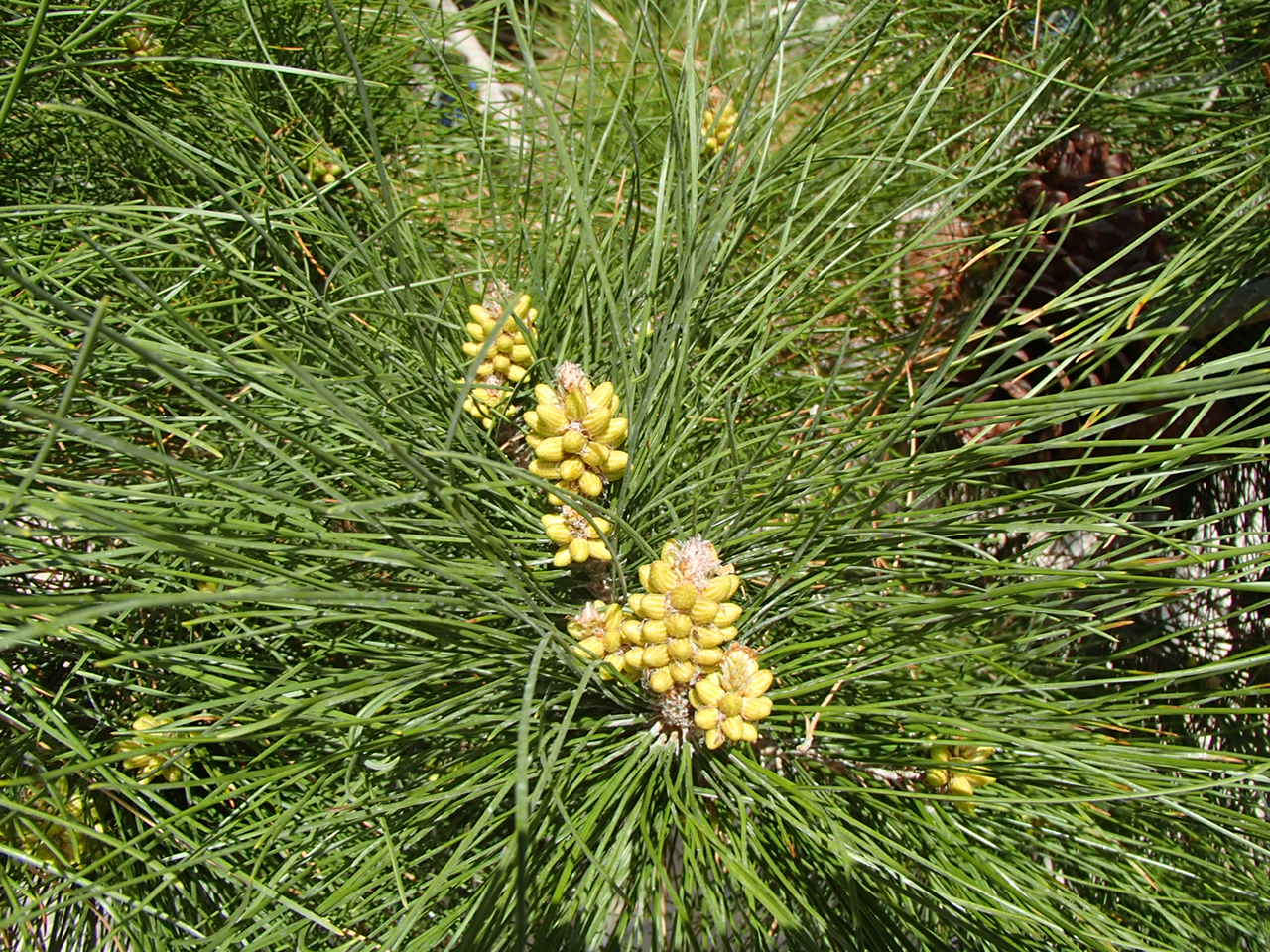
Pine getting ready to release pollen from the male flowers
Pine trees and olives were different. They also produced allergenic pollen but pollen and fruit were produced on the same tree; male and female trees were not separate from each other. Fruitless (and flowerless) olive was discovered, promoted and adopted as the only olive tree which could be planted in major urban centers like Las Vegas because it produced no flowers and hence no pollen.
Mulberry flowers getting ready to release pollen
Palo Verde produces allergenic pollen on flowers that are both male and female in the same flower. Comparing them to the above 3 trees, they are more similar to olive than pine or mulberry. There are no flowerless Palo Verde, unlike the olive.
Olive fruit can sometimes be prevented by spraying the tree with a product like Florel Fruit Eliminator. (contains ethephon). This product also controls the fruiting of several ornamental plants (and sometimes the flowers) when applied just before bloom. Depending on your Palo Verde, flowering will probably be in April or May in our Las Vegas climate. You can read the label below


I hesitate to recommend this product because if it is applied at the wrong dose it can cause leaf drop or possibly damage the tree. There is a recommended rate for several ornamental trees including olive but Palo Verde is not listed on the label. Use it at your own risk but if you are thinking about removing the tree anyway it might be worth a shot. I am not sure who sells it in Las Vegas but you cannot purchase it online.

Thin Peaches and Nectarines

Peach fruit too close together
Thinning, or the removal of fruit by hand, is an important step in growing larger and higher-quality peaches and nectarines. Enough fruit is removed from the tree so that the remaining fruit gets larger. We typically target this fruit to reach the size of 3 to 4 inches in diameter.
Peach fruit before thinning
Peach fruit after thinning
I like to relate this concept to something we can all appreciate; money. If you have an income that does not get any bigger and you have a family, the larger the income the more money you can spend on each individual in the family. If you have a dozen children then each of the children will receive less. If you have 3 children, then you can afford to spend more on each of those 3 children.
Peach fruit before thinning

Is the same with the fruit tree. The income for the tree is the sunlight, water and nutrients taken from the soil. A tree that is 10 feet tall can only gather a certain amount of light, water and nutrients from the soil. If the tree has 1000 fruit on it, the fruit may be the size of a coin. But if the fruit is thinned so that only 200 fruit remain, then the fruit might be the size of a small ball. Thinning of fruit is important to increase the size of the remaining fruit.
Peach fruit after thinning
Remove enough peach and apricot fruit so that the remaining fruit is 4 inches apart. As you are thinning or removing the fruit, remove fruit that is damaged or deformed 1st. Favor fruit that hangs from the bottom of the branch rather than the top of the branch. It is harder for birds to pack fruit on the bottom of the branch than the top of the branch.

Problems When Planting Tomatoes, Peppers and Eggplant

Two  Major Problems When Planting in Desert Garden Soils

The first problem regards the organic content of the soil. When growing many vegetables, they perform better with improved soil aeration around the roots. This is not necessarily true of root crops such as carrots or onions but is more important for tomatoes, eggplant, peppers and the like.

To improve soil aeration add a 1 inch layer of compost and dig or till it in each growing season. If you use compost make sure you pay attention to the carbon to nitrogen ratio (C:N) of that compost. The lower the carbon to nitrogen ratio, the more nitrogen is added to that garden soil. If the carbon to nitrogen ratio is 20:1 or lower, you may not need to add any nitrogen fertilizer for 1 to 2 months after transplanting. Adding a rich compost with a low carbon to nitrogen ratio and then adding a high nitrogen fertilizer at the same time may result in very bushy plants with no flowers until the nitrogen begins to run out.

The second problem involves water. Garden soils and soils in raised beds have additional compost added to them prior to planting. Frequently compost and soil mixes blended in desert environments are high in salts. These are not the bad salts but they are good salts in high enough concentration where they might damage plants if soils remain dry at the time of planting. This is usually not true in wetter environments with higher humidity.

Be sure to keep garden soils wet at the time of planting and immediately water the soil around transplants to remove air pockets and dilute any salts that may be present.

Do the same thing when planting from seed. Make sure the soils does not dry between irrigations until you begin to see strong growth from the seeds. Seedlings of many plants are less tolerant to salts, whether they are good salts are bad salts, than the mature form of the same plant.