Type your question here!

Friday, June 16, 2023

Attracting Honeybees into a Garden Landscape

Q. I’ve been trying to attract bees to my garden and thinking about a hive at some point. Need to put in some year-round flowering plants first. Rosemary comes to mind. Any thoughts or literature that comes to mind.

Rosemary flowers in the winter so it is a good choice for attracting and feeding honeybees to keep the hive alive.

A. Rosemary is a good choice; it flowers during the winter and is lower in water use since it is a Mediterranean plant that is smaller. Any plant that has conspicuous flowers during early spring and is cold hardy will work. That is one reason roses work so well. Other plants to consider that flower during that time and are cold hardy for our climate include the different Texas sage and Tecoma types.

Texas ranger (sage) flowers during the winter and is a good choice for attracting and feeding honeybees.

Don’t forget a mixture of annuals and perennials that have brightly colored flowers. Use many different colored flowers like mustards, clovers, desert bluebells and blue eyes, and the like. Scratch the seed into the soil with a rake and start watering them twice a month in December and January with 15 minutes of water from a sprinkler. Turn off the water when your fruit starts flowering.

Honeybees haul water if its in the garden.

Don’t forget water. Honeybees like to haul water during the winter as the hive starts to warm up. Bird baths and plastic troughs dug in the ground help attract bees and other critters. Don’t let the bees drown. Put rocks in the water so bees have a place to land. Honeybees are active during the daylight anytime temperatures are in the mid-50s, clear and sunny and little to no wind. Night flowering plants such as some cacti don’t work because bees need to see the sun to fly. Honeybees are supplemented with sugar water when they can’t find flowers they like. Feeding the colony with sugar water helps to keep the population alive during the coldest parts of winter.

Vegetable Growing in Moapa and Virgin Valley Southern Nevada

 Requests for Dr. Witwer’s information on raised bed gardening, his “Bible” I call it, overwhelmed and surprised me. I just finished sending out copies to everyone and my fingers are tired! (Ask me to send it to you ((morrisr@unr.edu)) because UNR doesn't carry it anymore.) 

Dr. Wittwer was the former vegetable extension specialist for Michigan State University before he retired to southern Nevada. In Logandale, Nevada, he maintained a large in-ground vegetable garden for many years before moving and eventually passing away. Logandale, in its agricultural area called the Moapa Valley and located about 60 miles north of Las Vegas, is slightly warmer but has a similar climate to Las Vegas.

Use His Recommended Varieties First

It is essential to use his recommended varieties but his recommendations on fertilizers and pesticides can be substituted for “organic” forms if you prefer. When using raised beds, or Bartholomew’s “square foot gardening”, look for more compact forms of the same variety to learn from. Vegetable breeders “earn their pay” by recognizing popular varieties in regions would be even more popular with homeowners provided they have enough space to grow them. They concentrate on making them small or changing their fruiting habits in some way. The ‘Early Girl’ variety of tomato is now available from Burpees as an example as a “bush” or determinate type instead of the continuously vining type called “indeterminate”.

Reasons for Raised Beds (or Modified Raised Beds Called "Containers")

There are many reasons for constructing raised beds; rocky soil beneath it, uninhabitable because of pests like nematodes, small space requirements, beautification, etc. A type of “raised bed” are nursery containers. 

Even smaller “raised beds” such as ornamental containers in the landscape can add beauty and height to traditional gardens. Unlike larger raised beds they can be easily emptied, scrubbed clean, sanitized, and refilled again with new soil. Remember to fill them to within one inch of the container “lip” to maximize their soil depth and ease their heat dissipation. Use the same or similar soil mix in the container to make watering them easier.

Remember pots get hot on the outside unless the pot has something shading it. Double potting them (so they have an air space) is one answer in keeping the heat under control.

Plants Grow Toward Light

Q. I pulled out my old, bent crepe myrtle and bought a new one from a grower. It's still small, but I noticed the "trunk" is already curving. Is this going to be a problem like the old one? Is there something I should do now, or will it straighten itself out as it grows? When I plant it, should I put the root ball in the ground at an angle so the trunk is pointing more or less straight up?


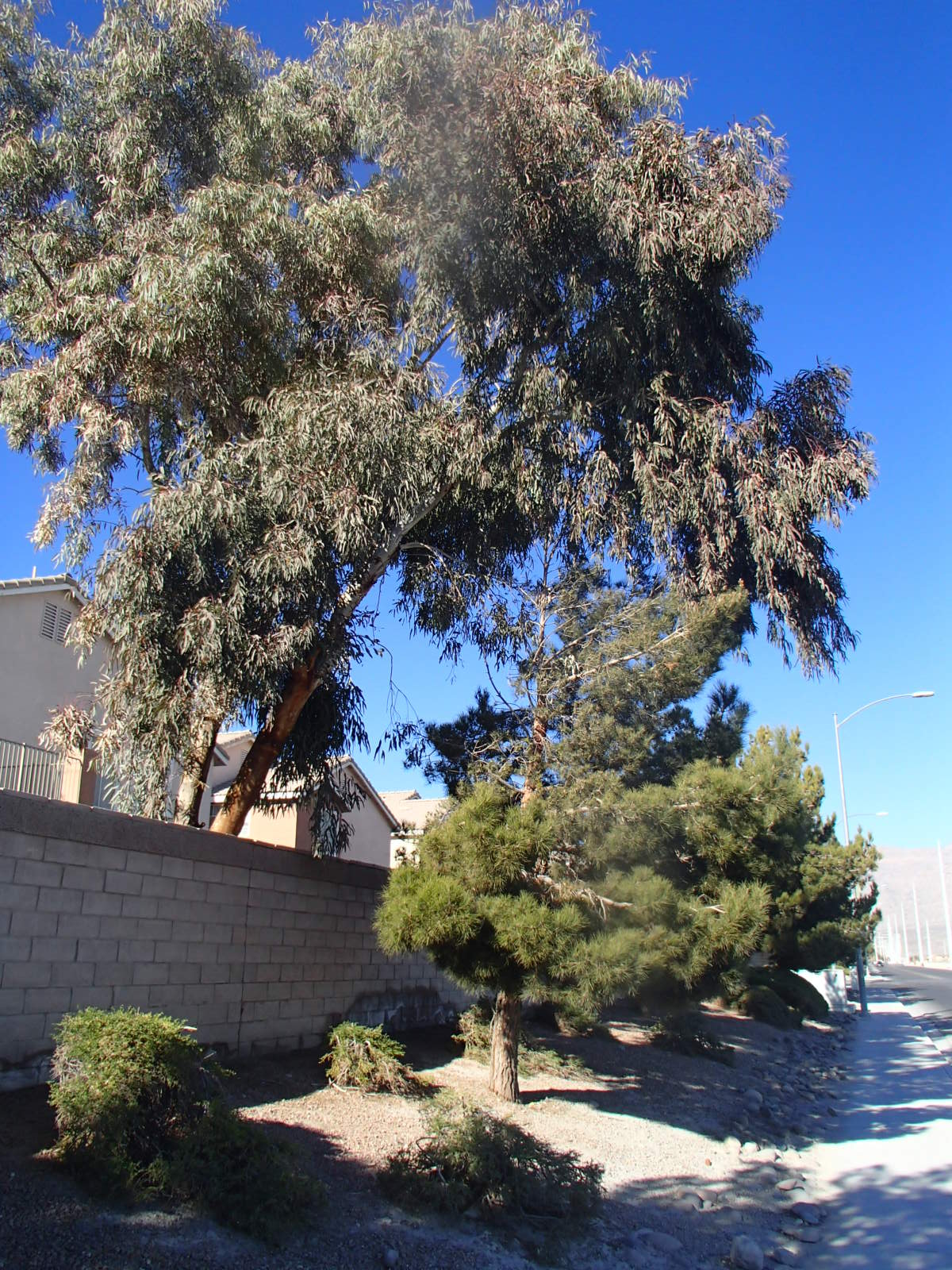
Pine tree leaning due to shade on its West side from the eucalyptus.

A. As soon as you plant it, the new growth will start straightening (bending toward the light) as it grows. The light will come at it from all different directions than in the nursery. When you plant it, plant it as straight as possible and let the plant figure it what is straight with its new growth. You can help it “straighten out” with pruning. As you guessed, the plant will figure it out as it grows.

Pine tree leaning. What is not known to you is that there was a large tree that burned down (died) last year to the left side of that tree on the other side of the wall. That's why it is leaning.


Leaves and buds are light receptors. The side that is open will "fill in" with new growth as long as the plant gets enough light, water and fertilizer to push this new growth. The top growth from leaves and buds (where it "sees" light which determine where and how stems develop) is what we call "positively geotropic" which means it “grows up”.

Roots are "negatively geotropic" which is a fancy way of saying roots “grow down”. Of course, root growth is encouraged by water, air, and fertilizer. Top growth is encouraged mostly by light but heavily influenced by irrigating and applying fertilizer to push new growth.

Saturday, March 25, 2023

Both Nitrogen and Iron Fertilizers Contribute to Dark Green Plant Color

Q. Thanks to your previous advice I used an iron chelate, applied it to the soil in March, and got my plants to develop a dark green color rather than a yellowish green color.


Shrubs that the reader was speaking about. Not sure but they do look like desert natives.

A. There are many things that develop a yellowish color in plants besides needing an iron fertilizer or chelate. The plant you questioned appears to be native desert plant, a Texas sage. That is odd needing an iron fertilizer for native desert plants. They are usually accustomed to our soils and don’t need iron. Watering or a nitrogen fertilizer may be the issue.

Not sure but I do recommend iron chelates that contain EDDHA as the chelating agent. It works in all the different alkalinities of desert soils. EDTA and DTPA iron chelates don't.

Regardless, the two fertilizers that can create dark green leaves are nitrogen and iron. If that plant is native to the Western US, then yellowing leaves is more likely issues involving either nitrogen or watering too often. Nitrogen causes stem growth as well as dark green leaf color. Adding only an iron fertilizer or chelate causes the new growth to become green but does not stimulate new growth that much. When iron is involved, the yellowing occurs on newer growth. Yellowing due to a need for nitrogen occurs all over the plant. Also, the yellowing of leaves due to iron may be a yellow leaf color while the veins of the leaves stay a darker green.

wk
Winter yellowing I call bronzing of a shrub due to very cold temperatures for Las Vegas.

Two types of “overwatering” can occur; watering too often or giving the plant too much water all at once. It is easier for the plant to resist “overwatering” from the second kind than the first kind. It is easy to water desert native plants too often when placed on the same irrigation line as non-desert plants.

Mesquite leaf yellowing and leaf drop during winter cold temperatures.

Another reason for yellowing of plant leaves are cold temperatures. This type of yellowing is more of a “bronzish yellow” leaf color and happens during cold weather. Cold weather damage to mesquite leaves (yellowing or bronzing) is a common occurrence during cold weather just before the leaves may fall from the tree if it gets cold enough.

Pine Trees Don't Need as Much Fertilizer as Fruit Trees


Pine trees in the desert do not need as much fertilizer as fruit trees. We don't expect as much from them as we do fruit trees.

Q. I have a few Aleppo pine trees that I fertilize and water regularly growing in Logandale. I am wondering how much fertilizer to give them each year and how much to water them. I am wondering if I can get them off of the irrigation due to a shallow water table here and apply less fertilizer.

Pine trees access water from shallow aquifers if they are within a few feet of the surface of the soil. One way to see if that is the case is to look for salt pushed to the soil surface by shallow water.

A. In my experience trees like Aleppo pine need fertilizer applied AT THE MOST once a year and perhaps less often. In the case of pine trees mostly nitrogen and potassium because we don’t need them to flower or fruit. That requires fertilizer higher in phosphorus, the middle number. Whenever the trees are “improved” (hybridized or improved for some reason) they need to be fertilized more often and need more care. For example, most fruit trees require one full or a split application of fertilizer twice a year.

This is Burgundy plum growing in Las Vegas, NV. Fruit trees will need more fertilizer if we want large fruit to be produced. Are expectations aren't as high for pine trees so they can get by without applying as much fertilizer.

My guess is that your pine trees, at the most, will need fertilizer applied once a year in the spring. Improved trees like fruit trees need about one pound of a nitrogen fertilizer in the spring (or the fertilizer divided in half and applied twice) for each 1000 square feet under their canopy. Aleppo pine trees require it less often or apply less total amount each time you fertilize.

New growth of older pine trees should be at least 8 inches or more to give adequate growth for a full canopy.

Look at the results of irrigations and applications of fertilizer. The fertilizer is needed every year or every other year. A tree of that size should put on about 8 inches of new growth every year to keep it full. That takes primarily nitrogen similar to a lawn fertilizer (21-7-14). Don’t skimp on nitrogen and potassium in the fertilizer for pine trees. Because they are “all green” and no flowers or fruit you can apply less of the middle number (the amount of phosphorus).

As far as applying irrigation less often or eliminating them, you need shallow groundwater to about 5 to 7 feet deep. At the same time force its roots to grow deeper in the soil so it can discover the water. Pine trees have taproots or large roots that can grow deep if given the chance. Groundwater can go down in the summer months and up to normal in the winter. What I am telling you is that you might need to water occasionally during the summer months.

This is bubbler and basin irrigation on pine trees. The basin doesn't have to be deep but it must be flat and capture the water from the bubbler so it stays put long enough and penetrates the soil deeply.

When you irrigate, water the trees deep when you do, water them less often and watch the tops. Force the tree roots “to go after” deeper water and see how much fewer extra irrigations they need and still maintain 8 inches of new growth during the early summer months.

Friday, March 24, 2023

Winter Cold Damage and Freezes

Oleander after a strong freeze.

This is the time of year, the second week of December, we normally experience the start of freezing temperatures. The likelihood of freezing temperatures increase through the winter. Sometimes freezing temperatures occur in November, as it did a few years ago, but that's rare and not “normal”. What I mean by “freezing temperatures” is plant damage that occurs anytime the air temperature drops below 32 degrees Fahrenheit (F). Those familiar with Celsius or centigrade, may realize this temperature is the same as 0 degrees on the Celsius scale.

Cold or freezing damage.

Refrigerators Don't Freeze

As a reference point, the temperature inside most refrigerators is set to around 40 degrees F, or 8 to 10 degrees above freezing; too cold for most tropical fruit and plants but not too cold for temperate fruit like and plants apples and peaches. Chilling injury (plant damage that occurs because air temperatures are too cold for the plant but not yet freezing) is one reason many ripe tropical fruits, like tomatoes and (more obviously) bananas, should not be exposed to the 40-degree F temperatures of a refrigerator. 

If winter temperatures aren't cold enough to kill, the plant will regrow from buds.

Chilling Injury

All parts of tropical plants such as tomatoes and bougainvillea, experience “chilling injury” when temperatures drop a few degrees above freezing and may extend to 50+ degrees F. Chilling injury (as opposed to freeze or frost damage) occurs at different temperatures and depends on the plant.

Tomato plants might freeze at 32F but the fruit is damaged below 55F.

Chilling injury damage to tropical and subtropical plants include small stem and leaf discoloration, leaf roll, poor growth, and susceptibility to some diseases like root or collar rot. Symptoms of chilling injury include a change in color such as yellowing or bronzing of leaves that ultimately result in leaf scorch or drop, the slowing or halting of growth, leaf drop, water-soaked patches in soft and semi-hard tissues, susceptibility to diseases, and wilting. Chilling injury is due to cooler or cold weather (above freezing) temperatures to tropical plants growing outside of, or close to, the fringes of their normal range. As a side note, I noticed leaf and stem discoloration (closer in color to leaf “bronzing”) in mesquite, palms, citrus and a wide range of plants growing at different temperature ranges.

Chilling Injury and Vegetables

Vegetables can exhibit chilling injury and freezing damage as well. So-called “warm season vegetables” such as tomatoes, peppers and eggplant can show chilling injury anytime the air temperature drops into the damaging temperature range I mentioned earlier. Cool season vegetables, on the other hand, may sail through the same temperatures, or lower, or require a crop cover when temperatures are below freezing. Vegetable varieties may differ in their chilling injury by a few degrees. The ‘Dragon’s Tongue’ variety of bush bean is more susceptible to collar rot (chilling injury) when grown in garden soil a few degrees cooler than other bush bean varieties.

Nopales freeze damage during the winter of 2007-2008

Temperate Flowers and Fruit Can Freeze

Temperate fruit like apples and pomegranates, unlike tropical fruit like tomatoes and bananas, are not damaged at refrigerator temperatures (around 40 degrees) because fruit from these trees can handle these lower temperatures. The ideal storage temperature for these types of fruit is somewhere close to freezing (0 degrees F) and combined with high humidity. A high humidity slows water loss and helps delay some fruit from shriveling.

Refrigerator Freezers and Freezing

The freezer part of our refrigerator is set to around 32 degrees F, or about 10 degrees below the “refrigerator temperature.” Our nighttime winter temperature frequently drops to a “refrigerator temperature” range at night during the late fall, winter and early spring and occasionally into the “freezer temperature” range during the early morning hours of December, January and occasionally early February. When nighttime temperatures reach the “freezer range” is when we often times see plant damage or experience fruit loss, but we may not know it yet.

Open Flowers can Freeze

Open flowers of any fruit (citrus, peach, apple and others) can’t handle temperatures below freezing (32 degrees F) even though most plants or trees might show no damage at all! When flowers are simply buds and not yet open, there is a small amount of freeze protection provided to the developing flower. This freeze protection starts disappearing as the flower buds mature into open flowers. As the flower begins opening, and the frost-sensitive ovary is surrounded by the freezing night air, is when we experience damage or fruit loss. Fruit loss due to a frozen flower ovary can happen in a few seconds. This is why sprinklers, ultimately resulting in applied water turning to ice on the flowers, are used in orchards to prevent freeze damage to flowers (ovary). The act of water freezing releases a small amount of heat that protect flower ovaries from death.

Early winter freeze damage to persimmons.

Was the Flower Frozen?

If you are curious if the ovary of a flower from your fruit tree was damaged during a freeze, pull the flower apart a few days after a suspected freeze and inspect the ovary for death. Ovaries that eventually turn into fruit will be robust and green. Dead flowers drop from the tree early or have a dull, water-soaked appearance if they are still attached. Just because the flower you inspected was “dead” doesn’t mean there will be no fruit produced at all. It takes about two or three weeks for all the flowers to open in spring flowering plants. Several consecutive light freezes in a row (or only one hard freeze) are needed to totally wipe out a crop of fruit from a mature tree.

when a fruit tree flowers it is hold your breath that no freezes happen during this time. When fruit tree flowers are open is a dangerous time for freezing temperatures.


Freezing Death Differs

 There is a temperature difference between the freezing death of open flowers and the freezing damage or death of the plant or tree. For citrus this difference can range from the same temperature as flower death (32 degrees F; limes and true lemons) to lower temperatures (mid 20 degrees F; Myer lemon, grapefruit, and kumquat). Much of this depends on how many minutes or hours a killing freeze lasts and at what temperature.

Temperature, and duration of that temperature, are what is critical. With open flowers, freezing temperatures are needed for just a minute. With plant or tree death, the same temperature is needed for a longer time period. With some fruit trees (such as citrus), the temperature difference between flower and tree death can be small (0 to 7 degrees). In other fruit trees (such as apples, pear, peach and apricot) it can be much greater (20 degrees or more).

Weather Apps

What to do about freezing temperatures and fruit or plant loss? Track and use weather station apps during times when freezing temperatures might occur. Buy a recording thermometer for your backyard and hang it in your important trees. If you are into growing vegetables, use a soil thermometer to judge when to precisely plant.

Weather stations like this one can play a critical role in helping to predict if freezing temperatures are a possibility.

What to Do?

Move fruit trees to a new location. If your fruit trees are less than three to four years old, now is the time of year to move them. South and West-facing sides of walls and buildings are tough to grow plants because of the heat they reflect. Some citrus are in landscape “wind tunnels” that remove flowers during strong winds. North and east sides of buildings and walls as well as backyards have a gentler environment. In cooler, gentler areas of the landscape expect flowering to be two to three weeks later. Group plants together so they can share water, fertilizer, and protect each other. If they can't be grown together, consider constructing wind barriers.

Try kumquats which are a cold hardy, subtropical citrus trees. The small fruit can be freshly harvested and eaten from the tree but still gives you that citrus “kick”. Kumquat flowers several times during the summer instead of just once and yet is small enough to grow in a container. Flowering more than once during a single growing season increases your chances of having a successful crop if you have late or multiple freezes.

Wrapping a fruit tree correctly might give you a few degrees of winter protection from cold.

Grow fruit trees that flower continuously. Pomegranate, fig and jujube are temperate cold and heat tolerant fruit trees that flower continuously through the growing season.

Fruit Trees Benefit from Neighboring Plants

Always group plants and fruit trees together. Improve the soil at the time of planting and every couple of years. The water, soil improvement and shade that they provide and share is a big benefit to them when grown in the desert.

Pines in Logandale Need Less Fertilizer But the Same Amount of Water


In my experience trees like Aleppo pine need fertilizer applied AT THE MOST once a year and perhaps less often. 

Non-Flowering and Non-Fruiting Trees Need Mostly Nitrogen and Potassium

In the case of pine trees mostly nitrogen and potassium because we don’t need them to flower or fruit. That requires fertilizer higher in phosphorus, the middle number. Whenever the trees are “improved” (hybridized or improved for some reason) they need to be fertilized more often and need more care. For example, most fruit trees require one full or a split application of fertilizer twice a year.

Force Them After this Water

My guess is that your pine trees, at the most, will need fertilizer applied once a year in the spring. Improved trees like fruit trees need about one pound of a nitrogen fertilizer in the spring (or the fertilizer divided in half and applied twice) for each 1000 square feet under their canopy. Aleppo pine trees require it less often or apply less total amount each time you fertilize.


Look at the results of irrigations and applications of fertilizer. The fertilizer is needed every year or every other year. A tree of that size should put on about 8 inches of new growth every year to keep it full. That takes primarily nitrogen similar to a lawn fertilizer (21-7-14). Don’t skimp on nitrogen and potassium in the fertilizer for pine trees. Because they are “all green” and no flowers or fruit you can apply less of the middle number (the amount of phosphorus).

As far as applying irrigation less often or eliminating them, you need shallow groundwater to about 5 to 7 feet deep. At the same time force its roots to grow deeper in the soil so it can discover the water. Pine trees have taproots or large roots that can grow deep if given the chance. Groundwater can go down in the summer months and up to normal in the winter. What I am telling you is that you might need to water occasionally during the summer months.

When you irrigate, water the trees deep when you do, water them less often and watch the tops. Force the tree roots “to go after” deeper water and see how much fewer extra irrigations they need and still maintain 8 inches of new growth during the early summer months.

Friday, February 17, 2023

Bitter Orange in Las Vegas

Q. I was so happy to see an article you recently wrote in the RJ concerning bitter orange trees.  I have one that was here when I bought my house 16 years ago.  It was in a patio pot at that time and I had it replanted, along with a Meyer Lemon, in the “alley” between my house and my neighbor.

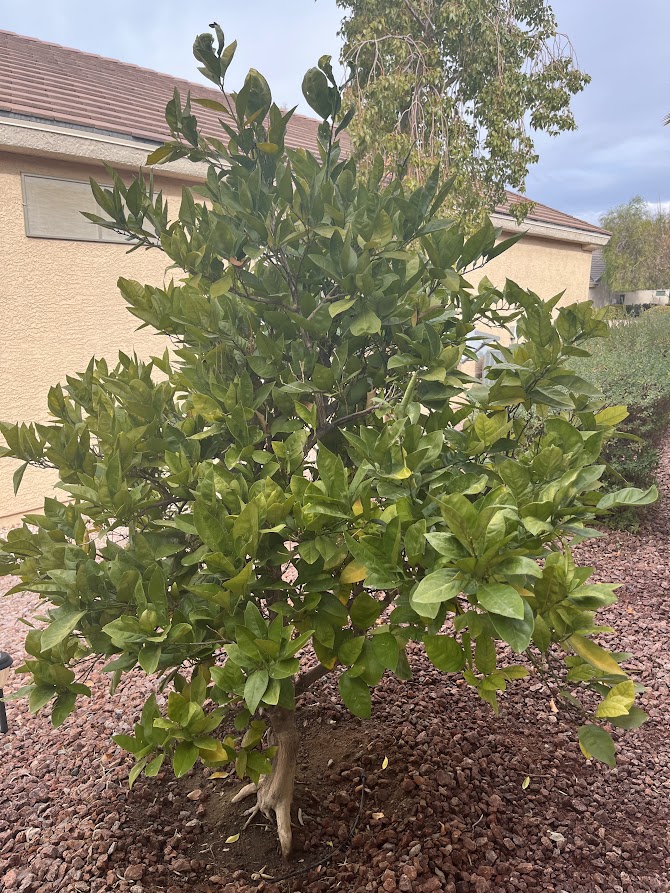
Bitter orange tree planted in Las Vegas.

My lemon has been giving me fruit for the past approximately 8 years and about 30-35 lemons.  My orange tree has always produced flowers, but no fruit up until 2 years ago. I got about 25 nice sized oranges.  Last year I got flowers but Not A SINGLE fruit. Is this a tree that may “skip” a year in fruit production?  I have done nothing to these trees except fertilize with Arizona Best’s Citrus fertilizer Valentine’s Day, Memorial Day and Labor Day.

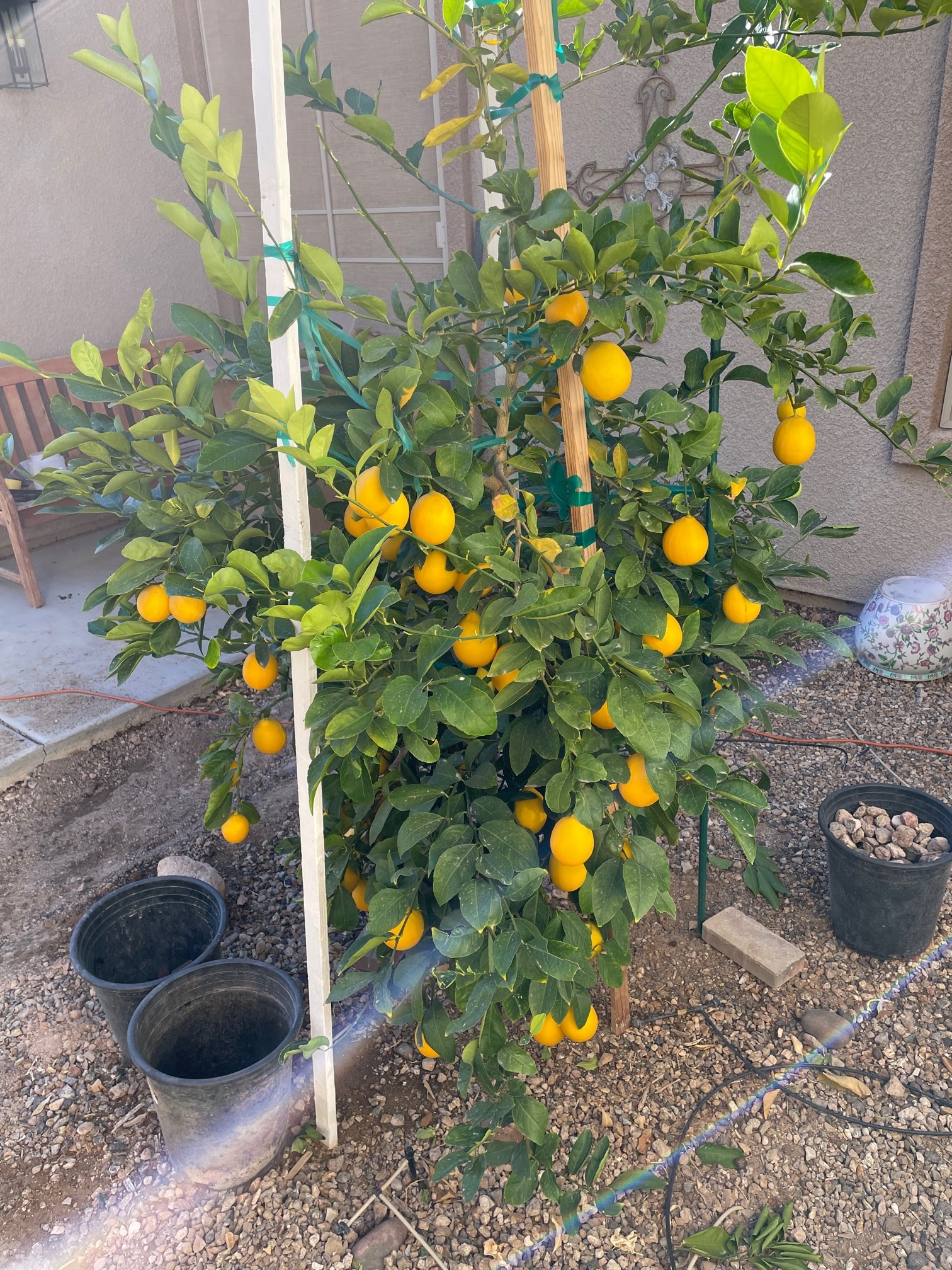
Myers lemon (not readers) planted in Las Vegas.

A. “Skipping” a year is called “alternate bearing” and occurs, usually, with older varieties of fruit trees like some almonds and apricots. Bitter orange, like most oranges, produces the majority of its flowers in the early spring. This is the same time we experience freezing weather. Your fruit loss could be because of freezes.

Did You See Flowers?

It is important to ask, “Are you sure you saw flowers in the spring and no fruit?” That’s an important consideration. If you did then it was a failure to set fruit. That is either because no pollinators were present (bees and other pollinators like flies and moths) or it froze several times in a row in the early spring.

No Flowers

If you did not see flowers in the spring, then it was because it never flowered. That could be because of some hard pruning that was done, and the tree is recovering, or too much fertilizer was applied too often. This is true particularly of high doses of nitrogen fertilizer such as ammonium sulfate (21-0-0). In either case, the tree grew so vigorously that it never flowered!

Fertilizer Applications

Normally one fertilizer application is all that is necessary, or two at the most. If two is applied, then apply half of your normal fertilizer application in the early spring and half right after harvest. If harvest is close to your early spring application time then apply fertilizer to citrus just before it gets hot in the early summer. Avoid making fertilizer applications when it is hot. In the case of citrus that might freeze, avoid fertilizer applications after July.

Tree Surrounded by Rock Mulch

Some citrus okay with rock mulch.

I noticed that the tree is surrounded by rock mulch. Yet it has good color. Citrus of all types don’t usually like rock mulch all that much. The first thing to go is dark  to medium green color in the leaves when it gets unhealthy. That’s why I was surprised with your tree. Maybe your choice of fertilizer helps.

Some citrus not okay with rock mulch. Use amended soil when planting and citrus fertilizer every year.

Citrus are from southeast Asia and China. They prefer to grow in soils with a higher organic content than most soils covered in rock. Along with your fertilizer application try raking back the rock at least three feet all around the tree and applying compost or wood chips to the top of the soil. Water it in and rake the rock back on top of it after it is watered. Do this about every year or every other year at the least. I think your bitter orange will like this type of soil better than soil covered in rock.

Pomello on our farm in the Philippines.


Properly Staking Trees and Other Plants in Desert Soil

 Q. I have a tree that was staked and now the wires used in staking it are starting to strangle the tree trunk.

Fairly common forgetfulness of homeowners and plant maintenance companies. Tree staking. Proper staking removes the stakes after one season of growth.

A. That's a common problem on large, staked trees planted in home landscapes. It's a gamble on the wind whether to stake or not to stake. I encourage people to stake nearly all plants. It's cheap insurance. On smaller 5-gallon plants (sometimes even 15-gallon shrubs) the small, square, green nursery stake found in the container may be adequate if cut loose from the plant, driven or pushed into the moist, solid ground beneath the plant. Retie the plant when you’re finished. Always have some half-inch, stretchable green nursery tape on hand. It's very useful.

Green stretchable nursery tape is used to tie one inch caliper bare root trees to a wooden stake.

The purpose of staking any plant is to keep new roots from being damaged during establishment. The movement of roots usually happens during strong winds. Planting in wet planting holes and amending the backfilled desert soil may get around the use of stakes with smaller plants. Use your judgement.

Wind blew over this cactus either because it was watered too often, watered too close to its center. If the soil surrounding the roots were moist, this cactus would find water further from its center and resist blow over.

Typically staking is only needed for one growing season and then removed. One growing season is all that is needed to establish plant roots in the surrounding soil and make the plant secure against wind. 

Some homeowners may think the reason for staking is to hold the tree upright. That's only partially true. On occasion more than one growing season of staking may be needed when planting trees grown too close to each other in wholesale or production nurseries. In cases like these, metal ties are loosened and then retightened at the end of each growing season to prevent “choking the trunk” as seen in your picture. Remember, plants grow in two dimensions; length AND girth. Sometimes excessively tall and weak plants must be pruned smaller to encourage new, stronger growth. 


The proper way to stake a tree is to allow the canopy and trunk of the tree to move but not it's roots. Movement of a tree’s trunk allows it to gain taper (become stronger) as it grows in size. Trunk taper may or may not be missing because of production nursery practices. Properly grown trees have a tapered trunk as you look at it from top to bottom.


Some Plants are Damaged if Temperatures are Above Freezing

Some plants can get damaged at temperatures above freezing. Learn how and which ones.

Chilling damage occurs mostly to tropical fruit if temperatures are like a refrigerator.

Freezing Temperatures

This is the time of year, the second week of December, we normally experience the start of freezing temperatures. The likelihood of freezing temperatures increase through the winter. Sometimes freezing temperatures occur in November, as it did a few years ago, but that's rare and not “normal”. What I mean by “freezing temperatures” is plant damage that occurs anytime the air temperature drops below 32 degrees Fahrenheit (F). Those familiar with Celsius or centigrade, may realize this temperature is the same as 0 degrees on the Celsius scale.

What is Chilling Injury?

As a reference point, the temperature inside most refrigerators is set to around 40 degrees F, or 8 to 10 degrees above freezing; too cold for most tropical fruit and plants but not too cold for temperate fruit like apples and peaches. Chilling injury (plant damage that occurs because air temperatures are too cold for the plant but not yet freezing) is one reason many ripe tropical fruits, like tomatoes and (more obviously) bananas, should not be exposed to the 40-degree F temperatures of a refrigerator. All parts of tropical plants such as tomatoes and bougainvillea, experience “chilling injury” when temperatures drop a few degrees above freezing and may extend to 50+ degrees F. Chilling injury (as opposed to freeze or frost damage) occurs at different temperatures and depends on the plant.

Chilling Damage

Chilling injury damage to tropical and subtropical plants include small stem and leaf discoloration, leaf roll, poor growth, and susceptibility to some diseases like root or collar rot. Symptoms of chilling injury include a change in color such as yellowing or bronzing of leaves that ultimately result in leaf scorch or drop, the slowing or halting of growth, leaf drop, water-soaked patches in soft and semi-hard tissues, susceptibility to diseases, and wilting. Chilling injury is due to cooler or cold weather (above freezing) temperatures to tropical plants growing outside of, or close to, the fringes of their normal range. As a side note, I noticed leaf and stem discoloration (closer in color to leaf “bronzing”) in mesquite, palms, citrus and a wide range of plants growing at different temperature ranges.

Warm Season Vegetables Usually Have More Chilling Damage

Vegetables can exhibit chilling injury and freezing damage as well. So-called “warm season vegetables” such as tomatoes, peppers and eggplant can show chilling injury anytime the air temperature drops into the damaging temperature range I mentioned earlier. Cool season vegetables, on the other hand, may sail through the same temperatures, or lower, or require a crop cover when temperatures are below freezing. Vegetable varieties may differ in their chilling injury by a few degrees. The ‘Dragon’s Tongue’ variety of bush bean is more susceptible to collar rot (chilling injury) when grown in garden soil a few degrees cooler than other bush bean varieties.

Refrigerator Temperatures Result in Chilling Damage

Temperate fruit like apples and pomegranates, unlike tropical fruit like tomatoes and bananas, are not damaged at refrigerator temperatures (around 40 degrees) because fruit from these trees can handle these lower temperatures. The ideal storage temperature for these types of fruit is somewhere close to freezing (0 degrees F) and combined with high humidity. A high humidity slows water loss and helps delay some fruit from shriveling.

Freezer Temperatures Result in Freezing Damage

The freezer part of our refrigerator is set to around 32 degrees F, or about 10 degrees below the “refrigerator temperature.” Our nighttime winter temperature frequently drops to a “refrigerator temperature” range at night during the late fall, winter and early spring and occasionally into the “freezer temperature” range during the early morning hours of December, January and occasionally early February. When nighttime temperatures reach the “freezer range” is when we often times see plant damage or experience fruit loss, but we may not know it yet.

Open Flowers are All Subject to Some Type of Damage

Open flowers of any fruit (citrus, peach, apple and others) can’t handle temperatures below freezing (32 degrees F) even though most plants or trees might show no damage at all! When flowers are simply buds and not yet open, there is a small amount of freeze protection provided to the developing flower. This freeze protection starts disappearing as the flower buds mature into open flowers. As the flower begins opening, and the frost-sensitive ovary is surrounded by the freezing night air, is when we experience damage or fruit loss. Fruit loss due to a frozen flower ovary can happen in a few seconds. This is why sprinklers, ultimately resulting in applied water turning to ice on the flowers, are used in orchards to prevent freeze damage to flowers (ovary). The act of water freezing releases a small amount of heat that protect flower ovaries from death.

If you are curious if the ovary of a flower from your fruit tree was damaged during a freeze, pull the flower apart a few days after a suspected freeze and inspect the ovary for death. Ovaries that eventually turn into fruit will be robust and green. Dead flowers drop from the tree early or have a dull, water-soaked appearance if they are still attached. Just because the flower you inspected was “dead” doesn’t mean there will be no fruit produced at all. It takes about two or three weeks for all the flowers to open in spring flowering plants. Several consecutive light freezes in a row (or only one hard freeze) are needed to totally wipe out a crop of fruit from a mature tree.

 There is a temperature difference between the freezing death of open flowers and the freezing damage or death of the plant or tree. For citrus this difference can range from the same temperature as flower death (32 degrees F; limes and true lemons) to lower temperatures (mid 20 degrees F; Myer lemon, grapefruit, and kumquat). Much of this depends on how many minutes or hours a killing freeze lasts and at what temperature.

Temperature, and duration of that temperature, are what is critical. With open flowers, freezing temperatures are needed for just a minute. With plant or tree death, the same temperature is needed for a longer time period. With some fruit trees (such as citrus), the temperature difference between flower and tree death can be small (0 to 7 degrees). In other fruit trees (such as apples, pear, peach and apricot) it can be much greater (20 degrees or more).

What to do about freezing temperatures and fruit or plant loss? Track and use weather station apps during times when freezing temperatures might occur. Buy a recording thermometer for your backyard and hang it in your important trees. If you are into growing vegetables, use a soil thermometer to judge when to precisely plant.

Move fruit trees to a new location. If your fruit trees are less than three to four years old, now is the time of year to move them. South and West-facing sides of walls and buildings are tough to grow plants because of the heat they reflect. Some citrus are in landscape “wind tunnels” that remove flowers during strong winds. North and east sides of buildings and walls as well as backyards have a gentler environment. In cooler, gentler areas of the landscape expect flowering to be two to three weeks later. Group plants together so they can share water, fertilizer, and protect each other. If they can't be grown together, consider constructing wind barriers.

Try kumquats which are a cold hardy, subtropical citrus trees. The small fruit can be freshly harvested and eaten from the tree but still gives you that citrus “kick”. Kumquat flowers several times during the summer instead of just once and yet is small enough to grow in a container. Flowering more than once during a single growing season increases your chances of having a successful crop if you have late or multiple freezes.

Grow fruit trees that flower continuously. Pomegranate, fig and jujube are temperate cold and heat tolerant fruit trees that flower continuously through the growing season.

Always group plants and fruit trees together. Improve the soil at the time of planting and every couple of years. The water, soil improvement and shade that they provide and share is a big benefit to them when grown in the desert.

Yellow Leaves on Potted Myer Lemon

Q.  I have a Myers lemon tree in a pot on a south facing patio. The wall near it faces east and there was a large pine tree out front so it receives shade in the afternoon. There are quite a few yellow leaves that just appeared. All the new fruit has turned black. It seems to me that maybe I just need to replace this tree. The lime tree is doing very well in a similar location.


A. The picture you sent to me shows a Myer lemon with ready to harvest fruit being grown in a small container with smaller plants growing around its base. Meyer lemon typically flowers sometime in January and February. The fruit can be harvested starting about now (December) with this harvest, finished by January, encourages new flower development for next year’s production.

Producing flowers and then fruit in midfall is early for Meyer lemon. Early flower development can be a sign that it is under some sort of stress. Certainly it's not normal for this type of tree at this time of year.

            All fruit trees and vegetables need a minimum of six hours of full direct sunlight. 8 hours is even better. In home landscapes the best sunlight for it in our hot climate in the summer months is during the cooler morning hours. Partial shade may be pleasant for people sitting on the patio but not for many plants that produce fruit or vegetables.

If shade is present during most sunlight hours, then I would recommend an ornamental plant for that spot with variegated or colorful leaves, not a flowering or a fruit-producing plant. A non-flowering ornamental handles shade better than a flowering plant, whether those flowers produce fruit or not.

Don't Plant Annuals at the Base of Perennial Trees

            Secondly, and perhaps more importantly, are the smaller plants demand for frequent watering compared to the tree. Growing a shallow-rooted plant or plants at the base of a deeper-rooted plant is a big “no-no” regarding how often water is applied. Shallow-rooted plants “signal” they need water applied more often than deeper-rooted plants, so they get water applied more often than the watering frequency needed for deeper-rooted plant needs.

This type of watering can suffocate the roots of a deeper-rooted plant. Watering a deeper-rooted plant too often can produce leaf drop, flower drop, fruit blackening, and a tree that's “loose in the soil”. Trees that develop “collar rot disease need to be staked after just a few years of growth. Does that sound like your fruit tree?

            I would replace this tree with a plant that requires moderate to low levels of sunlight. If you want to grow other plants along with it, select plants with a similar rooting depth and need for applied water.

Pecans With Black Spots and Bitter Meat in Southern Nevada

Q. I had two pecan trees that are now 25 years old. One variety has round nuts and the other one has oblong nuts. This is the first year in 25 years they have produced nuts that have black spots and are bitter tasting but the outside of the nut looks normal. Any idea what the problem might be?

Pecan scab. Picture from Texas A and M University.

A. Pecan nut problems are hard to diagnose. The nuts themselves can be bitter if some of the husk is attached to the nut. But yours sounds like a disease issue to me. Perhaps it was our wet early summer and spring that created the problem.

The most common disease of pecans is scab. When it is a wet spring, after a rain, it is wise to spray the trees in March with a fungicide such as Bordeaux or copper sulfate. If it rains again, spray it again after the rain has stopped. The problem is spraying these trees top to bottom since there are no systemic fungicides that can be applied to the soil and taken up by the roots. The lesions on the outside surface of the shell this disease produces are difficult to see and does produce an “off flavor” once inside the meat.

I must guess a little bit, but the varieties popular about 25 years ago in the West were oblong nut varieties called “Western Schley”, “Mahan”, “Wichita”, “Mohawk”, and “Cheyenne”. The older and round nut varieties were either “Burkett” or possibly “Choctaw”. The reason I mention it is because there are probably well over a hundred varieties of pecan. The more recent hybrids are smaller, produce nuts sooner, less likely to bear nuts every other year (alternate bearing), and don’t need a pollinator tree. Also “Choctaw” and “Cheyenne” varieties were considered “resistant “to this disease.

Even though pecan trees can handle our summer heat and poor soils, I don't recommend them for our area because of their size and water use. Pecan trees can get big, growing 60 to 100 feet tall and 30 to 50 feet wide, and have no semi-dwarf or dwarf varieties that I know. Their size dictate they use a lot of water. They do have a sizeable tap root so they possibly could be used where there is shallow underground water.