Type your question here!

Showing posts with label how to prune. Show all posts

Saturday, September 3, 2022

Prune Larger Shade Trees to Save Water and Be a Good Neighbor

 Q. I have a 20-year-old African sumac nearly 30 feet tall which provides great shade in my backyard. It needs another pruning when it cools off. I did a major cutback last fall at the request of my neighbor because of leaf drop. Any suggestions on how best to do so and keep the shade and cooler temperatures it provides?

Drop crotching an African Sumac that is too tall will save water.


A. Two things you need to know if you are doing this yourself; drop crotching and how to do a 1-2-3 pruning cut.

Stand away from the tree so that you can see all of it. Identify the limbs giving you the problems. Trace the limbs back to a lower crotch. A crotch is where at least two limbs come together. This is where the pruning cuts and lowering will be done.

In a 1-2-3 cut the first cut is made 12 inches from the tree trunk and upward to prevent a large limb from pulling the bark from the trunk

Make a 1-2-3 Pruning Cut

During cooler weather remove the limbs that are offensive. Use a 1-2-3 cut to avoid stripping the bark from the tree. A 1-2-3 cut is done first by making an undercut six inches from a limb to about 1/3 of its diameter.

The second cut is made outside of the first cut. Attached bark may strip down to the undercut, or first cut, so the falling limb will not tear the remaining limb and tree trunk. This is why the undercut is made first. A third cut is used to finally remove the remaining stub. It is a finished cut. The third cut is the smallest cut made that removes most of the stub remaining so the cut heals faster.

If you have never done it, for safety reasons and a better-looking tree, hire a certified Arborist to make these pruning cuts so that it will make the tree smaller and keep it beautiful. Part of your payment is for decisions that result in a prettier tree than you could have done.

Wednesday, December 9, 2015

When and How to Prune Lantana and Oleander?

Q. How and when should we prune our lantana and oleanders?
This is a Lantana I saw pruned by a local company. Leaving this much wood remaining will make it very "twiggy" at the base. You can actually prune it much closer to the ground in this.
You can see from this close-up that I took last February that suckering can occur much lower on the stems of Lantana. Don't be afraid to cut it close to the ground. Leave about 1 inch for suckering.


A. Both of these plants are pruned during the winter months since they both produce flowers on new growth during the summer months.
After pruning, apply a high nitrogen and high phosphorus fertilizer to push new leaf and stem growth and dark green color. The phosphorus will help to promote flowering. Flowering will not occur until the top growth is large enough and comes into balance with the existing root size. This is sometimes referred to as the root to shoot ratio.
 I would delay pruning them until late winter (late January) unless you don’t mind looking at "dead" space (the space is not occupied by anything). For lantana it normally freezes during winter months and you have a choice whether to leave the dead top of the plant in place or cut it down to the ground, leaving one inch of stems remaining to support the new growth beginning in February.
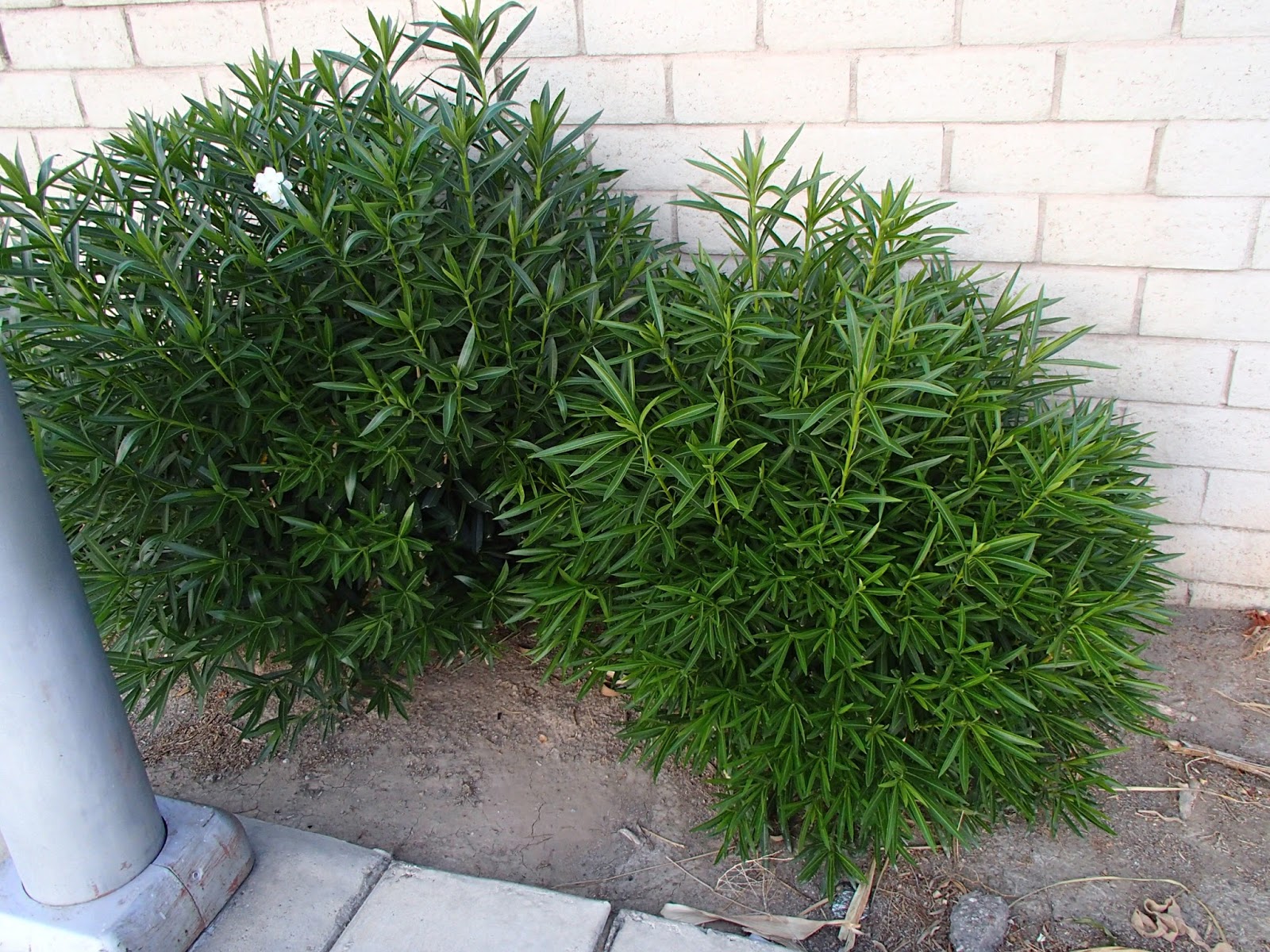
You can prune oleander close to the ground, just like Lantana. Cut it back to within 2 to 3 inches of the soil surface. This is the time of year to do it up until about the end of January when it begins to push new growth all by itself.
            Because the roots are fully grown, alive and healthy you will see very rapid growth in the spring. Fertilize the pruned plant in late January or early February to encourage new growth and flowers. Use a fertilizer that supports flowering plants such as a rose fertilizer blend or other fertilizer for flowering plants.
You can see from this picture that new growth is beginning to sucker from the base just like Lantana. Apply a fertilizer near the base of the plant close to a source of water. Use the same fertilizer as the Lantana. A rose type fertilizer is fine.

Oleander will regrow very quickly when cut back close to the ground, fertilized and watered. This was one month after pruning. Nitrogen in the fertilizer will push leaf and stem growth along with dark green color. Phosphorus in the fertilizer will push flower growth and flower size.
            Oleander is pruned at the same time of year as lantana because it also blooms on new growth, not older growth. You can chose to remove 1/3 of the plant by cutting these largest stems to the ground for renewed growth at the base or you can cut the entire plant to the ground and let it regrow. Your choice. Either way you will see luxurious growth and lots of flowers next year. Again use a fertilizer that supports flower growth and apply it early in the spring.

This is an example of a fertilizer that will push leaf and stem growth and dark green color. You would apply this immediately after pruning and water it in. A 10 pound bag sells locally for $7.95
This is an example of a fertilizer that it increases the number of flowers and their size. It should be applied about 4 to 6 weeks later. A 10 pound bag also sells for $7.95 .


Sunday, August 9, 2015

What's Wrong with My Pampas Grass?

Q. My question is about our pampas grass which is now about six or seven years old. In the beginning the plumes were white, but now are brownish yellow. In fact, they look dirty. I notice too most of the plumes are coming on only half of the plant. 


Pampas grass flowering
A. Pampas grass is native to the grasslands and plains of South America. It has evolved with fire which is a clue about how to manage it. In the wild, range fires every few years keep these things burned to the ground and renewed naturally.
            By the way, the standard size pampas grass is very large and should not be used in landscapes that do not have the room to support its growth. There are dwarf forms of this plant that would be more suitable and in a variety of colors.
They are a pain in the neck to prune and some people burn them to the ground every three or four years where burning is permitted. If burning is not permitted, they may be cut to the ground and hauled off. This avoids the problems surrounding fire. Burning or pruning helps renew the plant and keeps its growth more evenly balanced. 
When pampas grass first blooms, the plumes may be an assortment of colors depending on the type of pampas grass. After a short time the flowers may begin to turn an off shade of the same color.
Pampas grass continually puts on new growth from short rhizomes on the periphery of the plant. As it does this, the center may stop being very productive. In some cases parts of the plant may die as they get older, larger and overgrown. 
Giving the plant adequate water, fertilizer in early spring and pruning it properly should help quite a bit in maintaining good growth and color.

Sunday, June 22, 2014

Reviving Crepe Myrtle After Neglect

Crepe myrtle with annual fertilizer applications
Q. I inherited an established crepe or crape myrtle tree when we moved into a bank-owned vacant home two years ago.  The landscaping was pretty distressed.  I replaced the rock mulch with bark and the drip system seems to be working fine.  The tips of the leaves are dry and brittle and it blooms very little.

A. You are probably going to have to give this crepe myrtle a jumpstart. It is good you put down a wood mulch with this type of tree. I hope this is wood and not bark mulch.
            Since it is summer now you want it to push some new growth so you can see the tree’s strengths. Fertilizer is okay to apply now to trees and shrubs.
            Use a normal tree and shrub fertilizer and apply it a foot or two away from the trunk and close to its source or sources of water. Water it in with a hose.
            Construct a moat or a doughnut around the trunk of the tree at least 4 feet in diameter and 4 inches tall. This is nothing more than an irrigation basin to hold water. Fill this basin with water from a hose once a week for the next four weeks. Let your irrigation system run normally during this time.
Crepe myrtle trunk and bark
            Let irrigations push the fertilizer into the root area of the soil over the next couple of weeks. At the same time, add an iron chelate along with the fertilizer. The best iron chelate is iron EDDHA. You can find it in most nurseries now.
            When the weather cools off in the fall, around September, spray the foliage with Miracle Gro fertilizer used for the promotion of flowering. Try using a hose end fertilizer applicator so you can get it to spray that high.
            If you can't spray that high, apply it to the soil and water it in.
            Next spring start pruning out the deadwood in the canopy. Don't climb in the tree, but rather I would use a ladder. This is time-consuming because you will be cutting a lot of tiny branches along with some larger ones. Basically you are thinning out the canopy and getting rid of branches on top of each other or crossing each other.
            I question if your tree is getting enough water. If it is a sizeable tree it will require 30 or more gallons during each watering. You will have to look at your irrigation emitters and the time on your irrigation valve to figure this out.

Sunday, April 6, 2014

Bamboo Damaged Just After Winter

Q. Do you have any advice on what I can do to green up these bamboo planted in rock mulch? Give them iron perhaps?

Sunday, March 2, 2014

How to Prune My Blackberries?

Q. Last summer I planted one blackberry bush in my little garden plot.  I got about 10 blackberries and they were delicious.  The problem I have is how to prune it.

Monday, February 10, 2014

Not Too Late to Trim and Fertilize Lantana

We generally grow two types of lantana in the landscapes in southern Nevada; the purple one and the one that is multi-colored, usually with some yellow and rose or pink flowers. Both are handled about the same way in watering, pruning and fertilizing.