Type your question here!

Showing posts with label plant selection. Show all posts

Monday, March 28, 2022

Glad You Selected a California Pepper Tree


Q. I have a California pepper tree near my pool that’s constantly dropping leaves into it. I am wondering if I can lower its height so it will drop fewer leaves and stems. Anything else I should think about?

Because pepper tress are usually evergreen during warm winters in southern Nevada they will drop their leaves all season long.

A. California pepper tree is a better selection than Brazilian pepper. But they are both evergreen and can pose a problem near water that you want to keep clean. Evergreen plants constantly drop leaves all season long but drop their leaves heaviest soon after times of new growth. A deciduous tree that drops its leaves for the winter months is a better choice near pools because you clean the pool only once.

Read more about pepper trees here

Make Sure its Not Water

Make sure it’s not dropping leaves because of a lack of water. Increase the amount of water and the frequency of application to make sure it’s not dropping its leaves because the soil is too dry. The recommended frequency of water application by water purveyors is correct for mesic trees growing in landscapes. Check to make sure enough water is applied each time to penetrate the soil 18 to 24 inches deep. Make sure that water is applied to at least half the area under the tree canopy. Water again when the soil at 8 to 10 inches deep is about half full of water or starting to dry out. To reduce soil evaporation and we growth, apply a surface mulch of rock or woodchips to a depth of 2 to 3 inches.

            Also remember to apply water on, or just before, windy days. Use your weather app on your phone to judge when it will be windy in the future.

You're Right

            You’re right in that lowering the trees height decreases the amount of leaves and stems you must clean up, but evergreen trees are still going to drop leaves at inconvenient times of the year. If you decide to lower the trees height rather than replace the trees, then pay the extra expense to have it done correctly by a licensed arborist. Not all licensed arborists are good at pruning trees. See some examples of their work before you employ them.

Tuesday, January 12, 2016

Tropical Themed Landscapes Possible in the Desert

Q. I have a pool that is being built and we're at the final stages of it being done. We are trying to create a tropical theme around the pool and most tropical plants don't do well in the desert. Do you have any suggestions? 

A. There is no reason you cannot have a tropical or Hawaiian theme around your pool using either desert plants or plants that thrive in our climate. There are dozens of of desert plants that resemble tropical plants and even some plants that grow easily in both climates.
Let me give you a list of some plant materials. There are so many to pick from that will fit into this theme. This just came off of the top of my head.
Some of the tropical look has to do with planting density. This area should be densely planted and use at least plants from three different size categories. Use more size categories if it's a larger area.
Be careful of focal points. Don't have too many of them but use plant color or dramatic changes in plant texture to pull the eye to a focal point. The focal point can be a waterfall, water feature, spa area, entry/exit of from the pool, etc. designing an area should make use of continuity and rhythm through plant repetition this is usually done through plant texture or color.

There are a few landscape architects and designers who read my blog. I am neither. Perhaps they will chime in with some pointers as well.Don't be shy and please let readers know who you are and how to get a hold of you.

Trees
Mesquite. Any of the Mesquite trees look tropical.
Bottlebrush
California pepper
Acacia, some of the smaller Acacia
Windmill Palm, Mediterranean fan palm

Larger Shrubs
desert bird of paradise
Rose of Sharon (hibiscus)


Small Shrubs
Daylilies
Aloe
Nandina or heavenly bamboo
Bottlebrush
Mock Orange
ornamental grasses
Lantana

Vines
Carolina Jessamine
Star Jasmine
Bougainvillea (freezes back each year)

Groundcovers
Myoporum, sometimes called Australian Racer
Star Jasmine
Hearts and Flowers
Bougainvillea
Hen and chicks
Gopher plant

Perennials
Agapanthus
Amaryllis
Hollyhocks
Red Hot Poker
Canna lilies

Annuals
Vinca or periwinkle
Alyssum
Geranium
Celosia
Nasturtium

Portulaca

Tuesday, January 27, 2015

Diversity of Plants Help in Butterfly Gardens

Q. I've been thinking about growing milkweed plants to help in the Monarch butterfly fight. Any thoughts?

A. I agree with you wholeheartedly on encouraging our local populations of butterflies and moths. They add a lot of beauty and grace to our landscape and provide some pollination and act as a food supply.
Butterflies can be pollinators

To my knowledge the Monarch butterfly does not pass through southern Nevada in its migration. I understand there are two migration routes; one from the Eastern population and the other supports the Western population.

The Eastern population misses us completely in its migration routes to Mexico. The Western population is restricted for the most part by the Sierra Nevada mountains.

Instead of focusing just on milkweeds I think a diversity of plant material for attracting these insects might be important. I have posted some reading material on my blog regarding butterfly gardens.
Reducing or eliminating pesticide use in the butterfly garden area would be wise. There are a number of pesticides that are harmful including two that I recommend frequently to organic gardeners: Bt and Spinosad. When considering pollinators both of these insecticides can be lethal to butterflies.

Always apply pesticides, if they must be applied, at times when these creatures are not active. This means the very early morning hours. Many of our moths fly at night so I would avoid applying pesticides at dusk if a major concern are night flying moths.

I put together some links on general information on Monarch butterflies, moths and butterflies of southern Nevada and how to make a butterfly garden. I wish you much success.

Wikipedia on Monarch butterflies

Threats to Monarch butterflies

Map of Monarch routes

Butterflies of southern Nevada.

How to make a butterfly garden in the southwestern desert of the US

Tuesday, June 17, 2014

Texas Mountain Laurel a Good Desert Landscape Choice


Texas Mountain Laurel or Mescal Bean

Andrea Meckley, Certified Horticulturist
andrea.meckley@aol.com
  
Description:  flowering large shrub or small tree
Mature size: 15-20 feet tall x 8-10 feet wide
Water use:  low to medium
Exposure:  all day sun to half day sun

Origin: Texas, New Mexico, northern Mexico
Caution: red seeds are poisonous
Flower:  purple sweet scented blooms early spring
Hardy:  0 degrees F
Evergreen

Texas Mountain Laurel (Sophora segundiflora) slowly grows naturally as a shrub or can be trained as multi trunk tree.  The poisonous seeds have a coat that is very hard and difficult to crack limiting risks to humans and pets if swallowed.  Native peoples used the seeds for ceremonial use and ornamental jewelry.  Use this plant as a hedge, screen or accent plant.

Friday, May 30, 2014

Sunday, May 11, 2014

Gopher Plant Adds Interest to a Desert Landscape

Gopher plant adds a lot of interest to an otherwise boring desert landscape due to color and texture during bloom and even after bloom. Use it as a specimen (planted alone as the center of attention) or in masses if you have a large area. In masses, plant them two to three feet apart.

Tuesday, August 20, 2013

Buford Holly a Thing of the Past In Las Vegas?


Q. We have two holly trees in our front yard that are at least 40 years old.  Last summer one of the trees began to get curled leaves and this year the entire tree looks like it is dying. The trees are on the north side of our house and get sun in the morning and afternoon. We were told locally that the trees are probably dying from old age but they didn’t know the name of the tree. We had our entire front yard replaced with desert landscaping this spring but that should not have caused the problem because one of the trees began getting curled leaves last year.
Plant problem sent in by Reader
 

A. Years ago Chinese holly (Ilex cornuta) was commonly planted as a foundation plant in southern Nevada. They performed best planted on the north or east sides of a home, somewhat protected from the hot sun.

            The most commonly planted Ilex was ‘Bufordii’ or Buford Holly. You can google this name in google images and see if it matches your plant. With the onset of desert plants and desert landscaping it has pretty well been forgotten along with some other really cool plants. All the nurseries in Las Vegas carried it forty years ago and many up to about 20 years ago.
Burford Holly Foliage
Buford Holly foliage
 http://hort.ifas.ufl.edu/treesandpowerlines/ilex_cornuta_burfordii_foliage.shtml
 

            Buford holly is fairly long-lived but I have to agree a bit that as  they age, without proper care, they will begin to decline.
Buford Holly berries (poisonous) from University of Florida website
http://hort.ifas.ufl.edu/treesandpowerlines/ilex_cornuta_burfordii_berries.shtml

            I am not sure what the problem is but since one or two limbs are dying back you will most likely see the cause by following those dead limbs back inside the plant until the dying stops. The problem should be at that spot or very close to it.

            A real guess is that it might be a wood boring insect that is common to all plants here. I rather doubt that it is a disease but it is most likely mechanical or physical damage by insects tunneling or accidental damage by a human being.

            Buford holly is a beautiful plant if it is well cared for. It will get to about six feet, taller in very protected areas. It can be grown into a small tree maybe getting as tall as 20 feet. The thick glossy leaves have spines but not nearly as spiny as English holly.

            They will produce more red berries in winter if you have a female plant and there is a male nearby. Sometimes they appear to produce these red berries with no apparent mate nearby. All hollies grow best in rich, slightly acidic soils. They would do nicely grouped with camellias and other sun-tender and acid loving plants.
From residence in East Texas
http://easttexasgardening.tamu.edu/homegardens/easttex1.html

            Remove this dead limb by cutting it just above the healthy part of the limb. Add another drip emitter or increase the amount of water that is applied and apply a fertilizer such as Miracid or a fertilizer for acid loving plants at least once a year in the spring. Do it now if it has not had any for awhile.

            Applying mulch to the base of the plants will help conserve moisture, add nutrients to the soil, make the soil more acidic, reduce weed problems and improve the general vigor of the plant. It would help to have it pruned carefully by someone who knows how to prune.

Monday, June 11, 2012

Cleveland Sage a Great Choice for Beauty and Fragrance


Q. I am trying to identify this bush/plant. It is in a desert landscape. Poor picture (sorry) but the blooms are blue/purple and seem to grow out of the center of the bloom below. Each bloom is shaped like a pinwheel with small flowers around the edge. Each stem/stalk supports 4 or 5 of the pinwheels, each spaced evenly up the stem. Very interesting and pretty.
Cleveland sage picture submitted by reader

A. The picture is a bit fuzzy which doesn't help with my old eyes but I think what you have is Salvia clevelandii or Cleveland Sage, or Blue Sage. It gets its name from being named in the Cleveland National Forest which is east and north of San Diego.
            I really love the plant for its visual beauty but one extra is the wonderful fragrance of the foliage. Even on warm days with just the lightest of zephyrs the fragrance wafts all around.

Tuesday, June 5, 2012

Joshua Tree and Other Agaves Acceptable for Pool Area


Young Joshua tree in desert landscape
Q. A visitor has told us that we need to remove our Joshua Tree and Agaves from around our swimming pool. The Joshua Tree is about 4’ from the edge of the pool and the Agaves are about 2’ from the edge. Do we have a problem with these plants trying to get into the pool water?

A. I tried to think of reasons why this person would tell you this and I cannot think of any.

I don't agree. These are very good choices close to a pool area. What is nice about plants such as these is that you can direct their root system with the location of your water supply. I suppose there could be cracks in the pool that would allow for leaks.

However, most plants go after water which is the cleanest. If you apply drip irrigation to the sides of the plants away from the pool this will encourage their roots to grow in this direction.

Pool water is not good water for most plants and if they have a chance to take up better water they will. So keep your drip emitters or your sources of clean water on the side of the plants away from the pool. These types of plants survive on infrequent rain water so their roots are typically shallow and very efficient at scavenging for water close to the soil surface.

 
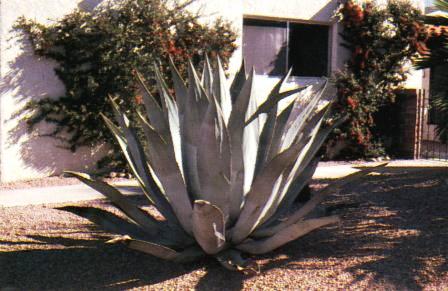
American agave
Water them with shallow irrigations, perhaps no more than a foot deep and don't do it very often. In Midsummer if you want to encourage growth water them every two to four weeks. If you want them to slow down, water them less often. Watch carefully for agave weevil attacking and killing primarily agaves and in particular American agave. I have posted information on their control in this blog. You can search for it by entering agave weevil in the search box.


Monday, March 5, 2012

Lilac Pruning and Selection for the Desert


Q. My daughter has just moved into a house that has old growth lilacs and we need to know how to prune them without causing too much stress on the plants.  Do you have any ideas?

A. By the way, Persian lilacs grow and bloom better here than the common lilac and are very showy. However, the lilac variety “Lavender Lady” requires less chilling and blooms very well here. These are not plants for rock landscapes but should be in the high water use zones and the soil should be amended well at planting and covered with organic mulch.
            For good-looking lilacs always start pruning at the bottom of the shrub. At the bottom, identify the two or three largest stems coming from the base. Remove them with clean cuts close to the ground. I can't see the shrub but several smaller stems should remain that supports flowering for next year.
            What you are trying to accomplish with many woody shrubs is to renew the shrub with new growth on a constant basis. You do this by removal of the largest stems close to the ground. This should cause smaller and newer growth to originate from the base keeping the shrub green, juvenile and full of flowers and leaves from top to bottom.

            Every couple of years, repeat this type of pruning; remove the largest stems at the base. If done correctly, this will keep the shrubs renewed and looking good. This is all you need to do unless you have some crossed or broken branches at the top that you need to remove.

            Don't forget to fertilize the with a good quality fertilizer made for woody plants. Fertilize plants whenever you take anything from them (pruning) or they give you something (flowering). So when you’re pruning or they bloom for you, you need to give back to them lightly in the form of a fertilizer. You can use fertilizer stakes. Put fertilizers close to the emitters or their source of water. Do this in late January through March and make light applications right after they finish blooming. I hope this helps.

Monday, January 30, 2012

Special Deal on Fruit Trees on My Twitter Causes Frustration - For Me!


Q. Your twitter feed mentioned a good deal on peach trees which we are going to now purchase. Which two peach trees to get for a 10 x 10 space? I'd like to keep the harvest staggered so we can enjoy the fruit longer. I also have a five-gallon Bonanza dwarf peach in a whiskey barrel that I started last October.

https://twitter.com/ or go to my home page and follow my Twitter there.
Stark Saturn peach with some bird damage. For some
reason birds LOVE this particular fruit.
Problem: SO DO WE!
A. This was a special deal on ten fruit trees for $199 plus $35 shipping on Groworganic.com. On the peaches that they had available, I would recommend that you look at Red Haven (yellow acidic), Babcock (white subacid) or Stark’s Saturn (donut, white, subacid, but birds like it alot). For an earlier peach, mid July or so, and Indian Free (late august, beautiful flesh turning nearly blood red and subacid) or O’Henry (early august, yellow, favorite at roadside stands and farmers markets) for a later peach.

            It is hard to recommend just one or two peaches since they can be so different from each other. There is not really a June peach in the group that I know well enough to recommend.

Monday, January 23, 2012

Planting Zones for Las Vegas Nevada

USDA hardiness zones

Q. What do you say is our planting zone?  I got a Plant Smart Sensor for Christmas and it says we are a 7B which is way lower than I always read.  Just because a website says a tree or plant will be ok for a certain zone doesn't mean it is necessarily right?
A. I use both the USDA and Sunset’s planting zones for our area. Because we have various microclimates in landscapes I will normally include a couple of climate zones colder for very exposed microclimates and a couple of climate zones hotter for protected areas with lots of exposure to sun in the winter time and wind protection. Start with winter time lows reaching 10F and add zones that are just at freezing (32F) to cover our microclimates in backyards. Yes, they will vary that much.
USDA Hardiness Zones
http://www.usna.usda.gov/Hardzone/hzm-sw1.html

            I like Sunset’s zones but find them a little bit too narrow at times and too restrictive. That is the reason Sunset went ahead in developing their own which they did a fabulous job doing. On the other hand, the USDA zones are too broad. Very little in this world is perfect so I use these fudge factors I mentioned to “fudge in” the microclimates.
Mojave Desert Las Vegas and Arizona
Mojave Desert Las Vegas and California

            Frequently, the selection of a plant and whether it will work or not, depends on several things: the microclimate, where you plant it in the yard, how you modify the soil and irrigate it.