Type your question here!

Sunday, March 13, 2016

After Agave Blooms It Will Die

Q. I bought this plant 4 years ago and was told it is an Octopus agave. I was advised it might take 40 to 50 years to bloom and afterwards the plant will die. The stalk coming from the center of the plant grew to about 12 feet in 2 weeks. I really do not know what I am looking at or what to do.

A. This is not Octopus agave. Compare it to pictures of Octopus agave on the Internet. Yes, that is a bloom spike. The plant will die after it flowers.
The mother plant should have small offsets or pups at the base of the plant prior to blooming. You may not see them until after the mother plant dies and is removed. These pups can be replanted in new locations or given away to friends.
Pups growing at the base of American agave.

When planting agaves and cacti, amend the soil with compost at the time of planting and mixed with the backfill around the roots. They will grow better.
Be careful how frequently the plant is watered. Do not water them more often than every three weeks but give them 5 to 10 gallons when you do.


Agaves look better when they are either planted in groupings of three or five with enough distance between them so they can spread out or planted singularly as a focal point in the landscape.

When planting in groups, use odd numbers of plants and plant them at different distances apart to make them more appealing to the eye.

Plant Irish Potatoes Now

Q. Do Red Pontiac potatoes grow in Las Vegas? When should I plant them?

A. Red Pontiac potato is an excellent variety for Southern Nevada and Irish potatoes should be planted now. It is best to purchase certified potato seed (potato seed are potatoes cut up into pieces that have “scabbed” over or healed slightly) for planting. 

Many gardeners buy potatoes out of the grocery store, cut them into their own pieces and plant them. It can be done but the problems faced are virus diseases in the tubers because they are not certified and buying potatoes treated with chemical sprout inhibitors. Sprout inhibitors cause them to be really slow in sprouting after planting.

Potatoes growing with drip irrigation


Cutting a potato into seed pieces is quite easy. On smaller potato tubers, cut them into equal sized quarter pieces, let the cuts heal at room temperature for 24 hours and then plant them. Large potato tubers are cut into six pieces. Each piece should contain an at least one "eye" and plenty of flesh around it. 
Potatoes growing in North Las Vegas Nevada
Plant them directly into the prepared garden soil or put "seeds" into a shallow flat that drains easily and cover them with soil. Watering them in a flat at warm temperatures causes them to "sprout" in a few days. Once they have sprouted, carefully plant them in the garden about three or 4 inches deep and 12 inches apart in rows. Be careful not to knock off the sprouts from the pieces when you're planting. 

In large gardens rows are about 3 feet apart. In raised beds you can squeeze potatoes in rows closer than this but alternate them in the rows so they have more room to grow. Once the potatoes are about 12 inches above the soil cover the potato plants with loose soil so that only a couple of inches see light. 
Potato tuber growing on short rhizomes from mother potato plant
Potato tubers form on short rhizomes growing from the stems that are buried in soil. As the potatoes plants grow more, cover the stems with more soil about every three weeks. Feed them with nitrogen fertilizer lightly about every four weeks. Do not let them stress from a lack of water until you are ready to harvest. 

If you plant now, they should be ready to harvest in about July. Cut back on the water at this time so that the skins of the potato begin to heal. There are plenty of other varieties to try including Yukon Gold, Russets, blue potatoes and fingerlings.

Tuesday, March 8, 2016

Not Too Late to Apply Dormant Oil

Not Too Late to Apply Oil: It used to be called dormant oil. Everyone thought the only time you could apply it was the winter. Now it's called horticultural oil b...

Protect Nectarine Fruit from Scarring

Protect Nectarine Fruit from Scarring: Do you want fruit from your nectarine tree that looks like this? Western flower thrips and damage to nectarine I didn't think so....

Viragrow Delivers!

Sunday, March 6, 2016

Loss of Bark on Ornamental Plum Due To Borers

Q. I have a flowering plum which I first noticed this morning has a problem with loss of bark on the west side of the trunk. My yard faces south. What should I do?
Borer damage to ornamental plum on the west side of the trunk

A. This is borer damage to the trunk. You can read more about this insect and the type of damage it does to ornamental and fruit trees and how to correct it from the links below.

Your picture was extremely helpful but the other thing that keyed be in was that you said it was on the west side of the trunk. This is the side of the trunk getting very hot in the late afternoon. Heating up on this side from the sun leads to sun damage. Sun damage to the trunk attracts boring insects. They like to lay their eggs on these kinds of damaged sites.
Concentrated form for commercial applicators and professionals
Since you are not eating the fruit of this tree you can apply a liquid soil drench insecticide. This product comes in several trade names so I cannot list them all but the key chemical ingredient is Imidacloprid. This will be listed in the active ingredients.
Homeowner version found in many nurseries and garden centers
Follow the label directions and apply it after it finishes blooming.  Otherwise take a clean knife and clean up the damaged area and let it heal as explained in the posts on my blog below.

Stopping or Suppressing Flowering and Fruiting of Ornamentals

Q. Is there anything to stop or suppress flowering of a Palo Verde tree? My wife is allergic to the pollen and unless I can mitigate its effects, I guess it's gone. 

A. You are hitting on a very important topic as we convert our landscapes into water conserving desert landscapes. Before the conversion of landscapes from traditional to desert landscapes, the three biggest problem trees for allergy sufferers were mulberry, pine and olive.
Olive flowers just before they begin to open
Female mulberries produce only fruit. Male mulberries produce only pollen. Years ago fruitless (male) mulberry was planted because it was a great shade tree for the desert, water for landscapes was abundant and the male tree produced only pollen. Female mulberry trees made a mess on cars and sidewalks and birds who ate the fruit dropped it everywhere.
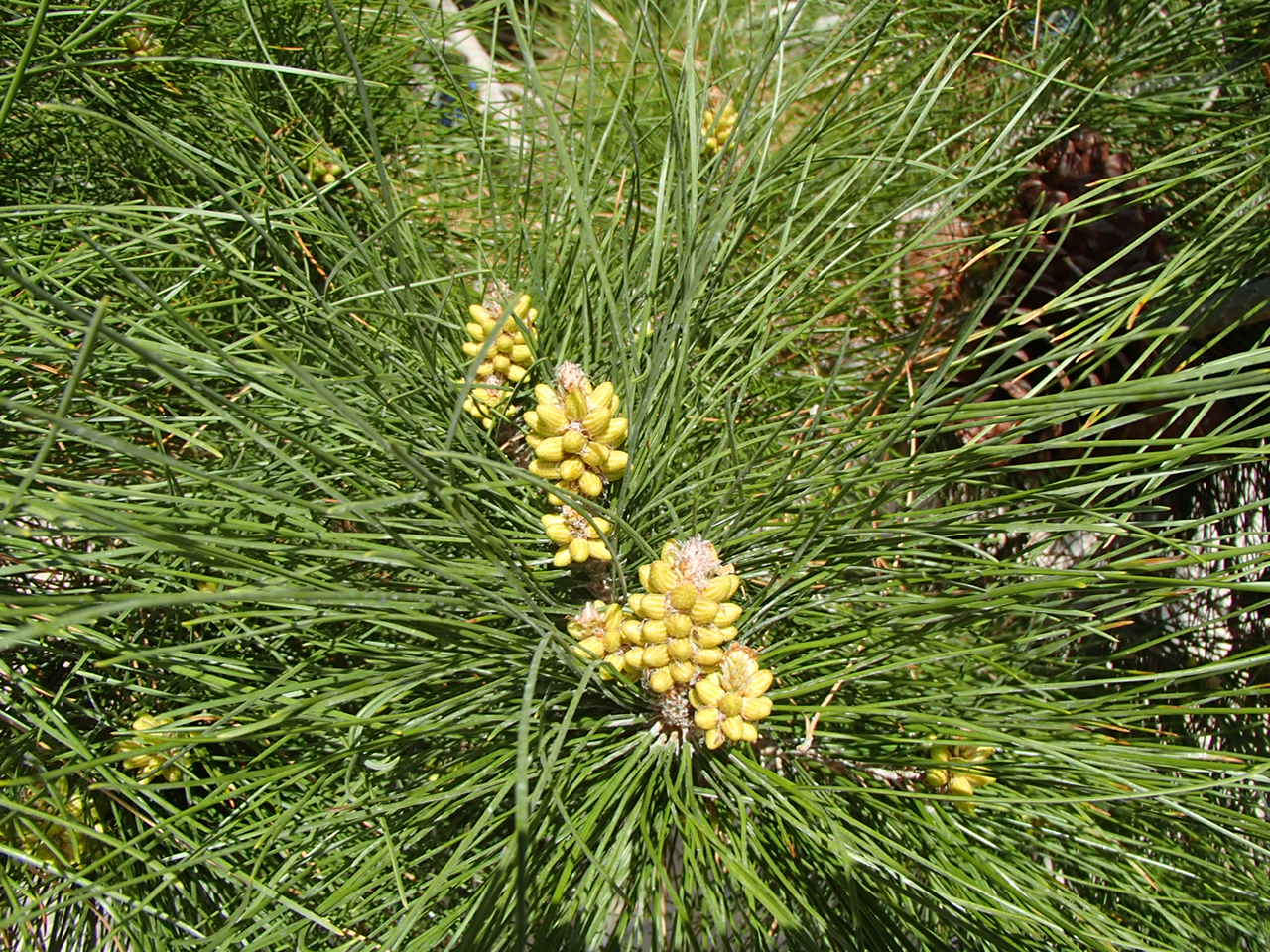
Pine getting ready to release pollen from the male flowers
Pine trees and olives were different. They also produced allergenic pollen but pollen and fruit were produced on the same tree; male and female trees were not separate from each other. Fruitless (and flowerless) olive was discovered, promoted and adopted as the only olive tree which could be planted in major urban centers like Las Vegas because it produced no flowers and hence no pollen.
Mulberry flowers getting ready to release pollen
Palo Verde produces allergenic pollen on flowers that are both male and female in the same flower. Comparing them to the above 3 trees, they are more similar to olive than pine or mulberry. There are no flowerless Palo Verde, unlike the olive.
Olive fruit can sometimes be prevented by spraying the tree with a product like Florel Fruit Eliminator. (contains ethephon). This product also controls the fruiting of several ornamental plants (and sometimes the flowers) when applied just before bloom. Depending on your Palo Verde, flowering will probably be in April or May in our Las Vegas climate. You can read the label below


I hesitate to recommend this product because if it is applied at the wrong dose it can cause leaf drop or possibly damage the tree. There is a recommended rate for several ornamental trees including olive but Palo Verde is not listed on the label. Use it at your own risk but if you are thinking about removing the tree anyway it might be worth a shot. I am not sure who sells it in Las Vegas but you cannot purchase it online.

Thin Peaches and Nectarines

Peach fruit too close together
Thinning, or the removal of fruit by hand, is an important step in growing larger and higher-quality peaches and nectarines. Enough fruit is removed from the tree so that the remaining fruit gets larger. We typically target this fruit to reach the size of 3 to 4 inches in diameter.
Peach fruit before thinning
Peach fruit after thinning
I like to relate this concept to something we can all appreciate; money. If you have an income that does not get any bigger and you have a family, the larger the income the more money you can spend on each individual in the family. If you have a dozen children then each of the children will receive less. If you have 3 children, then you can afford to spend more on each of those 3 children.
Peach fruit before thinning

Is the same with the fruit tree. The income for the tree is the sunlight, water and nutrients taken from the soil. A tree that is 10 feet tall can only gather a certain amount of light, water and nutrients from the soil. If the tree has 1000 fruit on it, the fruit may be the size of a coin. But if the fruit is thinned so that only 200 fruit remain, then the fruit might be the size of a small ball. Thinning of fruit is important to increase the size of the remaining fruit.
Peach fruit after thinning
Remove enough peach and apricot fruit so that the remaining fruit is 4 inches apart. As you are thinning or removing the fruit, remove fruit that is damaged or deformed 1st. Favor fruit that hangs from the bottom of the branch rather than the top of the branch. It is harder for birds to pack fruit on the bottom of the branch than the top of the branch.

Problems When Planting Tomatoes, Peppers and Eggplant

Two  Major Problems When Planting in Desert Garden Soils

The first problem regards the organic content of the soil. When growing many vegetables, they perform better with improved soil aeration around the roots. This is not necessarily true of root crops such as carrots or onions but is more important for tomatoes, eggplant, peppers and the like.

To improve soil aeration add a 1 inch layer of compost and dig or till it in each growing season. If you use compost make sure you pay attention to the carbon to nitrogen ratio (C:N) of that compost. The lower the carbon to nitrogen ratio, the more nitrogen is added to that garden soil. If the carbon to nitrogen ratio is 20:1 or lower, you may not need to add any nitrogen fertilizer for 1 to 2 months after transplanting. Adding a rich compost with a low carbon to nitrogen ratio and then adding a high nitrogen fertilizer at the same time may result in very bushy plants with no flowers until the nitrogen begins to run out.

The second problem involves water. Garden soils and soils in raised beds have additional compost added to them prior to planting. Frequently compost and soil mixes blended in desert environments are high in salts. These are not the bad salts but they are good salts in high enough concentration where they might damage plants if soils remain dry at the time of planting. This is usually not true in wetter environments with higher humidity.

Be sure to keep garden soils wet at the time of planting and immediately water the soil around transplants to remove air pockets and dilute any salts that may be present.

Do the same thing when planting from seed. Make sure the soils does not dry between irrigations until you begin to see strong growth from the seeds. Seedlings of many plants are less tolerant to salts, whether they are good salts are bad salts, than the mature form of the same plant.

Mulberry Allergies and Its Elimination

Sneezing? Eyes watering? Headaches? Mulberries are in bloom and have been this past week. If you do not own a mulberry there is not much you can do.However, if you do own a mulberry you can understand where these allergies are coming from and perhaps do something about them other than spraying.
Mulberries produce flowers categorized as catkins. Male and female flowers grow from  respective male and female trees.
Many fruit trees that grow in climates that have seasons (temperate fruit crops) produce their flowers and fruit either on the wood that grew last year (grapes, peaches), or the wood that grows this year (pomegranate) or both years (figs).

Mulberry is a fruit tree. It is slightly different from many of the fruit trees that we know because the tree which produces fruit is a female only. All girl. The tree that produces pollen that pollinates and fertilizes the female flower is a male tree. All boy. Wind is responsible for carrying the pollen from the flowers of a male tree to the flowers of a female tree. Mulberries are either male trees or female trees but male and female flowers are not found on the same tree.

Male mulberry tree ready to flower and release pollen from wood that grew last year.
Female trees are no longer planted much in cities because female trees produce fruit that stain cars, sidewalks, patios and attract birds which love the fruit and poop the same mess.When mulberry is outlawed in a community because of allergies, it is the male mulberry tree that is banned, not the female.
Mulberries pruned so that all of last year's wood has been removed. The primary areas where new growth occurs are at the ends of the major branches.Yes, this is an acceptable pruning practice and not considered "topping" which is unacceptable.

Mulberry flowers or catkins are produced very early in the spring on branches or wood that was produced last year. They are not produced on wood during the current season. If wood that was produced last year on a male tree is removed each year, there would be no male flowers and no pollen.

There is an old pruning technique seldom used anymore called pollarding. Pollinating is a very specialized pruning technique usually established on trees when they are very young. Branches or arms radiate from the trunk. New growth is concentrated at the ends of these arms and is removed every year.

Read a great article published in Australia about pollarding.

Read a more detailed discussion about pollarding

Pollarding can be used on several types of trees to keep them from growing into power lines, allow for more light into the landscape during winter months, conserve water and reduce or eliminate either pollen or fruit by some landscape trees.

I believe pollarding should be an acceptable and encouraged practice of pruning mulberry trees to reduce allergies, save water and beautify our landscapes.

Use Limb Spreaders on Fruit Trees Now to Increase Production

If you have been to any of my pruning workshops you will know the best production from fruit trees comes from branches growing at 45° angles from horizontal. Several fruit trees such as pears and plums tend to grow more upright than this. Frequently their limbs may be at 60° angles from horizontal.
Upright growth of plum in bloom
Limbs that grow more upright than 45° tend not to flower and fruit as much as limbs growing at lower angles. Limbs growing at angles lower than 45° tend not to grow rapidly but will flower and fruit more readily. Bending branches so that they receive more light and grow at 45° angles will improve fruit production of most fruit trees.
Limb spreaders on peach. Spreading the limbs apart to a 45° angle permits more light to penetrate inside the canopy and improves fruit production in the interior of the tree.
To spread limbs that are less than 3 years old to the correct angle use limb spreaders or string to pull them down to the proper angle. Limbs that are older than this will not bend easily and probably will break. On these younger branches the best time to bend them is when their bark is slipping as they are beginning their growth cycle. That time is now, March, and for the next month or so.
Limb spreaders on a young apple tree.
You can make limb spreaders for older trees with 1x2 inch wood notched at both ends. Make some that are 8 inches, 10 inches, 12 inches and longer for different situations. On very young trees some people have used popsicle sticks, tongue depressors, paint stirring sticks, etc. Some people will put a finishing nail in the crotch of this notch to prevent the limbs spreader from slipping. Other people will use string to tie weights to the branches or stake the string to the ground to hold the branch at a 45° angle.

Now is also a good time to bend branches in a different direction. If you have an empty spot in the canopy of the tree explore the possibility of bending a branch to fill this void. Now is the time to do it.
Finishing nail driven into the crotch of a limb spreader. The head of the nail is removed
You can purchase limb spreaders as well.These will come in various lengths but I think you will have to buy them online.


Avocados for the Cold Desert?

Q. I have read that Mexicola avocados are ok in as low as 15 degrees once established. Am I wasting my time trying? Or do I need to grow it in a pot until a certain size so I can bring it inside? Love avocados but don't want to buy something just for it to die.

A. Avocados are a real gamble in the Las Vegas area. If you look around town you don’t see too many which is a good indicator they don’t survive here very well. But you are right. If you are going to try one, it would probably be a Mexican race of avocado such as Mexicola, and planted in a protected location.
A few of the avocado varieties
            The problem is its size. You could keep it pruned below 20 feet which will help keep it from freezing if planted in a warm microclimate and protected from cold winter wind. The other problem is pollination. There is a good chance you will not need a second tree for pollination to produce fruit but you may produce more fruit with a compatible tree for pollination.
            Another option is to plant a dwarf avocado such as Little Cado, a hybrid between Mexican and Guatemalan races. This dwarf avocado can handle temperatures down to about 25° F, similar to many citrus growing in Las Vegas planted in warm microclimates.

Read more about the 3 races of avocado published by the University of California Riverside

Farmer Photinia versus Fraser's Photinia

Q. Is there a difference between the red tip Photinia and one I saw called Farmer Photinia?
Fraser's Photinia or Red Tip Photinia demonstrating its name in the spring as new growth emerges.

A. I have never heard of Farmer Photinia. Maybe you mean Fraser's photinia or Photinia fraseri. Red Tip photinia and Fraser’s photinia are the same plant.
Red Tip Photinia
            Most of the Photinia available to us originally come from south to east Asia including China and Japan. There are 2 other Photinia we can sometimes find locally called Chinese Photinia and Japanese Photinia. But Fraser’s Photinia, or Red Tip Photinia, dominates our landscapes in Las Vegas.
Red Tip Photinia trying to survive in rock mulch
            Remember that these plants do not like rock mulch and frequently turn yellow and scorch in 4 to 5 years after they have been planted. Most of this is because the soil has become mineralized and the organic matter, or compost, applied at the time of planting has disappeared over time.

Bird Damage to Citrus Flowers and Immature Fruit?

Q. I have a lemon and a lime tree in my yard. For several years now they have only produced one lemon and one lime. I was told that the birds are probably eating the blossoms but I never see any signs of birds in the yard. Can birds be the cause for only one lemon and one lime in two years?

A. I have heard that before from some people who have citrus but I have never seen it. I think it is anecdotal. Some flowers are sweet and if there is nothing else available perhaps they might but not when other food is plentiful. Different citrus flower and fruit at different times of the year.
The reports I have seen point mostly at sparrows or finches as the culprits. To be sure, you would have to catch them in the act. The only solution I know is bird netting or giving them a chance to eat food they would prefer.
The usual problem with lack of production is freezing weather soon after or during bloom. Even before bloom. Flowers, flower buds and young fruit cannot withstand temperatures below freezing while the tree may not have any damage at temperatures slightly below freezing (lime) or to the low 20's (most lemons).

Another possibility is irregular watering, particularly in the spring and summer months when plants require more frequent watering. Increase the times you water during the April and May months. Use a surface mulch on the soil around the tree to retain moisture around the roots.

Fig Tree Would Produce Figs with More Water

Q. In the small orchard in back of Tule Springs, Nevada, at Floyd Lamb State Park is a huge Turkey Fig that will not produce fruit, only hard little knots. Each tree only has one watering head. Wish you had some pull out there so they could get some major water on that large fig. It tries to produce hundreds of figs each season but they dry out due to lack of water. Thank you so much.


A. Sorry. I don't have any pull there. You are exactly right. there is enough water for the tree but not enough for production of juicy figs. Maybe someone will read this and do something about it. Or maybe they don't want it to produce figs. If they correct the watering problem and no one harvests the figs from that tree at least the birds will have something to eat.

Friday, March 4, 2016

Xtremehorticulture Blog Hits Near 30,000

My blog, Xtremehorticulture of the Desert, is approaching 30,000 hits per month. Judging from the number of hits this time last year, my blog should exceed 30,000 hits in the next one to two months.

Even though my blog has a focus on the Mojave Desert, these hits are coming from all over the world. Remember, these posts are focused on Desert Horticulture at 36,12 degrees north latitude at an elevation of 2,000 ft (610 meters) and should be adjusted accordingly for different locations.Pest and disease problems vary with locations as well.

I do not sell anything here (okay, maybe my coffee donation to help keep me awake when I get up early to do some posting. I like good coffee.). I will continue to recommend based upon my experience with products. I appeal to readers. If you have experiences to share please Comment at the bottom of the post. I review each Comment and if it is just a marketing effort then I reject it. If it adds something to the discussion, I will post your comment.

Monday, February 29, 2016

Growing Cherries Can Be a Problem in the Hot Desert

Q. From my Googling, it sounds like if I want cherries in this climate a good strain is royal Lee with Minnie Royal as a pollinator tree.  Do you know if they will grow and fruit well here?

A. Cherries produce erratically in the Las Vegas Valley. In some locations cherries produce abundantly and in other locations they produce almost nothing.
For instance, at the University Orchard in North Las Vegas we produced about 15 cherries in 15 years from 17 different varieties of trees. Virtually nothing. They flowered every year abundantly, there were no freezing temperatures after flowering that would eliminate fruit but the fruit failed to mature. In other words, the fruit failed to set.
However, some people in backyard locations here have produced cherries abundantly every year. Reports to me by homeowners are anecdotal but varieties that produced here include Bing, Lambert and a few others known to have a high chilling requirement.
In the Las Vegas Valley we don’t have enough cold winter weather to satisfy fruit trees with a high chilling requirement. Picking fruit trees with the proper chilling requirement for a certain climate is thought to be a cornerstone of good fruit production.
A chilling requirement is the amount of cold temperatures fruit trees should sustain during the winter in order to flower and produce a normal crop of fruit. Most research supports the concept that all fruit trees must satisfy their chilling requirement in order to produce fruit abundantly.
My observations at the University Orchard in North Las Vegas don’t agree with this universal concept 100%. When I interview homeowners about their abundant cherry crop and the location of their trees, one common theme seems to appear; cherry trees that produce fruit abundantly are located in areas where there is higher humidity such as near a lawn area or a swimming pool. Higher humidity may also play an important role for a good crop of Hachiya persimmons.

In my opinion the location of the cherry tree is more important than selecting a variety. My recommendation would be to locate cherry trees near a lawn area or swimming pool to improve your chances of having a good crop. Otherwise it’s a crap shoot regarding cherries regardless of the variety.

Is Bark Peeling on Mesquite Some Sort of Problem?

Q. I have a six-year-old, multi-trunked mesquite tree with bark that is beginning to peel from the trunk. It started last fall and is getting worse. Otherwise it is a beautiful tree and appears to be healthy but I am concerned I may be losing it. Any suggestions?


A. There are several different kinds of mesquite trees and it is normal among some of these for the bark to peel from the trunk as they get older. In some mesquite trees it is quite distinctive. It would be helpful if you knew which particular mesquite you have so we could determine if this is true of your tree.


However, peeling bark can also indicate a dead area developing underneath this area. You will not hurt any tree by peeling this bark back and looking more closely at the trunk. Inspect the trunk under the bark for possible damage and sap oozing from that location.
It is possible if the tree is watered too often that damage can occur to the trunk or limbs. Frequently damage from overwatering can also cause sap to ooze from the trunk or limbs. This damaged area of the trunk can lead to bark peeling.

If you peel off the bark and you don’t see damage underneath it, then assume it is natural for this tree at this age to have peeling bark and don't be concerned about it.

Is My Apple Tree Diseased?

Q. My apple tree has several different things going on with it and I’m wondering if it is suffering from some sort of disease. Other than that, the tree appears to be growing normally.

A. Let's cover these pictures one at a time.

First picture. The tree was damaged on the trunk but it is mending. You can see how the bark is beginning to roll back from that damage. It looks like the trunk was damaged either by sunburn or possibly borers. The damage stopped, the bark peeled away from the trunk leaving the dead interior exposed. Now the living part of the tree is growing over the top of the dead interior wood. The center of the trunk in all apple trees is dead. The only living part of the trunk is the outside cylinder that continues to expand year after year. This is nothing to worry about. Just keep the tree in good health and it will heal completely.

Second picture.  This is either some borer (insect) damage or a disease called crown gall. The only way to find out is to take a sharp, sanitized knife and dig down and see what's going on. If this is insect/borer damage then the bark will peel away easily and you will see evidence of this kind of damage under loose bark. You can go to my blog and search using the word “borer” and several postings will come up with pictures showing you what borer damage looks like when the bark is

removed. If this is borer damage, then remove all of the loose bark and allow the tree to mend itself in the same way it did in the previous picture. If this is crown gall it is not a serious problem. Don't cut it out or worry about it. It will not be a big problem for the tree in the future. It just looks ugly and it will get larger over time.

Third picture. This does look more like crown gall. It does not look like borer damage because it is on the underside of the limb. Borer damage usually occurs on the upper surface of a limb or on the side of limbs facing West. Very seldom do we see borer damage on the underside. Take a sharp, sanitized knife and see if any of that bark is loose and can be removed for closer inspection. If not, leave it alone and it will not be a big problem in the future.

Fourth picture. This looks like sun damage in the crotch of a limb. It is also possible there are borers in that spot causing some damage. Take a sharp, clean knife and remove any dead bark down to the wood. Allow the tree to heal over that area.


Borer Damage to Fruit Trees Best Corrected Now

Q. I have a peach tree planted in 1998 with the bark lifting from the trunk easily. My gardener doesn't know what this is or how to treat it. Can this tree be saved?


A. This is borer damage to your peach tree and is the usual reason for their death at an early age. The damage is done by an immature stage of a beetle. Some people called them "worms" but they are properly called larvae.
The adult female beetle flies looking for a mate during the spring and summer months. Once she mates than she lays eggs on many different kinds of trees including fruit and many landscape trees and shrubs.
It appears she is attracted to trees damaged by a lack of water or intense sunlight on the limbs. Reducing damage to the tree because of intense sunlight is thought reduce damage by boring insects.

This is done by “whitewashing” limbs, particularly on the upper surface, with a mixture of white latex paint and water in a 50/50 mix.

Whitewashing these limbs reduce, but do not eliminate , damage created by intense sunlight. If you look closely you will see most of the damage is either on the upper surfaces of these limbs or on the sides of limbs that are facing south or west. These directions are where the most intense sunlight comes from.

When pruning peach trees in particular, which seem to be very susceptible, try not to prune so much out of the tree that it lacks the shade needed to protect the limbs from intense sunlight. Here are a couple of postings on my blog.

Trees that get borers sometimes go into a death spiral; borers continued to attack these limbs or more limbs, limbs die and open the canopy for more intense sunlight which causes more damage which attracts more borers.

There are no safe insecticides or chemicals that you can apply to these trees to cure the problem. The best approach I have found is removing the damage from the trees with a very sharp knife and let the tree heal on its own.

Pruning Oleander into a Multi-Trunked Tree

Q. I have two, 7 foot tall oleander bushes about 8 feet apart. Can I turn them into trees by cutting all the branches to the ground except for the largest, fattest branch in the middle? I know the suckers will be a problem for a while. Also, is it safe to grow a small vegetable or herb garden between them? Is oleander flower and leaf mulch safe around the edible garden?
                    
A. Yes, you have the right idea. Oleanders can make very nice small trees but the suckers at the base will be a problem for several years.
Oleander pruned to a multi-trunked tree and in bloom.
They can be made into a single trunk or a multi-trunked tree. Multi-trunk trees are easier to manage. Select 5 to 7 stems, or branches as you call them, coming from the base and going in different directions. Odd numbers of branches are more pleasing to the eye than an even number. Those are the stems you will keep. They should be large and vigorous.
Oleander suckering from the base when pruned as a multi-trunked tree.
Remove all other stems as close to the ground as possible. A reciprocating saw with a pruning blade is an easy way to remove them than a saw or loppers. Remove side branches from the stems up to a height that looks good to you. The trunks should be cleaned of side branches. Make sure you cut these side branches as close to the trunk as possible. Clean the trunks anywhere from 2 feet up to about 4 feet.
New stems will sucker from the base throughout the growing season for several years. This is because oleander wants to be a shrub. You are forcing it to be a tree so it will try to revert back to a shrub.
As soon as suckers emerge from the base, remove them by pulling rather than cutting. If you pull them when they are very new they are easy to remove. Removal by pulling causes fewer suckers in the future than cutting them.
Oleanders are poisonous but research from California demonstrated that leaves and stems can be composted and returned to the soil without problems for other plants including vegetables. 

Monday, February 22, 2016

Beneficial Nematodes and Diatomaceous Earth

Q. Will the diatomaceous earth I have used in my garden and around fruit trees kill beneficial nematodes?

A. Diatomaceous earth has the same effect on beneficial nematodes as any other nematode. I don’t know of any solid research that shows diatomaceous earth will reduce nematode populations. You might be wasting your money.
When nematodes are damaging plants, most recommendations are to mix compost into the soils to reduce nematodes populations and encourage more rapid growth. Some fruit trees such as stone fruits are grown on rootstocks, such as Nemaguard©, that are somewhat resistant to nematodes.

Some sources will tell you to grow varieties of vegetables resistant to nematodes, reduce nematode populations periodically using a technique called “soil solarization” or abandon the spot. I wish they were easy to control but they are not.

Figs Producing No Fruit

Q. My fig tree produced almost no fruit and no new growth last year.  The leaves looked burned on their perimeter. Any recommendations?

A. This sounds like a water issue; not enough water applied or not watering often enough or both. Water and nitrogen fertilizer is what pushes new growth. They work together.
Fig trees could be considered desert adapted plants (Mediterranean actually). Lack of enough water is a common problem when growing figs here. I see this a lot with figs grown using drip irrigation.
Figs grown in Las Vegas raady for the Farmers Market
The amount of water depends on the size of the plant. Generally, productive figs that have been pruned correctly will require about 30 gallons of water once a week at this time of year. This amount will be applied twice a week around May 1 or when temperatures approach 100F.
Cover the soil with wood chips to a depth of 3 to 4 inches (minimum) and extend it to a distance of at least 3 feet in all directions from the trunk. This will help reduce fruit drop.
If the tree is irrigated with drip irrigation, increase the number of emitters or increase the number of minutes, until you approach the volume of water I am recommending.
Kadota figs grown in Las Vegas
Flood the area under the tree with water from a hose now and capture this water in a 6 foot diameter basin or moat around the tree. This should help flush any possible salts that may have accumulated in the watered area and get the tree off to a good start.

Rock mulch is not a good idea for figs. There is no reason why you cannot have a bountiful crop with nearly any variety of fig in this climate. They all do well here when they are managed correctly.

Clover-Like Weed Not Clover, Difficult to Control

Q. I have reddish, clover-looking weeds that have taken over my lawn.  Last year they nearly covered it.  I tried weed and feed several times but that didn't seem to get rid of them.  A friend of mine had the same problem and had to remove all of their grass and re-sod their lawn. They bought their own lawnmower made their landscaper use it because they said the lawnmowers that landscapers use can spread this clover everywhere.
Readers picture of "clover"

A. the picture you sent to me appears to be oxalis and not clover. Oxalis has a yellow flower. Clovers usually have white, pink or reddish flowers. They both have clover-like leaves.
            Oxalis is extremely difficult to control once it gets established. We see them growing in flowerbeds and shrub beds as well as lawns. In beds, it is usually brought in with the plant material as a weed contaminant in the container. But it also can be brought in on lawnmowers.
Oxalis
Focus on weed killers for lawns that include the weed “oxalis” on the label rather than clover. If you are not sure, give me the name of the product in an email and I can help you from there.
Control it now or in the fall, not during summer heat. If there were not too many, you could consider digging out the contaminated lawn areas to a depth of about 6 inches and replace it with sod.
In your case it sounds like it’s covering the entire lawn. There are many different lawn weed killers labeled for controlling dandelions. They contain several weed killers in different combinations to control a different array of weeds. Look at “dandelion” weed killers but make sure the label includes controlling oxalis. Use a product that is sprayed rather than a dry granular applied to the lawn.

Related links to this post

Unknown Tree With Branch Dieback Not Ash

Q. I have a tree that appears to be dying but I don’t know what it is. I was reading your article about the disease on ash trees and tried to access the pictures of ash trees but couldn't find them. I believe the tree is about 15 years old.

Readers tree
A. Thank you for sending me pictures of your tree. I can tell you it is definitely not an ash tree. It was difficult to identify from the pictures but from the close-up of the leaves I think it is Japanese privet, sometimes called wax leaf privet.
This is a tree or sometimes grown as a shrub commonly planted in southern Nevada. If this is wax leaf privet you should see clusters of white flowers followed by black berries about the size of blueberries in the same clusters.
Privet with leaf drop and twiggy dieback due to irrigation
They frequently have the same problem here which is dieback of small branches which makes them look very “twiggy”.  I posted a picture of this plant growing in southern Nevada on my blog that shows this branch dieback and leaf drop I am talking about.
This plant doesn’t like our desert environment or drip irrigation very much. It definitely does not like rock mulch. They prefer growing in a much lusher environment.
The only time I really see them looking good is when they're surrounded by a lawn that receives a lot of water. You might try putting bedding plants that require watering water every couple of days and surround the tree with wood mulch or a very lush lawn.

They do great in East Texas all the way back to the Carolinas but do not look all that well in landscapes located in the dry or desert West.

See these links in this blog

Myrtle Good Choice for Desert Landscapes


Viragrow Delivers! : Add Phosphorus After Compost and Before Planting

Add Phosphorus After Compost and Before Planting: Renew Growth in Garden Plots Triple super phosphate is a conventional granular fertilizer  15lb @ $18.20 You purchased a good qualit...

Viragrow Delivers! : Growing Raspberries, Blueberries, Bananas, Papaya,...

Growing Raspberries, Blueberries, Bananas, Papaya,...: Q. What soil and mix do you recommend for berry bushes like raspberries, blueberries and so forth. I am also planting some oranges and exo...

Viragrow Delivers! : Water Soluble Sulfur Lowers Soil pH Fast

Water Soluble Sulfur Lowers Soil pH Fast: Sulfur granules remaining on top of the soil three years after applying it to the soil surface. This is a ma...

Viragrow Delivers! : Harvesting Caulifower Now at Viragrow

Harvesting Cauliflower Now at Viragrow: It is getting too late to plant broccoli and cauliflower because our hot weather is approaching fast and these are cool season vegetables, ...

Viragrow Delivers!