Type your question here!

Sunday, April 9, 2017

Droplets on Plants May Be Guttation

Q. I have never seen this on a plant before and I have never had a problem with pests on this plant.  What am I dealing with here? 


A. Great pictures, that helps a lot. I am going to take an educated guess that this is water being released from small openings on the leaf edges called hydathodes. The release of excess water from inside the plant is called guttation. You can read more about hydathodes here.


What is gutational water?

These can be very complicated explanations and I don't know about your background and whether they will confuse you or if you understand them. Basically, small plants can push a lot of water inside of them through a mechanism called root pressure. Root pressure takes water from the surrounding soil, if there's plenty of it, and push it inside the plant. Sometimes the root pressure can be so great that the plant needs to release some of this excess water. Many plants have specialized openings on the leaf edges called hydathodes that allow it to do this. Technically, the process of taking excess water inside the plant and releasing it through hydathoes is called guttation.

Back in the day….

Golf course superintendents are very familiar with this but may not know the correct scientific terms. Years ago golf course superintendents would go to the putting greens early in the morning and "whip the greens" with a long bamboo pole. It was found when plants are growing very close together in places like golf course greens that this excess water, guttational water, could encourage diseases if it was not removed from the leaf blades. They used to call it dew but the main problem was from guttational water full of plant sugars and a good "food" for plant diseases.Whipping the greens with a bamboo pole knocked the water off of the blades of grass and reduced the possibility of disease. Very few whip the greens anymore but instead they use a short irrigation cycle to wash off the leaves of guttational water (which is high in plant sugars and disease prone) and replaces it with irrigation water which has no sugars in it.

So what does this have to do with you? 

If this is guttational water it simply tells you that the soil is full of water. Little leaf Cordia is a desert adapted species and does not have to be irrigated frequently. It tells you that the soil around these plant roots is full of water and you may or may not be watering too much if you see this water present frequently. Make sure that you give the plants a "rest period" without water before the next irrigation. Other than that, nothing to worry about.

Saturday, April 1, 2017

Non Organic Substances Permitted by USDA for Organic Livestock Production

https://www.federalregister.gov/documents/2017/03/21/2017-05480/national-organic-program-usda-organic-regulations

§ 205.603 Synthetic substances allowed for use in organic livestock production.
In accordance with restrictions specified in this section the following synthetic substances may be used in organic livestock production:
(a)As disinfectants, sanitizer, and medical treatments as applicable.
(1)Alcohols.
(i)Ethanol-disinfectant and sanitizer only, prohibited as a feed additive.
(ii)Isopropanol-disinfectant only.
(2)Aspirin-approved for health care use to reduce inflammation.
(3)Atropine (CAS #—51-55-8)—federal law restricts this drug to use by or on the lawful written or oral order of a licensed veterinarian, in full compliance with the AMDUCA and 21 CFR part 530 of the Food and Drug Administration regulations. Also, for use under 7 CFR part 205, the NOP requires: (i) Use by or on the lawful written order of a licensed veterinarian; and (ii) A meat withdrawal period of at least 56 days after administering to livestock intended for slaughter; and a milk discard period of at least 12 days after administering to dairy animals.
(4)Biologics—Vaccines.
(5)Butorphanol (CAS #—42408-82-2)—federal law restricts this drug to use by or on the lawful written or oral order of a licensed veterinarian, in full compliance with the AMDUCA and 21 CFR part 530 of the Food and Drug Administration regulations. Also, for use under 7 CFR part 205, the NOP requires: (i) Use by or on the lawful written order of a licensed veterinarian; and (ii) A meat withdrawal period of at least 42 days after administering to livestock intended for slaughter; and a milk discard period of at least 8 days after administering to dairy animals.
(6)Chlorhexidine—Allowed for surgical procedures conducted by a veterinarian. Allowed for use as a teat dip when alternative germicidal agents and/or physical barriers have lost their effectiveness.
(7)Chlorine materials—disinfecting and sanitizing facilities and equipment. Residual chlorine levels in the water shall not exceed the maximum residual disinfectant limit under the Safe Drinking Water Act.
(i)Calcium hypochlorite.
(ii)Chlorine dioxide.
(iii)Sodium hypochlorite.
(8)Electrolytes—without antibiotics.
(9)Flunixin (CAS #—38677-85-9)—in accordance with approved labeling; except that for use under 7 CFR part 205, the NOP requires a withdrawal period of at least two-times that required by the FDA.
(11)Glucose.
(12)Glycerin—Allowed as a livestock teat dip, must be produced through the hydrolysis of fats or oils.
(13)Hydrogen peroxide.
(14)Iodine.
(15)Magnesium hydroxide (CAS #—1309-42-8)—federal law restricts this drug to use by or on the lawful written or oral order of a licensed veterinarian, in full compliance with the AMDUCA and 21 CFR part 530 of the Food and Drug Administration regulations. Also, for use under 7 CFR part 205, the NOP requires use by or on the lawful written order of a licensed veterinarian.
(16)Magnesium sulfate.
(17)Oxytocin—use in postparturition therapeutic applications.
(18)Parasiticides—Prohibited in slaughter stock, allowed in emergency treatment for dairy and breeder stock when organic system plan-approved preventive management does not prevent infestation. Milk or milk products from a treated animal cannot be labeled as provided for in subpart D of this part for 90 days following treatment. In breeder stock, treatment cannot occur during the last third of gestation if the progeny will be sold as organic and must not be used during the lactation period for breeding stock.
(i)Fenbendazole (CAS #—43210-67-9)—only for use by or on the lawful written order of a licensed veterinarian.
(ii)Ivermectin (CAS #—70288-86-7).
(iii)Moxidectin (CAS #—113507-06-5)—for control of internal parasites only.
(19)Peroxyacetic/Peracetic acid (CAS #—79-21-0)—for sanitizing facility and processing equipment.
(20)Phosphoric acid—allowed as an equipment cleaner, Provided, That, no direct contact with organically managed livestock or land occurs.
(21)Poloxalene (CAS #—9003-11-6)—for use under 7 CFR part 205, the NOP requires that poloxalene only be used for the emergency treatment of bloat.
(22)Tolazoline (CAS #—59-98-3)—federal law restricts this drug to use by or on the lawful written or oral order of a licensed veterinarian, in full compliance with the AMDUCA and 21 CFR part 530 of the Food and Drug Administration regulations. Also, for use under 7 CFR part 205, the NOP requires: (i) Use by or on the lawful written order of a licensed veterinarian; (ii) Use only to reverse the effects of sedation and analgesia caused by Xylazine; and (iii) A meat withdrawal period of at least 8 days after administering to livestock intended for slaughter; and a milk discard period of at least 4 days after administering to dairy animals.
(23)Xylazine (CAS #—7361-61-7)—federal law restricts this drug to use by or on the lawful written or oral order of a licensed veterinarian, in full compliance with the AMDUCA and 21 CFR part 530 of the Food and Drug Administration regulations. Also, for use under 7 CFR part 205, the NOP requires: (i) Use by or on the lawful written order of a licensed veterinarian; (ii) The existence of an emergency; and (iii) A meat withdrawal period of at least 8 days after administering to livestock intended for slaughter; and a milk discard period of at least 4 days after administering to dairy animals.
(b)As topical treatment, external parasiticide or local anesthetic as applicable.
(1)Copper sulfate.
(2)Formic acid (CAS #—64-18-6)—for use as a pesticide solely within honeybee hives.
(3)Iodine.
(4)Lidocaine—as a local anesthetic. Use requires a withdrawal period of 90 days after administering to livestock intended for slaughter and 7 days after administering to dairy animals.
(5)Lime, hydrated—as an external pest control, not permitted to cauterize physical alterations or deodorize animal wastes.
(6)Mineral oil—for topical use and as a lubricant.
(7)Procaine—as a local anesthetic, use requires a withdrawal period of 90 days after administering to livestock intended for slaughter and 7 days after administering to dairy animals.
(8)Sucrose octanoate esters (CAS #s—42922-74-7; 58064-47-4)—in accordance with approved labeling.
(d)As feed additives.
(1)DL-Methionine, DL-Methionine-hydroxy analog, and DL-Methionine-hydroxy analog calcium (CAS #'s 59-51-8, 583-91-5, 4857-44-7, and 922-50-9)—for use only in organic poultry production at the following maximum levels of synthetic methionine per ton of feed: Laying and broiler chickens—2 pounds; turkeys and all other poultry—3 pounds.
(2)Trace minerals, used for enrichment or fortification when FDA approved.
(3)Vitamins, used for enrichment or fortification when FDA approved.
(e)As synthetic inert ingredients as classified by the Environmental Protection Agency (EPA), for use with nonsynthetic substances or synthetic substances listed in this section and used as an active pesticide ingredient in accordance with any limitations on the use of such substances.
(1)EPA List 4—Inerts of Minimal Concern.
(f)Excipients, only for use in the manufacture of drugs used to treat organic livestock when the excipient is: Identified by the FDA as Generally Recognized As Safe; Approved by the FDA as a food additive; or Included in the FDA review and approval of a New Animal Drug Application or New Drug Application.

Natural Substances Prohibited by USDA for use in Organic Crop Production

https://www.federalregister.gov/documents/2017/03/21/2017-05480/national-organic-program-usda-organic-regulations

§ 205.602 Nonsynthetic substances prohibited for use in organic crop production.
(a)Ash from manure burning.
(b)Arsenic.
(d)Lead salts.
(e)
Potassium chloride—unless derived from a mined source and applied in a manner that minimizes chloride accumulation in the soil.
(f)Sodium fluoaluminate (mined).
(h)Strychnine.
(i)Tobacco dust (nicotine sulfate).

Synthetic Substances Allowed by USDA in Organic Crop Production 2017


National list section
This National List identifies the synthetic substances that may be used in organic crop production.
https://www.federalregister.gov/documents/2017/03/21/2017-05480/national-organic-program-usda-organic-regulations

                                               Substance listing
§ 205.601 Synthetic substances allowed for use in organic crop production.
(a)As algicide, disinfectants, and sanitizer, including irrigation cleaning systems.
(1)Alcohols.
(i)Ethanol.
(ii)Isopropanol.
(2)Chlorine materials—For pre-harvest use, residual chlorine levels in the water in direct crop contact or as water from cleaning irrigation systems applied to soil must not exceed the maximum residual disinfectant limit under the Safe Drinking Water Act, except that chlorine products may be used in edible sprout production according to EPA label directions.
(i)Calcium hypochlorite.
(ii)Chlorine dioxide.
(iii)Sodium hypochlorite.
(4)Hydrogen peroxide.
(7)Soap-based algicide/demossers.
(b)As herbicides, weed barriers, as applicable.
(1)Herbicides, soap-based—for use in farmstead maintenance (roadways, ditches, right of ways, building perimeters) and ornamental crops.
(2)Mulches.
(i)Newspaper or other recycled paper, without glossy or colored inks.
(ii)Plastic mulch or covers (petroleum-based other than polyvinyl chloride (PVC)).
(c)As compost feedstocks—Newspapers or other recycled paper, without glossy or colored inks.
(d)As animal repellents—Soaps, ammonium—for use as a large animal repellant only, no contact with soil or edible portion of crop.
(e)As insecticides (including acaricides or mite control).
(1)Ammonium carbonate—for use as bait in insect traps only, no direct contact with crop or soil.
(3)Boric acid—structural pest control, no direct contact with organic food or crops.
(5)Elemental sulfur.
(6)Lime sulfur—including calcium polysulfide.
(7)Oils, horticultural—narrow range oils as dormant, suffocating, and summer oils.
(8)Soaps, insecticidal.
(9)Sticky traps/barriers.
(10)Sucrose octanoate esters (CAS #s—42922-74-7; 58064-47-4)—in accordance with approved labeling.
(f)As insect management. Pheromones.
(g) As rodenticides. Vitamin D3.
              h is missing
(i)As plant disease control.
(2)Coppers, fixed—copper hydroxide, copper oxide, copper oxychloride, includes products exempted from EPA tolerance, Provided, That, copper-based materials must be used in a manner that minimizes accumulation in the soil and shall not be used as herbicides.
(3)Copper sulfate—Substance must be used in a manner that minimizes accumulation of copper in the soil.
(4)Hydrated lime.
(5)Hydrogen peroxide.
(6)Lime sulfur.
(7)Oils, horticultural, narrow range oils as dormant, suffocating, and summer oils.
(9)Potassium bicarbonate.
(10)Elemental sulfur.
(j)As plant or soil amendments.
(1)Aquatic plant extracts (other than hydrolyzed)—Extraction process is limited to the use of potassium hydroxide or sodium hydroxide; solvent amount used is limited to that amount necessary for extraction.
(2)Elemental sulfur.
(3)Humic acids—naturally occurring deposits, water and alkali extracts only.
(4)Lignin sulfonate—chelating agent, dust suppressant.
(5)Magnesium sulfate—allowed with a documented soil deficiency.
(6)Micronutrients—not to be used as a defoliant, herbicide, or desiccant. Those made from nitrates or chlorides are not allowed. Soil deficiency must be documented by testing.
(i)Soluble boron products.
        j is missing
(ii)Sulfates, carbonates, oxides, or silicates of zinc, copper, iron, manganese, molybdenum, selenium, and cobalt.
(7)Liquid fish products—can be pH adjusted with sulfuric, citric or phosphoric acid. The amount of acid used shall not exceed the minimum needed to lower the pH to 3.5.
(8)Vitamins B1, C, and E.
(k)As plant growth regulators. Ethylene gas—for regulation of pineapple flowering.
(l)As floating agents in post-harvest handling.
(2)Sodium silicate—for tree fruit and fiber processing.
(m)
As synthetic inert ingredients as classified by the Environmental Protection Agency (EPA), for use with nonsynthetic substances or synthetic substances listed in this section and used as an active pesticide ingredient in accordance with any limitations on the use of such substances.
(1)EPA List 4—Inerts of Minimal Concern.
(o)
As production aids.
Microcrystalline cheesewax (CAS #'s 64742-42-3, 8009-03-08, and 8002-74-2)—for use in log grown mushroom production. Must be made without either ethylene-propylene co-polymer or synthetic colors.

Saturday, March 25, 2017

Yellowing Roses May Need Chelated Iron

Q. I was told I need chelated iron for my roses. So, per instructions I added the granulated type today.  How often do I do this?  It’s not mentioned on the label.
Yellowing and green veins the same on roses
A.  Chelated iron applied to the soil only needs to be done once every year.  The time of year to do this is now, during January and February.  This applies not just to roses but all landscape plants including fruit trees.
            Chelated iron applied to the leaves as a liquid spray may need three or four applications, a few days to a week apart, to be effective.  Chelated iron sprays are applied after leaves have emerged but avoided during the heat of the summer. 
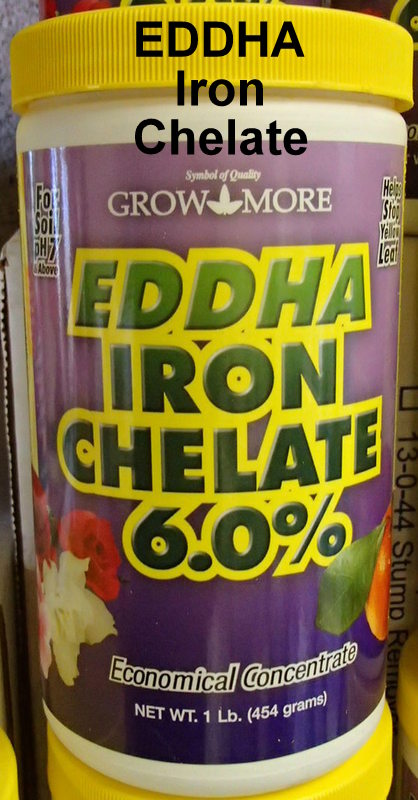
Iron chelate EDDHA best choice for controlling iron problems.
            Once plants have begun growing in earnest, the single application of iron to the soil won’t do much.  At this point, multiple liquid applications to the leaves is the only way to correct iron deficiency, yellowing or chlorosis.
            The best iron chelate applied to the soil contains EDDHA in the active ingredients.  When applying chelated iron to the leaves, use distilled water when making the spray.  Avoid using tap water.  Include 1 teaspoon of liquid detergent per quart in the liquid spray mix to help move the iron move inside the leaves.  Add this liquid detergent at the very end so you don’t get a bunch of bubbles. 

This type of iron is available from Viragrow in Las Vegas for less than $20 for a 1 lb cannister. One pound goes a long way and can probably treat over 100 roses.

Spray Olives Twice for Good Fruit Control

Q. We have seven large olive trees on our property.  In the past, we used two different local tree services to spray our trees to minimize the amount of olives.  One company told us we needed two applications in early Spring, and the other said we only needed 1.  Both came at a very high cost and results left much to be desired.  Every day we had to sweep up hundreds of olives. Do you have any suggestions as to what might work, and the timing of when the trees should be sprayed?

Olive flowers
A.  The chemicals used for preventing olive fruit from forming work if the timing is right. The timing depends on when the flowers open.  If the right chemical is used, it is applied at the right concentration and applied correctly, you should prevent 98% of the fruits from forming.  Two sprays are more effective than one spray.
Olive flowers hanging from the tree
            Nearly all the chemicals now being used need to be applied when flowers are open to get satisfactory results.  If flowers are open, pollen is released so applying these chemicals has little to do with preventing allergy problems.  Its purpose is to prevent fruit from forming.
            Here are why two applications work better than one.  First, flowers must be open when the spraying is done.  This is because the spray must enter flowers to be effective.  It is not effective if it lands on the outside of the flower; when the flower is closed.
            Secondly, flowers do not open all at the same time.  Flowers exposed to full sun open first.  These are primarily on the south and west sides of the tree.  Flowers on the north and east sides open later.  Flowers that are not in full sun, scattered throughout the inside of the tree, also open later. 
            For all the flowers to open may take up to 10 days.  The length of time needed for all the flowers to open depends on the weather.  If it is cold, all the flowers take longer to open.  If it is hot, all the flowers finish opening much sooner. 
            For best control of the fruit, two sprays should be applied; the first when 20% of the flowers have opened and the second when 80% of the flowers have opened.  One spray prevents fruit from forming but two sprays prevent MORE of the fruit from forming.  Never expect 100% control.
            Applicators have a very limited amount of time to get all their customers trees sprayed.  If this spray “window” is missed it results in very poor control of the fruit. 
            I should mention there is one chemical which can be applied which prevents flowers AND fruit from forming.  This chemical is normally applied from February until March, before flowering.  It is hard to get but there may be a few applicators still using it.

Taking Care of Yellow Bells

Q. Can you tell me the care and fertilizing of Tecoma stans, Yellow Bells?  Mine are looking rather shabby, leaves dropping and lots of what looks like seed pods dangling from branches. What action should I take at this time to invigorate the plant? Any certain fertilizer that I should be using?
Yellow bells

A. I am a proponent of organic type fertilizers, such as quality compost, but you can use a mineral fertilizer like 16-16-16 or 10-5-5 if you like. These mineral fertilizers have a large quantity of some major nutrients but are missing many of the others. If your landscape or garden soil is relatively new, mineral fertilizers usually work okay. But in older soils these mineral fertilizers might not provide all the nutrients plants need.
Yellow bells flowers

If using compost, apply 1/2 cubic foot of compost per plant if they are 1-2 years old. Use 1 cubic foot if 3-5 years old. Use two cubic feet if they are older and bigger. When using mineral fertilizers, the amount to apply depends on the type of fertilizer but it should say how much on the bag.

Yellow Bells can grow to more than 15 feet tall but you can keep them 6 to 10 feet by correct pruning with no problems. Remember, prune from the bottom to control height, not the top of the plant. And don’t use a hedge shears. If you prune it incorrectly, this may remove all the spring flowers. If not sure, prune after they finish blooming this spring. They should flower again in the fall.

Remove seed pods as soon as they appear. This won’t hurt the plant at all. Fertilize them now with mineral fertilizer and again just before they bloom in the fall. Apply compost once a year. Do it now. If you have large rock, apply compost on top of the rock and water it in with a hose. In my opinion, compost gives better results.

Clarifying What "Pruning from the bottom" means

Q. The recent article about Tecoma stans, yellow bells, advised the correct pruning for height control is from the bottom, not the top of the plant. Please clarify the difference between top and bottom pruning.

A. Pruning at the bottom of the plant for height control means making the pruning cuts at the bottom of the plant, removing the tallest stems a few inches above the soil. Pruning at the top of the plant means making the pruning cuts near the top of the plant near some desirable height.

Go here to learn more about it

            Results from doing these two different methods of pruning results in a very different plant years later. Making cuts continuously near the top results in larger and larger stems with fewer and fewer leaves near the top. Pruning at the bottom keeps the plant eternally young.
            Pruning at the top of the plant is like giving the plant a butch haircut and requires no knowledge of how plants grow. Cutting at the bottom of the plant removes the largest and oldest stems, removing about ¼ of the entire plant in a few single cuts.
            Cutting at the bottom renews the plant with new growth from the base. Cutting at the top causes no renewal from the base but instead results in all the new growth growing from just below the cuts at the top.

How Late Can You Fertilize Nectarine Tree?

Q. Is it too late to fertilize my nectarine tree with buds starting to form, flowering and growth? Fertilizer instructions advise to apply early February before buds appear.
Arctic Star Nectarine, one of my all time favorites, in flower. Never, never, never spray ANY plants when they are flowering.
A. No, it is not too late to fertilize fruit trees now. The best time is late winter around mid-January, 2 to 3 weeks before new growth begins. The fertilizer bag is telling you the best time for an application, not the only time.
            The concept is to have the fertilizer in place so the tree can use it when needed during spring growth. If you miss this deadline, it is not a big deal if you apply the fertilizer within a couple of weeks after new growth begins.
Continue spraying when the fruit has formed and there are no more flowers. This is the time to start protecting the fruit from Western flower thrips and scarring.
            This fertilizer does not need to be a mineral fertilizer. Compost applications around the base of the tree are more gentle, release nutrients more slowly and improve the soil which mineral fertilizers do not. This is particularly important in desert soils. Use quality, 100% compost, not a soil mix.
            When fruit trees produce fruit early, having the fertilizer available in late spring and early summer when the fruit is enlarging is desirable. When fruit trees produce fruit later in the season, split a single application into two, half applications; half now and the other half later when fruit is quickly getting larger.
Fruit scarring due to Western flower thrip damage to the fruit. 
            Fruit trees do not need fertilizer applied later in the season when growth has stopped and the fruit has been picked.
            Don’t forget to apply iron fertilizers to the soil, during early spring, if plants were yellowing last growing season. If you miss this window for a soil application of iron, apply liquid iron solutions to the leaves later in the season.

Blueberries Iffy Here But Will Work With Extra Effort

Q. I planted three blueberry plants (Southmoon and Misty) last year and they haven’t grown. I used compost and peat moss in a raised bed and added soil acidifier. They are growing very little and the new growth is reddish. I suspect the problem is nutritional but I need advice.

Blueberries
A. Please realize that blueberries are “iffy” in our climate and soils. One of my precautions to people: “when plants are less suitable to our climate and soils, the more time, energy and money is required to keep them growing and in good health.” I agree with you, it is probably a soil nutritional problem. But it can be remedied.
            That being said, I have seen blueberries productive here. Very close attention must be paid to the variety and type of blueberry selected, planting location, amendments added to the soil at planting and every year thereafter, and irrigation.
Blueberry production is known in Western Oregon and Washington state and even here in Southern Europe in Kosovo.
            You picked blueberry varieties that work well here. We must use Southern, highbush blueberries in our climate. Southmoon and Misty are appropriate as well as some others like O’Neil, Sharpblue and Sunshine Blue.
            Blueberries do not like our climate very much and perform better when protected from late afternoon sun. But they need 6 to 8 hours of full sunlight for good fruit production. Eastern exposures or full sun with protection from direct sunlight during mid to late afternoons is best.
Avid gardeners in Las Vegas can get them to grow as well with some TLC.
            Plenty of compost should be mixed into the soil at the time of planting. Either use a good quality compost and mix it into your existing soil at a 50/50 ratio or use a good quality planting mix in the raised bed.
            Soils are where you must be careful. Compost and soil mixes are not all the same in quality. When using poor quality compost or soil mixes, these plants will fail. Guaranteed. As I already said, blueberries are “iffy” here in the first place and using inferior soils or amendments will guarantee failure.
            You are right. Soil acidifiers help but use the right kind of soil acidifier. Granular sulfur does not work. It does very little to increase soil acidity. Sulfur, yes but granular, no. A better choice is water dispersible (powdered) sulfur. If the soil is warm and moist, powdered or water dispersible sulfur adds acidity to the soil which blueberries need.
            There are other products which also add acidity to the soil. Contact me through email or my blog if you need to find them.
            Blueberries do quite well if fertilized with good quality compost in January or February, once a year. If there soil is good quality, well-balanced mineral fertilizers used for roses or tomatoes work okay. Whenever possible, select acidifying or acid forming fertilizers intended for flowering and fruit producing plants. It will state this on the label.
            Cover the surface of the soil in a layer of wood chips 3 to 4 inches deep. Wood chips from trees taken out of urban landscapes work well. Keep this surface mulch 6 inches from the plants but cover the soil where roots are growing.
            Water them as you would fruit trees and other non-desert landscape plants. Keep the soil moist but not wet. Use a water moisture meter for houseplants if you are unsure when to water. Make sure that 20% of the applied water drains away from the roots.

Pink and White Spring Flowering Trees Commonly Plum and Pear

Q. My husband and I just moved to Summerlin, and I am seeing pink and white blooms on trees in this area.  Do you know what kind of trees these are?
Ornamental pear in full show in spring

A. Two very popular ornamental trees grown in our desert climate are the ornamental pear and flowering plum. Both bloom this time of year. Very popular and commonly planted, they are tough survivors in urban landscapes and adapt to our desert environment. They are not desert species but can handle our summer temperatures and low humidity.
Ornamental pear flowers
            The ornamental pear has very showy white flowers in the spring which last 2 to 3 weeks depending on temperatures. Sometimes called Callery pear, the oldest variety is Bradford but has been replaced by other, improved varieties.
            The flowering plum, besides very showy pink or rose colored flowers, frequently produces fruit. Several varieties of flowering plum exist; some with green leaves, some with purple leaves and some with purple leaves that turn green as they mature.
            I frequently get questions whether the fruit is edible or not. Yes, it is. A number of people collect this fruit and make excellent jams or jellies and alcoholic beverages from it.
            If you’re thinking of planting these trees, they will grow best with the soil above their roots covered in wood chips that easily decompose, enriching the soil. They struggle in soils covered with rock and frequently develop problems.
            Although they grow in the desert environments, they are not desert plants. Water and fertilize them like a fruit tree. But prune them as an ornamental tree.
Purple leaf plum in flower
            Plant them as you would any other landscape tree or shrub. Dig the hole at least three times the diameter of the container. Mix into the soil removed from the hole about 50%, by volume, with good quality compost and a couple hands full of phosphorus fertilizer.
Flowering plum flower
            When planting these trees, remove them from the container and use plenty of water during planting. The planting hole should be a slurry of soil, compost and fertilizer when finished to remove air pockets and then allowed to drain.
            Make a basin around the tree 3 to 4 inches deep and fill it with water three times after planting. Continue hand watering these trees three times a week, filling the basin each time, before leaving them to your irrigation system.
            If the tree has a stake in the container, cut the green plastic fastening the tree to the stake and pound it solidly into the soil at the bottom of the hole. Reattach the stake to the tree with green nursery tape to prevent the roots from moving. Remove the stake after the first growing season.

Oranges Have Strong Winter Roots But Weak Tops in Cold Climates

Q. We have an orange tree in our backyard with only two fruit. I noticed there are two different looking branches. One has bigger leaves with flowers and the other one has smaller leaves and thorny branches but it is getting bigger and fuller. Is my tree going to produce fruit or not?
Citrus died and sour orange rootstock took over

A. Citrus trees purchased from nurseries, like most other fruit trees, are two trees combined into one. They are grafted together when they are very young. One tree provides good quality roots but poor quality fruit. The second tree provides the top of the tree which has good quality fruit.

            A common tree grafted to citrus because of their strong roots in our cold climate is sour orange. It is very tolerant of winter freezing temperatures. The fruit looks beautiful but it is extremely sour; too sour to eat fresh.
Purple leaf plum with huge sucker coming from the rootstock (right)
            Sour orange is grafted onto many wonderful citrus trees that provide high quality fruit. Most are more sensitive to winter low temperatures while the sour orange roots are not. If you look closely, you will see a crook or “dogleg” where the two trees are joined together.
            Sour orange, when it is young, may sprout suckers that grow from this “dogleg”. If they are not removed but allowed to grow, they produce very vigorous stems that are very thorny. They eventually dominate the top which produces good fruit and perhaps even cause it to decline and die.
            Sometimes the more winter tender top may die while the sour orange roots will sucker and produce a vigorous tree with horrible but beautiful orange, fresh fruit. These thorny citrus suckers eventually replace the more desirable citrus tree.
            The solution? Remove the sour orange sucker where it grows from the trunk. Make sure your pruning saw or shears is sharp and sanitized. Do not lay it on the ground after it has been sanitized where there are soil diseases that can harm the tree. There is no need to paint the wound but allow it to heal on its own.

Fruit Tree Things ToDo in March

            Aphids are on fruit trees, roses, winter vegetables and other landscape plants. They love cool nights but warm day time temperatures for feeding and breeding. Their feeding causes new leaves to curl on the edges and glistening, sugary sap on leaves.
Shininess from aphid honeydew dropping on the leaves

            Opening these curls with your fingers, you will see adults and “babies”. The mother aphid survived the winter on this plant just below the soil or on neighboring weeds, then migrated to the new growth when it appeared. Mother aphids don’t need a mate. They can have babies on their own.
Plum leaf curl due to aphid feeding on the inside of the curl

            If protected inside leaf curls then they are difficult to control without chemicals applied to the soil and transported to the leaves from the roots called systemic insecticides. Personally, I would not apply these types of chemicals to plants that provide food such as vegetables or fruit trees. They are fine if used on ornamentals like roses, shrubs and trees.
Insects overwinter on weeds. Get rid of the weeds and keep a clean garden!
            Other “organic” options are to make repeat, weekly applications of soap and water sprays or use oils. Neem oil is safe to use on all vegetables or fruit trees now if they are not flowering. Or apply dormant oil used during the winter on fruit trees and ornamentals.
            Dormant oils are okay to use until the weather gets hot. Never apply soap and water, oils or any insecticide when plants have flowers. Wait until the flowers have passed and then apply them to protect honeybees.
            Some ants pick up aphids and distribute them to tender, new leaves for feeding. They are the cattle ranchers of the insect world. You will see the entrance to ant nests being created now in dry soils near to where aphids are feeding. These are 4 to 6-inch diameter mounds with a hole in the center.
Aphids and ants on apricot leaves. They work together!

            If you find an entrance to an ant nest you will probably find aphids feeding in nearby plants. Ants love the sugary “sap” that comes from the aphids. So do bees. Ants protect aphids if they are threatened and may even transport them to safety.
            Controlling in nests helps control aphids. My favorite method for controlling ants is to lightly sprinkle a poisonous bait they take back to their underground nest. Products like Amdro work within 24 hours when applied to the entrance of a nest provided the entrance is dry when it is applied. Read the label of any pesticide before applying it.

How Close Should Pollinizer Trees Be?

Q. How close for cross pollinator?? I am looking to plant more fruit trees and was curious how close the pollinator needs to be?? My neighbor's have various fruit trees and I am about 1/2 mile from Gilcrease orchard. Is this close enough to be effective or should I plant my own??


A. I know this sounds like a cop out but it should be as close as possible. What this means is that the further away a pollenizer tree is, the less likely it will do its job. In orchards, pollenizers are in a neighboring row or in the same row with the trees needing pollination. Sometimes the pollenizer is one tree in a block of 8 to 10. Line of sight is important. If pollinators like honeybees can visit the flower needing pollenating in a “straight shot” it is best rather than turning a corner. But ½ mile is too far away to do any good at all.

As a rule of thumb honeybees will forage about two miles from the hive but as distance increases the likelihood a bee will visit your trees decrease. If you know where there is a pollenating tree for yours, take a “bouquet” of branches and put them in a vase of water at the base of the tree as the flowers are about to open. Delay pruning the pollenizer tree so that you can incorporate this technique as part of your management plan for your fruit trees. You can swap bouquets with your neighbor to improve fruit set.

Plant a pollenizer tree in the same hole, 18 inches apart, for the sole sake of providing a few flowers for pollination.

Make sure the problem is pollination. There is some misinformation out there about what needs pollination and what doesn’t. Fruit set is usually not an “on and off” switch. Poor fruit set, few fruit on the tree, can be due to poor pollination.

Can't Find Western Redbud

Q. I want to plant a Western Redbud but cannot find one locally. In fact a local nursery told me they don't grow well here due to the heat. When I told him they occur naturally at Red Rock, he was incredulous. Any suggestions about how to obtain this tree?

A. Yes, it is more difficult to find and you may have to purchase through native plant nurseries. It is much tougher and just as beautiful as its eastern counterpart which is everywhere in the nursery trade.

It may be too late this year to ship to Las Vegas but you can give online nurseries like Las Pilitas

or start it from seed

Don’t put it facing south or west near a hot wall and no rock mulch and don’t let local maintenance companies prune it. It’s a showstopper.

Try Mexican redbud instead. A good alternative for dry, desert landscapes.

Sunday, March 19, 2017

Growing Beans in Las Vegas

Q. Can I grow green beans in LV?  If so, can you suggest a varietal and the 
best time to plant.  Thank You!

A. Yes you can. Green beans are grown as French (filet) beans, snap beans, beans for shelling and dry beans. Green beans are a bit fussy as to the time of year to plant them here because they don’t like cold soils and they don’t like hot weather. 

Royalty purple pod bean
So during the deepest parts of winter they do not grow well and during hot weather either. You have truly cold weather crops like lettuce, peas, cabbage, carrots, cauliflower and radish. And you have hot weather crops like tomato, eggplant and melons. Beans are in between.

Dragon tongue bean
Plant them in February until they give out with the heat or even better in September until the succumb to the cold. The best tasting green snap beans are some of the old varieties like Blue Lake, Kentucky Wonder, Contender and Topcrop to name a few. Pole beans are more productive than bush beans but you have to provide a trellis for them.
 
Plants dwarfed and collapsing because planted in cold soils and collar rot
Planting. Plant beans in full sun. Beans will not germinate in soil colder than 60°F. Some varieties develop crow rot in cold soils and die. Follow directions on the seed packet.

Put bean seeds in warm water for 3 to 4  hours or until they plump up before planting. This speeds up how fast they sprout from the soil. Plant bush beans ½ inch deep and 12 inches apart. Plants in blocks can be 12 inches apart while rows are best at 18 inches apart.
Crown rot of besn, Dragon tongue

Support pole beans. Pole beans require the support of poles, tepees, cages, or trellises. Set up supports when you sow seed. Air circulation is crucial to warding off disease.

Beans require even, consistent watering. Don’t water with a sprinkler. Once every couple of weeks wash off any dust on the leaves to help reduce spider mite problems.
Sorting French beans at Kabaru co-op in Kenya

Pick beans at the right time
: pick French beans when they are pencil thick; pick snap beans when you feel seeds forming in pods–the bean should snap when bent in the middle; pick green shell beans when the pods are full size but have not begun to dry; pick dried beans when the pods are stiff and break with pressure.

Tuesday, March 7, 2017

Roasters | Sugar Mountain Farm

Roasters | Sugar Mountain Farm

Over $60 Million in Grant Availability

USDA Announces Over $60 Million in Grant Availability for the Specialty Crop Industry

Date: 
Tuesday, March 7, 2017 - 1:00pm
Contact Info:

Michelle Person


WASHINGTON, March 7, 2017 - The U. S. Department of Agriculture’s (USDA) Agricultural Marketing Service (AMS) is making more than $60 million in grants available to support farmers growing fruits, vegetables, tree nuts, and nursery crops, also known as specialty crops.  The Specialty Crop Block Grant Program (SCBGP) grants are allocated to U.S. states and territories for projects that help support projects including research, agricultural extension activities, and programs to address the needs of America's specialty crop industry.

Interested parties should apply directly through their state departments of agriculture, which manage the competitive grant process.  A listing of the SCBGP’s state contacts, and how to apply with state application due dates, can be found on the AMS Specialty Crop Block Grant Program web page. State departments of agriculture must submit their applications to AMS by June 7, 2017.

The SCBGP funding, administered by AMS, is allocated based on a formula that considers both specialty crop acreage and production value in each State and Territory.  The grants are part of USDA’s continued effort to enhance the competitiveness of specialty crops and provide resources to strengthen American agriculture.

USDA encourages states to submit specialty crops projects related to the following priority areas: research; food safety; sustainability; developing new and improved seed varieties and specialty crops; pest and disease control; child and adult nutrition; improving efficiency of distribution systems; and helping businesses to comply with the requirements of the Food Safety Modernization Act.

For more information about these grant programs, including program background, visit the AMS grants website: www.ams.usda.gov/services/grants.  The website also contains a link "What AMS Grant is Right for Me?" under which applicants can use a grants decision tree to determine which AMS grant fits their project best.

Get the latest Agricultural Marketing Service news at www.ams.usda.gov/news or follow us on Twitter @USDA_AMS. You can also read about us on the USDA blog.
USDA is an equal opportunity lender, provider and employer.