Type your question here!

Friday, February 17, 2023

Pecans With Black Spots and Bitter Meat in Southern Nevada

Q. I had two pecan trees that are now 25 years old. One variety has round nuts and the other one has oblong nuts. This is the first year in 25 years they have produced nuts that have black spots and are bitter tasting but the outside of the nut looks normal. Any idea what the problem might be?

Pecan scab. Picture from Texas A and M University.

A. Pecan nut problems are hard to diagnose. The nuts themselves can be bitter if some of the husk is attached to the nut. But yours sounds like a disease issue to me. Perhaps it was our wet early summer and spring that created the problem.

The most common disease of pecans is scab. When it is a wet spring, after a rain, it is wise to spray the trees in March with a fungicide such as Bordeaux or copper sulfate. If it rains again, spray it again after the rain has stopped. The problem is spraying these trees top to bottom since there are no systemic fungicides that can be applied to the soil and taken up by the roots. The lesions on the outside surface of the shell this disease produces are difficult to see and does produce an “off flavor” once inside the meat.

I must guess a little bit, but the varieties popular about 25 years ago in the West were oblong nut varieties called “Western Schley”, “Mahan”, “Wichita”, “Mohawk”, and “Cheyenne”. The older and round nut varieties were either “Burkett” or possibly “Choctaw”. The reason I mention it is because there are probably well over a hundred varieties of pecan. The more recent hybrids are smaller, produce nuts sooner, less likely to bear nuts every other year (alternate bearing), and don’t need a pollinator tree. Also “Choctaw” and “Cheyenne” varieties were considered “resistant “to this disease.

Even though pecan trees can handle our summer heat and poor soils, I don't recommend them for our area because of their size and water use. Pecan trees can get big, growing 60 to 100 feet tall and 30 to 50 feet wide, and have no semi-dwarf or dwarf varieties that I know. Their size dictate they use a lot of water. They do have a sizeable tap root so they possibly could be used where there is shallow underground water.

'Desert Museum' Palo Verde Damaged by Wind

Q. I have a Desert Museum Palo Verde that was damaged during a windstorm. One of the branches blew off and damaged the trunk. It is an eyesore. Should I replace it?

Palo verde is a rather soft tree particularly if you are in a hurry and want to grow it fast. Watering it like a mesic tree will speed its growth but could increase its potential for damage during strong winds.

A. I would let the tree heal on its own but help it along its way. Healing takes two to three years if the tree is kept in good health. To do that, clean up the wound and apply management practices that encourage it to heal. 

Sealing paints are a gimmick and don't help the tree heal. In fact it can do just the opposite and prevent rapid healing.

Don't use any paint or “tree healer” as this was proven ineffective in past research and could actually slow the healing process. If you do paint the damaged area, use latex water-based paint. If there are any “splinters” resulting from the damage, remove them with a sanitized knife. Make the damage, and healthy areas surrounding it, as smooth as possible so the healing is faster and pleasant to look at.

With that same knife remove the outer bark so that the edge is smooth and clean, and the damaged area is shaped like a vertical football. The damaged area will “compartmentalize” and the tree will “roll” over the area as it heals over the next couple of years. When the tree starts to grow this spring, make sure it gets adequate amounts of water and fertilizer. Good health practices help the tree to heal faster.

To reattach or repair a limb split, or otherwise damaged area from a tree during a windstorm, is usually a lost cause. If done successfully the limb must be reattached, or repaired, within minutes or even seconds after it is severed or broken. Time is very important so that the damaged area doesn’t “dry out” before it is repaired.

Strawberry Guava for Las Vegas?

Q. I am interested in growing strawberry guava in Southwest Las Vegas and wish to know if these are good choices. Can you tell me what fruit and evergreen tree varieties have the best chance to survive in our desert?

Strawberry guava is a guava with red fruit. It is cold or winter tender and should only be grown on the east side of a house or tall wall. The soil MUST be amended with compost.  It requires a lot of water (mesic) and can grow over ten feet tall. Here it is growing at our farm in the Philippines where it is warmer. Strawberry guava doesn't taste like strawberries.

A. Our desert can be a place to grow strawberry guava except for our cold winters and occasional snowfall. The fruit grows on new growth from a small tree, 10 to 20 feet tall. If they are kept warm or from freezing and planted in a part of the landscape that gets afternoon shade, then strawberry guava will work here. 

During the very low winters of 1989 to 1990 it got from 10 to 15F but those are 25-to-50-year lows. So short term, temperatures of 25F or below is expected occasionally. Fully grown, they will survive freezing temperatures to about 25F for short periods of time.

How to Grow It Here

Its not easy or cheap. My suggestion, if you plan to grow them here, is to pick a non-windy place (windy locations make temperatures colder in my opinion) in your landscape. This protected location should get at least six hours of direct sunlight in the morning. Protect them from the wind with a constructed wind barrier. Not a solid wall. Solid walls create “dust devils”. Pick a location that is either on the east side or north side of a building or wall, not hotter locations found on the west or south sides.  Plant them at least five feet from a wall or building.

Make sure the planting hole is about 3 to 4 feet wide and dug as deep as the roots. Amend the soil with compost or use composted soil when planting. Make sure the soil is wet, not dry. Plant in a hurry. Cover the soil with a 3-to-4-inch layer of wood chips when finished. Stake the tree after planting. Protect it from rabbits or other vermin if they are seen. Applied water should wet the soil to 18 inches deep to at least half the area under the tree canopy as it gets bigger.

Avoid planting seeded types but instead pick pink or red varieties like ‘Homestead’, ‘Barbie Pink’, ‘Hong Kong Pink’, ‘Blitch’ and varieties recommended by the University of Florida that have proven successful there. Green varieties are picked before they are ripe and red or pink varieties are picked after they ripen. Guava is a climacteric fruit so it will ripen further after the fruit is hard but near ripe.

Star Jasmine Needs Sun and Watered Like a Shrub

Q. I am hoping you can tell me what is wrong with my "star jasmine". These plants are approximately twenty years old. The wall they are growing on is north facing. I have pulled the rock mulch away from the base. I mix in compost to each plant every spring when I fertilize. Could it be the irrigation is too close to the trunk?

Star jasmine is from the area of Japan. The great deserts of Japan...not!!! It is not a xeric plant and so it can get yellow, iron chlorosis, in rock. Plant it with compost in the soil and build up the organic content.

A. Without looking at the pictures I was expecting them to be yellow. That’s usually what happens to star jasmine in rock landscapes. Your addition of compost to the soil is keeping them green and healthy.

Bare wooden stems can sometimes happen when it is in poor health or covered with shady growth on top.

Perhaps Watering too Often

Bare stems on older growth can be a natural occurrence. I don’t think it is in your case. It is possible if the water applied is too close to the stems AND it is being applied too often then you can end up with bare stems. It is best if the water is applied at 12 to 18 inches from the trunk (stems, base) of the vine.

Water, when it hits the soil, spreads out. In soils that are very sandy then this distance might be 12 inches from where it is applied. If the soil has a small amount of clay in it then the spread is about 18 inches from where it is applied. In soil with lots of clay (most of the soils in Las Vegas do not have that much clay) then water can spread out from where it was applied from 4 to 6 feet. A happy medium is 12 to 18 inches from the stems or trunk.

Be careful of applying water too often. It can keep the soil wet too long. This can result in leaf drop followed by bare stems. It is always best on plants that have deeper roots (like your jasmine vine) to apply water less often. Vines like star jasmine are deeper-rooted, like medium sized shrubs. Water should wet the soil 12 to 18 inches deep each time is applied. Water your vines like they are medium sized shrubs.

What to Do?

What can you do with bare stems? Cut them back no closer than three or four inches and they will send out “suckers” and those suckers will fill in open spaces if the vine is alive. You may have to cut alot of stems back and start over if it is bad.

Rabbit Chewing Damage to Peach

Q. I planted a peach tree late last winter but before I could protect it the rabbits began chewing on it a bit, not all the way around just a few spots. I’m not sure if borers have gotten to it. Do you think it can be saved or is it time to pull it out?

Rabbit damage to a peach tree. Rabbits love to eat fruit trees in the winter when not much else is around to eat. If you fear rabbit damage, use one inch hexagonal fencing to protect them when they are young.

A. Most trees, including fruit trees, can lose about half of their bark by chewing and still survive. If it were me I would tally up all of the damage and if this damage is less than 50% then it should be fine. You might lose some branches that are severely damaged but the majority should survive. 

A cylinder of 24 inch wide, one inch hexagonal chicken wire is usually good enough protection for fruit trees from rabbits.

Protect the rest of the tree from vermin damage and don't worry about it too much. The damage will heal on its own. If you want the tree to recover from damage faster, make sure it is getting enough water and fertilize it at least once each spring.

Best Iron to Use is EDDHA Chelated Iron

Q. I’m starting to think about the springtime approaching and the need for fertilizing. Do you have an “iron Fertilizer” you recommend? We added the compost you suggested but I want to make sure we are on top of the iron needs of our plants.

Iron chelate fertilizer that works in all soils. Its a bit more expensive but it is a guarantee. The others will work most of the time.

A. The iron chelate I like to use is a little bit more expensive. The reason I recommend it is because of its stability in both highly alkaline and highly acidic soils. It works regardless of the soil or its alkalinity (soil pH). I consider it cheap insurance.

Severe iron chlorosis on a peach seedling. Chlorosis is any yellowing leaving behind green veins. Iron chlorosis occurs all summer long but it is on new growth. Iron should be applied sometime in the early or mid spring, before April in our climate.

The chelate I like to use is EDDHA iron chelate. It comes under several names but as long as the iron is bound to the EDDHA chelate then it is what I recommend. Other types of chelates and iron fertilizers stop working in highly alkaline soils.

This is another iron chelate fertilizer called EDTA. It works in most soils. It is the most common form of chelated iron fertilizers for plants because its more available and cheaper.

            If you are adding compost to compost amended soil then any chelate or iron fertilizer will probably work whether it is iron sulfate, brake filings, or iron chelates such as EDTA or DTPA This is because soils that have compost added to them usually are not strongly alkaline. The compost additions, along with water, usually lowers the alkalinity of the soil.

The chelated iron I prefer, iron EDDHA, works over all of the different soil pH or alkalinity.

            Any iron fertilizer or chelate MUST be applied and mixed with the soil in the early spring (sometime soon after February 1 in our Las Vegas climate). Soil applications get less effective as the growth begins stopping. By mid to late summer you must switch to iron fertilizers applied as a liquid to the leaves for acceptable results. This usually requires several applications to shrub leaves. Iron fertilizers applied wet to the leaves (foliar applications of iron) are not as effective and may need to be applied to the leaves of trees and shrubs several times to work.

How to Get Rid of Bermudagrass Weeds in a Tall Fescue Lawn

Q. How can I get rid of bermudagrass now, growing in a tall fescue lawn.

Bermudagrass invasion of tall fescue due to irrigation and mowing height. Keep mowing height at least 2 inches for tall fescue and keep it full and lush.

A. The best way to get rid of it in fescue is to cut it out if possible and then seed the bare spots after the Bermudagrass has had time to die. The best time to do this would be about April or May when Bermudagrass is starting to green up. You've got to kill the Bermudagrass when its alive, which starts growing in late spring, and seed the bare areas after all the grass in that area dies.

That's tricky because Bermudagrass is a warm season grass and doesn't start growing until about mid-March or early April. It’s easier to control fescue growing in a Bermudagrass lawn while the bermudagrass is dormant (sleeping and dead looking). The fescue in the lawn is cool season so you can begin seeding when it's cooler. But bermudagrass is warm season so it doesn't "wake up and start growing" until late spring.

If you want to try that then I would recommend spraying Roundup (its the only systemic grass killer available) in spots where the Bermudagrass is growing in the late spring and wait about a week. Don't use Roundup combined with any other weed killer. Just plain old Roundup. The systemic Roundup translocates and kills some of the roots of bermudagrass. 

First, cut the grass in the Roundup-applied area shorter and seed directly into those spots. Because Roundup is systemic and slow acting it will continue to kill the bermudagrass. The label on Roundup prevents you from seeding any sooner than this. You should start seeing the fescue pop up from seed in about 7 to 10 days as the grass in those spots continues dying.

What to Do?

1. Mow the area shorter.

2. Spray Roundup over the area without any other weed killers in it. Just plain old Round-up. The grass wont die for 2 to 3 weeks. 

3. After one week, seed a high value tall fescue seed in the same area. The grass you sprayed will look like it is alive but it is dying.

I would mow the area shorter, somewhere between a half to an inch tall, and apply ammonium sulfate (21-0-0) in early March. The Bermudagrass likes warm weather, as well as nitrogen fertilizer, and it will start turning green a couple of weeks earlier than when it is taller. Use a high-quality tall fescue variety to seed in those spots. The grass will not be dead yet but it's dying, and you have to trust that it's dying. As the new fescue seed is coming up you will see sprayed areas start to die or turn brown.

You can safely seed into Roundup-applied areas 7 to 10 days after the spraying has been done. The tall fescue and Bermuda does not look dead yet, but they are dying. You can't start killing Bermudagrass until after it starts getting green in the spring.

Preventing Bermudagrass Invasion

In the future keep your mowing height between two and three inches. Keep the lawn thick to choke out any invading Bermuda grass. To do this apply fertilizer to fescue lawns at least 4 times per year; Valentine's Day, Labor Day, Memorial Day, and Halloween. The fertilizer to use is a 21-7-14, between half to 3/4 of the bag rate if you are returning the clippings to the grass (not bagging). The rate on the bag may be too much fertilizer. Don't give the edges of your lawn of bevel cut because it encourages in Bermudagrass invasion. Instead use a steel edger perpendicular to the edge of the lawn.

How to Prune Clematis Vine

Q. How to prune clematis vine in North Las Vegas?

Always prune "pretty plants" immediately after they finish flowering. If they flower most season long, then prune them in the winter. This picture is from another reader.

A. To get a “how” it is best to send some pictures. Without pictures I can tell you “when”. Clematis vine should flower late in the spring and then again in the fall if you are lucky. 

There are multiple ways to prune it depending on what you've got. Clematis is basically a flowering woody vine that can be pruned as if it were a shrub. The flowers grow on older wood and, depending on the variety, can flower anytime from spring until fall. If the vine or shrub flowers all season long, then winter is the best time to prune.

Always prune flowering vines and shrubs just after they finish flowering. You are okay pruning now because the winter has interrupted the flowering.

Did you know there is a “native” clematis? It is not as spectacular when it flowers, but it is a native and so it can handle less frequent watering. It is still a clematis!

Brown Leaf Tips on Strappy Leafed Plants

Q. What causes the brown tips on some strappy-leaved plants like iris or agapanthus? Should I cut it off?

Tried to find some leaf tip burn or leaf scorch on narrow leafed plants like Mondo grass or agapanthus. No luck. It is always the same. Not enough water is applied, the soil is not improved, salty soil or water, or it was planted in a hot location. In the case of Mondo grass, it should not be planted here. The humidity is just too low for it. 
https://www.public.asu.edu/~camartin/plants/Plant%20html%20files/liriopemuscari.html

A. You didn't tell me which plant you're concerned about because some plants are less tolerant of certain location than others. This browning of the leaf tips is called plain old “leaf scorch”. It can be caused for lots of reasons; sun is too bright, low humidity, windy locations, poor periodic soil amendments, watering too frequently, salty soil or irrigation water, or watering not often enough.

            For instance, Mondo grass (it is a form of Liriope muscari or grape muscari) is a small plant with “strappy leaves” with lots of different common names like border grass, monkey grass, grape hyacinth, and others. It gets leaf scorch in the desert in ALL locations. That’s the way it looks in the desert. When in doubt, call it by its scientific name (or Latin name) and understand where it is from.

            Getting back to your plant, do what the gardeners in the hotels do to indoor plants. They cut the leaf scorch off and make the ends of the leaves resemble others. This makes the plant leaves look more “natural” to passerby’s who just glance at it or pay no attention. If most of the remaining leaves are pointed, then cut it off in a point. If you end up not liking the look, remove the entire leaf by cutting it off at its base and hiding the cut.

            I know I sound like a broken record but, when pruning, always sanitize the blades with at least 70% alcohol when starting.

            Consider moving the plant to a more hospitable location. If it looks like the leaves are scorching, then move it to a shadier spot. If that doesn’t work and you remove it, then lesson learned. Consider it part of your education. Learn the name of the plant and buy something different.

            Remember, plants that have showy flowers need more light than those that don’t conspicuously flower. If you planted a nonflowering plant and it was planted at the lowest level of light available, then the same plant will not work in that spot. Either that or more light needs to be made available.

Bitter Orange a Good Choice for Las Vegas But....

Q. Is it possible to grow sour or bitter orange in Vegas? It’s becoming almost impossible to find at the local markets and we use it in so many recipes. I was curious if that was something that might grow here? When should I plant it?

Bitter orange, sometimes called trifoliate orange, is a good choice for colder climates like Las Vegas where it oftentimes freezes.

A. They aren’t very popular here. I understand why you might want to grow them. We are talking about Citrus aurentium. They are used as a landscape highway plant or landscape hedge in the Phoenix area where it’s warmer during the winter. Here they are mostly used as a low temperature rootstock for citrus when shipped to our area by wholesale nurseries. Trifoliate orange is used primarily as a freeze tolerant rootstock for our area, but sour orange is also used.

Sour orange is used as a rootstock for citrus needing to be cold hardy. If the top of a citrus dies due to freezing temperatures, at least the rootstock will sprout and grow after the top freezes.

I don't have the information on their low temperature tolerance for the winter, but I think it’s around 20° F so it would be a good choice for planting in the Las Vegas area. Meyer lemon and kumquat, two more commonly grown citrus here, will handle freezing temperatures to about 24-25° F. once established. In protected backyards Meyer lemon, grapefruit, and kumquat survive most of our winters. So, my guess a fifteen-foot sour orange will be at least reach those temperatures, if not a bit lower.

This tree should start flowering in about year four to six. You will still lose fruit due to early spring freezes combined with open flowers in some landscapes depending on its exposure to early spring freezes and wind. But the tree itself should survive our annual fluctuating freezing temperatures for about 25 years or more.

Remember ALL citrus are from China and parts of southeast Asia. This means the desert soil needs to be amended at the time of planting, and periodically adding amendments to the soil. No citrus are xeric so they will need about the same amount of water as regular fruit trees of a similar size, about 4 to five feet of water under applied under its canopy in one year.

Just for your information bitter orange does get a deadly disease occasionally but it's usually not prevalent in non-orchard citrus areas so you should be all right. Buy the tree smaller and protect the tree from sun damage through shading itself or providing it shade while it gets established. Buy a tree that is shrublike.

You won’t find it locally. It is not that popular as a tree on its own. I think you will have to order it online. Places outside of the desert southwest don’t have to worry much about sun damage to the trunk so it is limbed up higher into a tree. For this reason, you want to buy it grown into as much of a bush as possible. Limb it up later when it gets older and acclimated to our desert. The best places to order it are from Arizona nurseries such as Whitfill or Greenfield if they will ship it to you. Both are in the Phoenix area.

Plant it when temperatures are cool, but spring planting is best in the case of citrus. Because of digging and availability, most nurseries sell bareroot trees in the spring. Bareroot trees need to be planted as early in the spring as possible. Potted or container trees can be bought anytime but planting them is always best in the spring. If it were totally freeze tolerant, or you were sure it will not get extremely cold this winter and you can find it available, then fall planting is always best.

Root Rot on Pines?

 Q. I have several very large pine trees that have been in ground since 2002. Due to heavy winds, one was felled, and the trunk broke. Upon inspection, it looked like root rot! Can you advise how much water these trees need in winter and summer. I want to be sure the see does not happen to others.


A. Make sure the trees have water applied to a wide area, equal to about half the spread of their canopies. Tree roots follow applied water in the desert. Pine trees are relatively deep rooted. For this reason, apply water to them deeply. However, if the soil is hard, and the water applied too rapidly, the water may begin puddling and the tree can blow over easily. Watering plants in the desert tells them where you want their roots to grow.

The roots of any large tree near a wall is a "recipe for disaster". This large pine tree eventually heaved this wall when the roots "grew looking for water". The roots heaved the wall.


The other problem is watering. If they are given small drinks of water frequently (think planting in lawns) they develop roots that are shallow and will not hold them upright during strong winds. 

When planting pine trees it may be a good idea to plant other smaller shrubs around its canopy. Pine tree roots will grow where the shrubs area as well and help support it. Unless you know what you are doing, it may be a bad idea to have a pine tree planted all by itself surrounded by desert soil that is not irrigated. These trees will blow over. 

Place plants around the pine tree that are throughout its canopy as it grows larger. Putting irrigated shrubs around pine trees helps the pine tree roots to grow into the surrounding soil and become more firmly anchored. It is not something mystical about the surrounding plants. It is because these plants are irrigated, and they share water with the pine trees.

When to Stop Cutting Asparagus

Q. When should you stop cutting asparagus? We've had a good crop in the past but seem to have quit harvesting too soon in prior years so want to go as long as possible. We enjoy eating it!

Asparagus spear called 'Purple Passion' harvested

A. The textbook answer is 6 to 8 weeks of cutting and then you should let it go and rebuild its crowns beneath the soil for next year’s harvest. That information was given back when asparagus spears were thought to be marketable only if they were the diameter of your thumb. That’s changed and now we see asparagus sold much smaller in diameter than that and marketed as such.

Asparagus spears will produce spears large in diameter at first but after the crowns get exhausted from production the spears will get smaller and smaller in diameter. It is up to you when to stop harvesting them. But in the older days, asparagus spears were harvested until the spears got smaller in diameter and smaller.

The other answer is to continue to harvest until you see a noticeable decrease in the diameter size of the spears. When they start to get too small for harvesting (don’t just look at one spear but take an average), stop and let the roots and crowns of asparagus rebuild themselves.

            Asparagus will rebuild itself better if you can provide some nutrients as the crowns are putting away storage for next year. After harvesting, apply at least an inch of rich compost or you can also use manure.

In late December or early January the asparagus bed is fertilized with either manure or a rich compost. Sometimes a fertilizer is required if no manure or rich compost is available.

            The crowns should be 6 to 10 inches deep depending on the soil so laying manure on top of these areas should cause no problems. (Some manure is high in salts.) Planting the crowns deep makes sure the spears don’t come up too early. Make sure you water it after planting. After planting don’t water too often because the crowns are deep. Apply water on a similar irrigation cycle as fruit trees. The roots and crowns should have water available at the same depth.

Asparagus crowns are planted 8 to 10 inches deep. In retrospect, I would have used more compost when planting and made the planting area darker...more organics in the soil.


Saturday, January 21, 2023

Hot Locations are Tough for Fruit Trees and ALL Plants

Q. I have a very hot location I want to plant. It’s facing West. I had a 'Pink Lady' apple tree in that spot but I think it was just too hot for it. It died in a couple of years. What do you suggest?

Hot locations are tough on fruit trees. Afternoon shade is better for the plant.

A. Hot locations are tough. From the look at the picture you sent there does not seem to be much air movement. Just a lot of reflected heat from high walls. In my opinion, that area will get super cold in the winter as well. I know you are in a hurry want to get it done. But do you want it to survive?

I would put a waterproof, recording thermometer in that area to track temperatures both during the heat of the summer and cold of the winter.

High/low battery operated recording thermometers have been around for decades.

Not having much air movement can have both good things about it and bad things. The main advantage to that “hot” location is blockage of the wind.

            In spots like that I would recommend first to cut back on reflected heat. Cover this area with about 50% shade cloth until the tree gets grows enough to cast its own shade on the walls and soil. While shade cloth is provided, grow a deciduous vine that likes the heat, such as catclaw vine, so that it covers the wall. Covering the wall during the heat of summer reduces the reflected heat to that area. Provide shade for that spot for about four to six years if the tree grows quickly. The fruit tree should start producing in the second to fourth year depending on what is grown.

            Let the temperatures recorded there dictate what to plant in the future. Personally, I think apples, pears and other related fruit trees may be a poor choice for that spot due to excessive heat. Most citrus, except Myer lemon, grapefruit, kumquat, and tangerine may work if the winter temperatures are warm enough. Apricot or pomegranate are better choices.

Thursday, December 15, 2022

How to Water Sago Palm (Cycad) Once Each Week in the Winter

Q. Now that our irrigation is only allowed for 1 day, I was wondering if once a week is sufficient watering for my small sago palm. Should I hand water it on other days?

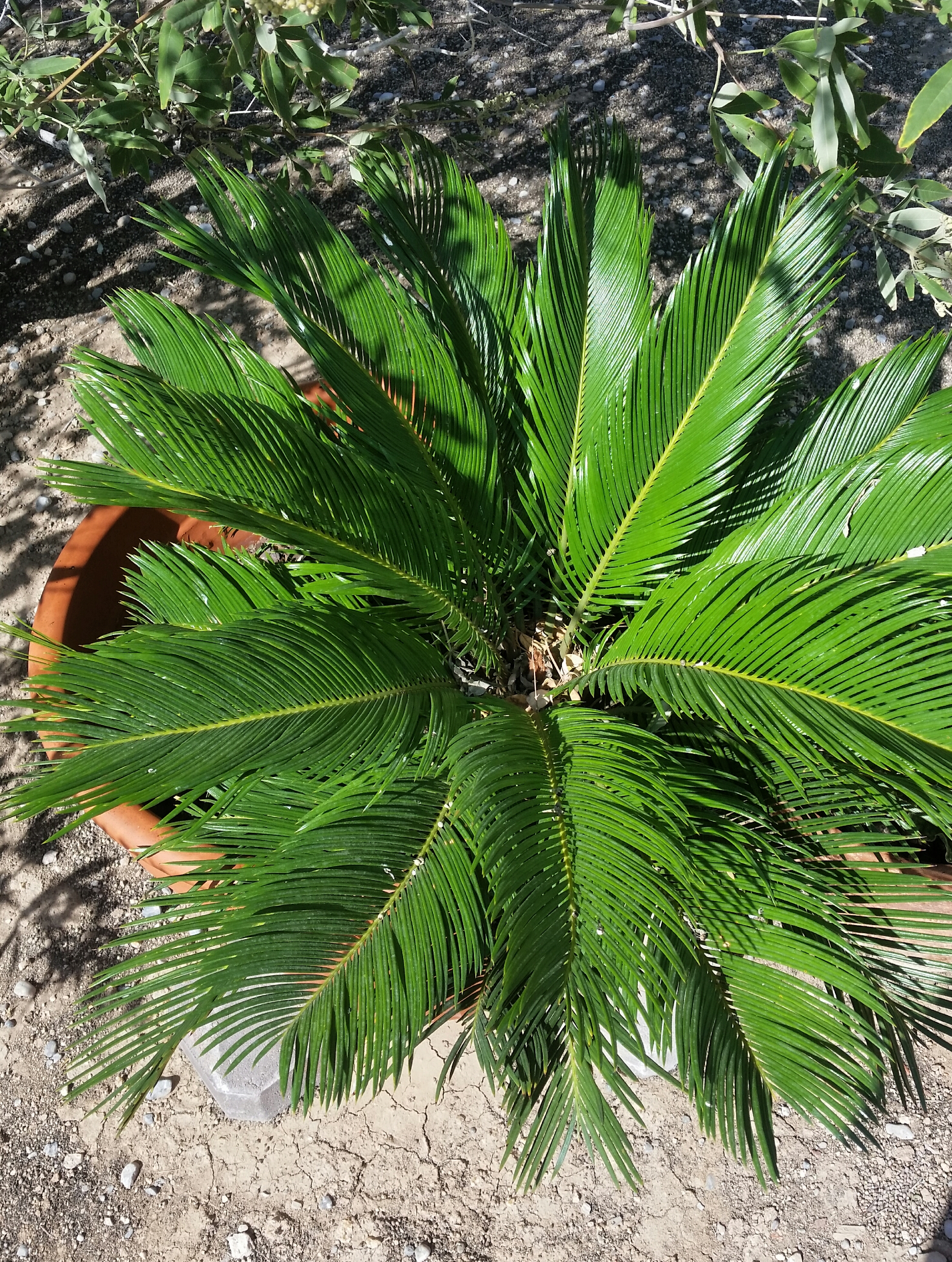
Not the readers sago palm (cycad) but it is small! It is in a container so it is more difficult to water than one planted in the ground. The soil in the container is more limited in size than one planted in the ground.

A. Hard to say. Depends on how much water your soil around the sago palm holds, where the drip emitters for it are located and the side of the house it’s on.

Hard to believe this cycad, or sago palm, is growing in Las Vegas. It was situated in the right location with the right care.


           Ideally the drip emitters are located between 12 to 18 inches from the trunk. For large sago palms I would suggest three emitters spaced in a triangle. Run the irrigation system long enough to water 12 to 18 inches deep. you can measure that with something long skinny and hard like a piece of rebar. If the sago palm is smaller, it may need only two emitters to wet the soil to the same depth. Smaller plants don't use as much water, but the system needs to run just as long.

Hard to accept this is the same plant as the one above. But this one is located in the heat of the sun and growing in poor soils.

           Plants on the south and west sides of the house or wall use more water faster than those on the east and north sides. A deep watering once a week should be all that is necessary for them in most soils and locations except the hottest.

Pines and Eucalyptus With no Water Growing in the Desert

Q. I have pines and eucalyptus that are not being irrigated at all. There is no irrigation applied but these trees are tall and healthy. What gives?

This eucalyptus has on applied irrigation in the desert. Sometimes trees can access underground water and survive.

A. Trees need water to survive. And large trees need more water than smaller ones. Some trees like your eucalyptus and many pines can grow deep roots. But trees need a minimum amount of water, or they won’t thrive otherwise deserts would be filled with tall, healthy trees like yours. They are getting water from somewhere.

Large trees use more water than smaller trees. Such is the case when the water was turned off to this mulberry.


           Plants are lazy, like us. Tree roots take up water where its easiest to survive. If they want to reproduce, then they need more than enough to survive. If the deep water is easiest to follow, then it will use it, if their roots can reach it.

           Tree roots don’t “seek” water in dry soil. They chase it. They “sense” water is there (compared to dry soil surrounding their roots) and grow best where water (and air) are abundant. If it can get lots of shallow water, like growing in a lawn, then that’s where tree roots grow abundantly as long as they can get air as well. If the water is deep, then that’s where roots grow if the soil is moist often enough to attract tree roots and they can “breathe”.

           Established pine trees grew “without water” at the El Rancho on the Las Vegas Strip after its fire. The property was abandoned, and the irrigation was turned off as well. Pine trees had to survive on only the deep salty water that their roots could get several feet below the Strip. This available water used to be considered a “nuisance” until developers saw its value in the desert. As Mark Twain used to say, “Whiskey is for drinking; water is for fighting over.”

           Both established pine trees and many eucalyptus have the potential to develop deep roots if given a chance and find a deep source of water.

Leaf Miner in Lemon Leaves

Q. My potted Myer lemon tree has “wrinkles” on the leaves. The nursery told me that the leaves have an insect living inside the leaves.  I used whatever product was sold to me last spring and the leaves still look wrinkled. This is my second year having the tree and it has 12 lemons on it.

Leaf miners on Myer lemon is usually a "greenhouse problem" with warmer temperatures.

A. The nursery was right. The leaves of your Myer lemon have leaf miners inside of them. But the product you were using was wrong. Leaf miners are usually small flies that lays eggs on the surface of the leaves. these eggs hatch and the “maggot” of this fly tunnels between the outer surfaces of the leaves. Previous to yours, the only place I ever saw leaf miner on Myer lemon were in another country grown inside a plastic tunnel they called a “greenhouse”.

Leaf miner infestation of tree leaves of Myer lemon is usually a greenhouse problem but here it was growing in a container. By the way, Myer lemon is a bit too large for container growing unless you use a very big container.

           There is no insecticide I would use to control them. The usual method used is to hand remove or pick the infested leaves and immediately destroy them.  Leaf miners found inside tree leaves are usually a minor problem when growing citrus. Their life cycle can be easily interrupted by removing infested leaves. Leaf miners are more of a problem in leafy greens like spinach and lettuce. 

A word of caution. These leaves must be destroyed soon after they are removed, or the leaf miner insect will emerge, mate and continue to infest other leaves.

           I guess if you were to use an insecticide for controlling leaf miner then I would spray a systemic insecticide like imidacloprid if it is labeled for food crops. But in your case the easier and safer method is to remove infested leaves and immediately destroy them and interrupt the insect’s lifecycle.

Palo Verde 'Desert Museum' Will Recover from Wind Damage

Q. I have a desert museum Palo Verde that was damaged during a windstorm. One of the branches blew off and damaged the trunk. It is an eyesore. Should I replace it?

Replacing a tree because of damage is a personal call. The tree will repair itself from that kind of damage. It may take three or four years if you can live with that kind of damage for the next year or two.

A. I would let the tree heal on its own but help it along its way. Healing takes two to three years if the tree is kept in good health. To do that, clean up the wound and apply management practices that encourage it to heal. Don't use any paint or “tree healer” as this was proven ineffective in past research and could actually slow the healing process. If you do paint the damaged area, use latex water-based paint. If there are any “splinters” resulting from the damage, remove them with a sanitized knife. Make the damage, and healthy areas surrounding it, as smooth as possible so the healing is faster and pleasant to look at.

Large tree wounds will heal if given time and you provide adequate water and fertilizer.  First they will compartmentalize their wounds and then start rolling in their cambium layer as it heals from site.

With that same knife remove the outer bark so that the edge is smooth and clean, and the damaged area is shaped like a vertical football. The damaged area will “compartmentalize” and the tree will “roll” over the area as it heals over the next couple of years. When the tree starts to grow this spring, make sure it gets adequate amounts of water and fertilizer. Good health practices help the tree to heal faster.

Early or late snowfall can damage trees with leaves still on them as this African sumac was damaged in Las Vegas. Repair of split limbs must be done very soon after the damage occurs or it won't work.


To reattach or repair a limb split, or otherwise damaged area from a tree during a windstorm, is usually a lost cause. If done successfully the limb must be reattached, or repaired, within minutes or even seconds after it is severed or broken. Time is very important so that the damaged area doesn’t “dry out” before it is repaired.

Century Plant (American Agave) Not Growing Well

Q. We have a century plant thriving over the past 10-12 years in our front yard. Towards the end of summer, we noticed lower leaves getting soft and tender, leathery even, eventually turning yellow. No new shoots are visible emerging from the core. It gets watered occasionally.

Century plant or American agave. A magnet for agave weevils.

A. Century plant is an agave weevil magnet! My guess is that's the problem. The only method I know to control agave weevil is to apply an insecticide around the base of all agaves in March or April of every spring. The insecticide is used to protect the plant from spring infestations. Sprinkle a granular insecticide at the base of the plant and lightly water it. The other option is possibly to drench the soil immediately around the agave with systemic such as imidacloprid (if the label permits). 

Warning sign of American agave that it might have agave weevils. Apply granular insecticide in the spring as a prophylactic treatment.

            The adult weevils have wings and can fly. They can fly from a neighbor’s plants to a different neighbor’s landscape. These adult beetles lay their eggs in the crotches of the agave in the spring. They don't use calendars but fly during the spring when it's perfect weather. That is why the timing for an application is sometime “in the spring”. The “grubs” hatch from the eggs and tunnel inside the core of many different types of agaves and cause their tunneling damage. Sometimes the damage is so severe it kills the plants outright or it might cause a smaller problem when plants are larger.

This is the type of problem agave weevil can do on established plants. Notice the base was rotten and the plant "collapsed".

            The other usual problem is watering too often. This can weaken or kill the plant. It doesn’t sound like that is your problem. I would caution you to water the plants deeply and not just a sprinkle them with a hose. Depending on the size of the agave it can take from 5 to 15 gallons of water varying from a small to a large American agave. If the American agave is large, then use three drip emitters located about 12 to 18 inches from the plant in a triangular spacing and watch for signs of stress. Apply water about three to six weeks apart during the summer.

Thursday, December 1, 2022

Plant Found During Cooler Weather May Be Toxic

Q. Found a plant growing under my fig tree. It has sticky leaves, tiny white flowers, and clusters of small green balls. Any idea what it might be?

This picture was sent to me. I am guessing it is one of the nightshades.

A. I could not make out the plant from the pictures you sent so let me take an educated guess. Toxic black nightshade is a common weed that grows when the temperatures begin to cool off. It has 3/8 inch in diameter white flowers that resemble tomato flowers and produces immature green fruit that are ball shaped that vary from 3/8 to ½ inch in diameter. These green “balls” of fruit turn darker and sometimes black when they mature.

I am guessing the weed is toxic black nightshade which is a common weed during the cooler fall weather. If it's sticky it might have aphids. Regardless it doesn't belong near fruit trees. Get rid of it.

Toxic black nightshade found growing in the Orchard at Ahern.

            If the plant attracts aphids, then it can get sticky due to aphid “poop” from sucking the internal juices of the plant. Even though the plant is poisonous, aphids do like this plant. Like any weed growing near fruit trees, pull it when the soil is moist and get rid of it. Otherwise, the aphids will ride the winter out at about soil level as it gets colder and spread to your fruit trees in the spring. I thought I saw rocks around the fig tree. Make sure you rake the rocks back, put a thin layer of compost down and water it in to enrich the soil.

Nightshade with small green balls (fruit)