Type your question here!

Monday, January 27, 2020

Growing Food in a Desert Climate

If you are reading this blog post you probably live in the desert. I don't know, but maybe you wondered if it was different growing plants in the desert versus other locations. Maybe you know it's different but your curious about my thoughts. Or maybe you know it's different but you want to get my "take on it".

Yes, growing plants in the desert is different than growing plants in other locations. I have lived in the upper Midwest, in arid Northern Colorado,the more arid Salt Lake city area and finally in the Mojave Desert. Yes, when I moved here it was dramatically different from the other locations I have grown plants.

Let's handle each category, how it differs from conventional gardening, separately. I will put them in the order I think they are significantly different from each other.

Desert Soil

That's my left foot in that picture in a raw desert soil in North Las Vegas, Nevada, in the Eastern Mojave Desert that has never been under cultivation. In other words, it has never had water applied to it to grow anything outside of natural rainfall.
As far as desert soils go, I have lived and worked in Central Asia (Afghanistan, Tajikistan) since 2005. I am familiar with desert soils in the Middle East, North Africa and south Africa as well as locations in our Southwestern deserts. This is my take on desert soils.

The Mojave (Mohave) Desert is a very harsh environment to grow plants. It is harsher than Colorado, Tajikistan, Afghanistan, Northern Africa, most of Arizona, New Mexico, West Texas and beyond. It is the MOON!

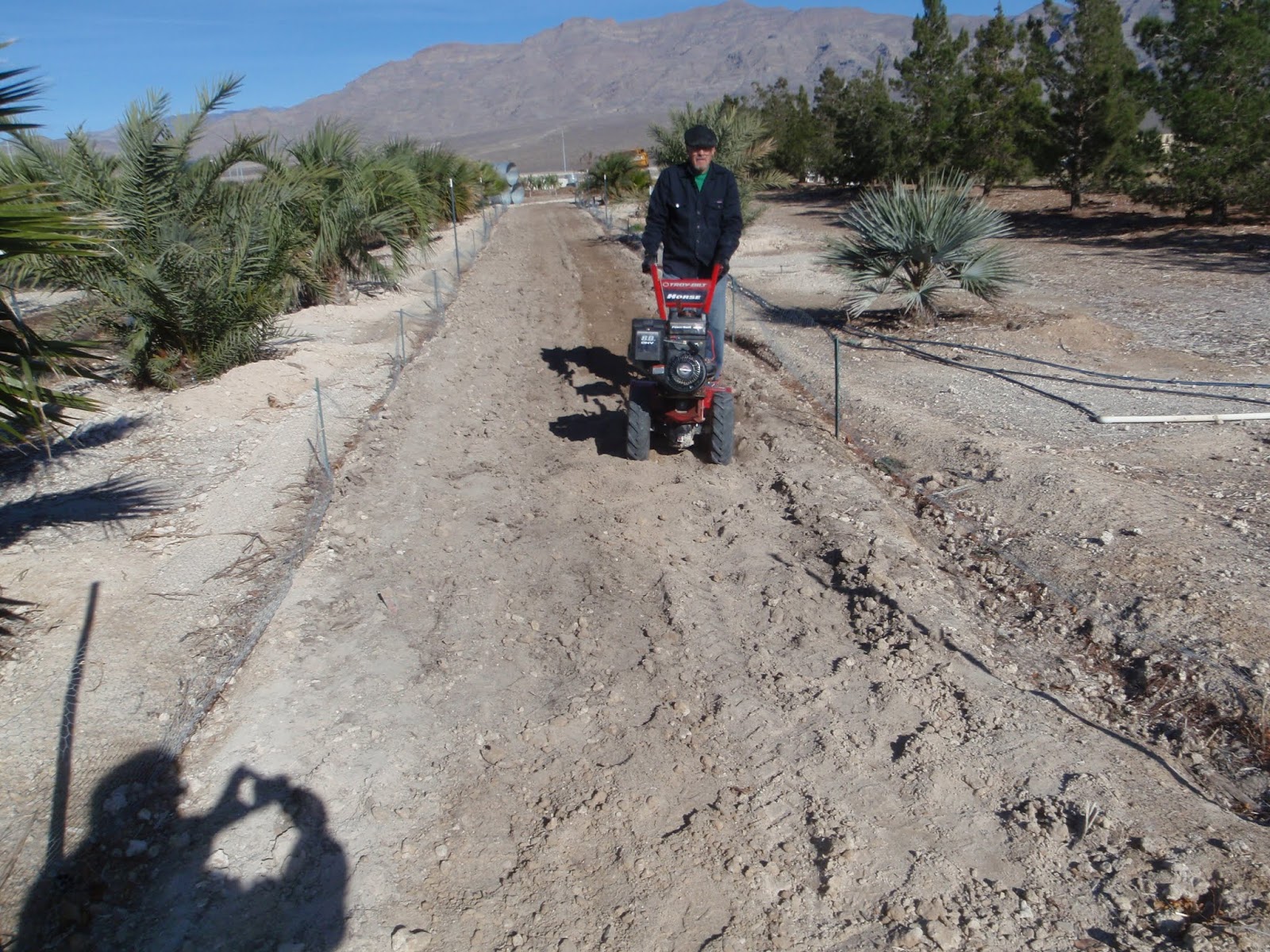
This area is about 10 feet wide. I put as many trenches in this 10 foot wide area as I could space together. Then I flooded it with water using hoses. The water ran all night long to fill these trenches and wet that soil. I then had to wait for the soil to dry enough so it was workable with a tractor.There were 10 of these areas about 100 feet long.

The first thing I look at in a desert soil is its color. Is it a light tan color like the picture or is it significantly darker brown. The second thing I use to get a handle on what I have to do with it is how hard it is to put a shovel in that soil. If I have to jump on the shovel and it barely goes in the ground or if the shovel goes in with less work. The color and how easily I get a shovel in tells me roughly its organic content.

This is the gasoline driven walk behind trencher I used to cut those trenches in the picture above. It would've taken me days to try to use a pick on that soil and not nearly as effective.

How to Fix This Soil?

Water and organics. First you have to soften the soil with water then add compost to it or some other form of organics so that it stays "fluffy".

After waiting about five days for the soil to become dry enough so that it could be worked with the tractor, I filled the trenches with compost and put a thick layer of compost on top of the soil as well.

Besides filling the trenches with compost to about 30 inches deep, a thick layer of compost was applied to the surface of the damp soil. The soil was dry enough for compaction not to be a problem but it still had some moisture in it, not enough to grow plants but a heck of a lot more moisture in it than it had under a hot desert sun with no rainfall.

A series of different tractor attachments were used for deep cultivation of this soil, intermediate cultivation and finally seedbed preparation.

Mark compost was added to the surface of the soil dependent on soil color. I wanted the soil to be a medium brown the first year we grew vegetables in it.
The disc plow was used for nearly the final soil preparation and final mixing of the compost with the soil.
That mixing wasn't good enough for me. The final stage of soil preparation was mixing the compost to thoroughly with the soil with a Rototiller.We weren't done. The raised beds needed to be shaped on both sides and a walkway created between the two raised beds.
Two raised beds were created in this 10 foot wide area with the walkway in the center 18 to 24 inches wide. The walkway was created with a manure shovel and lots of work throwing the soil on both of the raised beds. The natural slope 45° slope of the soil in the raised bed kept the raised bed in place. The raised beds were leveled with a landscape rake. The raised beds were 3 1/2 feet wide not counting the slope. Drip tubing was installed on the raised beds. It was never the film drip tubing with emitters spaced every 12 inches and emitting 9/10 of a gallon per hour in each emitter. Emitters of the drip tubing on one bed were triangulated for better water distribution to the bed.spacing of the drip tubing allowed for planting on either side of the bed. Close spacing like onion and garoic would be 4 to 6 inches apart while broccoli and caulifower would be spaced 24 inches apart.
Adding adding compost to Rod desert soil takes about three years before you see fabulous production. The first year has good production, the second year better production and the third year the production is fabulous in most amended desert soils.

Walla Walla onion produced in this amended desert soil three years later.

Garlic trials conducted in amended desert soil.When building this irrigation system, PVC pipe was used in the footer and header and painted to prevent becoming brittle from the sun. You could also build footers and headers from blank polyethylene pipe.

Some of the asparagus varietal trials in North Las Vegas in amended desert soil.Asparagus was planted in a triangular pattern with 12 inch spacing between crowns. Asparagus loves compost and moisture. Asparagus plots were covered in compost of every year during the winter. Drip irrigation moved the water through the compost carrying nutrients to the crowns planted 8 to 10 inches deep.


Water and Irrigation

Another shortcoming of desert soils is because they are so dry. Water is needed but without amending the soil when needed, you are throwing your money "down the drain" so to speak. If your desert soil was used to grow crops previous to your inheritance, the soil will be a dark brown and easier to dig. Every year crops are grown in a desert soil, the soils are improved. If your soil had crops growing in it previously its color and texture will be different from raw, native desert soil.

Hand in hand with irrigation is water drainage through the soil. If your soil is not improved with compost or other organics, the water will not drain easily. Vegetable production will be poor. Nutrient content of these vegetables will be sad. If your soil needs it, improve the soil first!

Drip irrigation for a raised bed. The drip tubing emits 0.9 gallon of water per minute, 12 inches apart. I usually run this system for 30 minutes or until I see water escaping the raised bed. The drip tubing is held down with metal staples (that corrode in one season of use.)

Metal staples holding drip tubing down after one growing season. Yes, that's my hand.

When finished, drip tubing should emit water evenly along the length of the raised bed.I like the half inch drip tubing better than the much smaller laser tubing because they don't plug as easily.

I started using drip tape for my onion and garlic variety trials because drip tubing didn't emit water close enough for me. I wanted water emitting about every 4 to 6 inches. Both onion and garlic are shallow rooted and the dry desert soil combined with the heat evaporated the water in the soil quickly.If I was very careful I could get two years from drip tape. I was not very careful. I could get over 10 years from drip tubing. Drip tape was cheap, about 7000 feet of it for around $100 back then.Notice how I put half inch connectors in the PVC 12 inches apart for different crops. If a crop needed wider spaced irrigations, I would adjust the drip tape accordingly.That orange "ball" is on top of a 24 inch long piece of rebar for safety reasons. The rebar is needed to stretch the drip tape or drip tubing tight enough so it's not blown by the wind and stays in a straight line.


Drip tubing or drip tape will blow out of place unless it's tacked down with staples (which corrode in desert soils in short times) or pulled tight with rebar and cut to the exact length needed.Each of these irrigation plots are about 100 feet long and outfitted with a water filter, pressure regulator and battery-operated timer. The water is from a well so it can get dirty at times. The filter needs to be cleaned monthly during the summer and the system flushed at the other end same time. This gets rid of stuff that can cause plugging of the emitters. Even with that, I walk the lines once a month checking for emitter plugging because I can see it when the irrigation first starts up. Sometimes I have to get on my hands and knees and "suck the dirt out" of the plugged emitter holes. And I'm still alive.Oh, I forgot. You can cover the drip tape or drip tubing with soil to keep it from blowing away but it's hard to see if emitters are plugged or not.

Rabbits can be a problem in the desert particularly in the spring. I use 1 inch hexagonal chicken wire 24 inches wide to keep them out of the raised beds. But those little baby bunnies in the spring are so small they can fit through that 1 inch hexagonal chicken wire at a dead run! I know. I have seen it happen. If they get trapped inside the raised bed they get fat really fast and can't get through the chicken wire. They are trapped. And tasty!The bottom edge of the chicken wire is buried about one or 2 inches below the soil surface so that its tight. Otherwise the rabbits can get under it easily.

Fence stakes are pounded into the soil in a straight line and a shallow trench is dug with a pick. Next, the 1 inch hexagon chicken wire is attached to the garden stakes. I was too cheap to run a wire along the top so the chicken wire was just tied to the garden stakes. The bottom edge was slightly below ground so the rabbits couldn't get under it. At least for the first couple years because the metal fencing corroded and then it was a free-for-all.
Rabbit damage to melon.


Heat

Probably the worst time to encounter desert heat is when you have to direct seed into raised beds. The surface of the soil dries out quickly when it's warm and particularly when it's windy. When it's hot the soil will get wet and dry out quickly. It's not so bad if your using large seed that can be planted a half inch or more in the soil. But it can be a big problem for small seed that is planted more shallow. The soil wets, then dries quickly, then wets and dries out again quickly. If this cycle of wet and dry dries the seed out as well, the seed will die. Mulch applied to the surface of the soil and shades it helps prevent these quick wet and dry cycles. Surface mulch helps keep the soil moist longer and improves the chance of seed germination.

Straw. I don't like straw but it's recommended a lot. It doesn't break down easily when its turned under. I like something that will "melt' into the soil over time and breaks down quick. Chopped straw would be better but I've never found it. Bales of straw are not cheap. When I was buying it, it was eight to $10 per bale. I imagine it's much more expensive than that now.


I started using horse bedding, pine shavings, and it works much better. When it's warm out and I have small seed, I put a thin layer of horse bedding on the soil surface after seeding, just enough to shade the soil surface and help keep it moist.

Horse bedding works better for me as a soil mulch then straw, grass clippings, shredded newspaper, etc.It's easy to turn it under and it disappears in the soil very quickly before the next crop get started. Pine shavings are nearly all carbon so just make sure the soil is rich when you turn it under and it will decompose and disappear.
I tried using it in raised beds and container is at Viragrow where it was available. If you're going to buy something, it's cheaper and works better than straw.

Pre-Germinating Seed
Pre-germinating seed is soaking it in freshwater for several hours and then planting the seed while the outside is dry but the inside is swollen with water. The easiest seed to soak are the large seeds like corn, beans, peas, melons, etc. there is less risk to losing them if they dry out. If I pre-germinate seed I will usually get 24 to 48 hour faster germination. The first step in seed germination is called "inhibition"where water enters the dry seed and starts all the chemical processes needed for germination. Dead seed and living seed will imbibe water but only living seed germinates. If the seed is fresh, germination should be 98 or 99%.

Think about it. If seed is planted in warm or hot soil, it has trouble taking up enough water so it begins swelling and germination begins. This might take the seed three or four irrigations before it starts swelling up from the water. Soaking or pre-germinating the seed shortens this first step and can be effective when temperatures are warm and the air is dry. Some like the desert?

The trick when pre-germinating seed is to leave it in the water long enough so that imbibition starts but not long enough so that the seed dies from a lack of oxygen. Once the seed has imbibed water and it is swollen, it is removed from the water and the surface of the seed is allowed to dry. The inside of the seed is still swollen and full of water, but the outside of the seed is dry to the touch and can be planted by hand or by machine.

Besides the large seed of vegetables, I also soak dried garlic cloves and potatoe"seed" before planting. I throw a little bit of fertilizer in the water. There is nothing stopping the dissolved fertilizer from entering the seed when it's dissolved in water.

Humidity
Very little research has been done on the very low humidity of the Mojave Desert. It has been reported that a very low humidity (below 30%) will prevent some tropical flowers from pollinating. It is suspected that they low humidity interferes with pollen (sperm) survival and subsequent pollination.

.The humidity of the Sonoran and Chihuahuan deserts are often times much higher than the Mojave Desert, particularly during the summer months that they call "summer monsoon" season.This may be the reason why sweet cherries have difficulty setting fruit in some parts of the Mojave Desert even though flower production seems normal. This is also true of Haichiya Japanese persimmon. Fruit set is more common with these plants  after a spring rain and the resulting higher humidity. Landscapes with lawns and pools seem to set sweet cherries more often than those without.

Intense Sunlight
The Mojave Desert has more intense sunlight than non-desert environments. It is thought that the lack of humidity increases the chance that the energy from the sun will reach the Mojave Desert while more humid climates contain water in the air that interferes with this transfer of energy from the sun. We can see this damage from intense sunlight on fruit and vegetables that are exposed to intense sunlight.

With damage from intense sunlight in the Mojave Desert.

Damage to sweet peppers from intense sunlight

Friday, January 17, 2020

Desert Horticulture Podcast: Verticillium Wilt on Desert Willow, Soil Amendments for Raised Beds, and Planting/Managing Palo Verde Versus Crepe Myrtle

Join me in this Desert Horticulture Podcast where I discuss the possibility of branch die back due to Verticillium wilt in Desert Willow, different soil amendments that can be added to soil mixes and your garden, and planting/management differences between Desert Museum Palo Verde and crepe myrtle. All this and more on this episode of Desert Horticulture.

Thursday, January 16, 2020

Viragrow: Mix Soils Together or Get Rid of Soil Interfaces

Viragrow: Mix Soils Together or Get Rid of Soil Interfaces: Q. I dug an area about  5 feet by 8 feet at around 12” deep. I removed all the bigger rocks and mixed remaining soil at around 70% native di...

Viragrow: Mulch Lying Against the Trunk Can Lead to Collar R...

Viragrow: Mulch Lying Against the Trunk Can Lead to Collar R...: Q.  I've had a problem with a cape honeysuckle. I have two plants that are trellised and were thriving (~5 feet tall) until one of them...

Viragrow: Rosemary Oil Effective against Spider Mites

Viragrow: Rosemary Oil Effective against Spider Mites: This is an interesting piece of research done in British Columbia using Rosemary oil against spider mites.The two spotted spider mite is a ...

Viragrow: Featured Article: Good Irrigation Managers Save Wa...

Viragrow: Featured Article: Good Irrigation Managers Save Wa...: This will appear in Southwest Trees and Turf in November, 2014. Avoid Mayhem with Good Irrigation Managers Bob Morris, Consultant fo...

Viragrow: Some Recommended Vegetable Varieties for Fall and ...

Viragrow: Some Recommended Vegetable Varieties for Fall and ...: Here is a recommended vegetable variety list for the Mojave Desert. Some varieties perform better than others under desert conditions. Thes...

Viragrow: Make Your Own Raised Beds for Vegetables

Viragrow: Make Your Own Raised Beds for Vegetables: You can make your own raised beds. It is not hard to do. Using Viragrow garden soil eliminates the rocks that can cause problems for ca...

Viragrow: Viragrow Vegetable Planting Calendar Available

Viragrow: Viragrow Vegetable Planting Calendar Available: We asked Bob Morris, Extremehort, to update our vegetable information for you. Bob has put together a vegetable planting calendar for s...

Viragrow: Leaf Yellowing and Scorch Could Be Bugs

Viragrow: Leaf Yellowing and Scorch Could Be Bugs: Scorchy leaves and yellowing could be lots of things. Check out your discolored and scorchy leaves. This could be a number of th...

Viragrow: Pepper Leaves Curling. Bugs Again!

Viragrow: Pepper Leaves Curling. Bugs Again!: Leaves curling on pepper. Typical pepper leaf curled on the plant. Flip leaf over and we see evidence of aphids feeding. ...

Viragrow: Replenish Garden Soils With Fresh Compost Each Pla...

Viragrow: Replenish Garden Soils With Fresh Compost Each Pla...: Replenish Your Garden Soil with Compost Compost should be thoroughly mixed into your garden soil for best results. Raw (unamended) D...

Desert Horticulture Podcast: Pears, When to Plant Pomegranate and Controlling Whiteflies

Join me in this episode of desert horticulture where I discuss which pears grow the best in the Mojave Desert, the best time to plant pomegranate and the types of damage that whiteflies do and how to control them. All this and more on this episode of Desert Horticulture.


Sunday, January 12, 2020

Selecting the right citrus for the Mojave Desert

Q. My oranges haven’t ripened on my two year old tree. Some are green and others yellowish with very hard skin and last year’s fruit wasn’t very sweet or soft.  Should I cover them tonight? It will be freezing.

A. The fruit of many oranges are damaged at temperatures of 30°F or a few degrees lower.  The type or variety of sweet orange is highly variable to freezing temperatures. If you think winter temperatures will drop low enough for damage, then throw a sheet over the tree to protect it from cold and wind. Go outside at night and look at the sky. Clear skies are more likely to contribute to lower temperatures than cloudy skies. If there is wind combined with freezing temperatures, fruit damage is worse.
Fully ripe citrus in the Philippines
            They may not be ripe yet. Depends on the variety and time of year. Cold weather can get them to turn orange when they ripen. Oranges in warm climates never turn orange but they are ripe and it is acceptable. My guess from their color is they should stay on the tree longer. Oranges are tropical to subtropical and are not intended to be grown where it freezes. If they are sweet they can handle SOME temps down to about 28F or so. We grow ours in US in Yuma, Az, Corpus Christi TX, south Florida and southern California where it seldom freezes. If it does freeze farmers have crop insurance.
             Ripe fruit handles temperatures a couple of degrees lower than unripe fruit during freezing weather because of their higher sugar content. The sweeter the orange, a couple of degrees lower in temperature is needed to damage the fruit.
            Our desert climate creates winter temperatures too low for growing and producing citrus. You might have a couple of warm winters in a row followed by low winter temperatures that wipe out the citrus.
            Citrus growing areas have warmer winters than Las Vegas; places like Yuma, Rio Grande Valley in Texas, mid to South Florida and lower elevations in California are the US premier citrus growing regions.
            Will citrus grow here? Sometimes, depending on where they are planted and your choice in citrus. Will they produce fruit here? Sometimes, depending on when they flower and the temperatures just before and after flowering and food production.  
            Talk to your neighbors and look around your neighborhood. If your neighbors had luck growing oranges, you might have the same luck. Be suspicious of neighborhoods that have no citrus growing in them at all. There might be a weather and climate related reason for that.
            Pay attention to the type or variety of orange you have. Your calling yours an orange. It has a name or variety besides “orange”. These different varieties of oranges flower and are harvested at different times. Some perform better here than others.
            The “University of Arizona” has published a fact sheet that you can retrieve online called, “Low Desert Citrus Varieties”. Use your favorite search engine and type in what I have here in quotations and look at the last two pages. It will tell you the harvest time for these fruit. Avoid those varieties which should be harvested in the middle of December or later in the winter.
           Take a look at the last page of this document from the University of Arizona. They can be ripe any time from October through March depending on the type of orange and growing conditions. If it gets really cold the fruit can freeze.

Plant Citrus in the Mojave Desert Just Be Smart About It

I receive quite a few questions regarding growing citrus in the Las Vegas Valley. Some people even accuse me of not telling people to plant citrus here. That’s far from the truth. But you should be aware that there are two strikes against citrus growing well here. It’s your job, after you are aware of that, to make the right decisions and care needed by them.
Calamansi fruit in Batangas, Philippines

            First of all, as I tell a number of my students, when we choose plants that are not 100% compatible with our desert climate then it will “cost” you in personal time,  energy and money to grow them here. That isn’t the same as telling people not to plant them.
            The first strike against them is their port to variable tolerance to freezing temperatures during the winter. Plant them in the warmest part of your landscape and keep them out of the way of cold winter winds. This may require establishing a man-made windbreak on your property to prevent these wins from causing damage.
            The second strike is when they flower. Oftentimes they flower in early spring when very light freezing temperatures are possible. If freezing temperatures occur when they are producing flower buds or small fruit flower and small fruit tolerance to these freezing temperatures are practically nil. This is the primary reason for erratic production of a fruit crop by one of our most popular “lemons”, Meyers, even though it’s one of the most freeze tolerant of the citrus.
            All citrus trees are subtropical. Most do very well on our farm in the Philippines where it is tropical. We don’t have the same problems with cold temperatures that wreck havoc on these trees in our cold desert climate.
            Plant citrus in your landscape and have fun and enjoy their production. But do it wisely. Understand the limitations of your landscape. Find or create “warm pockets” or “cool pockets” where you can grow quality food whether it is vegetables or fruit production. Finding or creating these microclimates will produce the highest quality food possible for you.

Harvest time of citrus University of Arizona

Desert Horticulture Podcast: fruit tree pruning can be done other months than January

Fruit trees can be pruned when there in flower, shortly after fruit set, during early summer and other times of the year. Know which tools you can use and how much you can remove in the desert.


Friday, December 27, 2019

🤍⚪ !!Google Reviews!! ⚪🤍

An email I received. One reason to be careful trusting what you see......


......from 

USDA Approves First State and Tribal Hemp Production Plans


The U.S. Department of Agriculture (USDA) today announced the first set of approved plans submitted by states and Indian tribes for the domestic production of hemp under the U.S. Domestic Hemp Production Program. The plans were submitted by the states of Louisiana, New Jersey, and Ohio, and the Flandreau Santee Sioux, Santa Rosa Cahuilla, and La Jolla Band of Luiseno Indian Tribes.
USDA continues to receive and review plans from states and Indian tribes and maintains a list of all on our website, along with approved plans. To check the status of a plan or to review approved plans, visit: Status of State and Tribal Hemp Production Plans.
For additional information about the program and the provisions of the interim final rule, visit the U.S. Domestic Hemp Production Program web page.
For information or questions related to a specific plan, please contact the applicable state or tribe.

Thursday, December 26, 2019

Desert Horticulture Podcasts Make Top 15

Hi Robert,

My name is Anuj Agarwal, I'm the Founder of Feedspot.

I would like to personally congratulate you as your website Desert Horticulture has been selected by our panelist as one of the Top 15 Horticulture Podcasts on the web.

https://blog.feedspot.com/horticulture_podcasts/

I personally give you a high-five and want to thank you for your contribution to this world. This is the most comprehensive list of Top 15 Horticulture Podcasts on the internet and I'm honored to have you as part of this!


Anuj Agarwal
Founder, Feedspot

Monday, December 16, 2019

Controlling Springtails without Chemicals

Q. Each year around the end of February until the end of May I experience and irritating problem with springtails. Do you have and suggestions how to eliminate them? I don’t have decaying plants or problem with water in that area.

A. Springtails are tiny insects that jump in the air en masse when disturbed, usually at ground level. They love it wet. Springtails are sometimes confused with leafhoppers. But leafhoppers, also very small, reproduce and feed higher on plant leaves of plants like grapes and vegetables. Leafhoppers start appearing about April or May, the time when springtails are disappearing because of the heat and dryness. Both jump about the same distances when disturbed but look totally different with a hand lens or microscope.
            I can see you know this insect because springtails are found commonly in wet soils with rotting or decaying plants or infesting open bodies of water like summing pools and puddles. That would’ve been my first comment to you if you hadn’t made that last statement. Sometimes springtails become a nuisance inside the house in wet areas with light like bathrooms. Outside, I commonly see them in cooler, dark areas of lawns that are kept too wet during the cooler months. Springtails like stagnant, wet areas and are attracted to light. I’ve seen them as nuisance problems in swimming pools or spas. Leafhoppers, on the other hand, like it hot and dry.
            The bottom line in all habitats suitable for springtails is water or wetness. If it’s dry, they will disappear. They must feed and so rotting or decaying plants is important nearby, but water and wetness is more important. So, in our climate oftentimes they are found in irrigated shady spots.
            I know what you told me, but the key to managing or eliminating these guys is drying up wet areas. This might be as simple as improving air circulation in that area. Wetness is oftentimes accentuated in darker areas without much air movement or north sides of buildings.
            Pesticides do not work in the long haul. It’s really getting the area to dry up will or at least should clean up the problem. Ways to dry it out are to get more air movement in that area and/or more light. The rooting plants (organic matter they use for feed) will eventually disappear with time.

Be careful of excessive irrigation nearby. Do not water daily. Water and then let the surface area dry out.
Use deeper rooted plants in the area if plants are there. Bigger, deep rooted plants can handle longer periods of time without water applied.
If mulch is present, let it dry out before irrigating again or remove it. If rock is used, smaller rock like ¼ inch minus might allow you to keep the area drier and longer times between irrigations.

If it is unbearable then try spraying the area starting in late January with one of the horticultural oils. Spray the surface of the soil in hopes of suffocating them.
I would like you to read the information at this link
http://ipm.ucanr.edu/PMG/PESTNOTES/pn74136.html

Figs Need Water to Produce Figs

Q. We're considering planting a fig tree grove in our school garden this year. How long typically does it take for them to produce figs ready for harvest?
12 year old fig tree kept small by pruning

A. Figs produce fruit very quickly after planting. You should start seeing fruit produced the year after planting in most varieties. Remember, figs produce fruit on the wood that grew last year as well as the wood actively growing.
            Figs can be very big trees if you allow them to grow. They can also be cut back to a much smaller size. You mentioned planting a grove of figs. Their planting distances apart should be the same as their maximum height. If you plant them 10 feet apart, don’t let them grow above 10 feet tall.

Figs with early Briba crop and later main crop growing together

            Remember that figs do great and desert climates, in desert soils, in the desert heat with low humidity. But they are heavy water users much like palm trees. Water them the same as you would any other fruit tree and don’t expect production if you don’t give them enough water. They will benefit from soil covered with woodchips simply because the woodchips keep the soil moist longer.

Two Different Types of Trees: Palo Verde and Crepe Myrtle

Q. I have a Museum Palo Verde and a crepe myrtle planted in the Fall of 2012. The  Palo Verde has grown well but the crepe myrtle hasn’t grown much in seven years. The roots of the Palo Verde are now lifting the stone ring I built around it. Can those big roots be cut out?

A. Palo Verde 

I will tell you about cutting the roots at the end but let’s talk about your situation first. You have two different types of trees; the Palo Verde is native to the desert Southwest and considered xeric (desert adapted) while the crepe myrtle is native to the wetter and richer soils of South and Southeast Asia. It is considered mesic and not desert adapted. You can’t grow them the same way, under the same conditions, and have good results.
            The Palo Verde can handle the poor growing conditions of our desert while the crepe myrtle must be pampered. Your crepe myrtle isn’t getting pampered that’s why you have problems with it. These two trees are planted, managed and irrigated differently.
            The Palo Verde will grow roots where water is applied to desert soils. If you water Palo Verde 2 to 3 feet deep and let the upper foot of soil dry between irrigations, the roots will  grow mostly 2 to 3 feet deep and not bother that stone ring lying on the surface of the soil. You can  control its rate of growth by giving it lots of water occasionally and let the soil dry out before the next irrigation. Every time it gets a deep drink of water, it will grow. When the soil is dry, it does not.
            The Palo Verde is more forgiving of desert soil even when it’s planted badly. I’m not saying it was or wasn’t planted correctly, but it tolerates bad soils better if they are amended before planting. The Palo Verde will look better if it’s planted in decent soil at the beginning, but how and where you apply water will dictate how fast it grows and where its roots are located.
            You can’t do any of those things with crepe myrtle. Crepe myrtle will not tolerate soils if amended badly at planting time. It won’t like the hotter and harsher locations in the landscape. But Palo Verde will. Crepe myrtle will grow much better if the soil is continuously moist and covered with 3 to 4 inches of woodchips. Palo Verde will like this too, but it can sail through desert hotspots and poorly amended soils better than crepe myrtle.
            If they are both on the same irrigation valve, then you will have a problem because the Palo Verde will get water when you think the crepe myrtle needs it. They should be watered separately. That would be too often for Palo Verde. It will grow shallow roots because its watered too often. If these trees are on separate irrigation valves, then the Palo Verde can be watered less often than the crepe myrtle. Using separate valves benefits both of them.
            Can you cut off the roots of the Palo Verde that are causing problems? You can remove a few of them each year for the next three years but start watering the Palo Verde less often and give it more water with each of its applications. Get its roots deeper and out of the way. Apply water to at least half the area under the canopies of these trees.

Crepe Myrtle

Readers crepe myrtle

On your crepe myrtle, I would put a ½ to one inch layer of compost 12 inches away from the trunk to about three foot away. You can get it bagged from Viragrow. I think you will need about ten bags or less. Concentrate the compost closest to irrigation water or drip emitters where it will get wet and decompose faster and move the leachate into the ground toward the roots. The tree will respond faster if you can auger as many holes as possible around the trunk to about 12 inches deep and fill them with compost. Spreading it on the top of the soil will work but it will take longer for the tree to get the benefits.

Cover that compost area with woodchips about three to four inches deep. You can get them free from the University Orchard in NLV (N. Decatur and Horse Drive) or their office complex on the corner of Paradise Rd and Windmill just south of the airport. Call their Master Gardener helpline at 702-257-5555 and make sure they have the woodchips available before you go.

Then I would prune back the height of your crepe myrtle and try to force some new growth lower on the trunk. Prune the top back as much as possible while still keeping the growth on top. I am hoping you will see some new growth lower on the trunk in the spring. This growth will help strengthen the trunk and I am hoping you will not need to stake it in a couple of years.

Plants to Replace Roses for Low Light Levels

Q. My roses are not doing good because there is no sun by the wall where they are planted. Can you please suggest other flowers that can be planted there?

From the look of the leaves in this picture you might need to amend the soil before planting roses. Roses appreciate amended soil in the soil surface covered in wood chips, not rock.

A. Whenever you have a location in a landscape that’s not getting much sun, you can’t grow flowering plants in that location. They need more sun  to produce flowers. Instead, focus on plants that do not produce flowers but are still ornamental. In other words, forget most flowering plants in that location. Flowering plants will need at least six to eight hours of sunlight to flower well.
            Some examples of ornamental, nonflowering plants for nondesert shady areas might include Agapanthus, Box Leaf Euonymus, Dwarf Indian Hawthorne, asparagus fern, Mondo grass, sago palm, Algerian ivy, purple flax, split leaf philodendron, dwarf Burford Holly, heavenly bamboo, and Oregon grape. All of these require compost mixed into the soil at the time of planting, moist soil and they will do better with woodchip mulch on the soil surface.

All of these plants are mesic (nondesert) so make sure the soil is amended with compost at the time of planting.

Friday, December 6, 2019

Desert Horticulture References

Q. I am relatively new to this desert environment and I know hardly anything about desert plants.  Would you recommend the best book(s) you have read that describe these desert plants? Which are best as decorative lawn plants? When to plant them and how to care for them?

A. I would focus on something written for the Las Vegas climate or secondly Tucson, Arizona and lastly the desert Southwest. Books I suggest are available on Amazon and Abe’s Books as well as other places if you search using the author names.
            Linn Mills from Las Vegas and Dick Post from Reno teamed up and wrote a book called the Nevada Gardeners Guide that has information split between both northern Nevada and southern Nevada. Its focus was to understand both Mojave Desert (Las Vegas) and Great Basin (Reno) conditions, soils and how to manage a landscape growing in them. 
            Tucson has a similar climate to Las Vegas; a bit warmer and humid in the winter and wetter during the summer months. From here is Plants for Dry Climates by Mary Rose Duffield and Warren Jones. It includes desert landscape design ideas as well. The newest edition includes and expanded section plant selection and care.
            Adjust books not written for the Las Vegas by recognizing that our winter low temperatures can get into the low twenties and even the upper teens on occasion. Trees you select for the “backbone” of your desert landscape should withstand these temperatures or you are asking for trouble. Play around with lesser important landscape plants that don’t tolerate these temperatures but don’t expect them to survive forever.
            A solid reference book is the Sunset Western Garden Book. It is not specific for the Las Vegas area but does a good job discussing desert soils, desert environments as well as an exhaustive list of plants suitable for advanced gardeners.
            I use Chris Martin’s Virtual Library of Phoenix Landscape Plants, free online and housed at Arizona State University, quite a bit. Just realize plants discussed are used in the Phoenix climate and soils. Adjust your selection for our colder winter temperatures and not as much heat in the summer.
            Several knowledgeable local experts like the Southern Nevada Water Authority (SNWA) searchable database of landscape plants for Las Vegas, called “Find Plants”.  It is a good online reference when first looking for possible plants to use.

Creeping Thyme Between Rocks and Pavers

Q. Some time ago you mentioned a plant used between stones or pavers, and when you step on it, it releases a fragrance. Can you tell me the name of that plant again? I would sure appreciate it.

A. I don’t remember a specific ornamental groundcover that I mentioned but creeping thyme will work, and it does come in culinary and nonculinary types. You can direct seed it in those cracks by preparing the soil with compost, watering the soil to settle it, lightly cover the seed with sand and keeping the soil moist until you see it germinating.
            You can use creeping thyme for cooking in a pinch but use new growth. Don’t plant it in extremely hot locations but it will work in an open area without reflected heat from a south or west facing wall. Plant it just like you would in a vegetable garden.

Can I Plant Texas Rangers Now?

Q. I recently purchased some Green Cloud Texas Rangers from a building supply store and was wondering if it is safe to plant them now since our weather is turning colder.

A, Since you emailed this question to me it froze in parts of the valley this past week. But not to worry. This kind of weather can be freakish this time of year. It normally does not freeze until the second week of December. But the ground is still warm. After you plant you want the roots to grow but you should not care about the top growing yet. The best planting time for woody plants is from late September until mid-November. You can still plant at other times but its just not as good because of root growth.
            The ground is still warm enough to plant. The magic number for landscape plant root growth is about 50F. Of course, roots of plants grow faster in warmer soils, but they will still grow at 50F. The ground never froze or was even close to freezing. The soil temperature rises up and down mimicking the air temperature, but these temperature swings are much smaller compared to air temperatures. For instance, in some areas vegetables like tomatoes, peppers and squash froze, but the ground never did. The soil in the ground was much warmer than the air.
            If you want the soil to warm up fast then keep it dark, fluffy, dry and in the sun. Those kinds of soils have wide temperature swings from very warm to very cold but still not as cold as the air. Landscape plant roots like to grow in those warm temperatures during the day. Soils that are not fluffy, wet and instead are covered by a surface mulch or in the shade stay cooler and don’t swing up and down as much.
            Surface mulch keeps soils warmer in the Fall and cooler in the Spring.

I Want Larger Bartlett Pear Fruit

Q. I have a ten-year-old Bartlett pear tree and the pears are kind of small, about 3 inches long. The label says they ripen in August but mine are not ripe until end of October. November. I pick them, leave them out in kitchen and they become juicy and ripe. I water the trees heavily once a week and the fruit improve. Is there any way to make tree produce larger fruit?

A. Bartlett pear has the potential here for getting the same size as in the stores with the same or better quality. It is a matter of how many fruit there are compared to the number of leaves. If there are a lot of fruit and not enough leaves to support the fruit, the fruit will be smaller. 
            For Bartlett pear you should have about 45 to 50 leaves for each piece of fruit so that they can get larger. The fruit is produced on spurs that form an average of five fruit per cluster. Remove all but one fruit per cluster when the fruit has recently set and is still very small. This may be hard to judge when the fruit is just starting out in the spring but try removing all but one of the fruit in each cluster. If you want the fruit larger, next year remove more. Do it when they are small. Don’t wait. The remaining fruit will get larger. This is called “thinning the crop” or just plain “thinning”.
            Fruit also needs water present to expand and get big when its growing. Make sure the tree gets adequate water while the fruit is enlarging. If the tree doesn’t, the fruit will not grow as much. I don’t know if your watering is often enough or not. But in midsummer I would guess the trees should be watered deeply two or three times a week. Once a week is good in the Fall when it cools off.
            Pick Bartlett pears when they are still green, but the green has changed from dark green to light green. Your label is wrong. Harvesting should be in about late September or early October, not August. If you aren’t sure, pick one and cut it open to look at the seeds. The seeds should be all brown then go ahead and pick them. Picking may last two weeks as they don’t all get ready to pick at once.
            Pick the fruit before they turn yellow because this keeps the fruit texture buttery instead of gritty. Then let them ripen in a cool place out of the sun until they are ready to eat in a few days. When you get them from the store they are sometimes green. Ripen them like that before eating them.

Irrigation Frequency of New Desert Ironwood Trees

Q. I have two desert ironwood trees that are ten years old, 12 to 16 feet tall, in my landscape. A nursery told me I should water these trees deep daily for 7 to 10 days. I did that and after the third day the leaves turned a pale yellow and fell off to the touch, so I have stopped watering. The soil moisture meter I use is showing 7 to 8. Any thoughts because I really don’t want to hurt these beautiful trees.

A. When you call these trees “desert ironwood” I am guessing you mean the ironwood native to the Sonoran Desert. It’s a beautiful native desert tree that does not need to be watered very often. It is considered an indicator tree for growing citrus so during cold weather in southern Nevada it might get damaged. There are other trees called ironwood as well.
            Because it grows in the desert, it is not used to getting water very often. When you water this tree, irrigate the area under its canopy to a depth in the soil about 18 to 24 inches. Then don’t water again until the soil dries out. Because it’s a desert tree, it will not like wet soil but soil that occasionally gets wet. That’s why the leaves are yellowing and falling off; watering is too often and the roots are suffocating.
            On the soil moisture sensor, or meter that you have, the needle should be in the three or four spot before you water again. The meter reads zero to ten with ten being sopping wet. You want the soil to be on the dry side about six inches deep, not the wet side when you water it again.
            When you do water, try a hose, an inexpensive sprinkler that screws onto the end of the hose and a mechanical timer that shuts off the water. If you are like me, I forget to turn it off. The mechanical timer will shut it off for me. Set it for one hour. Take a length of rebar and stick it into the ground in three places and make sure the water got to the right depth. If the water isn’t deep enough then water for 15 minutes more.

I Want Plants That Bloom All Season Long

Q.  I am looking for plants that bloom all season long like lantana. Can you help me?

A. I would rather that you use a searchable plant database online like the one created by Southern Nevada Water Authority. It’s a good one. Google or use your favorite internet browser and type in “find plants SNWA”. The Sunset Zone for Las Vegas is Zone 11. The rest of the information needed for the database should be straight forward. Use this before you go to the nursery and get a list of plants that you want.
            If you want plants selection advice from me, ask for five suggestions at your nursery and then I can help you pick which might be best. There is a lot of information available to help you decide. Select trees and shrubs that you cannot afford to lose using a minimum winter temperature of 20F. If we have a few warm winters in a row then you won’t lose anything!
            If you select plants that tolerate winter temperatures above this temperature then expect to lose them occasionally during cold winters. Even at 20F we will have 30 to 50-year freezes that will get as low as 12F. If the 20F plants are established in the landscape well before that, they will probably survive.

Should I Add Worms to My Raised Beds?

Q. I made a couple of raised bed planters for tomatoes and peppers and currently have garlic, spinach and lettuce growing. Would adding worms to the soil help?

A. Worm benefits far outweigh any feeding damage they do to plant roots. I know I will get some heat for saying this, but earthworms can create some damage to small plant roots. Just like ants can carry away seeds that you plant. Too much of a good thing can be too much.
            If you do add some earthworms to your garden plot, you don’t need to add many. They multiply quickly when organics and moisture are present. The addition of compost to raw desert soil and growing plants in it is usually enough. I will see earthworms in soils that I amend and cover with woodchips in abundance the first year after planting. Adding worms to your soil will speed up what will occur naturally. 

Spider Mites on Italian Cypress Is a Hot Weather Problem

Q. My Italian cypress had spider mites, so I sprayed the trees with an insecticide about six weeks ago. Nearby Italian cypress trees are also full of spider mites. I was going to spray them with an insecticide until I listened to your Desert Horticulture podcast which told me to use a miticide instead. Which one should I use?
This Browning could be from spider mites, watering too often, or borers. If it occurs in the middle of summer it's very likely spider mites.

A. Spider mites are a hot weather insect so spraying when it's not summer just for them doesn’t make much sense. However, spraying oils in Fall and Winter months makes perfect sense for insects that might spend the winter on your trees.
Horticultural oils, sometimes called dormant oil or spray oil, is the best insurance to prevent insect outbreaks like aphids, spider mites, and scale insects.

            Remember, spraying insecticides make mite problems more likely on susceptible plants like Italian cypress. Miticides, unlike insecticides, are less likely to cause mite problems later. Spider mites are nearly always present on all plants they feed on. There are lots of insects that feed on spider mites as well and keep them in check.
Spider mites, like their name suggests, usually leave a webbing that you can see when there is damage.

            These predatory insects hunt down spider mites and use them for food. Think coyotes and rabbits. Spraying traditional insecticides like Malathion, Sevin and even organic insecticides like Neem oil or soap and water kills most insects off, good ones as well as the bad one you wanted to control. The primary benefit of organic sprays are its environmental safety and short life after its sprayed.
When spider mites are active they can create a bluish green cast when they are actively feeding and often times then leaves of Italian Cypress are "dusty". Spider mite damage always starts in the heat of the summer.
            If an insecticide must be sprayed for some reason, watch the sprayed plants very carefully during hot weather to see if spider mites become a problem or not. Frequently spider mites will become a problem after spraying an insecticide because their predators were killed. I realize sometimes you must, but spray insecticides as a last resort.
Close-up of the needles or foliage of Italian Cypress and spider mite damage.

            Miticides are chosen because spider mites are more like spiders than insects and sprays that kill insects oftentimes don’t kill spider mites. I am glad you did not use an insecticide for mite control. It would have made the problem worse and probably not killed the spider mites.
            Use the University of California Integrated Pest Management websites (“Google” them by using your favorite search engine and typing in “UCIPM” and “spider mites”). Read these notes. They are written by entomologists who specialize in controlling pests. After reading these notes you will be better informed than 90% of the landscapers spraying plants.
            The UCIPM notes will recommend spraying oils like canola, clove and cinnamon oils as well as horticultural oils and sulfur sprays to control spider mites. In our hot desert environment these sprays may damage plants during the hot months. It is cool enough in the Fall, Winter and Spring you can spray oils without damaging most plants. Plants that may be damaged will be listed on the label.