Friday, November 8, 2019
Desert Horticulture Podcast: Why Italian Cypress Turn Brown
Italian cypress can turn brown in desert landscapes. Learn why and how to prevent or cure the problem.


Tuesday, October 29, 2019
Desert Horticulture Podcast: What's Wrong with my Roses?
This podcast will teach you how to correctly select, plant and care for roses in our hot Mojave Desert climate.
Desert Horticulture Podcast: Freeze Alert from the National Weather Service Now!
Listen to this podcast so you know how to protect your tender plants from freezing temps.
Protect Plants from Early Fall Freeze Now
October 29
There are some freezing temperatures projected by the National Weather Service for the Las Vegas Valley over the next few nights. Temperatures may drop as low as 28F in some lower parts of the valley. What makes this worse is that landscape plants are not prepared for freezing temps. They need time to prepare and progressively lower temps help them to do this. Sudden freezes are the worst and cause the most damage!

If this cold air is combined with wind in your spot it will make it worse. Wind can channel between buildings and picks up speed in those spots. Wind removes any heat that might linger around and helps drop temperatures to freezing. Skies with good cloud cover and no wind usually don't allow freezing temps if there is a threat. Look at the sky and cloud cover before you go to bed.
Bougainvillea, a tropical plant that loves the heat of the desert, will freeze at 32F. It just does. Other tropical plants that freeze like this are tomatoes, peppers, eggplant and most of the hot weather vegetables. Plants that still have flower buds may lose them. Flower buds are very sensitive to freezing temps. They are more susceptible to freezing temps as they get closer to opening. If you have plants like Camelias that are loaded with flower buds, they may drop. Citrus too. Make a mental note which plants have flower buds.
Never, never, never apply nitrogen fertilizers to plants that are tender after August 1. Nitrogen fertilizers push tender new growth that is more susceptible to freezes than phosphorus and potassium. This includes compost! No compost applied to freeze tender plants after July 1. The fertilizers contained in compost are slow release and last longer so stop applying them earlier in the year to tender plants.
Covering the plants with a freeze blanket or crop cover gives you about 5 degrees of protection. Thats all. Temperatures may get as low as 28F so freeze blankets or crop covers will work provided cold air does not get inside. So fasten them to the ground tightly to prevent wind and cold air from entering the inside. Apply them to plants when the ground is still warm in late afternoon. Don't wait until night because you are relying on heat from the ground to get captured under the frost blanket.
There are some freezing temperatures projected by the National Weather Service for the Las Vegas Valley over the next few nights. Temperatures may drop as low as 28F in some lower parts of the valley. What makes this worse is that landscape plants are not prepared for freezing temps. They need time to prepare and progressively lower temps help them to do this. Sudden freezes are the worst and cause the most damage!

Where are the Possible Problem Areas?
Any lower parts of the valley where cold air has no where to drain or if it does drain, it drains slowly. Think of water. Cold air settles into low spots or pockets. But we really dont know how cold it will get. The NWS is telling you this so you have time to prepare and they usually are very cautious in their predictions. |
| This bougainvillea froze back at the peak of its beauty |
Wind Makes it Worse
If this cold air is combined with wind in your spot it will make it worse. Wind can channel between buildings and picks up speed in those spots. Wind removes any heat that might linger around and helps drop temperatures to freezing. Skies with good cloud cover and no wind usually don't allow freezing temps if there is a threat. Look at the sky and cloud cover before you go to bed. |
| Cloud filled skies mean warmer temps on the ground. Cloudless skies mean a greater chance of freezing. |
Plants and Plant Parts That Might Freeze
Bougainvillea, a tropical plant that loves the heat of the desert, will freeze at 32F. It just does. Other tropical plants that freeze like this are tomatoes, peppers, eggplant and most of the hot weather vegetables. Plants that still have flower buds may lose them. Flower buds are very sensitive to freezing temps. They are more susceptible to freezing temps as they get closer to opening. If you have plants like Camelias that are loaded with flower buds, they may drop. Citrus too. Make a mental note which plants have flower buds. |
| Flower bud drop due to a light freeze and damage to the edges of new leaves are signs of a light freeze. |
Summer Fertilizing and Freezes
Never, never, never apply nitrogen fertilizers to plants that are tender after August 1. Nitrogen fertilizers push tender new growth that is more susceptible to freezes than phosphorus and potassium. This includes compost! No compost applied to freeze tender plants after July 1. The fertilizers contained in compost are slow release and last longer so stop applying them earlier in the year to tender plants. |
| Fertilizers with anything in the first number, nitrogen, should not be applied after August 1 to winter tender perennial plants. Vegetables are fine because you will pull those to plant Fall vegetables. |
Protect Tender Plants
Covering the plants with a freeze blanket or crop cover gives you about 5 degrees of protection. Thats all. Temperatures may get as low as 28F so freeze blankets or crop covers will work provided cold air does not get inside. So fasten them to the ground tightly to prevent wind and cold air from entering the inside. Apply them to plants when the ground is still warm in late afternoon. Don't wait until night because you are relying on heat from the ground to get captured under the frost blanket. |
| Crop covers or frost blankets give you about five degrees of protection. |
Thursday, October 24, 2019
Why Desert Soils Kill Plants
Q. I really didn’t understand the “soil” here, did not
dig large enough holes and didn’t amend the dirt when I planted my oleanders.
It’s been 5 years and I’ve tried to correct their scrawny growth by adding plenty
of mulch and fertilizing regularly but the growth continues to be weak. Any suggestions how to encourage stronger
growth?
A. As a friend of mine would say, “Pay me now or pay me later.” At some point you will pay the price for good plant growth and modify the soil at planting time or later when it is more difficult.
 |
| Its like backpedaling when you try to amend the soil after planting. Do it at the beginning and save yourself some grief and hard work. |
A. As a friend of mine would say, “Pay me now or pay me later.” At some point you will pay the price for good plant growth and modify the soil at planting time or later when it is more difficult.
Amend Soil at Planting Time
Whether
it is raw desert soil or imported “soil” brought into the development by the
developer, soils in developments are typically horrible in the Las Vegas
valley. Constructing planting holes at the very beginning and using amendments
are extremely important for good plant growth. Its cheap insurance.
 |
| Look at the size hole this guy dug for a 5 gallon mesquite tree. The brownish soil tells me it probably has 2% organic matter already but this mesquite tree will LOVE it. Just remember to mix the amended soil with native soil at the perimeter so there is no "hard edge" for roots to grow through. |
Oleanders like Wet Winters and Hot Dry Summers
Oleanders
are Mediterranean plants. They grow well in a Mediterranean climate and soils
but need some help when grown in the desert. The help is in the form of
constructing a decent planting hole, using soil amendments that encourage good
growth when the plant is young, and adding supplemental water. They love the
heat and low humidity of our desert environment.
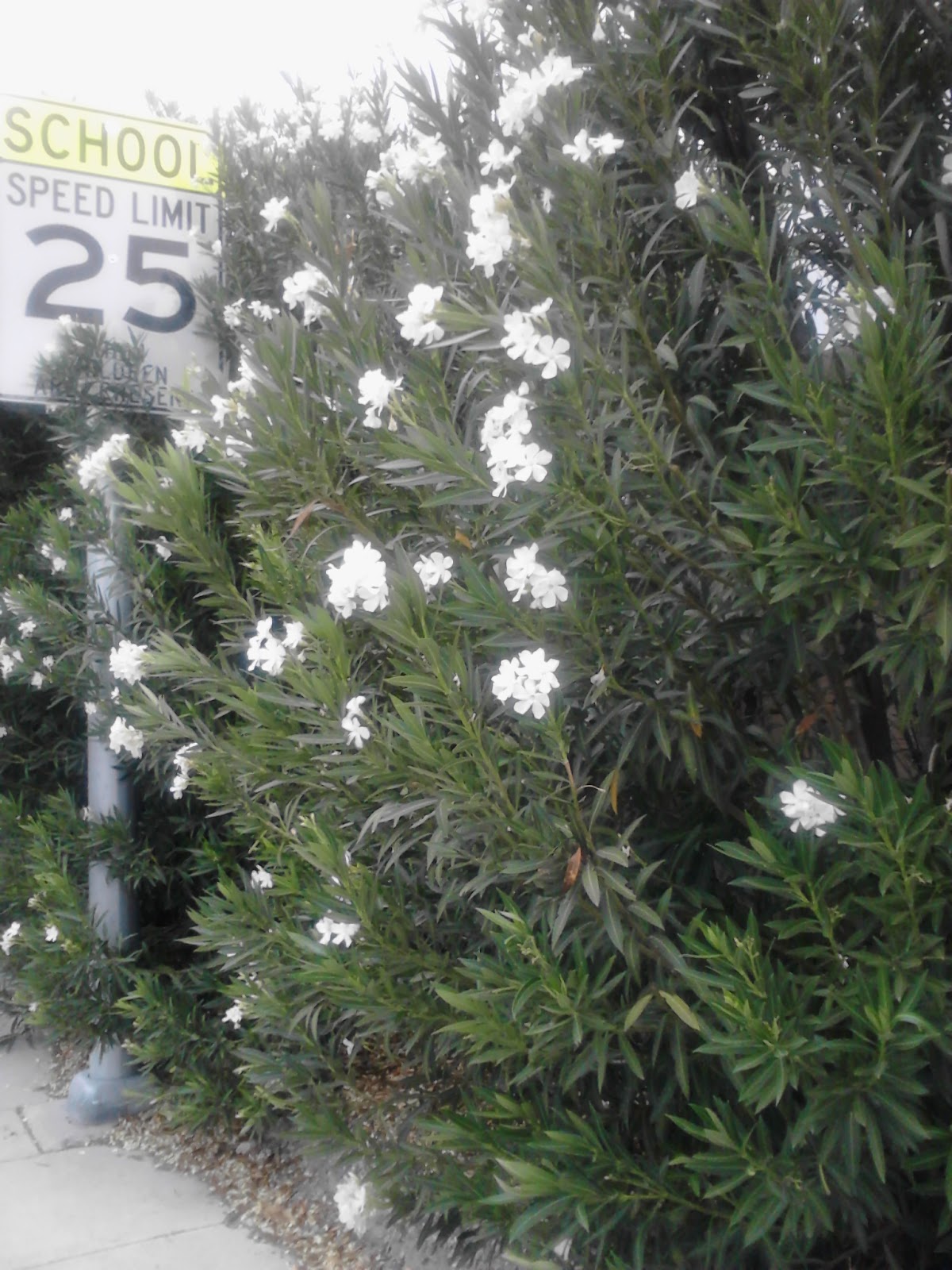 |
| Oleander is tough. If given enough water they can survive just about anywhere. |
Now you
have the job of amending the soil after it has been planted. Hopefully, your
oleanders were planted with at least six hours of full sun every day. If not,
prune any interfering trees so that they receive enough sunlight.
Fixing Trees After Planting
Auger
holes 12 inches deep around these plants so the holes occupy about half of the
surface area. Fill these holes with a rich compost or make a rich compost by
mixing a granular fertilizer like 16-16-16 with standard compost at the rate of
two Grande coffee cups full for each cubic foot of compost.
Construct
a donut around the plant for containing the irrigation water and hand irrigate
for about two weeks filling the donut each time. After that, let your
irrigation system take over. Prune it after about three to four years of growth
and fertilize lightly each spring.
How to Heal Chitalpa from Damage
Q. I have a Chitalpa tree that faces west with lots of
direct sunlight. The tree bark has separated from the trunk leaving the inner
portion of the tree exposed. There are very few leaves on the tree. Help!
 |
| Not the treaders tree but if chitalpa like this is put in a part of the landscape without enough water applied over a wide enough area under the canopy then the tree can struggle. |
A. The tree trunk has sun damage. Probably because the
tree’s lower limbs were removed too soon. This sun damage has caused the bark
to be easily lifted from the damaged part of the trunk. Sunburn has cooked the
living part of the tree that faces West while the side facing East may still be
alive.
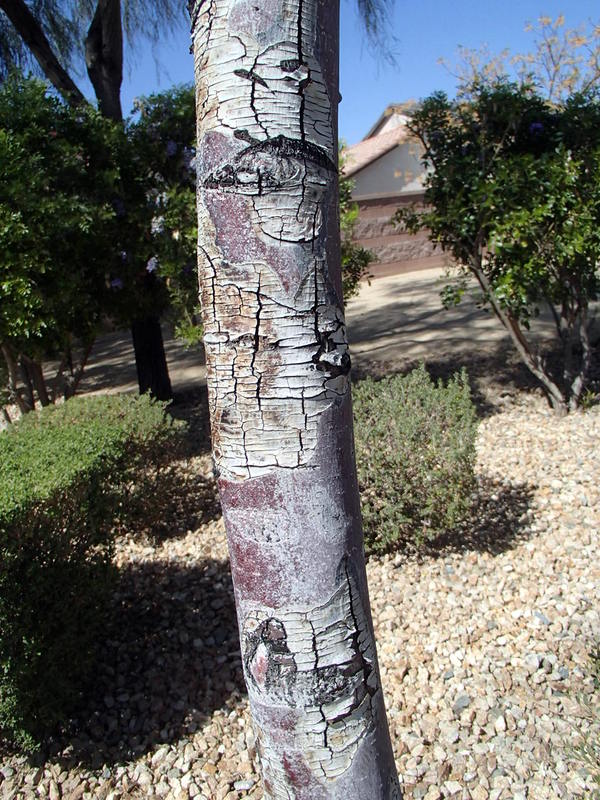 |
| This is sunburn on a locust tree. This side is facing the sun, probably the south or west side. The tree is surrounded by rock and t his can reflect alot of heat and light back at the trunk and cause greater damage. Paricularly if the tree was limbed too high at the start. |
Sunburn
of the trunk can leave it exposed to other problems like wood boring insects
(borers) and diseases like sooty canker. Let’s hope it is just sunburn on the
trunk causing the poor growth.
 |
| Locust tree has sunburn on the upper surface of its limbs. |
My
concern is that the tree might be surrounded by rock. Reflected heat from the
rock can damage the trunk if the tree was pruned so the lowest branches are
removed. Not a good idea when the tree is young and the trunk susceptible to
sun damage.
When
trees are young, leave the lowest branches attached to the trunk to help shade
it from sun damage, particularly from the West side. Remove lower branches when
the trunk gets older and develops a thicker bark layer that insulate it from
direct sunlight.
 |
| Tree wounds like this large one can heal by the cambium layer "rolling over" the damaged area and eventually burying it. |
If there
are no insect and disease problems, the tree will heal itself by “rolling over”
its new growth on top of the damaged area. The tree just needs adequate water
and fertilizer to do this.
Apply
water to a large area under the canopy. This area should be at least half the
area under the canopy. Apply enough gallonage so the applied water wets the
soil to 18 inches deep. Although this tree can handle a rock landscape, water
it as frequently as fruit trees and other non-desert landscape trees.
How to Have Beautiful Roses
Q. I cut back my roses last mid-winter and they grew back
just fine this summer. Later, all the leaves discolored, blotchy yellow. Any
advice how to correct this and prevent it from happening next year?

A. I would like to see some pictures showing me what you mean. But before I get into this, if you want roses in the desert I would go to the Rose Show on November 9. Rosarians are experts on growing roses in the desert. Some of them have 300 or 400 roses growing in their yards! They know roses. Come talk to them on November 9.

When it’s hot, the roses use more water. When
temperatures cool off, they need less water. If the soil stays soggy when
temperatures begin cooling, the newest leaves begin to yellow. It’s an iron
problem called chlorosis caused by suffocation of the roots.
I have seen this too many times! Rock placed
on top of the soil contribute to a soil problem while woodchips won’t. Spraying
the plants with iron fertilizer may be a temporary fix but not a long term one.
 |
| Rocks covering the soil around roses eventually cause browning of leaves and dieback. |
Roses
like soils that allow water to drain from around the roots. To get this kind of
soil there must be organics in the soil. Organics come from things that rot,
not rock. Putting rock on top of the soil causes the soil to lose its organic
content over time. But the slow digestion or rotting of organics like woodchips
keeps the level of organics in the soil high over time.
 |
| Expect your roses to look like this in a couple of years if you use rock. |
The
rotting of organics is caused by moist soil, plant nutrients in the soil like
nitrogen, and warm soil temperatures. Rich compost has lots of plant nutrients
like nitrogen and organics all bundled together. This bundle of organics and
nutrients all rotting together helps keep a healthy balance of good chemistry that
benefit the plant nutritionally and environmentally.
 |
| Roses that grow this well will require compost and iron applications at a minimum. |
To
correct this yellowing problem requires some expense and work on your part.
When temperatures start to cool off this fall, remove whatever is covering the
surface of the soil. Mix iron chelate called EDDHA with some rich compost at a
rate of about 2 ounces per cubic foot of compost.
 |
| You can have roses in bare soil but amend this soil and improve it before planting. Notice the color. This color indicates it has at least 2% organics in it. Add EDDHA iron in January and a fertilizer. |
Auger
holes around the roses to about 12 inches deep and pour this compost and iron
mix in the holes and irrigate the plants. Replace the surface cover with
woodchips to a depth of 2 to 3 inches. Spray the leaves with a liquid iron
fertilizer three times, three to four days apart.
In the
early spring each year mix one ounce of EDDHA iron chelate in a bucket of water
and pour it around your roses along with your favorite rose fertilizer. This
should prevent leaf yellowing of roses in the future.
Why Vegetables Can Be Sweet but Bland
Q. I have vines producing melons during the summer. They
wanted to split, and the taste was bland. But the same vine producing melons in
the Fall were much sweeter! Can we conclude that when it is too hot sweetness
suffers, and splitness reigns?
 |
| Melons splitting due to irregular watering and lack of surface mulch. |
A. I wish it were that simple. It’s really a question of
the type and variety of melon grown as well as time of year.
Why Melons Split
During
times of high water use some types of melons easily split. Splitting is usually
an irrigation issue; soil gets dry followed by an irrigation. This happens frequently
in the desert when growing in uncovered, bare soils. Water loss from the soil
can be over 4/10 of an inch per day! This is about 50% higher than water lost
from the same crops in melon growing regions. It helps if you make sure the soil
is not dry when it enters the hottest time of the day.
Melon
splitting is a variety issue complicated by weather and climate. If splitting
is a problem with a variety, then select sequential planting times, or chose a
different variety. It can make a difference. Write down your choices in a
garden calendar and learn from these notes.
Harvesting Melons
Never
harvest melons that do not separate from the vines easily. Melons can be
harvested early, and they will ripen, but they don’t get any sweeter than when
they were separated from the vine. Not true of many tree fruits. You can have a
fully mature melon that is not sweet if harvested too early.
Melons Need Fertilizer
Melons
are “hungry” crops and can deplete a soil of nutrients quickly. That’s why it
will be necessary to add nutrients back to the soil at least yearly.
Choose Varieties Carefully
Some
varieties and types of melons just don’t perform ideally during our hot summer
months. If you grow tomatoes, this might sound familiar. The heat is great for
helping the plant make sugars but not in developing acidity. So, in the future
keep good notes, pick varieties of melons that are consistent quality
producers, plant them so fruits are harvested during cooler times of the year
and wait to harvest until the melon slips easily from the vine.
Trials
can be fun, but I would caution you about “putting all your eggs in one basket”.
Rely on a proven variety that you like and combine it with something new. And don’t rely on one season of growth. It
can be a bad year. Three seasons are better and five are best.
Where to Find Screwbean Mesquite?
Q. After reading about the many desirable qualities of
screwbean mesquite trees, I am determined to plant two of them in my yard.
However, today I searched the nurseries and discovered there was none to be
found. One nursery offered to order them for me. I would rather see what I am
buying. Do you know of any place that carries them? Do I have to start my own from seed?
 |
| Seed pod of screwbean mesquite |
A. Screwbean mesquite is a very nice small desert tree native
to southern Nevada but not in high demand by the public. So, the local
nurseries typically don’t carry them. It’s
a “chicken vs egg” problem in marketing and sales. Some nurseries will order
them for you and that’s nice they offer that service. You may or may not be
able to see the tree ahead of purchase going this route. Ask.
 |
| Screwbean mesquite is an excellent small Nevada native tree that does not need much water to get to its mature size. This tree can be found at the Las Vegas Springs Preserve. |
Locally,
try the State Forest Nursery at Floyd Lamb State Park and check the
availability there. (Update: they had them available). They have a website and post plant availability, but it
doesn’t hurt to give them a call since not everything is posted.
 |
| Screwbean mesquite trunk |
On to
propagation. The tree is easy to propagate from seed, cuttings or marcottage
but for the inexperienced probably seed propagation is the easiest method. Just
remember, all tree seeds in the Mesquite or Legume family will have a hard coating
surrounding the seed that prevents accidental germination. You must damage this
seed coat for good germination.
 |
| The dried brown seedpods are where the seed can be found in midsummer |
Pick
seed from pods hanging from good looking trees in midsummer or when the pods
are brown. Open the pods and pick ten of the largest seeds you can find. Damage
the seed coat with sandpaper, small file or razor blade with as little damage
to the seed as possible. Soak this seed in warm water for a few hours to get
germination started.
While
you’re waiting, fill a clean nursery container with potting soil to within one
inch below its top lip. Plant the seed one-half inch deep and two to three
inches apart. Keep seed moist but not wet. Don’t water too often!
Why are Some Kumquat Branches Leafless?
Q. I have a Kumquat citrus in the ground for 8 years. During
the last 2 years a lot of leaves fell off in the Fall leaving some branches
leafless. Yet some branches stayed green with new shoots coming out. What might
be the cause of the problem?


A. Its very helpful when pictures are included with the comments. Sometimes pictures change everything!
The tree, from the pictures you sent, looks dense and
full, with a few “blind” shoots here and there. The tree might be too dense. Leaves
need sunlight and produce a net energy for the tree to stay productive and
healthy. Rather than leaves producing energy for the tree, leaves growing in
total shade will be dropped from tree limbs because the tree must exp
end energy
to keep them. Open the Canopy by Pruning
I would open
the tree canopy to admit light to the inside. This will encourage fruit to
develop throughout the canopy rather than just at its edges where there is
light. Do this by total limb removal; “thinning” cuts. Prune so that limbs are
four to six inches apart, not growing on top of each other.
Look at the Ground
A trick
to know if there is enough light penetrating the canopy is to look at the
tree’s shadow on the ground at noon during midsummer. The shadow created by the
canopy should have speckled light throughout it. If an area of the shadow is
totally dark, then this is the area of the tree that needs to be pruned to
admit more light. Admitting more light allows better fruit production
throughout the tree canopy and removing a few limbs here and there during the
summer does not hurt the tree.
 |
| A dense shadow on the ground under the tree at noon during the summer indicates no light is entering the canopy to cause fruit buds to form. Time to do some light summer pruning! |
Otherwise
you might be giving the tree water and fertilizer, particularly nitrogen, too
often. Water when the soil moisture is
starting to dry. On a soil moisture meter this would be an average of “5” on a
ten-point scale at a depth of about 4 to 6 inches and measured in three
different locations.
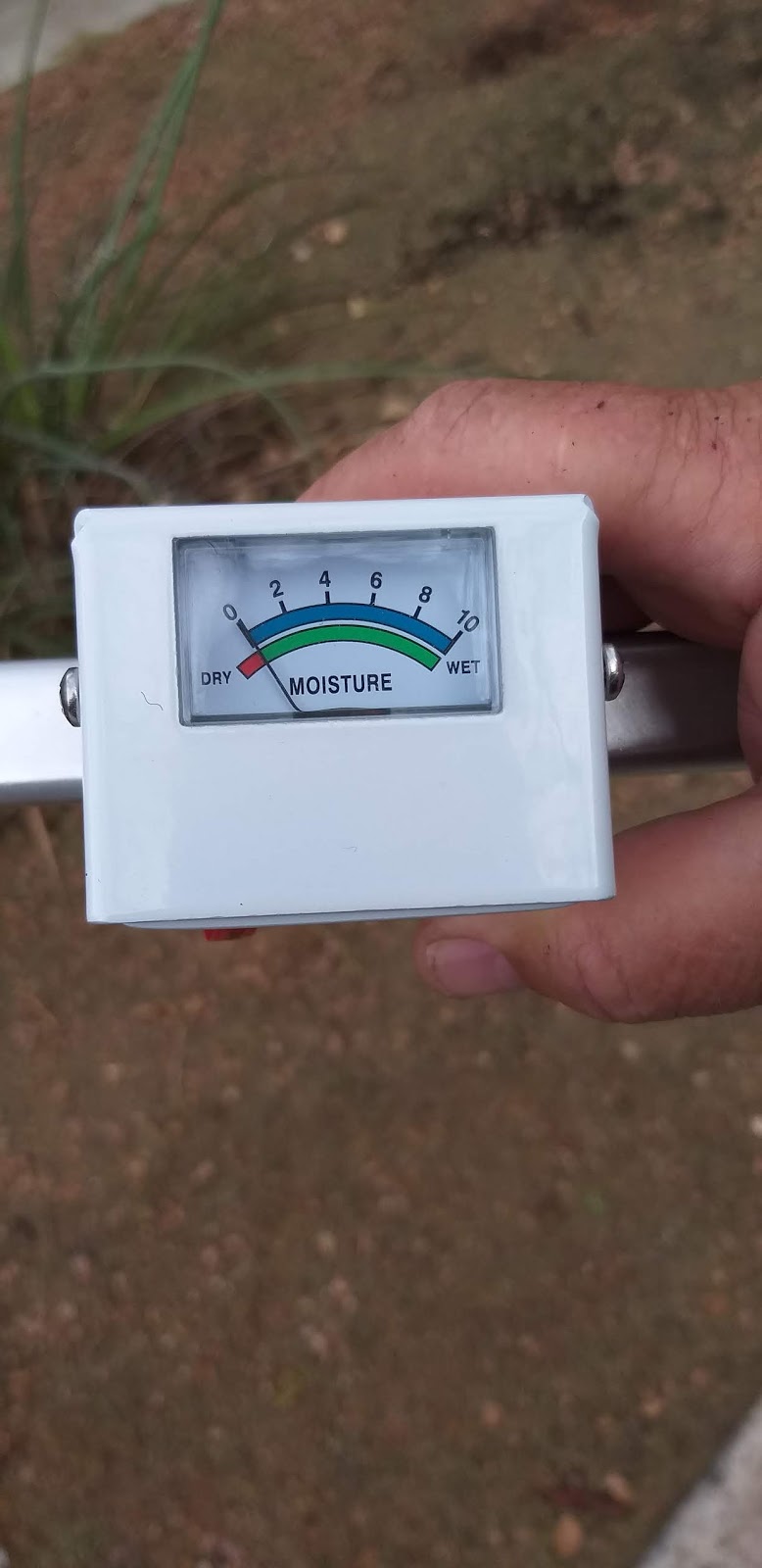 |
| This moisture meter does not have its tip in the ground so it is reading the dry air at zero. |
Never water daily.
Apply water to at least half the area under the tree canopy and apply enough water
to get it 18 inches deep.
Why Does My Kumquat Have Small Leaves?
Q. The leaves on my 3-year-old almond tree, planted in a container,
started to dry out quickly due to problem with drip system. To compensate, I hand watered but apparently
not enough. Once system remedied very
small new leaves starting to grow. Will
this tree survive the coming cooler weather?
I watered heavily and applied a tree and nut fertilizer.
 |
| Almond trees flowering in the spring |
A. I have seen
this before on young almonds planted in the ground and it is usually, like you
stated, an irrigation or drainage issue; the leaves dry up, turn brown and drop
from the tree before winter. Once the leaves are without water for a day, the
amount of hand watering you apply will not save any of the leaves. The leaves
are goners. But the buds already formed for next spring will grow instead. Usually
no flower buds, just leaf buds. That’s what happened to your tree.
 |
| Almond regrowth in September after pruning a 12 year old tree 24 inches from the ground in August. It produced nuts the following year. |
The tree
will have no problems surviving the winter, with or without fertilizers, if the
soil is moist and drains water. That’s not the issue. They used up buds saved
for next spring. That’s the issue. Hopefully there is enough time remaining for
the tree to grow new buds before it gets cold. If not, you might see a delay in
leaf development and flowering next Spring.
 |
| Almond nuts splitting and starting to dry before harvest. |
Trees
grown in containers are more finicky than those planted in the ground because
the roots don’t have access to as much soil mass. The limited soil volume in
containers makes watering and applying fertilizers more complicated; the tree
runs out of both more quickly. Watering and fertilizer applications are in smaller
amounts but applied more often to compensate for the small amount of soil.
 |
| ' Almond Neplus Ultra in bloom in Las Vegas with size control |
Almonds
put on a beautiful floral display in the Spring. I can see why you wanted it in
a container. Hopefully, you planted a dwarf almond like Garden Prince or All in
One and used a large container. Remember it needs to be repotted every few
years to keep it vigorous.
Will Mixing Lawn Seeds Together Make the Ideal Lawn?
Q. Is it possible to mix Kentucky bluegrass, ryegrass and
Bermuda for year-round greenery and thickness in a lawn?
 |
| This is the textural difference between Kentucky bluegrass and an old fashioned tall fescue, probably Kentucky 31. |
A. The short answer is no. But if you are satisfied with
a hodge-podge for a lawn that will slowly change over to Bermudagrass in full
sun, or where irrigation is weak, then this combo is fine. It depends on the
level of quality you are willing to accept in a lawn. Most people want a
beautiful lawn and this approach will not produce a beautiful lawn.
 |
| This is a winter picture of bermudagrass (brown) that has invaded tall fescue lawn area. The irrigated area is too narrow to support lawn grasses and the mowing height was probably short enough to encourage bermudagrass growth. Its the winter so bermudagrass is dormant. |
I
understand the temptation. Our valley and the Mojave Desert lie in what is
called the transition zone for grasses used for lawns in the US. The
transition zone in southern Nevada is not too cold for warm season grasses like
Bermudagrass and not too hot for the heat tolerant Kentucky bluegrasses, perennial
ryegrasses and tall fescue. The transition zone is a perfect place to grow all
the grasses but grow them poorly.
 |
| This is an old map from the Lawn Institute (no longer available online) showing the basic turfgrass growing regions. Green is best for growing cool season grasses like Kentucky bluegrass and ryegrass. The red zone is best for the warm season grasses like bermudagrass and centipedegrass. The yellow zone is ours...the transition zone where both types of grasses will grow. |
These
grasses are not managed the same either. Common bermudagrass can be mowed less
than an inch, hybrid bermudagrass less than half an inch. But Kentucky
bluegrass and tall fescue should be mowed at least 2 inches tall. Perennial
ryegrass has the most versatile mowing height since it can be mown as low as
hybrid Bermuda or as tall as bluegrass or fescue. Your selection of a mowing
height will favor grasses that grow best at those heights.
The
winter months favor the cool season grasses like bluegrass, ryegrass and
fescues. The summer months favor the warm season grasses like Bermuda. But
bermudagrass is aggressive and will choke out other grasses unless you do
something about it. This will require work and money on your part.
Golf
courses in Las Vegas were pioneers in using a mix of hybrid Bermuda and heat
tolerant perennial ryegrass together during the 1990s. But this mixture was
managed yearly. If it weren’t, the Bermudagrass would take over. The
Bermudagrass was thinned out and heat tolerant perennial ryegrass, like Palmer
and Prelude varieties, were sown back into it in the Fall. These management
practices guaranteed a solid stand of Bermuda and rye during the summer months.
Why Iron Fertilizers Don't Work
Q. You mentioned on your blog that chelated iron won't green
up yellow leaves when it's applied to the soil outside of the spring months. Why
does this happen? We are a major tree company and see this sometimes. Also, how
long should it take to see leaves become green again after we treat the tree
with iron?
Here’s where it can get tricky. If it is early enough in the year and the tree is still producing new leaves, I can apply an iron fertilizer to the soil, and it should work. If it is later in the growing season and the tree has, for the most part, stopped growing and preparing for next years growth, then the only thing that will work is spraying the leaves with a liquid iron fertilizer.
 |
| A popular iron fertilizer that takes the shotgun approach is Kerex. It contains EDDHA chelate in small amounts along with iron oxides, iron sulfate, Milorganite and other ingredients that are a hodgepodge of fertilizers. |
A. Two methods are used here to green up yellow leaves. It
has a lot to do with the chemistry of the soil, more specifically how alkaline
it is, whether it is an iron problem or not, and the type of chelate used in
the iron fertilizer. It can get hard to predict if it will work or not. You
will see later I will sometimes “shotgun” it if I am confident the yellowing is
due to iron and the problem can be corrected.
 |
| This, Sprint 138, manufactured by BASF, is an excellent EDDHA iron chelate and works great but it is expensive. One 5 lb bag is typically over $100. Less expensive EDDHA iron chelates are manufactured by China but I wonder sometimes about their quality. I have seen mixed results with off brands. |
If I
have the time, I will start with a spray bottle of iron fertilizer to see if an
iron application will work or not. Spraying this liquid mixture on yellow
leaves will tell me if the yellowing is due to iron or not. But it takes about
24 hours to find out.
 |
| This is a 1 lb cannister of EDDHA iron chelate but manufactured by an unknown source and marketed by an American company. It costs considerably less than Sprint 138 and works sometimes, and sometimes not. |
If the
leaves change to a darker green in 24 hours, then an iron fertilizer application
will work. Otherwise it’s a guessing game. For some people, 24 hours is too
long to wait for an answer.
 |
| This is another iron chelate labeled Sprint 330 and contains a different chelate called DTPA. It works IF the soil alkalinity is measured less than a pH of 7.6. Most desert soils are not that low in pH and so it does not work in many soils. It costs about half the amount as Sprint 138 so its tempting to buy. |
Here’s where it can get tricky. If it is early enough in the year and the tree is still producing new leaves, I can apply an iron fertilizer to the soil, and it should work. If it is later in the growing season and the tree has, for the most part, stopped growing and preparing for next years growth, then the only thing that will work is spraying the leaves with a liquid iron fertilizer.
 |
| This is another iron fertilizer made from acidified mine tailings that contain iron. If the pH of a soil is low enough then iron will be available to the plant. |
If an
iron fertilizer is applied to the soil, then the choice of iron fertilizer to
use can become critical. If the soil is in rough shape and neglected, then use an
iron fertilizer containing the chelate EDDHA. I would, in fact, use that iron
chelate fertilizer whenever trees and shrubs are surrounded by rock. Because this
can be a guessing game, I only recommend iron fertilizers that contain the
EDDHA iron chelate. Its more expensive but I am more confident it will work
under most circumstances.
 |
| Another way of correcting yellowing due to unavailable iron...iron sulfate. It will work as a foliar spray if the iron spray solution has a pH of about 7 or a little above. Works great on lawns. But it will stain fruit, concrete walks and pools. |
If the
soil is in good condition, then usually any iron fertilizer containing an iron
chelate should work. If you are price sensitive and always buy the least
expensive product then, because of the soil chemistry, your selection may or may
not work. I understand the reasoning, but it is a gamble. Sometimes you win,
sometimes you lose.
 |
| Iron sulfate staining grapes |
 |
| Iron sulfate staining concrete |
If you
see leaf yellowing about halfway through the year or later, then soil
applications wont usually work. You must spray the leaves with a liquid iron fertilizer
to cause the leaves to change from yellow to green. This can mean multiple
applications of an iron spray. Please read my directions on how to make liquid
iron applications to the leaves on my blog to improve your chances of success.
 |
| Iron fertilizer containing HEDTA chelate plus 3% water soluble nitrogen and potassium for foliar spraying. If the yellowing isn't due to iron, then the nitrogen will green it up. |
What to
do? I usually do both treatments, shotgun it, if there is a problem and I want
the best chance of success. Two applications can be cheap insurance. If
spraying works, it will cause the leaves to turn green overnight. Soil
applications might take up to a week to see a change in leaf color and then it
will be only in the new growth.
But
applying the right iron fertilizer before the leaves come out in late winter or
early spring can pay some dividends if you suspect leaf yellowing might occur.
Will My Leaning Palm Fall?
Q. We have a palm tree that is getting taller and is now
starting to lean. Should we be concerned about it falling over? A couple
different tree trimmers have told me not to worry, but I'm not sure of their
judgement.
 |
| Leaning palm |
A. If the water is applied to the soil out a distance 5
to 6 ft from the trunk in all directions and two feet deep, I agree with your
landscape professionals and not to worry about it. Roots grow where there is
water. If water is only available to palm roots two feet from the trunk, then
the tree will have a problem staying upright as it gets taller.
Ever hear of hurricane palms? These are palm trees that were nearly blown over in typhoons or strong winds and continued to grow leaning.
Ever hear of hurricane palms? These are palm trees that were nearly blown over in typhoons or strong winds and continued to grow leaning.
 |
| This is a coconut palm near our Family Farm, MoCa Family Farm, in Batangas, Philippines. It was nearly blown over in a typhoon but kept on growing...only at an angle. |
One of
the jobs of plant roots is to anchor the tree in the ground. Your job is to provide water far enough from the trunk so its roots can grow and anchor the plant. If roots can grow
out deeply and several feet from the trunk, the roots will provide enough
anchorage for the palm tree to stay upright.
Careful Using Borax Around Plants
Q. I screwed up in my pursuit of ant control with borax
and sugar. It worked well but one evening last week I made the mistake of
pouring my mixture right at the base of one of my vines rather than in a
plastic bottle cap to keep it out of the soil. Now one of my vines is showing
signs of toxic poisoning. I am very concerned about losing the other. I have
added some 20-20-20 food hoping this will help recovery.
 |
| Boron is an essential plant nutrient. Plants need it in very small amounts. Most soils have plenty in them. |
 |
| Borax contains about 11% boron by weight. Thats alot of boron when most plants are quite happy with soils containing 1-2 ppm boron. Thats ppm or parts per million. |
 |
| As a salt, boron is transported to plant leaves where it accumulates along the edges of leaves where water goes into the air, thus concentrating it. |
A. Ouch. What you are seeing is most likely boron
toxicity. Boron is one of the 16 or 17 essential nutrients for plants, but it
is needed in extremely small amounts. But if that very small amount is too
much, it becomes toxic to plants. The difference between enough and too much is
in the parts per million range! Grasses are a little more tolerant of higher
amounts boron than other plants.
Boron
does not move in the soil very well like other contaminants. That might prove
to be in your favor. Remove the surface soil around the plants down to about 4
to 6 inches and get rid of it. Hopefully you removed some boron mixed in the
soil as well.
Organics
in the soil help to tie boron up and make it less available to plants. Put a fresh
soil mix back with 50% compost mixed in it.
Water
dilutes salts including boron. Water the heck out of the areas where you
applied borax to try and dilute the boron remaining in the soil and push it
below the roots. Water, then let it drain, water, then let it drain. Do this
four or five times to push salts containing high levels of boron below plant
roots. Lastly, pray.
How to Grow Cut Flowers in the Desert
Q. I have a 17 ft. x 2-1/2 ft. raised bed on the south
side of my home I would like to turn into an all-season cutting garden. I will probably use a portion for growing
herbs for cooking. I plan to plant flowering bulbs for Spring flowers. I would like to have other perennials planted
above the bulbs to fill in as the seasons progress. I am open to planting annuals if they can be used
for cut flowers for bouquets. What flowering plants would you recommend?
A. Whoa! You must be a very good desert gardener to pull
this off! If you are thinking of the pictures in Sunset Magazine and its easy, it’s
not. Lots of soil modification, correct planting time of year, differences in
exposure to sunlight, wind, shade, plant selection will all be important.
I
strongly recommend joining one of the garden clubs in town such as the Chrysanthemum Society or Iris Society and start absorbing information and ask questions. Google the Nevada
Garden Clubs, Inc. website and send in a request. A mentor of mine when I first
arrived in the desert was a former president of these clubs and she was a great
gardener.
Lots of
plants can be grown for cut flowers in the Mojave Desert. They favor different
exposures to sun, shade, wind, and planting times. Whenever considering cut
flowers it requires wind protection, or they will look ratty. Some are bulbs.
Some are started from seed and rhizomes. The most successful growers of flowers
I know, plant in different locations in the landscape to take advantage of
different “microclimates”.
So, if you have not yet developed your desert
“green thumb” then start with a small area and experiment before thinking big. Some spring bulbs to consider include dahlia,
canna, gladiolus, and amaryllis. Fall bulbs might include crocus, narcissus,
hyacinth, ranunculus, and even tulips if you prechill them in the fridge first
or buy pre-chilled bulbs. Consider iris and all types of mums. There are garden
clubs in southern Nevada that focus on these plants.
Contact Las Vegas Mum Society
Contact Las Vegas Iris Society
Contact Las Vegas Mum Society
Contact Las Vegas Iris Society
Many
other perennials grow here as well, too many to list, but require different
exposures to sun, time of year and wind to perform best as well as soil
enhancement and irrigation. Two of the toughest to grow are begonias and calla
lilies.
Many thanks to a mentor of mine, Hobby St. Denis, a terrific desert gardener and former President of the Associated ! Much of this information is contained in the book she wrote for the Nevada Garden Clubs, Inc. and no longer in print.
And also a publication from the University of Arizona.
And also a publication from the University of Arizona.
How to Block Light from Your Neighbors
Q. I need to block out my neighbor’s intense landscape
lighting that pierces my screen of photinia and comes into my yard. I plan to
attach Mexican palm thatch to the iron fencing behind the photinia. That extra
layer will block my neighbors landscape "headlights". Should I spray
the palm thatch with any insecticide first in the event there are bugs that
could invade the photinia?
A. It sounds like an inexpensive way to enhance the
enjoyment of your backyard at night. Those fronds should last about 2 years
before they need replacement. They will last longer with fewer holes created in
the fronds when attaching them to the fence. Some box stores offer reed fencing
that might save you some work, last longer and is ready for attachment.
I know
of no bugs that would be a problem spreading to your photinia from the fronds so
no need to spray. I also don’t foresee any future problems using palm fronds except
a potential fire problem if they were to ever catch fire. An inexpensive fire
retardant is to spray them with a solution of ammonium sulfate dissolved in
water.
Why Stake Trees After Planting
Q. I just planted a 5-gallon mesquite tree following your
advice and was wondering how I should stake it. Also, I was wondering if I
should use the deep watering stakes recommended for it? They are plastic, two
feet long with holes drilled in it for deep watering and supposed to encourage
deep rooting of trees.


A. If the planting hole is dug wide enough, the soil used
when planting is amended with something decent, then these deep watering tubes
are not necessary. If you water your tree deeply, and not daily, the tree does
not need them. If you water your whole yard daily including your trees, which I
don’t recommend, then maybe there is some benefit using them.
Buy Soil Aeration Tubes?
The problem with digging a planting hole deep when its not needed is making soft soil beneath the tree that may cause it to sink as the soil beneath it collapses and trying to drive a sturdy stake into soft soil and expecting the stake not to move, along with tree roots.

I have
not listened to the sales pitch for these deep watering tubes, but I would guess they are marketed
to prevent shallow roots from growing on the soil surface. Most trees don’t
want their roots on the soil surface. They want their roots to grow deeply for
better anchorage in the soil and access to a larger amount of water.
The Problem is Soil Aeration
Tree roots need access air as well as water. Roots need to "breathe". Watering so often that deeper soils stay wet or the deeper soil is very compacted will hinder air from getting deep in the soil. True of clay soils, wet soils and compacted soils.
Small
trees should have soil amended to a depth of 18 inches, medium height trees to
a depth of 24 inches and tall trees, like most of our pines, to 36 inches.
Not all Roots are the Same
Root
depth of trees is controlled by three factors; if tree roots normally grow
shallow (its genetics which is mostly the soil environment where it is from), condition and type of soil and how the tree is watered.
These watering tubes focus only on the third factor.
Control root depth with soil amendments and water management
. Trees and large shrubs should be watered separately from
shallow rooted plants like lawns, flowers and vegetables. This gives these larger plants a chance at growing roots deeply.
Some
trees like mulberry and many types of ash have a preponderance of shallow
roots. Its normal for them. It is part of their genetics and the environment
where they came from. They like floodplains and wet soils. That's why they do so well in lawns. In some cases, these roots can be removed from the soil surface
or covered with mulch.
Some
trees grow roots near the surface of the soil where roots can access air
better. This happens in heavy clay soils or soils where the planting holes were
not dug or prepared well. With heavy clay soils it is best to grow trees on a 12
to 18-inch rise or mound, so the soil can drain, roots can “breathe” and have
somewhere to grow.
Advice on Digging Planting Holes
I have
harped on planting holes ad nauseum, but always dig the planting hole at
least three times the size of its container and amend this soil with decent
compost at the time of planting. Buy these tubes only if needed.
If the
tree is from a 5-gallon container, then it may not need staking. Trees planted
from larger containers probably need it. The primary purpose of staking is to
keep the roots from moving. Movement of the upper trunk and limbs is a good
thing.
Subscribe to:
Posts (Atom)